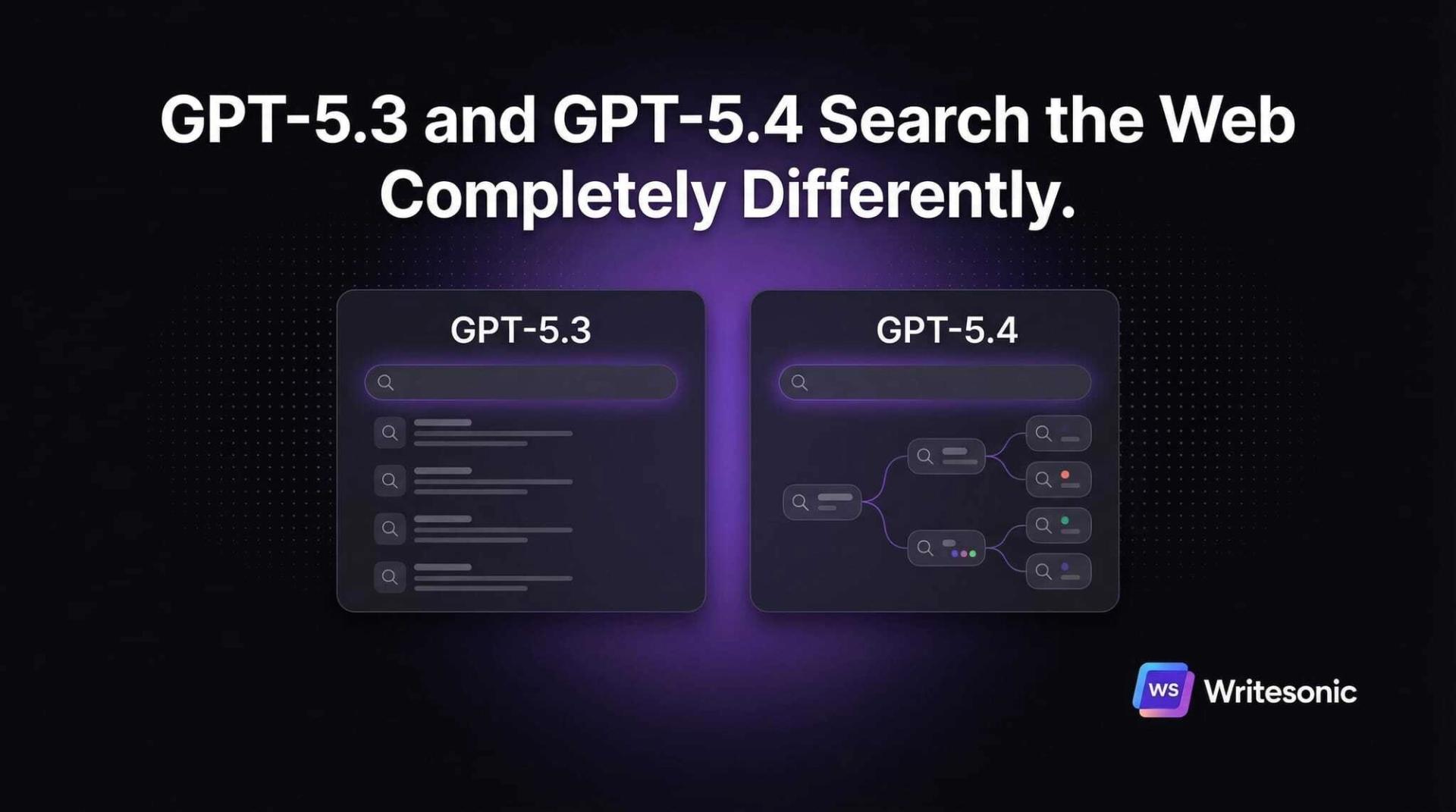
ChatGPT just rolled out two new models. GPT-5.3 Instant is the new default. GPT-5.4 Thinking is the new premium.
I wanted to know: do they search the web differently? Do they cite different sources? And what does that mean for brands trying to show up in AI search?
To find out, I tested 50 prompts across both models, extracted every fan-out query they sent, and classified every citation they returned.
Here’s the short version: GPT-5.3 sends users to blog posts about your brand. GPT-5.4 sends them to your actual website. Same question. Completely different outcomes.
Here’s the long version.
How we did this
We ran 50 prompts on ChatGPT across GPT-5.3 Instant (the new default), GPT-5.4 Thinking (the new premium), and GPT-5.2 Instant and GPT-5.2 Thinking as baselines. That gave us 119 total conversations.
After each response, we extracted the full conversation JSON using ChatGPT’s internal API. This exposed every fan-out query the model sent, every web search result it received, and every citation URL it included in its answer.
We also ran 30 of these queries through both Bing and Google via SerpAPI to compare ChatGPT’s results against traditional search engines.
| What we measured | Count |
|---|---|
| Total conversations | 119 |
| Fan-out queries extracted | 532 |
| Web search results analyzed | 7,896 |
| Citations classified | 1,161 |
| AI response words reviewed | 74,478 |
| SerpAPI queries (Bing + Google) | 30 |
Our 50 prompts spanned 16 categories: SaaS, ecommerce, healthcare, finance, travel, education, home, food, legal, marketing, productivity, fitness, shopping intent, comparisons, and trends.
For each product or service prompt, we classified citations as “first-party” (the actual brand’s website, like hubspot.com for HubSpot) or “third-party” (review sites, blogs, Reddit, media outlets).
Now, here’s what we found.
GPT-5.3 and GPT-5.4 cite completely different sources
This is the headline finding.
56% of GPT-5.4’s citations go to brand websites. Only 8% of GPT-5.3’s do.
And here’s the part nobody expected: GPT-5.3 is worse for brands than GPT-5.2 was. The previous default cited brand websites 22% of the time. The new default dropped to 8%.
Put another way: the model most ChatGPT users interact with now sends 92% of citation traffic to third-party sites.
The pattern holds across almost every prompt
This isn’t a statistical edge case. Look at what happens when you ask both models the same question:
| Prompt | GPT-5.3 first-party % | GPT-5.4 first-party % | GPT-5.3 cites | GPT-5.4 cites |
|---|---|---|---|---|
| Best CRM for B2B SaaS | 0% | 100% | designrevision.com, techradar.com | hubspot.com, salesforce.com, attio.com |
| Marathon running shoes | 0% | 88% | irunfar.com, reddit.com | nike.com, asics.com, hoka.com |
| QuickBooks vs Xero vs FreshBooks | 0% | 100% | gentlefrog.com, technologyadvice.com | freshbooks.com, quickbooks.intuit.com, xero.com |
| HubSpot vs Salesforce vs Pipedrive | 0% | 100% | emailtooltester.com, salesflare.com | hubspot.com, pipedrive.com, salesforce.com |
| Password managers | 14% | 100% | cybernews.com, reddit.com | 1password.com, bitwarden.com, dashlane.com |
| iPhone vs Samsung vs Pixel | 0% | 100% | tomsguide.com, phonearena.com | apple.com, samsung.com, store.google.com |
| Tesla vs BMW vs Polestar | 0% | 67% | drivingelectric.com, facebook.com | tesla.com, bmwusa.com, polestar.com |
| Smart home security | 0% | 86% | safehome.org | ring.com, wyze.com, simplisafe.com |
| Coursera vs Udemy vs LinkedIn | 0% | 83% | coursmos.com, airmeet.com | udemy.com, coursera.org, linkedin.com |
| EHR software | 0% | 40% | forbes.com, techradar.com | athenahealth.com, elationhealth.com |
| Email marketing platforms | 33% | 88% | techradar.com, insiderone.com | klaviyo.com, omnisend.com, mailchimp.com |
| SEO tools | 0% | 33% | apricornsolutions.com, morningscore.io | ahrefs.com, semrush.com, screamingfrog.co.uk |
| Notion vs Obsidian vs Roam | 0% | 100% | xp-pen.com, medium.com | obsidian.md, notion.so, roamresearch.com |
On comparison prompts (“X vs Y vs Z”), GPT-5.3 never cited a single brand. GPT-5.4 cited brands 83-100% of the time.
The first-party gap varies by category
Head-to-head comparisons show the biggest gap: 0% on GPT-5.3 vs 83% on GPT-5.4. SaaS sees a 7x improvement (12% to 82%). Even shopping, where GPT-5.4 is least brand-forward, still doubles the first-party rate.
And the models cite almost none of the same sources
For the same prompt, GPT-5.3 and GPT-5.4 cite completely different websites.
Average citation overlap across all 50 prompts: 7%.
On 22 of 50 prompts, the overlap was exactly 0%. Being visible on GPT-5.3 gives you no advantage on GPT-5.4.
This has massive implications for GEO and AEO strategy. A brand that dominates on GPT-5.3 might be invisible on GPT-5.4, and vice versa. Any AI visibility audit that only tests one model misses the picture entirely.
The “kingmaker” sites on GPT-5.3
Because GPT-5.3 cites third-party sites almost exclusively, a small number of review and media domains become gatekeepers:
| Domain | Citations | Type |
|---|---|---|
| forbes.com | 15 | Media/reviews |
| techradar.com | 10 | Tech reviews |
| tomsguide.com | 10 | Tech reviews |
| reddit.com | 7 | Forum/UGC |
| money.com | 5 | Finance media |
If Forbes or TechRadar writes about your product, GPT-5.3 finds it. If they don’t, you’re probably invisible to the default model.
GPT-5.4’s top domains? The brands themselves: hubspot.com (18), shopify.com (16), salesforce.com (14), quickbooks.intuit.com (10).
GPT-5.4 sends 8.5x more fan-out queries than GPT-5.3
The search architecture between these models is fundamentally different.
GPT-5.3 sends one query: the raw user prompt. GPT-5.4 decomposes it into 8.5 sub-queries on average, with domain restrictions and site: operators.
Here’s the full funnel:
| Model | Avg queries | Avg web results | Avg citations | Avg response length |
|---|---|---|---|---|
| GPT-5.2 Instant | 0.9 | 36.6 | 4.5 | 388 words |
| GPT-5.3 Instant | 1.0 | 27.3 | 5.8 | 548 words |
| GPT-5.4 Thinking | 8.5 | 109.4 | 14.8 | 769 words |
GPT-5.4 also uses two features no other model uses: domain-restricted queries (148 total) and site: operators (156 total). Combined, that’s 304 targeted queries across 50 prompts.
What GPT-5.4’s fan-out queries actually look like
GPT-5.4 follows a consistent two-phase pattern: brand verification first, third-party validation second.
Email marketing platforms (21 queries):
Phase 1 (brand sites):
“2026 best email marketing platforms ecommerce pricing”
→ restricted to: klaviyo.com, omnisend.com, mailchimp.com
“site:klaviyo.com pricing email marketing sms ecommerce 2026”
“site:omnisend.com pricing ecommerce email marketing sms 2026”
Phase 2 (validation):
“G2 ecommerce email marketing software 2026”
→ restricted to: g2.com
“Shopify app store Klaviyo Omnisend Mailchimp reviews 2026”
→ restricted to: apps.shopify.com
iPhone vs Samsung vs Pixel (4 queries):
“Apple iPhone 17 Pro official specs” → [apple.com]
“Samsung Galaxy S26 Ultra official specs” → [samsung.com]
“Google Pixel 10 Pro official specs” → [store.google.com]
“The Verge review iPhone Samsung Pixel” → [theverge.com]
This is why GPT-5.4’s first-party citation rate is 56%. It goes to brand sites first, validates second.
How much research does each category get?
Some categories trigger far more queries and citations than others on GPT-5.4:
| Category | GPT-5.3 queries | GPT-5.4 queries | GPT-5.3 cited | GPT-5.4 cited | GPT-5.4 web results |
|---|---|---|---|---|---|
| Productivity | 1.0 | 14.7 | 8.3 | 20.3 | 156 |
| Marketing | 1.0 | 11.7 | 6.3 | 25.0 | 144 |
| Legal | 1.0 | 12.5 | 8.0 | 15.0 | 165 |
| Services | 1.0 | 14.0 | 3.5 | 15.0 | 184 |
| Travel | 1.0 | 11.7 | 8.7 | 12.7 | 148 |
| Education | 1.0 | 10.0 | 6.0 | 17.7 | 130 |
| Finance | 1.0 | 8.3 | 6.0 | 17.7 | 130 |
| SaaS | 1.0 | 6.3 | 3.7 | 17.3 | 76 |
| Comparison | 1.0 | 9.3 | 6.3 | 14.3 | 99 |
| Shopping | 1.0 | 4.6 | 3.8 | 8.6 | 56 |
| Fitness | 1.0 | 4.0 | 4.7 | 10.7 | 64 |
B2B software categories (Productivity, Marketing, Legal) trigger the most queries on GPT-5.4. Consumer product categories (Fitness, Shopping) trigger fewer. This likely reflects the complexity of B2B purchasing decisions.
Same search index, different query strategy
Are GPT-5.3 and GPT-5.4 searching different web indexes? Or the same one?
The data points to the same index.
| Metric | GPT-5.3 Instant | GPT-5.4 Thinking |
|---|---|---|
| Avg queries per prompt | 1.0 | 8.5 |
| Avg web results per prompt | 27.3 | 109.4 |
| Web results per query | 27.3 | 12.9 |
GPT-5.3 sends one broad query and gets ~27 results. GPT-5.4 sends 8.5 specific queries and gets ~13 results per query.
The per-query result count is lower for GPT-5.4 because its queries are more targeted. But the total result pool is 4x larger because it sends 8.5x more queries.
Bottom line? Same index, different decomposition. The fan-out strategy IS the difference.
GPT-5.4’s site: operator changes the game for AEO
GPT-5.4 sent 156 queries with site: operators across 50 prompts. No other model used site: at all.
Here’s how all 423 queries break down:
| Query type | Count | % of total | Purpose |
|---|---|---|---|
| Domain-restricted (brand sites) | 142 | 34% | “Get pricing and features from this brand’s website” |
| site: operator queries | 156 | 37% | “Validate against review sites” |
| Open (unrestricted) | 125 | 30% | “Broad discovery” |
Top sites GPT-5.4 validates brands against:
| site: target | Queries | What GPT-5.4 checks |
|---|---|---|
| apps.shopify.com | 6 | App store reviews and ratings |
| g2.com | 4 | B2B software reviews |
| roamresearch.com | 5 | Product-specific docs |
| writesonic.com | 3 | Product pages and pricing |
This matters for three reasons.
1. GPT-5.4 pre-selects which brands to investigate. Before sending any query, GPT-5.4 decides which brands are relevant based on its training data. If your brand isn’t in the consideration set, no amount of SEO will help.
2. Your G2 and Capterra presence feeds GPT-5.4 directly. G2 (8 queries) and Capterra (6 queries) are top validation targets. Strong profiles translate directly to AEO visibility.
3. site: queries create a verification loop. GPT-5.4’s process: identify brands from training data, check brand websites directly, validate on review platforms. Brands need coverage across all three layers.
GPT-5.4 cites pricing pages 35x more than GPT-5.3
Different models don’t just cite different sources. They cite different page types.
| Page type | GPT-5.3 Instant | GPT-5.4 Thinking |
|---|---|---|
| Pricing pages | 4 (1%) | 138 (19%) |
| Blog/article pages | 92 (32%) | 61 (8%) |
| Homepage/root pages | 42 (15%) | 161 (22%) |
| Product/feature pages | 13 (5%) | 73 (10%) |
GPT-5.3 is a “blog reader.” 92 of its 284 citations (32%) point to blog posts and articles.
GPT-5.4 is a “pricing page checker.” 138 of its 739 citations (19%) point to pricing pages, 161 (22%) to homepages, 73 (10%) to product pages. Combined, 51% of GPT-5.4’s citations land on commercial pages.
4 pricing page citations on GPT-5.3 across 49 conversations. 138 on GPT-5.4 across 50. That’s 35x.
If your pricing page shows “contact sales” instead of actual numbers, GPT-5.4 will find the problem.
The #1 brand in ChatGPT changes 52% of the time.
Get the report and find out why.
Google rankings predict GPT-5.3 citations. GPT-5.4 bypasses rankings entirely.
Does ranking on Google or Bing help you get cited by ChatGPT?
Depends on the model.
We took 94 domains that GPT-5.3 cited across 9 prompts and checked whether each one also appeared in Bing or Google results for the same query (via SerpAPI).
47% of GPT-5.3’s citations come from domains that also rank on Google. Only 27% from domains on Bing.
But 44% don’t appear on either search engine for the same query. ChatGPT has its own retrieval layer.
GPT-5.4 is a completely different story
We did the same analysis for GPT-5.4. The results were striking.
75% of GPT-5.4’s cited domains don’t appear in Bing OR Google results for the same user prompt.
Why? Because GPT-5.4 doesn’t find brands through traditional search. It knows them from training data, then sends domain-restricted queries directly to their websites.
When you ask about running shoes, GPT-5.4 doesn’t search “best marathon running shoes” and hope nike.com ranks. It searches “[Nike Pegasus vs ASICS Gel Nimbus vs Brooks Ghost 2026]” restricted to nike.com, asics.com, etc.
| Prompt | GPT-5.4 cited domains | On Bing/Google | NOT on Bing/Google |
|---|---|---|---|
| A2: Shopify vs WooCommerce | 5 | 0 (0%) | 5 (100%) |
| B2: Running shoes | 8 | 2 (25%) | 6 (75%) |
| C1: Marketing agencies | 6 | 0 (0%) | 6 (100%) |
Bottom line? For GPT-5.3, invest in SEO (especially Google). For GPT-5.4, invest in brand recognition and first-party content quality. Search rankings don’t get you into GPT-5.4’s citation set.
GPT-5.4 makes AI search attribution trackable for brands
Every cited URL gets ?utm_source=chatgpt.com appended. Combine that with the first-party citation rate and you get something interesting:
| Model | First-party rate | UTM coverage | Trackable brand traffic |
|---|---|---|---|
| GPT-5.2 Instant | 22% | 60% | ~13% of citations |
| GPT-5.3 Instant | 8% | 96% | ~8% of citations |
| GPT-5.4 Thinking | 56% | 87% | ~49% of citations |
On GPT-5.3, the brand gets mentioned in the answer, but 92% of clicks go to Forbes, TechRadar, and Reddit. The brand gets the recommendation. Someone else gets the traffic.
On GPT-5.4, nearly half of all citation traffic goes to the brand’s own website with UTM tracking. The brand gets the recommendation AND the trackable visit.
This is the biggest attribution shift in GEO/AEO. For the first time, a thinking model makes AI search attribution comparable to paid search: the user clicks to your site, you track it in GA4.
Set up a segment for utm_source=chatgpt.com now. As GPT-5.4 adoption grows, you’ll see this traffic appear.
Some prompts don’t trigger web search at all
Before worrying about citations, worry about whether the model even searches.
| Model | Prompts that didn’t search |
|---|---|
| GPT-5.2 Instant | 1/10 (AI recruiting) |
| GPT-5.3 Instant | 1/49 (AI recruiting) |
| GPT-5.4 Thinking | 4/50 (AI recruiting, robot vacuums, standing desk deals, gift ideas) |
Paradoxically, the model that searches deepest when it does search also skips more prompts entirely. GPT-5.4 skipped two shopping prompts (“Best deals on standing desks this week” and “I need to buy a gift for my wife under $100”).
But here’s what’s interesting: GPT-5.4 still cited sources when it didn’t search. The robot vacuum prompt had 17 citations from training data alone. GPT-5.3 produced zero citations when it didn’t search.
Prompts with a specific year (“in 2026”), price constraints (“under $500”), or comparison structure (“X vs Y”) triggered search 100% of the time on both models.
Shopping intent behaves differently on GPT-5.4
We tested 5 explicit shopping prompts (“I want to buy…”, “Where can I buy…”, “Best deals on…”). The results surprised us.
| Prompt | GPT-5.3 searched? | GPT-5.4 searched? | GPT-5.3 citations | GPT-5.4 citations |
|---|---|---|---|---|
| Buy earbuds under $150 for running | Yes | Yes | 2 | 11 |
| Cheapest MacBook Air M4 | Yes | Yes | 5 | 9 |
| Best deals on standing desks | Yes | No | 4 | 15 (from memory) |
| Gift for wife under $100 | Yes | No | 4 | 2 (from memory) |
| Best rated espresso machine under $500 | Yes | Yes | 4 | 6 |
GPT-5.3 searched for all 5 shopping prompts. GPT-5.4 skipped 2 of them.
GPT-5.4 treated “deals” and “gift” prompts as knowledge tasks, not search tasks. It answered from training data. This means time-sensitive shopping queries may not trigger web search on the thinking model.
For ecommerce brands: your deal pages and gift guides may get more visibility on GPT-5.3 than GPT-5.4. But when GPT-5.4 does search for products, it cites your product pages directly (soundcore.com, breville.com) while GPT-5.3 cites review sites (reddit.com, steamritual.com).
GPT-5.3 surfaces older content than the previous default
| Model | % under 30 days old | % under 90 days old |
|---|---|---|
| GPT-5.2 Instant | 33% | 52% |
| GPT-5.3 Instant | 6% | 27% |
| GPT-5.4 Thinking | 18% | 37% |
GPT-5.3 retrieves dramatically less fresh content. Only 6% of its web search results are under 30 days old, compared to 33% on the previous GPT-5.2.
“Just publish more content” isn’t a winning AEO strategy for the new models. Comprehensiveness and quality matter more than recency.
How to extract fan-out queries from any ChatGPT conversation
You can see exactly what queries ChatGPT sends and which domains it cites. Here’s how.
Step 1: Have a ChatGPT conversation
Ask any question that triggers web search. Product comparisons, “best X” queries, anything with a year.
Step 2: Open the console
Mac: Cmd + Option + J
Windows: Ctrl + Shift + J
Step 3: Paste this script
<code>
(async () => {

const a = await fetch('/api/auth/session', { credentials: 'include' });

const b = await a.json();

const cid = window.location.pathname.split('/c/')[1];

const d = await fetch('/backend-api/conversation/' + cid, {

credentials: 'include',

headers: { 'Authorization': 'Bearer ' + b.accessToken }

});

const e = await d.json();

let queries = [], cited = 0, utmCount = 0, totalUrls = 0;

const domains = [];

for (const node of Object.values(e.mapping || {})) {

const m = node.message;

if (!m) continue;

if (m.content?.content_type === 'code' && m.content?.text) {

try {

const p = JSON.parse(m.content.text);

if (p.search_query) p.search_query.forEach(sq =>

queries.push({ q: sq.q, domains: sq.domains || [] })

);

} catch(err) {

const match = m.content.text.match(/search\("([^"]+)"\)/);

if (match) queries.push({ q: match[1], domains: [] });

}

}

if (m.metadata?.content_references) {

for (const ref of m.metadata.content_references) {

if (ref.items) ref.items.forEach(i => {

cited++; totalUrls++;

if (i.url?.includes('utm_source=chatgpt')) utmCount++;

try { domains.push(new URL(i.url).hostname.replace('www.','')); } catch(e){}

});

}

}

}

console.log('Model:', e.default_model_slug);

console.log('Fan-out queries:', queries.length);

queries.forEach((q, i) =>

console.log( ${i+1}. ${q.q}${q.domains.length ? ' [' + q.domains.join(', ') + ']' : ''})

);

console.log('Cited sources:', cited);

console.log('Cited domains:', [...new Set(domains)].join(', '));

console.log('UTM coverage:', utmCount + '/' + totalUrls);

})();
What to look for
On GPT-5.3: You'll see 1 query (the raw prompt) and 3-8 cited domains, mostly third-party review sites.
On GPT-5.4: You'll see 4-20 queries with domain restrictions in brackets and site: operators. Cited domains will be a mix of brand sites and review platforms.
Example output (GPT-5.4, CRM prompt):
Model: gpt-5-4-thinking
Fan-out queries: 7
best CRM for B2B SaaS 2026 HubSpot Salesforce [hubspot.com, salesforce.com]
site:hubspot.com pricing Sales Hub 2026
site:salesforce.com Sales Cloud pricing 2026
Attio CRM pricing features 2026 [attio.com]
Close CRM pricing 2026 [close.com]
G2 best CRM B2B SaaS 2026 reviews [g2.com]
Capterra CRM comparison small business [capterra.com]
Cited sources: 17
Cited domains: hubspot.com, salesforce.com, attio.com, pipedrive.com, close.com, freshworks.com
UTM coverage: 15/17
To extract from a conversation you're not viewing, replace the cid line with a hardcoded ID:
const cid = '69ac268b-1438-83a5-b143-b2063b416b79';
You can find conversation IDs in the URL: chatgpt.com/c/[conversation-id]
The full picture: GPT-5.2 to GPT-5.3 to GPT-5.4
| Capability | GPT-5.2 Instant | GPT-5.3 Instant | GPT-5.4 Thinking |
|---|---|---|---|
| First-party citation rate | 22% | 8% (worse) | 56% |
| Third-party citation rate | 78% | 92% | 44% |
| Avg queries per prompt | 1 | 1 | 8.5 |
| Domain-targeted queries | 0 | 0 | 304 |
| Avg web results per prompt | 36.6 | 27.3 | 109.4 |
| Avg cited sources | 4.5 | 5.8 | 14.8 |
| Pricing pages cited | 1 (2%) | 4 (1%) | 138 (19%) |
| Blog posts cited | 10 (22%) | 92 (32%) | 61 (8%) |
| Content freshness (% <30 days) | 33% | 6% | 18% |
| Response length | 388 words | 548 words | 769 words |
| Citations on Google (SerpAPI) | N/A | 47% | N/A (bypasses) |
| Citations on neither engine | N/A | 44% | ~75% |
| Prompts that skipped search | 1/10 | 1/49 | 4/50 |
The GPT-5.2 to GPT-5.3 shift looks incremental on the surface. Same query count. Similar citations. But GPT-5.3 is worse for brands (8% vs 22% first-party), worse for freshness (6% vs 33% under 30 days), and more blog-dependent (32% of citations are blog posts).
The GPT-5.2 to GPT-5.4 shift is structural. Domain-targeted queries. First-party-dominant citations. Pricing page reading. Multi-phase research. Everything about how the model searches changed.
What this means for brands
1. Audit your pricing page first. GPT-5.4 cited 138 pricing pages across 50 prompts. It checks for actual numbers. "Contact sales" pages get skipped.
2. Build third-party coverage for GPT-5.3. The kingmaker sites: Forbes (15 citations), TechRadar (10), Tom's Guide (10), Reddit (7). If these sites don't mention you, GPT-5.3 won't either.
3. Your G2 and Capterra profiles matter for AEO. GPT-5.4 validates brands against these platforms. Weak profiles mean weaker citations.
4. Set up GA4 attribution now. Create a segment for utm_source=chatgpt.com. Coverage is 87-96% across new models.
5. Test both models. GPT-5.3 visibility and GPT-5.4 visibility are different things with 7% overlap. You need both.
6. Google rankings predict GPT-5.3 citations better than Bing. 47% of GPT-5.3's citations come from Google-ranked domains, 27% from Bing. For GPT-5.4, rankings don't matter much: 75% of cited domains aren't on either engine.
What this means for agencies
1. Build model-level reporting. "Your client is cited 40% of the time" is incomplete. Report GPT-5.3 visibility (third-party-mediated) and GPT-5.4 visibility (first-party-driven) separately.
2. Run a two-track GEO/AEO service. Track 1: third-party distribution for GPT-5.3 users. Track 2: first-party content optimization for GPT-5.4 users.
3. Search rankings alone don't predict AI visibility. 44% of GPT-5.3's citations come from domains not on Google or Bing. For GPT-5.4, that number is 75%.
Questions we're still investigating
What determines GPT-5.4's brand list? It pre-selects which brands to search before sending any query. Training data? Market share? We don't know yet.
What's the 44% that appears on neither Google nor Bing? Nearly half of GPT-5.3's citations don't rank on either search engine for the same query. OpenAI has a retrieval mechanism beyond traditional search.
Do multi-turn conversations change the pattern? All our prompts were single-turn. Follow-up questions might shift citation behavior.
Methodology
Scope: 119 conversations on ChatGPT, March 7-8, 2026.
Prompts: 50 unique prompts. All 50 tested on GPT-5.3 Instant and GPT-5.4 Thinking. 10 prompts also on GPT-5.2 Instant and GPT-5.2 Thinking.
Data: 532 fan-out queries, 7,896 web search results, 1,161 citations, 74,478 words.
SerpAPI: 30 queries through Bing US and Google US. For GPT-5.3, we mapped ChatGPT's cited domains against both engines. For GPT-5.4, we compared cited domains against Bing/Google results for the raw user prompt.
Classification: Citations to brand-related domains classified as "first-party." All others as "third-party." Page types classified by URL path. Freshness measured from publication date metadata.
Limitations: Single user account. ChatGPT is non-deterministic. Repeat runs may vary. The India-based account may have affected some results (amazon.in appearing in citations). GPT-5.2 data is from 10 prompts only.
TLDR
GPT-5.4 cites brand websites 7x more than GPT-5.3 (56% vs 8%). It does this by decomposing prompts into 8.5 fan-out queries with domain restrictions and site: operators. The two models cite completely different sources (7% overlap).
For brands: fix your pricing page, build G2/Capterra profiles, and get third-party coverage on Forbes/TechRadar for GPT-5.3 users. For agencies: report visibility per model. They measure different things.
Ping me on LinkedIn or X if you have questions.
We built the same analysis pipeline we used for this study into Writesonic. Track your citation share, monitor fan-out queries, and see which models cite your brand, all in one dashboard. See it in action →
Appendix: all 50 prompts
| ID | Category | Prompt |
|---|---|---|
| A1 | SaaS | What's the best CRM for a 50-person B2B SaaS company? |
| A2 | SaaS | Compare Shopify vs WooCommerce vs BigCommerce for a DTC brand doing $5M in revenue |
| A3 | SaaS | Best project management tools for remote engineering teams in 2026 |
| B1 | Ecommerce | Best noise cancelling headphones under $300 for working from home |
| B2 | Ecommerce | What running shoes do marathon runners recommend in 2026? |
| B3 | Ecommerce | Best organic skincare brands for sensitive skin |
| C1 | Services | Best digital marketing agencies for ecommerce brands in the US |
| C2 | Services | Top accounting software for small businesses with under 20 employees |
| D1 | Trends | What are the biggest trends in ecommerce for 2026? |
| D2 | Trends | How is AI changing the recruiting and hiring process? |
| E1 | Healthcare | Best telehealth platforms for small medical practices in 2026 |
| E2 | Healthcare | What supplements do doctors recommend for sleep in 2026? |
| E3 | Healthcare | Best EHR software for independent physicians in 2026 |
| F1 | Finance | Best business credit cards for startups with no revenue history |
| F2 | Finance | Compare QuickBooks vs Xero vs FreshBooks for freelancers |
| F3 | Finance | Best payroll software for small businesses with under 50 employees in 2026 |
| G1 | Travel | Best travel insurance companies for international trips in 2026 |
| G2 | Travel | Top hotel booking sites with the best price guarantees |
| G3 | Travel | Best carry-on luggage brands for frequent business travelers |
| H1 | Education | Best online learning platforms for professional development in 2026 |
| H2 | Education | Compare Coursera vs Udemy vs LinkedIn Learning for tech skills |
| H3 | Education | Best coding bootcamps for career changers in 2026 |
| I1 | Home | Best smart home security systems under $500 in 2026 |
| I2 | Home | Top robot vacuums for pet owners in 2026 |
| I3 | Home | Best air purifiers for allergies recommended by doctors |
| J1 | Food | Best meal delivery services for families in 2026 |
| J2 | Food | Top rated coffee subscription services |
| J3 | Food | Best protein powder brands for muscle building in 2026 |
| K1 | Legal | Best contract management software for small businesses |
| K2 | Legal | Top legal document automation tools in 2026 |
| L1 | Marketing | Best email marketing platforms for ecommerce brands in 2026 |
| L2 | Marketing | Compare HubSpot vs Salesforce vs Pipedrive for sales teams under 20 people |
| L3 | Marketing | Best SEO tools for small business websites in 2026 |
| M1 | Productivity | Best AI writing tools for content marketers in 2026 |
| M2 | Productivity | Top password managers for small business teams |
| M3 | Productivity | Best video conferencing software for remote teams in 2026 |
| N1 | Fitness | Best fitness trackers for marathon training in 2026 |
| N2 | Fitness | Top rated yoga mats for home practice |
| N3 | Fitness | Best home gym equipment under $1000 in 2026 |
| S1 | Shopping | I want to buy wireless earbuds under $150 for running, what should I get? |
| S2 | Shopping | Where can I buy the cheapest MacBook Air M4 right now? |
| S3 | Shopping | Best deals on standing desks this week |
| S4 | Shopping | I need to buy a gift for my wife under $100, what are good options? |
| S5 | Shopping | Buy the best rated espresso machine under $500 |
| V1 | Comparison | Notion vs Obsidian vs Roam Research for personal knowledge management |
| V2 | Comparison | iPhone 17 Pro vs Samsung Galaxy S26 Ultra vs Google Pixel 10 Pro |
| V3 | Comparison | Tesla Model 3 vs BMW i4 vs Polestar 2 for daily commuting in 2026 |
| T1 | Trends | What are the top cybersecurity threats businesses should prepare for in 2026? |
| T2 | Trends | How is AI changing the legal industry in 2026? |
| T3 | Trends | What are the biggest challenges for DTC brands in 2026? |
The #1 brand in ChatGPT changes 52% of the time.
Get the report and find out why.

Founder @ Writesonic
Samanyou is the founder of Writesonic, a platform that helps you track & boost your brand’s visibility in AI search. Two years before the launch of ChatGPT, Writesonic was already at the forefront, helping organizations automate their entire marketing workflow through specialized AI agents for SEO and content. Samanyou is a Forbes 30 Under 30 awardee and a winner of the 2019 Global Undergraduate Awards, often referred to as the junior Nobel Prize.