Here’s everything you need to know about optimizing your content for AI-powered search engines, from structuring your pages to earning those coveted AI citations.
Have you ever asked ChatGPT or Perplexity a question and wondered how it decides which sources to cite? That’s the new battlefield for content visibility and most marketers are still playing by yesterday’s rules.
The reality is, AI-powered search is fundamentally changing how people discover content. They’re not just clicking through ten blue links anymore. They’re getting synthesized answers with a handful of cited sources, and if your content isn’t one of them, you might as well be invisible.
Traditional SEO got you ranking. Generative Engine Optimization (GEO) gets you cited. And while the two share DNA, on-page GEO requires a fresh playbook.
What is Generative Engine Optimization?
Generative Engine Optimization (GEO) is the practice of optimizing your content to be discovered, understood, and cited by AI-powered search engines and assistants.
These include tools like:
- Google’s AI Overviews
- Perplexity AI
- ChatGPT with web browsing
- Microsoft Copilot
- Claude with web search
When someone asks these AI tools a question, they don’t just retrieve links — they synthesize answers from multiple sources. Your goal with GEO is to become one of those sources.
Think of it this way: Traditional SEO is about winning a popularity contest. GEO is about becoming the expert the AI trusts enough to quote.
Traditional SEO vs. GEO: Here’s the difference
Online, people often lump SEO and GEO together, but there’s a meaningful distinction between the two.
SEO tells search engines your content exists. GEO tells AI engines your content is trustworthy enough to cite.
Traditional SEO focuses on ranking signals: backlinks, keywords, page speed, and technical optimization. It’s about getting your page to appear in search results so humans can click through.
GEO focuses on citation signals: clarity, authority, structure, and quotability. It’s about making your content so well-organized and authoritative that AI systems pull from it when generating answers.
Here’s a clearer breakdown:
| Traditional SEO | Generative Engine Optimization |
| Optimizes for ranking position | Optimizes for AI citations |
| Success = clicks and traffic | Success = being sourced in AI responses |
| Keywords in titles and headers | Clear, definitive statements AI can quote |
| Backlinks signal authority | Structured data and expertise signal authority |
| Competes with 10 other links | Competes to be 1 of 3-5 cited sources |
The good news? These strategies aren’t mutually exclusive. Strong on-page GEO often improves your traditional SEO, too. But if you’re only optimizing for the old way, you’re leaving visibility on the table.
The top 5 benefits of on-page GEO
Maybe you’re wondering whether GEO is really worth adding to your content strategy. Wouldn’t traditional SEO alone suffice? Here are five benefits that prove why on-page GEO is becoming essential:
1. GEO puts you in front of high-intent audiences
When someone asks an AI assistant a specific question, they’re often further along in their decision-making process than someone casually browsing search results. Getting cited in an AI response means reaching people who are actively seeking answers and are more likely to take action.
2. GEO builds brand authority in a new channel
Being cited by AI tools positions your brand as a trusted source. It’s the digital equivalent of being quoted in a news article except it happens at scale, across thousands of AI-generated responses.
3. GEO future-proofs your content strategy
AI-powered search isn’t a trend; it’s a fundamental shift in how people find information. Early adopters of GEO will have a significant advantage as these tools become the default way people search.
4. GEO can drive qualified traffic
While AI responses reduce some click-through behavior, users who do click through to cited sources are often highly qualified. They’ve already seen a preview of your expertise and want more depth.
5. GEO forces you to create genuinely better content
The tactics that work for GEO — clear structure, authoritative statements, comprehensive coverage — also make your content more valuable for human readers. It’s a rising tide that lifts all boats.
“In today’s AI-driven search landscape, being discoverable is not enough. Brands must be understood and trusted by generative engines. On-page GEO helps structure and communicate expertise in a way that allows AI systems to confidently reference and cite your content, driving both visibility and credibility in an answers-first environment. When organizations combine strong GEO execution with a strategic framework like our AI Search Optimization (AEO), they position their content to be sourced, not just seen.”
— David Sonn, President & Founder, Arc Intermedia
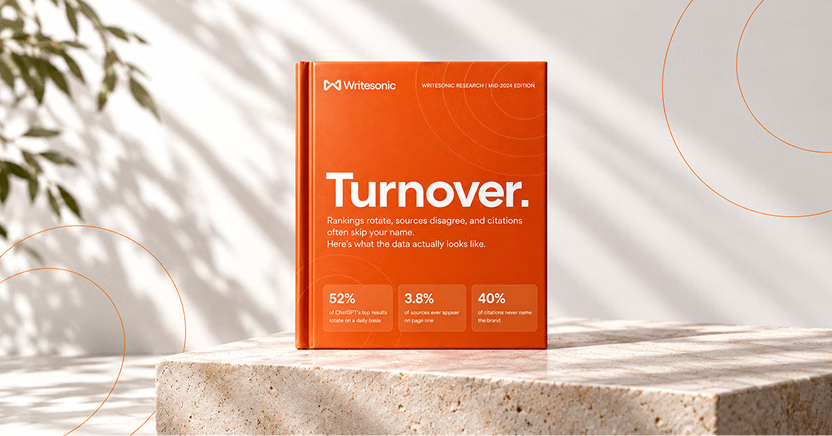
The #1 brand in ChatGPT changes 52% of the time.
Get the report and find out why.
How to optimize your content for AI engines in 6 steps
An effective on-page GEO strategy isn’t as complicated as you might think. Like traditional SEO, it’s rooted in consistency and quality. Here’s how to structure your approach:
1. Structure your content for AI comprehension
AI engines need to parse your content quickly and accurately. The clearer your structure, the easier it is for them to extract relevant information.
What this looks like in practice:
- Use descriptive H2s and H3s that clearly state what each section covers
- Lead sections with definitive statements, then expand with supporting details
- Include a brief summary or key takeaway at the end of major sections
- Use bullet points and numbered lists for processes or criteria (but don’t overdo it — readability still matters)
Think of your headers as answers to questions. Instead of “Our Approach,” write “How to Reduce Customer Churn in 5 Steps.” AI engines are essentially asking questions on behalf of users — make your headers the answers.
2. Write quotable, citation-worthy statements
AI engines look for clear, authoritative statements they can confidently cite. Vague or hedging language is less likely to be pulled into AI responses.
Weak: “Content marketing can potentially be helpful for some businesses looking to maybe improve their online presence.”
Strong: “Content marketing generates three times more leads than traditional outbound marketing while costing 62% less.”
This doesn’t mean you should overstate claims or remove nuance where it’s needed. It means being direct and specific when you have something definitive to say. Back up claims with data, cite your sources, and state conclusions clearly.
3. Demonstrate E-E-A-T throughout your content
Google’s E-E-A-T framework (Experience, Expertise, Authoritativeness, Trustworthiness) matters even more for GEO. AI engines are trained to prioritize credible sources.
Ways to signal E-E-A-T on-page:
- Include author bios with relevant credentials
- Reference first-hand experience (“In our analysis of 10,000 campaigns…”)
- Cite primary sources, studies, and expert quotes
- Update content regularly and display “last updated” dates
- Be transparent about methodology and limitations
If you’re writing about marketing, quote marketing experts. If you’re covering a technical topic, demonstrate that you’ve actually tested what you’re recommending. AI engines are getting better at distinguishing genuine expertise from surface-level content.
4. Answer questions directly and comprehensively
AI search is fundamentally question-driven. Users ask specific questions, and AI engines look for content that answers them thoroughly.
Tactics for question-focused optimization:
- Research the questions your audience actually asks (use tools like AnswerThePublic, AlsoAsked, or simply look at “People Also Ask” boxes)
- Include FAQ sections that address common queries
- Answer the core question early, then expand with context and nuance
- Cover related questions within the same piece to demonstrate comprehensive expertise
Here’s a useful exercise: Before publishing, ask yourself, “If someone asked an AI this question, would my content be the best source for the answer?” If not, identify the gaps and fill them.
5. Use structured data and semantic markup
While structured data has always mattered for SEO, it’s even more valuable for GEO. Schema markup helps AI engines understand the context and relationships within your content.
Priority schema types for GEO:
- Article and BlogPosting schema
- FAQ schema for question-answer content
- HowTo schema for instructional content
- Author and Organization schema
- Review and Product schema (for relevant content types)
Structured data acts like a translator between your content and AI systems. It removes ambiguity and helps engines categorize and cite your content accurately.
6. Optimize for natural language patterns
AI engines are trained on conversational language. Content that matches how people naturally ask questions is more likely to be surfaced in AI responses.
What this means for your content:
- Use conversational headers (“How do I…” “What is the best…”)
- Include the full question and answer in your content, not just implied connections
- Write in a clear, accessible tone — avoid jargon unless your audience expects it
- Consider voice search patterns, which often influence AI query interpretation
This doesn’t mean dumbing down your content. It means making your expertise accessible. The best GEO content is rigorous and readable.
The future belongs to citable content
On-page GEO isn’t about gaming a new system. It’s about creating content that’s genuinely useful, clearly structured, and demonstrably authoritative — the kind of content that deserves to be cited.
The marketers and creators who thrive in the AI search era will be those who focus on being the best answer, not just the highest-ranking result. That means investing in original expertise, structuring content for clarity, and consistently delivering value that AI engines can confidently recommend to users.
The shift has already begun. The question isn’t whether to adapt your strategy, it’s how quickly you can start.
Try Writesonic, to track your AI visibility and use its suggestions to start earning AI citations today.
The #1 brand in ChatGPT changes 52% of the time.
Get the report and find out why.

Niyati Mahale is a SEO/GEO Content Writer @Writesonic. She specializes in artificial intelligence and B2B, with a flair for combining effective storytelling and SEO best practices to create impactful content.