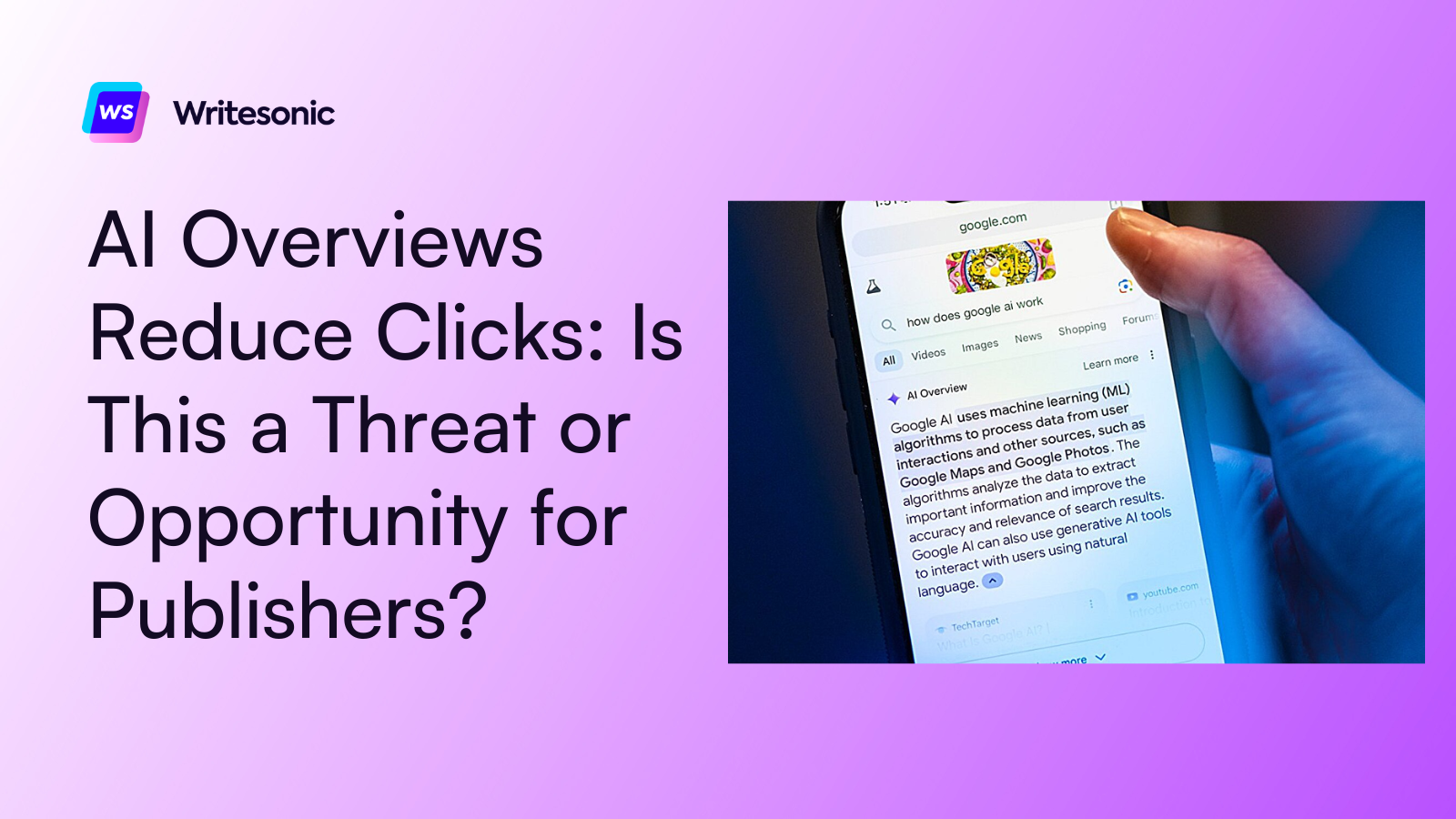
The internet is shifting again. But this time, it’s not just an algorithm update—it’s an interface revolution. Google’s AI Overviews (formerly known as Search Generative Experience or SGE) are now live for millions of users. These AI-generated summaries, appearing at the top of search results, provide instant answers without requiring users to click through to websites.
For publishers, this change sparks a fundamental question: If AI overviews answer the query upfront, will anyone bother to click anymore?
Let’s explore the data, analyze the implications, and lay out how publishers can adapt in a world AI Overviews reduce clicks and they are no longer guaranteed.
Why Traditional SEO is Losing Ground
Publishers can’t rely only on ranking in the top three positions anymore.AI-generated answers pose the biggest threat to traditional SEO methods. AI Overviews give direct answers, so users often don’t need to visit websites. Zero-click searches — where users get answers right from search results, keep growing. This creates problems for publishers who depend on website traffic.
Conversational queries are the new search trend. Instead of typing broken keywords, users ask complete questions or have conversations with search engines. This approach turns search from matching keywords to understanding what users really want. Users ask follow-up questions and get AI-generated answers. Voice assistants and mobile devices make it normal to speak searches out loud, which encourages natural language.
What Are AI Overviews, and Why Do They Matter?
AI Overviews are Google’s attempt to transform search into an answer engine, not just a directory. When users search for a query, especially one that’s informational or broad, Google now shows a boxed summary synthesized by generative AI. It cites sources—sometimes. But often, it satisfies the user’s intent without requiring a single click.
This isn’t a hypothetical future. It’s happening now.
In sectors like health, education, travel, and finance — industries that built empires on organic traffic, the effect is already visible.
The Threat Is Real: AI Overviews Cannibalize Clicks
Let’s call a spade a spade. Publishers are right to be alarmed.
Multiple studies and early tracking reports confirm a drop in organic CTR (click-through rate) on queries that trigger AI Overviews:
- Similarweb noted a less-than-60% click rate on Google search results overall as of 2024 — and AI Overviews could push that lower.
- Early heatmap data shows users linger longer on the AI Overview section, reducing attention paid to blue links below.
- Publishers are already reporting dips in traffic for top-of-funnel content, especially where queries are easily summarized.
Imagine you rank #1 for “How API vs UI results differ.” Before, that meant a flood of visits. Now, the AI overview answers the question in two lines — and users never even scroll to your link.
This is not just about traffic loss. It’s about disintermediation. The user gets your information, but not from you. Your role in the value chain is being absorbed by the AI layer.
Publishers have Begun to Push Back
As AI Overviews increasingly repurpose publisher content without guaranteed traffic or attribution, some major players are beginning to push back. In a landmark move, Cloudflare announced it would block AI crawlers by default, making it the first major infrastructure provider to take this stand. This change affects websites using Cloudflare’s services — representing over 20% of the internet, and that means bots like GPTBot (OpenAI), CCBot (Common Crawl), and others can no longer scrape content for model training or AI summaries unless explicitly permitted. For publishers concerned about content being used to feed AI without consent or return, this marks a shift in power. It signals the beginning of a broader movement: one where the open web reasserts its right to control how its content is consumed in the age of generative AI.
But you can still win without worrying about traffic.
AI Overviews: Is There an Opportunity Here for Publishers?
Surprisingly, yes.
While the surface-level numbers are worrying, smart publishers can still find leverage points in the new AI search era. Here’s how:
1. Visibility Isn’t Dead — It’s Just Changing
Even if users don’t click, your content can still be cited in AI Overviews. Those citations might not drive immediate traffic, but they do shape brand perception.
If your brand is consistently associated with accurate, trustworthy, insightful content, you win in share of search — even if not traffic right away. This is crucial for:
- Topical authority
- Thought leadership
- Brand recall in later funnel stages
In short: AI Overviews shift value from clicks to credibility.
2. The Long Tail Still Lives
AI Overviews tend to dominate broad queries. But long-tail searches, local intent queries, and transactional keywords still favor traditional blue links or map packs.
Publishers can double down on these:
- Niche informational posts
- Location-specific content
- Highly specialized or time-sensitive topics (e.g., “best SEO tools in 2025”)
These are less likely to be fully answered in a 2-line AI summary.
3. The Funnel Is Reversible
Users may not click on first search — but they remember brands. Later, they might:
- Search for “[Your Brand] + topic”
- Subscribe via a newsletter
- Follow you on social
- Return directly to your domain
The new goal is not always the click; but the imprint.
A Strategic Response: What Publishers Should Do Next
If you’re a content publisher, SEO specialist, or media brand, you need to rethink your playbook. Here’s how to stay competitive:
1. Track AI Overview Mentions
Use tools like Writesonic GEO to detect which queries trigger AI overviews — and whether your brand is being cited. If you’re not in the summary, you’re invisible. If you’re in it, you need to know how you’re being represented.
How does Writesonic’s AI Visibility tool – Writesonic GEO, actually work?
- It monitors your AI search visibility, tracks brand citations, share of voice, and sentiment across thousands of AI queries and business topics.
- You can see exactly where you stand against competitors in AI search results
- You can also configure exactly which topics, prompts, and competitors to track based on your unique business priorities.
2. Focus on Source-Worthy Content
Google prefers citing clear, well-structured, authoritative content. Google’s AI systems look at sources differently than old ranking algorithms do. Brand recognition helps, but topic expertise carries much more weight now. Publishers who show deep knowledge in specific subjects through accuracy and original content are more likely to be cited in AI Overviews. E-E-A-T principles (Experience, Expertise, Authoritativeness, Trustworthiness) help decide which sources the system trusts enough to use.
That means:
- Use proper H1–H3 hierarchy
- Add clear definitions and bulleted lists
- Back up claims with data and citations
- Ensure fast, mobile-friendly UX
Think like a dataset. Feed the AI.
3. Diversify Traffic Channels
Don’t be Google-dependent. Strengthen:
- Email newsletters (still a high-intent audience source)
- YouTube and podcasts (harder for AI to summarize without credit)
- Direct and branded search traffic
AI may win generic queries, but you still own your audience relationships.
4. Adapt to Generative Engine Optimization (GEO)
Generative Engine Optimization (GEO) is the new SEO. It means optimizing your content not just to rank, but to be cited by AI models.
Tools like Writesonic’s GEO feature let you:
- Audit where your brand is being cited in AI summaries
- Reverse-engineer prompts to boost visibility
- Rewrite content for AI models to better understand and quote with the help of in-built SEO extensions
If you haven’t explored GEO yet, now’s the time. Your old SEO checklist won’t cut it in 2025.
The Verdict: Threat or Opportunity?
Both; but only if you’re adaptable.
For static, ad-driven publishers reliant on high-volume, low-intent traffic? This is an existential threat.
For brands focused on authority, loyalty, and quality over quantity? This is an inflection point — a chance to pivot ahead of competitors.
The core idea remains: the value of content hasn’t disappeared. What’s changed is how it’s discovered and consumed.
AI overviews may steal the click, but they can’t steal your brand unless you let them.
Final Thought
We’ve been here before — zero-click searches, featured snippets, voice assistants. Each time, the landscape changed. Some publishers adapted. Some vanished.
This time, the change is deeper. But so is the opportunity.
Publishers need to understand that this change from links to answers will stick around. People want quick solutions instead of scrolling through pages of results. They must create content that answers specific questions to stay relevant. Position tracking might not matter as much now, but quick-moving publishers can find new ways forward. They can improve their chances of appearing in AI-generated answers through structured data, original reporting, and detailed topic coverage. On top of that, it helps to use tools like Writesonic GEO that tracks how often AI Overviews mention your content.
FAQs on AI Overviews Reducing Clicks
The #1 brand in ChatGPT changes 52% of the time.
Get the report and find out why.

Sumana Sarmah is a Content Writer @ Writesonic, with 5+ years of hands-on experience in B2B content writing and copywriting.
With a knack for creative brainstorming, she strategizes and curates impactful content that brings in exceptional engagement.