TL;DR
- Most brands failing at GEO are making structural and semantic errors, not editorial ones.
- LLMs cite content that is entity-clear, answer-formatted, and semantically authoritative. Well-written content alone is not enough.
- Missing structured data, vague entity definitions, and dense paragraph formatting are the three fastest ways to kill citability.
- GEO has a different unit of value from SEO: the extractable answer, not the ranked page.
- Fixing technical GEO mistakes means auditing your content through the lens of what an LLM needs to quote.
Generative Engine Optimization (GEO) is the practice of structuring and formatting content so that large language models (ChatGPT, Perplexity, Gemini, Claude, and others) extract, cite, and surface it in AI-generated answers. The success metric for GEO is citation frequency rather than ranking position: how often your content becomes the source an LLM quotes.
Most brands getting GEO wrong are making technical and structural mistakes, not editorial ones. These are errors in how content is architected, marked up, and semantically organized. They make content invisible to LLM retrieval pipelines no matter how good the writing is.
What makes a piece of content "LLM-citable"?
LLMs do not rank pages. They extract answers. A piece of content becomes citable when it contains a short, self-contained, factually grounded answer to a specific question that the LLM can lift and attribute without heavy paraphrasing.
Content that gets cited tends to share four properties:
- It opens with a direct definition or answer rather than a hook or an anecdote.
- It uses structured formatting (headers, lists, tables) that creates discrete, quotable units.
- It references named entities, sources, and statistics with clear attribution.
- It shows semantic depth by covering the sub-questions around the core topic, not the topic in isolation.
Content that fails to be cited usually fails on at least two of those four at the same time.
What are the most common technical GEO mistakes?
The most common one: writing for human reading flow instead of machine extraction. Dense narrative prose, hook-led intros, and transitional storytelling paragraphs are the opposite of what LLM pipelines prioritize when picking content to cite.
Here are the errors that come up most often, organized by category.
Mistake 1. No direct answer in the opening block
LLMs weight the opening 100 to 150 words of a piece heavily when deciding whether it is a credible source for a query. If those words are spent on anecdotes, broad context-setting, or rhetorical questions ("Have you ever wondered why AI seems to ignore your content?"), the model gets no extractable signal early.
The fix: open every article, product page, or FAQ entry with a 40 to 75 word direct answer to the page's primary question. The first sentence should follow the pattern: "[Topic] is a [category] that [key differentiator]." This is the structural signal LLMs use to identify answer candidates.
Mistake 2. Missing or broken structured data (schema markup)
JSON-LD schema is one of the clearest signals a page can send AI crawlers about what type of content it contains and what questions it answers. Pages without FAQPage, HowTo, Article, or Product schema are harder for LLM retrieval systems to classify correctly.
Common structured data errors:
- Using outdated schema types that no longer map to current schema.org vocabulary.
- Implementing schema that contradicts the visible page content (FAQPage schema with questions that don't appear on the page).
- Missing speakable schema, which tells voice and AI interfaces which sections are most extractable.
- No author entity markup, which weakens the E-E-A-T signals LLMs use to judge source credibility.
The fix: validate all structured data against the Schema.org vocabulary and test with Google's Rich Results Test. Add FAQPage schema to any page with Q&A content. Add speakable schema to the sections containing your most quotable, answer-dense paragraphs.
Mistake 3. Entity ambiguity and pronoun overuse
LLMs build knowledge graphs around named entities (brands, people, products, locations, concepts). When content uses pronouns ("it", "they", "the tool", "this platform") instead of repeating proper nouns, the model's entity resolution weakens. The content becomes harder to attribute and cite accurately.
Entity ambiguity is easy to miss because the writing still reads fine. The LLM has the content. It just doesn't know who the content is about.
Content with high entity repetition (using the brand or product name through the piece rather than substituting pronouns) tends to see stronger citation rates in LLM-generated answers, especially on product comparison and category explanation queries.
The fix: audit any content targeting brand-visibility or product-specific queries. Replace pronouns with proper nouns. In every paragraph, at least one reference to your core subject should use its full, correct name.
Mistake 4. Dense paragraph formatting
A 200-word paragraph is not a citation candidate. LLMs extract atomic units of information: a sentence, a short block, a list item, a table cell. When information is buried inside dense prose, the model either skips it or pulls it out with lower confidence.
The fix: break content into atomic chunks of 2 to 4 lines. One idea per block. Leave plenty of white space. If a paragraph answers more than one question, split it. Use lists and tables where the content is enumerable or comparative, not as decoration.
Mistake 5. Weak or missing statistics with named sources
LLMs prefer to cite specific, sourced, dateable claims over general observations. "AI search is growing rapidly" is not citable. "Perplexity reported 15 million daily active users as of early 2025 (Reuters, 2025)" is citable.
Common stat-related errors:
- Citing statistics without naming the source organization.
- Citing statistics without a year or publication date.
- Using outdated statistics (pre-2023 data cited without acknowledging its age).
- Paraphrasing statistics so heavily the original source is obscured.
The fix: every statistic should follow the format [Claim] ([Source name], [year]). If you are making an observation without a specific source, frame it that way ("Internal benchmarks indicate...", "From what we have seen across client accounts..."). Don't attach a false attribution to dress it up.
Mistake 6. No FAQ or Q&A section
FAQ sections get cited often in LLM outputs. A well-structured FAQ matches the way LLMs receive queries and construct answers. Pages without one are missing a structural GEO opportunity.
What separates an LLM-citable FAQ section from a decorative one:
| FAQ characteristic | Weak (decorative) | Strong (LLM-citable) |
|---|---|---|
| Question format | Vague ("What is GEO?") | Prompt-shaped ("What is GEO and how is it different from SEO?") |
| Answer length | 1 to 2 sentences, no depth | 3 to 6 sentences with a specific claim, mechanism, or number |
| Entity clarity | Uses pronouns ("it helps you") | Uses proper nouns ("GEO helps brands appear in ChatGPT answers") |
| Schema markup | None | FAQPage JSON-LD implemented |
| Source citation | None | Named source or observation-framed claim |
The fix: write FAQ answers as standalone, self-contained answers. Each one should make sense if read on its own, with no dependence on the paragraph above it.
Mistake 7. Ignoring semantic breadth
LLMs evaluate content for topical authority, which goes beyond the direct answer to a query. A page that answers "what is GEO" but does not cover "how GEO differs from SEO", "what tools are used for GEO", and "what metrics measure GEO success" signals narrower authority than one that covers all four.
Semantic breadth is how LLMs tell a subject-matter expert apart from someone who read one article.
The fix: before publishing, map the cluster of sub-questions a reader would have after reading your core content. Answer at least three to five of those within the same piece, either as H3 subsections or FAQ entries. That raises the range of queries your content is eligible to be cited for.
Mistake 8. No author entity or E-E-A-T signals
LLMs are trained on data that includes signals about source credibility. Content with no author attribution, no credentials, and no links to verifiable expertise is treated as less authoritative than content with a named, credentialed author who has a consistent web presence.
GEO-relevant E-E-A-T errors:
- Anonymous or byline-free content on topics that need expertise.
- Author bios that list no verifiable credentials, publications, or affiliations.
- No internal linking between the author's content pieces (which builds topical entity signals).
- Content that cites no external authoritative sources (arXiv papers, official documentation, peer-reviewed research, government publications).
The fix: add a structured author bio with a named credential to every piece targeting GEO citability. Link out to two to four high-authority external sources per article. Internal-link the author's content across related topics.
Mistake 9. Not tracking LLM citation performance
The most overlooked technical GEO mistake is treating GEO as a one-time optimization. Brands that optimize for LLM citations but never check whether they are being cited are working blind.
Citation tracking requires:
- Monitoring which AI platforms (ChatGPT, Perplexity, Gemini, Claude) surface your brand or content for category queries.
- Tracking competitor citation frequency for the same queries.
- Identifying which content pieces are being cited and which are being ignored even after optimization.
AI visibility platforms (Writesonic offers tracking across LLM platforms) let brands monitor citation rates, see which pages are getting pulled into AI-generated answers, and benchmark against competitors. Without measurement, GEO optimizations are educated guesses.
In GEO, the thing you're measuring is citation frequency, not ranking position. The tools have to match the metric.
Mistake 10. Forcing SEO keyword density patterns into GEO content
SEO keyword density (repeating a target keyword phrase at a set frequency through the text) works against GEO. LLMs do not parse pages looking for keyword repetition. They parse for semantic meaning, answer completeness, and entity clarity. Content that reads like it was written for keyword stuffing scores poorly on the coherence and authority signals that drive LLM citation selection.
The fix: write for the question. Use natural language variations of your core topic. Prioritize answer completeness over phrase repetition. GEO content should read like an authoritative explanation, not an optimized landing page.
How do technical GEO mistakes differ from content quality mistakes?
Technical GEO mistakes are structural. They affect whether an LLM can extract your content at all. Content quality mistakes are editorial. They affect whether the content is worth citing. Both matter. They are different problems with different fixes.
| Mistake type | Examples | Fix category |
|---|---|---|
| Technical / structural | Missing schema, dense paragraphs, no direct answer opener, no FAQ schema | Architecture and formatting |
| Semantic / topical | Shallow coverage, no sub-question depth, entity ambiguity | Content strategy |
| Attribution / trust | No author bio, no external sources, undated statistics | Authority signals |
| Measurement | No citation tracking, no competitor benchmarking | Analytics and tooling |
Brands that fix only one category will see partial results. A page with perfect schema but dense, hook-led prose will still struggle to be cited. A page with strong answer formatting but no author entity will underperform on E-E-A-T-weighted queries.
How to audit your content for technical GEO errors
A practical GEO audit works through four layers in sequence.
Layer 1. Structure audit.
Check every target page. Does it open with a direct answer? Are headers phrased as questions? Is content chunked into atomic blocks? Is there a FAQ section?
Layer 2. Schema audit.
Validate structured data for every page using Google's Rich Results Test or schema.org validation tools. Confirm that FAQPage, Article, HowTo, or Product schema is implemented correctly and matches the visible content.
Layer 3. Entity and authority audit.
Scan for pronoun overuse. Confirm every author has a bio with verifiable credentials. Confirm every statistic has a named source and year. Confirm two to four high-authority external links per piece.
Layer 4. Citation performance audit.
Use an AI visibility tracking platform to query the LLMs your audience uses (ChatGPT, Perplexity, Gemini) with the prompts your content targets. Record whether your content is cited, paraphrased, or absent. Writesonic automates this layer, tracking brand and content citation rates across major LLM platforms and surfacing which pages are performing and which are not.
Key takeaways
- GEO citability comes from structure and semantics first, writing quality second. Fixing formatting errors usually moves the needle faster than rewriting content.
- The top structural errors: no direct answer opener, missing FAQ schema, dense paragraphs, and entity ambiguity.
- Statistics without named sources and dates are not citable by LLMs. They need the format [Claim] ([Source], [year]).
- Semantic breadth, covering surrounding sub-questions, is how LLMs assess topical authority. Relevance alone is not enough.
- GEO without citation tracking is optimization without feedback. Skip the measurement step and you're guessing.
- E-E-A-T signals (author credentials, external citations, consistent entity presence) move LLM citation selection too, beyond their effect on Google rankings.
- Keyword density patterns from SEO work against GEO content quality signals.
Frequently asked questions (FAQs)
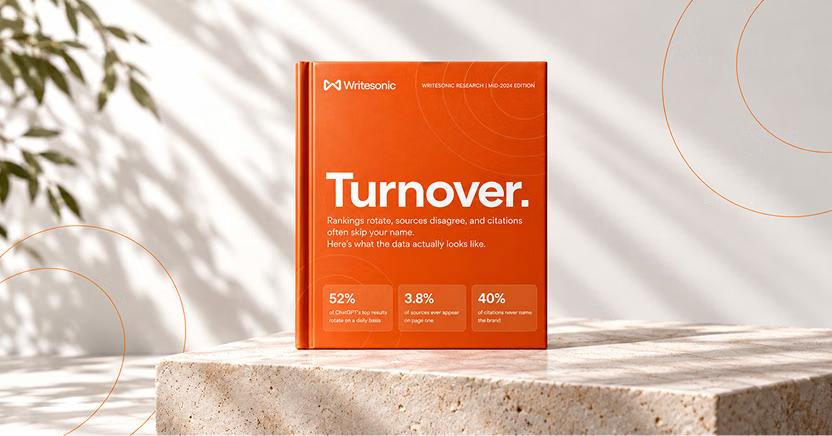
The #1 brand in ChatGPT changes 52% of the time.
Get the report and find out why.

GEO Strategist at Writesonic
Rohit is an GEO Strategist at Writesonic with nearly a decade of experience driving organic growth across industries. Over the past 9 years, he has partnered with brands across BFSI, ecommerce, and B2B SaaS, helping them turn search visibility into measurable revenue. His expertise lies in Generative Engine Optimization (GEO) and AI Search, where he crafts strategies that help brands earn placement in answers from ChatGPT, Perplexity, Google AI Overviews, and beyond.