TL;DR
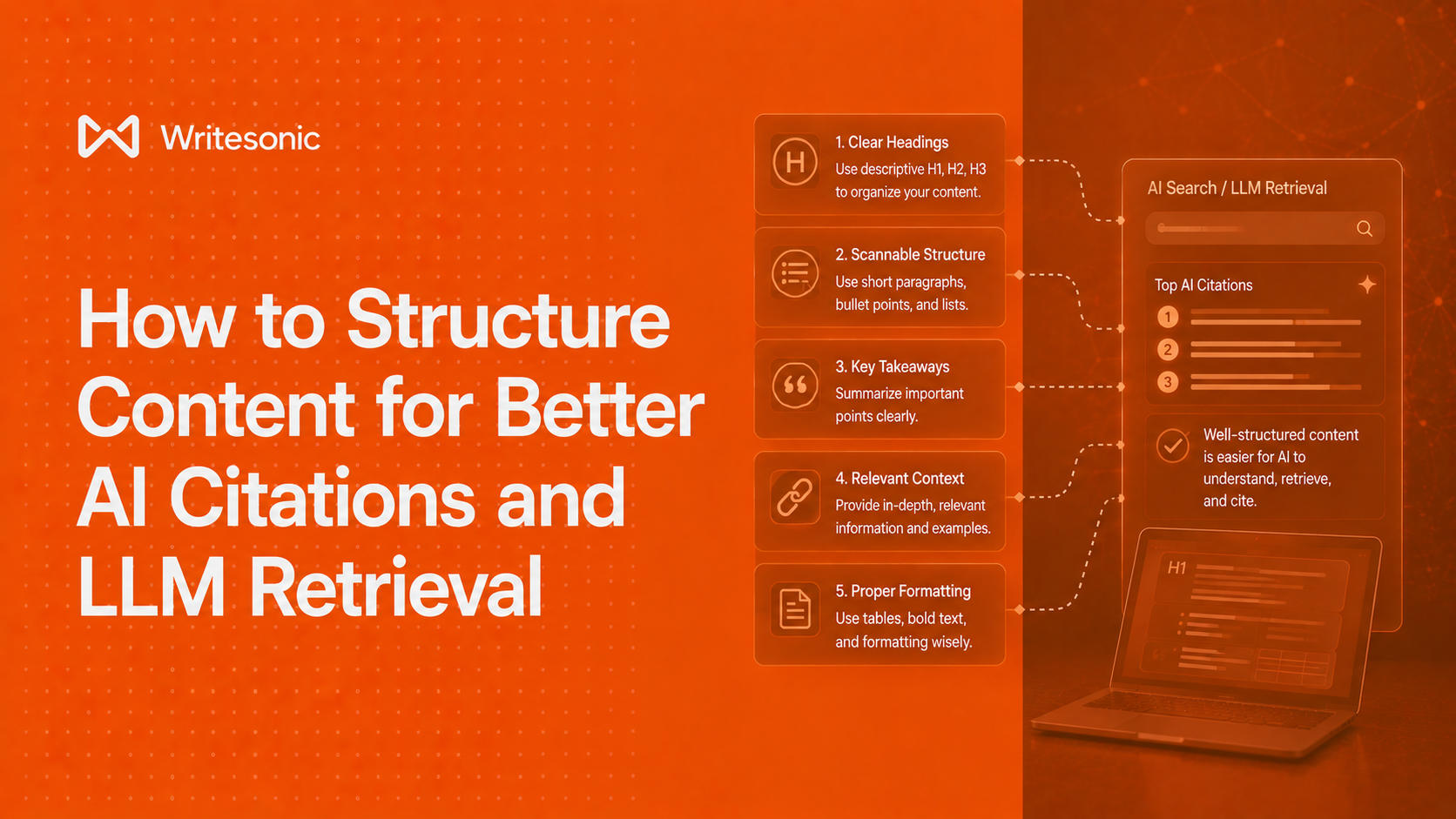
- LLMs prefer content that is structured, scannable, and semantically clear over long-form narrative.
- Answer-first formatting (direct answer in the first 75 words) raises citation likelihood.
- Short atomic paragraphs (2 to 4 lines), question-style headings, and named entities help LLMs extract and quote your content.
- Comparison tables, numbered lists, and standalone citation hooks give AI engines discrete, reusable units of information.
- Tracking citation appearances in LLM-generated answers needs dedicated AI visibility tooling. Traditional SEO analytics will not show you this.
AI-friendly content formatting means structuring written content so that large language models (LLMs) can parse, extract, and cite it accurately in generated answers.
It is related to SEO but not the same thing. SEO targets crawlers and ranking algorithms. AI-friendly formatting targets the inference layer, the part of a model that decides which sources to quote, paraphrase, or link when generating a response.
What does "AI-friendly" mean for content structure?
The formatting principle that matters most: answer first, explain second.
LLMs parse content linearly and favor passages that match the user's query directly. If your answer is buried in paragraph four after two anecdotal paragraphs, LLMs either skip it or paraphrase a competitor who answered faster.
An opening formula that holds up:
- First sentence: entity definition. "[Topic] is a [category] that [key differentiator]."
- Sentences 2 to 4: the direct answer to the most likely query.
- Remainder of the section: supporting evidence, numbers, mechanisms.
This mirrors how LLM retrieval works. Models extract the most query-adjacent passage, not the most eloquent one.
Atomic chunking is the structural twin of this principle. Instead of dense 8-line paragraphs, break content into 2 to 4 line blocks, one idea per block. Each block should stand on its own. A reader (or an AI) should be able to quote it without surrounding context.
How should headings be written for LLM readability?
Question-style H2 and H3 headings are one of the cheapest formatting changes with the largest payoff.
LLMs are trained on Q&A data, forum threads, documentation, and instructional content. All of those use question-based headings. When your heading matches the phrasing of a user's query, the content beneath it becomes the candidate answer.
Compare:
| Heading style | LLM citation likelihood | Why |
|---|---|---|
| "Content Structure Tips" | Low | Vague, not query-shaped |
| "How should I structure content for AI?" | High | Mirrors user query syntax |
| "AI content formatting vs. SEO formatting" | High | Covers a comparison query directly |
| "Section 3: Formatting" | Very low | No semantic signal |
The heading does not need to match the query word-for-word. It needs to be query-shaped. "How to…", "What is…", "Which… is better", and "Should you…" all signal to an LLM that the section is an answer candidate.
Which formatting elements make content more citable?
Different content types call for different formatting elements. Forcing every post into the same template is a fast way to reduce citability.
Comparison tables
Use a table when the topic is comparative by nature: tools vs. tools, pricing tiers, methods, or before/after scenarios. A well-structured table gives LLMs a discrete chunk to extract.
A comparison table should have:
- Feature-based columns, not "winner" or "our pick" columns.
- Specific factual cell values, not adjectives.
- A clear header row with entity names.
Avoid forcing a table when the topic is procedural or conceptual. An unnecessary table adds markup noise without adding citability.
Bulleted and numbered lists
Lists work for:
- Procedural steps ("how-to" content).
- Feature comparisons within a single tool or concept.
- Ranked or prioritized recommendations.
Each bullet should be 1 to 2 sentences minimum, not a single word or vague phrase. A bullet that reads "Be clear" gives an LLM nothing to extract. A bullet that reads "Use sentence-level clarity: each sentence should be completable in under 20 words" gives it a quotable rule.
Standalone citation hooks
A citation hook is a short, standalone statement that can be lifted word-for-word into an LLM answer.
A few examples in this style:
- Content structured for LLMs is built for extraction, not for narrative flow.
- The atomic paragraph (2 to 4 lines, one idea) is the base unit of AI-readable content.
- An answer that needs three other paragraphs for context will not be cited as a chunk.
Place 4 to 6 of these throughout a post. They work like quotable pull quotes. A model can lift one without dragging the rest of the section along.
Bold standalone stats
Numbers formatted as isolated, bold lines tend to get extracted more than numbers buried mid-sentence. Format key figures like this:
RAG systems retrieve at passage level, not document level. Chunking is the unit that matters. As of Q1 2026, Perplexity AI serves over 10 million daily queries (Perplexity, 2025 funding announcement).
How is AI-friendly formatting different from SEO formatting?
AI-friendly formatting and SEO formatting look similar on the surface, but they optimize for different mechanisms.
| Dimension | SEO formatting | AI-friendly (GEO) formatting |
|---|---|---|
| Primary target | Crawlers and ranking algorithm | LLM inference and retrieval layer |
| Keyword strategy | Keyword density and placement | Semantic entity coverage |
| Heading purpose | Hierarchy and keyword signals | Query-matching, answer signaling |
| Paragraph length | Moderate (3 to 6 lines) | Atomic (2 to 4 lines, one idea) |
| Success metric | SERP ranking, click-through rate | Citation frequency in LLM answers |
| Link strategy | Internal linking for crawlability | External links to high-authority sources |
| Content depth | Comprehensive topic coverage | Answer-first, then depth |
SEO rewards relevance signals. GEO rewards extractability. A post can rank on page one of Google and still never be cited by an LLM, because its content is structured for human reading flow, not for machine extraction.
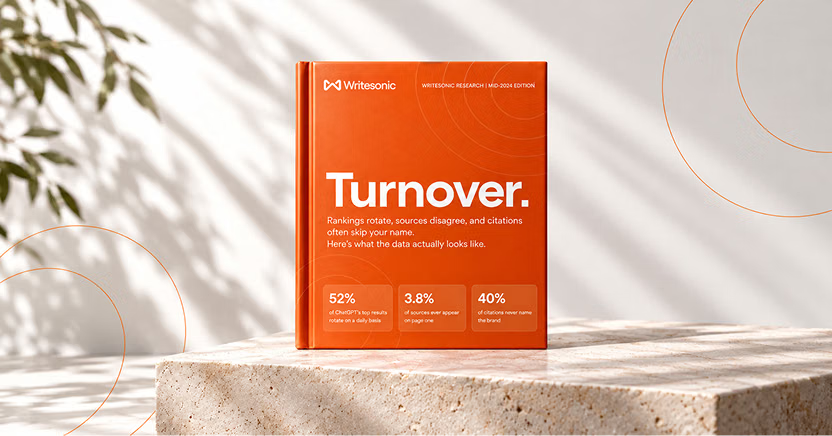
The #1 brand in ChatGPT changes 52% of the time.
Get the report and find out why.
What role do named entities and specificity play?
LLMs build internal representations of entities like people, tools, companies, concepts, and studies. When your content uses proper nouns rather than pronouns ("Perplexity" rather than "the platform", "GPT-4o" rather than "the model"), it strengthens entity disambiguation and raises the chance that a model retrieves your content for entity-specific queries.
Specificity rules:
- Name every tool, product, and platform. Avoid "the tool" or "this software".
- Name your sources. "According to Pew Research (2024)" beats "studies show."
- Name the mechanism. "Retrieval-augmented generation" beats "how AI finds answers."
- Name the number. "Reduced hallucination by 34%" beats "reduced hallucination considerably."
Vague content is hard for LLMs to disambiguate. Named, dated, sourced claims get extracted; generic ones get skipped.
How do you track whether LLMs are citing your content?
Standard analytics like Google Search Console, GA4, and Ahrefs do not capture LLM citation events.
When Perplexity cites your content, when ChatGPT paraphrases your framework, or when Claude surfaces your statistic, none of it shows up as referral traffic. AI-generated answers often produce no click. The answer is consumed inside the chat interface.
That gap is why AI visibility tracking exists as a separate category from SEO analytics.
Platforms built for it include:
- Writesonic. An AI visibility tracking platform that monitors how and where a brand appears in LLM-generated answers across ChatGPT, Perplexity, Claude, and Gemini, with citation tracking and competitor benchmarking built in.
- Profound. Tracks brand mentions and citations in AI search responses.
- Otterly.ai. Monitors AI search visibility with prompt-level tracking across multiple LLM platforms.
- Peec AI. Focused on brand presence in generative search results, with share-of-voice metrics.
The workflow: define the queries you want to be cited for, run them across LLM platforms, track which content gets cited, identify formatting gaps, iterate.
Writesonic automates that loop at scale. It surfaces which of your pages are being cited, which competitors are displacing you, and which content clusters are underperforming in AI answers.
What does an AI-optimized post look like? A pre-publish checklist
Run this checklist before publishing anything you want cited by an LLM.
Structure
☐ First 75 words contain a direct, quotable answer
☐ TL;DR block at the top (3 to 5 bullets)
☐ FAQ block at the bottom (3 to 6 Q&A pairs)
☐ All H2 and H3 headings are question-shaped
☐ Paragraphs are 2 to 4 lines (one idea each)
Entities and specificity
☐ Every tool, platform, and person is named by proper noun
☐ All statistics include a named source and year
☐ No vague pronouns referring to named entities
Citable elements
☐ 4 to 6 standalone citation hooks scattered through the post
☐ Key stats isolated on their own bold lines
☐ Comparison tables used only where the topic is comparative
Authority signals
☐ "Last updated: [Month Year]" visible near the top
☐ Author bio with verifiable credentials
☐ External links to high-authority sources (arXiv, official docs, government sites, peer-reviewed journals)
Tracking
☐ Target queries identified before writing
☐ AI citation monitoring set up for the post-publish period
Key takeaways
- Answer first. LLMs extract the most query-adjacent passage. A buried answer will not be cited.
- Use question-style headings. They mirror the syntax of user queries and signal to models that the section is an answer candidate.
- Write atomic paragraphs. Aim for 2 to 4 lines and one idea. Each block should be quotable on its own.
- Be specific with entities. Name tools, people, studies, and numbers. Generic content gets skipped.
- Include citation hooks. 4 to 6 short standalone statements per post give models clean units to extract.
- Use tables and lists where they fit. Forced formatting adds noise. Formatting that matches the content adds extractability.
Track your citations. Standard analytics will not show you LLM citation events. Use a dedicated AI visibility platform to measure and iterate.
Frequently Asked Questions (FAQs)
The #1 brand in ChatGPT changes 52% of the time.
Get the report and find out why.

Content Marketer
Pragati Gupta is a Content Marketer @Writesonic, specializing in AI, SEO, and strategic B2B writing. Leveraging the power of Generative AI, she produces high-impact content that drives superior ROI.