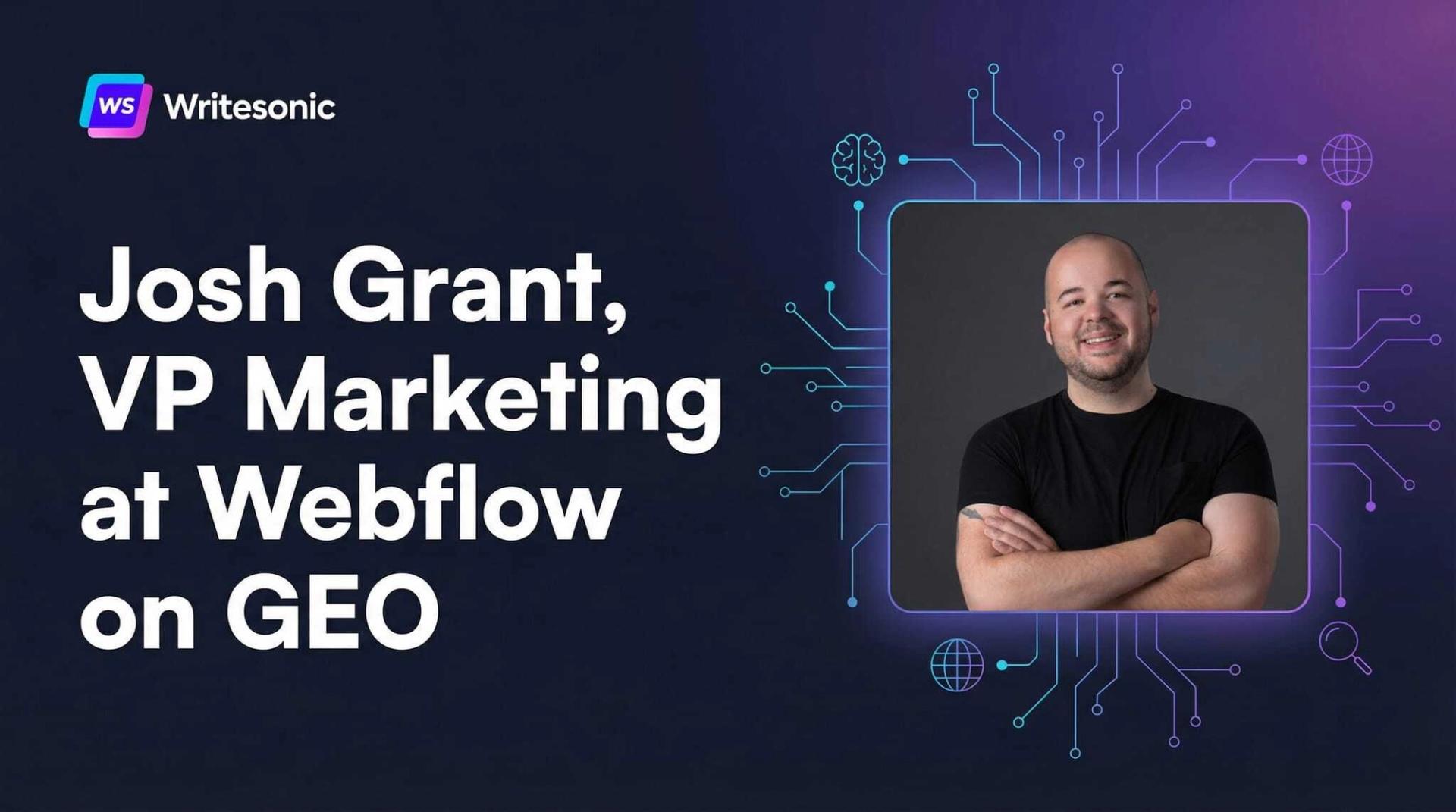
Josh Grant grew up playing in punk rock bands. No labels and producers. Just ship it, experiment, iterate, and learn by being in it.
Now he’s VP of Marketing at Webflow, and that same mindset is how he’s approaching one of the biggest shifts in marketing in a decade: Generative Engine Optimization.
“Traditional systems and playbooks are breaking down. The rules many teams relied on for a decade are eroding. Attribution is fuzzier. Distribution is fragmenting,” Josh says. “No one is going to spoon-feed you GEO insights. If you want to win, you have to embed yourself in the change.”
We, at Writesonic, sat down with Josh to get his unfiltered take on everything from attribution to AI hallucinations, and he didn’t pull punches.
Zero-Click Mentions Aren’t an Attribution Problem. They’re a Mindset Problem.
Your brand gets mentioned in a ChatGPT answer. No click. No visit. No trackable event. CMOs everywhere are asking the same question: how do you prove that mattered?
Josh reframes the whole thing: “AI answers influence preference the same way brand always has: before intent is measurable. We just got used to valuing clicks because they were easy to track.”
Instead of asking “Did this AI answer send traffic?” he asks “Did it make demand easier to convert?”
He treats AI mentions as a visibility signal, not a lead source. Track share of voice, context of recommendation, coverage across buyer questions. Then tie it to downstream efficiency: branded search lift, higher win rates, faster sales cycles, better demo-to-close.
“You don’t prove this with fake precision. You prove it with patterns over time. When AI visibility goes up and pipeline quality improves, that’s the ROI. You’re not assigning credit, you’re measuring influence.”
The Line Between GEO and Brand PR Has Basically Collapsed
LLMs don’t care what you own. They synthesize what’s most consistent and most trusted across Reddit threads, reviews, partner blogs, comparison posts, and competitor content. So where does GEO end and reputation management begin?
Josh calls it a portfolio approach. “GEO isn’t one channel or one tactic. It’s the entire marketing portfolio showing up in how the internet answers questions about you.”
The way he draws the line: SEO and GEO shape the answers. PR shapes the narrative. GEO sits in the middle, doing disciplined work across places you don’t control.
But here’s the kicker: “If you’re not actively managing how the internet answers questions about you, the model will do it for you. And by the time that shows up in pipeline, it’s no longer SEO or PR. It’s damage control.”
Product Moves Fast. Perception Moves Slow.
You ship a major product update today. How long before ChatGPT, Perplexity, or Gemini actually reflects it?
Josh’s honest answer: months, not days.
The pattern he’s observed:
- A few weeks for people to notice and talk about it
- One to three months for secondary sources to reflect it
- Three to six months (sometimes longer) before AI answers really converge on the new reality
Why so slow? “Models don’t just optimize for freshness. They optimize for consensus. One blog post doesn’t change an answer. Repetition across trusted places does.”
His advice: treat product updates like a distribution problem. Push the message into the places models already trust, correct outdated narratives where they live, and repeat it until it becomes the dominant version online.
You Don’t Need More Content. You Need the Right Coverage.
AI rewards hyper-specific content. That creates a volume problem for resource-constrained teams. Do you really need 50 pages instead of five?
Josh says the mistake is trying to solve it with volume. “GEO doesn’t reward more content. It rewards the right coverage.”
His three-layer prioritization:
First, revenue-weighted questions. Not “What is X?” but the questions that show up right before a buying decision. Comparisons, tradeoffs, limitations, integrations, pricing logic, edge cases. “Ten highly specific pages tied to high-intent questions will outperform 50 generic ones every time.”
Second, modular content. One strong piece of research or customer proof can be atomized into multiple hyper-specific answers without creating 50 separate projects. GEO rewards clarity and focus, not length.
Third, portfolio thinking. Dominate a narrow slice of questions first. Once AI associates your brand with authority in that slice, expanding gets easier.
90% of Webflow’s LLM Signups Come From One Place
Different AI platforms cite differently. ChatGPT likes definitive statements. Perplexity wants comprehensive sources. Google AI Overviews optimize for quick answers. Should brands build separate strategies for each?
Josh drops a data point that settles the debate: “At Webflow, over 90% of our directly attributed LLM signups come through ChatGPT.”
So they don’t run separate strategies. They run a priority-weighted approach. ChatGPT gets optimized for clarity and decisiveness. Everything else gets fed by reinforcing the underlying truth across the broader web.
“The market will fragment at the interface level, but not at the belief level. If you own the most accurate and repeated answer online, the engines adapt to you.”
David vs. Goliath: Enterprises Win on Breadth, Startups Win on Depth
Does GEO really level the playing field? Josh is honest: “GEO doesn’t magically level the playing field, and anyone saying that is overselling it.”
But here’s where it gets interesting.
Startups are better at question mining. They scrape Reddit, communities, X, reviews, support threads. They find the exact questions people are actually asking. Not polished keywords. Real language. Real objections. Real edge cases.
“Large enterprises often answer the question they wish buyers were asking. Startups answer the question buyers are actually typing.”
That’s a massive advantage, because LLMs mirror human phrasing. If you consistently provide the clearest answer to a very specific question, you can show up even without massive brand equity.
Don’t Panic About Hallucinations. But Don’t Ignore Them Either.
LLMs still get things wrong. They mix up brands, hallucinate features, serve outdated info. What’s the move?
Josh says the goal is to make the correct version of your brand “boringly consistent.” Clear canonical explanations. Stable language. Obvious differentiation. Reinforcement across places models trust.
When something is wrong, don’t panic and don’t argue with the model. Check whether it’s isolated or systemic. If it’s systemic, correct it where models actually learn: authoritative pages, documentation, comparisons, community discussions, third-party sources.
“Overreacting turns every error into a PR fire drill. Underreacting lets misinformation harden into consensus.” The sweet spot is operational discipline: quietly making the truth easier to repeat than anything else.
Webflow 5x’d Their Content Refresh Velocity. Here’s What Happened.
Is content becoming disposable? Does everything need constant refreshing now?
Josh says people are half right. Content decays faster, but not all of it.
Core positioning and product philosophy are still durable. What decays quickly: comparisons, integrations, pricing logic, edge cases. Anything tied to how the product actually behaves today.
Then he drops some real numbers: “At Webflow, tools like AirOps have been massively helpful. We literally 5x’d our content refresh velocity by targeting high-value pages, and we saw increases in AI-attributed signups within days of pushing those updates.”
Not more content. Faster refreshes on the right content. That’s the play.
He thinks in two layers: durable foundations and volatile surfaces. “The teams that win in GEO won’t publish endlessly. They’ll refresh with intent, and they’ll do it where it actually moves revenue.”
GEO Isn’t a Channel. It’s a Portfolio. And Portfolios Need a Manager.
Who should own GEO? It touches SEO, content, PR, product marketing, social, customer success. AI pulls from everywhere.
Josh has seen what fails: committees. “When everyone owns a piece, no one owns the result. Decisions slow down, inconsistencies creep in, and the model fills the gaps for you.”
What works is a single accountable owner with cross-functional authority. Usually lives closest to growth or SEO, but with a mandate spanning content, PR, PMM, and feedback from sales and support. Not execution of everything. Orchestration.
Is It Too Early to Invest in GEO?
Google still dominates. LLM adoption is growing but not universal. Most buyers still click through to websites. So is the whole GEO rush premature?
Josh gives two scenarios where he’d tell a brand to hold off.
First: if AI isn’t shaping how your buyers learn. If decisions are driven by referrals, outbound, or formal procurement, GEO is something you monitor, not something you staff aggressively.
Second: if AI answers about your brand are already accurate or neutral. No urgency to overcorrect. GEO becomes about readiness, not acceleration.
But then the warning: “Once AI starts shaping how buyers explain your category, your product, or your competitors back to sales, you’re already late.”
His bottom line: don’t rush and don’t wait. Calibrate. Scale GEO when you see it influencing real buyer behavior.
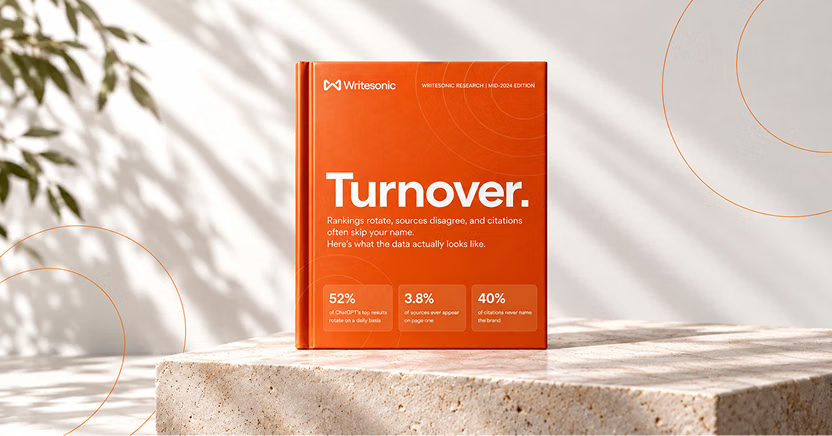
The #1 brand in ChatGPT changes 52% of the time.
Get the report and find out why.

Growth Marketer
Growth marketer at WriteSonic passionate about scaling content and building high-performing funnels. Ex-MoEngage, Whatfix, Tata AIG, Product Fruits, and TripleDart.