Key Takeaways
- Writesonic is the only platform built for full Generative Engine Optimization; tracking, identifying, fixing AI-visibility issues, and monitoring those fixes in one workflow.
- Profound is monitoring-first, strong visibility data, and broad engine coverage, but optimization requires external tools.
- Writesonic offers Citation Gap Analysis, showing missed citations and skipped pages; a capability Profound doesn’t provide.
- Writesonic's Action Center is the biggest differentiator. It gives you prioritized on-page, off-page, and technical fixes tied to AI-visibility losses. Growth gets five off-page and five on-page actions a month, Enterprise the full set. Profound's equivalent, Projects, sits at the top tier.
If you’re here, you’re probably confused between Writesonic and Profound, two of the biggest names in AI visibility right now.
Well, they might look similar since both track how often AI models surface your brand and where those citations come from. But the difference is simple: Profound shows you the data; Writesonic helps you act on it.
Profound gives you visibility data: where you’re mentioned, how often, sentiment, and the prompts behind it. Writesonic goes further with a Track → Act → Win workflow, showing missing citations, weak pages, and letting you optimize content right inside the platform.
Let’s break down what actually sets them apart.
Writesonic vs Profound: Quick Overview
Here’s a quick glimpse of the difference between Writesonic and Profound.
Writesonic
Writesonic tracks your brand across major AI engines like ChatGPT, Perplexity, Google AI Overviews, Claude, Gemini, and more (8 platforms total at the top tier).
But the difference is what happens after tracking. The platform offers sentiment analysis, identifies missing citations, weak pages, and content gaps, then gives you the tools to fix them with built-in AI writing, optimization workflows, and a full Action Center. Writesonic is built for enterprises and teams that want to track and boost AI visibility in one place.
Profound
Profound is built as a visibility monitoring suite. It covers 10+ AI engines, offers sentiment analysis, citation counts, Answer Engine Insights, and a massive 400M+ prompt dataset through Conversation Explorer.
It’s strong on analytics and trends, especially for enterprise teams that want to understand how AI systems talk about their brand. But it stops at reporting; optimization requires external tools.
TL;DR: Writesonic wins overall. It matches Profound on AI-visibility tracking and goes further with built-in content optimization, citation gap analysis, and a full Track → Act → Win workflow. Pick it if tracking isn't enough and you want the number to move. Want to see how it works? Book a demo!
| Feature | Writesonic | Profound |
| Core GEO Approach | Track → Diagnose → Fix (full GEO workflow) | Monitor, then act through Agents. Projects, powered by Aim, is Enterprise only |
| AI Engines Tracked | 3 on every self-serve plan. Perplexity and Claude on Enterprise | 1 on Starter, 3 on Growth, up to 9 on Enterprise |
| Citation Tracking | ✓ Page-level sources & relevance | ✓ Basic citation logs |
| Citation Gap Analysis | ✓ Detects missed citations & skipped URLs | ✗ Not available |
| Action Center | ✓ Prioritized fixes (on-page, off-page, E-E-A-T, entities). Growth gets 5 + 5 actions/mo, Enterprise the full set | Agents on credits (100/mo Starter, 400/mo Growth). Projects, the assigned-work layer, on Enterprise |
| E-E-A-T Optimization | ✓ Included | Included but not actionable |
| Prompt Intelligence | Basic prompt insights | ✓ Conversation Explorer (strong feature) |
| AI Bot / Crawler Analytics | ✓ Bot logs, crawl frequency, integrations | ✓ Agent Analytics (deep crawler insights) |
| Historical Data | ✓ Multi-month retention | ✓ All time, on every plan |
| Competitive Intelligence | ✓ SOV + competitor citations & gaps | Competitor insights; no content gaps |
| Fix Execution | ✓ Rewrite, update, optimize in-platform | Agents write and optimize content. Site audits and technical fixes need other tools |
| Content Tools | ✓ Integrated content workflows | Content generation and optimization Agents, plus Profound Sheets to run them at scale |
Which tool gives more actionable AI-visibility insights?
Writesonic
Writesonic tracks brand visibility across major AI engines and shows what needs fixing. You get citation gap analysis, weak-page detection, on-page and off-page recommendations, and a full Action Center that prioritizes what to update.
The platform is designed for Track → Act → Win, not just monitoring.
Profound
Profound gives strong visibility data, sentiment, and citation counts. Its Agents draft and optimize content, and Projects turns findings into assigned work, though it opens up only on the top tier. Site audits and technical SEO still need another tool.
Verdict: Writesonic is the only platform that tells you what to do next (visibility tracking + actionable insights + tools to act).
Which platform covers more AI engines?
Writesonic
Covers 8 major AI engines, including ChatGPT, Perplexity, Google AI Overviews, Gemini, Claude, and more at the higher tiers.
Profound
Enterprise covers nine engines, including Perplexity, Copilot, Grok, and DeepSeek. Breadth is a real Profound strength. Self-serve buys one engine at $99 a month and three at $399.
Verdict: Profound leads if engine coverage alone is the priority.
Which platform is more cost-effective?
Writesonic
Starts at $99/mo, or $79 billed yearly, with AI visibility tracking on ChatGPT, Gemini, and Google AI Overviews, plus content tools, the SEO suite, and integrations. Perplexity and Claude tracking sit on Enterprise. The seven-day trial takes no card.
Profound
Also $99/mo, or $82.50 billed yearly, and that $99 buys ChatGPT tracking only. Multi-engine tracking begins at $399, and nine engines plus API access and SSO need a custom quote. Their pricing page shows a "Try for free" button on Growth, but they don't publish the terms.
Verdict: Writesonic wins with more capability per dollar, especially for teams that need to act on insights.
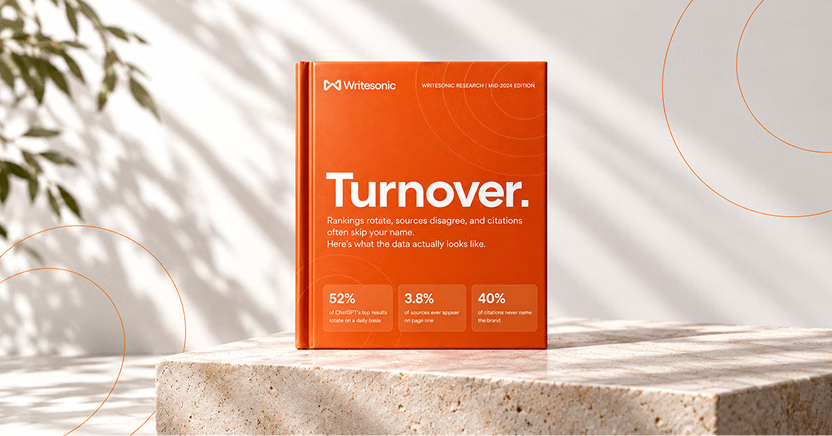
The #1 brand in ChatGPT changes 52% of the time.
Get the report and find out why.
Which tool does a better job of identifying missed citation opportunities?
Writesonic
Writesonic flags missing citations automatically, showing pages AI engines skipped, terms you should rank for in AI answers, and competitor citations you’re losing. It connects gaps directly to optimization tasks in the Action Center.
Profound
Profound tracks citations you already received, but doesn’t highlight missed ones. There is no citation gap analysis, and no workflow tied to improving underperforming pages.
Verdict: Writesonic is the only one with built-in citation gap detection.
Which tool handles AI bot & crawler analytics better?
Writesonic
Writesonic includes AI bot traffic analytics on every plan. You see crawler frequency, page-level bot behavior, and which engine each bot belongs to. It also integrates with Cloudflare, Drupal, Fastly, and Google Analytics.
Profound
Profound’s Agent Analytics is strong, but it’s locked behind paid tiers. You get page tracking, frequency monitoring, GA4 integration, and Vercel Marketplace availability, but nothing free.
Verdict: Writesonic wins. Same depth, and you get it on a lower plan.
Which tool offers better reporting and exports?
Writesonic
Writesonic provides full dashboards, trend analysis, automated scheduled reports, exports, and white-label reporting for agencies. Everything needed for operational reporting is built in.
Profound
Profound supports dashboards and data exports, but lacks scheduled reporting and white-label options. Agencies and content teams will need to assemble parts manually.
Verdict: Writesonic wins with more complete reporting for teams that need repeatable workflows.
Which platform supports more powerful SEO + GEO workflows?
Writesonic
Writesonic bundles a complete SEO suite: keyword research, on-page grading, site audits, and backlink insights. GEO visibility → SEO fixes → updated content, all in one system.
Profound
Profound offers no SEO toolkit. No keyword research, no site audits, no technical checks, and no backlink analysis. You’ll need multiple extra tools to identify why visibility dropped or where content is failing.
Verdict: Writesonic wins with GEO + SEO together, which Profound simply doesn’t support.
Which tool has stronger enterprise support and integrations?
Writesonic
Writesonic offers Slack support channels, role-based access (RBAC), SSO/SAML, API access for Enterprise accounts, and integrations with Ahrefs, Google Keyword Planner, Search Console, and more. It supports white-label reporting for agencies.
Profound
Profound supports SOC 2, SSO/SAML, and an API. Both the API and SSO sit behind a custom quote. Self-serve plans get email support, and a dedicated Slack channel starts at the top tier.
Verdict: Writesonic wins with better integrations + faster support + more accessible enterprise features.
Which tool is better for multi-domain and agency workflows?
Writesonic
Writesonic supports multi-domain tracking, multiple brands, team seats, white-label reporting, and agency-friendly plans. The platform’s maturity (5 years) makes it a more stable option for agencies managing multiple client sites.
Profound
Profound allows multi-brand monitoring and sells to agencies, with Agency Growth priced per client workspace. It doesn't advertise white-label reporting. That matters if client reports go out under your name.
Verdict: Writesonic is more stable, agency-ready, and built for multi-domain scale.
Final Words
Writesonic is built for teams that want to improve how AI engines see their brand, not just monitor it. It combines visibility tracking, citation gap analysis, E-E-A-T checks, and the Action Center so you can diagnose issues and fix them in the same workflow.
Profound takes a different approach. It excels at broad engine coverage and monitoring, and its prompt dataset is a real strength. But it stops at reporting. Optimization, content updates, and on-page improvements all require additional tools.
If your goal is to understand AI visibility, both platforms do the job. If your goal is to change that visibility and actually influence AI outputs, Writesonic is the stronger choice.
The #1 brand in ChatGPT changes 52% of the time.
Get the report and find out why.

Content Marketer
Pragati Gupta is a Content Marketer @Writesonic, specializing in AI, SEO, and strategic B2B writing. Leveraging the power of Generative AI, she produces high-impact content that drives superior ROI.