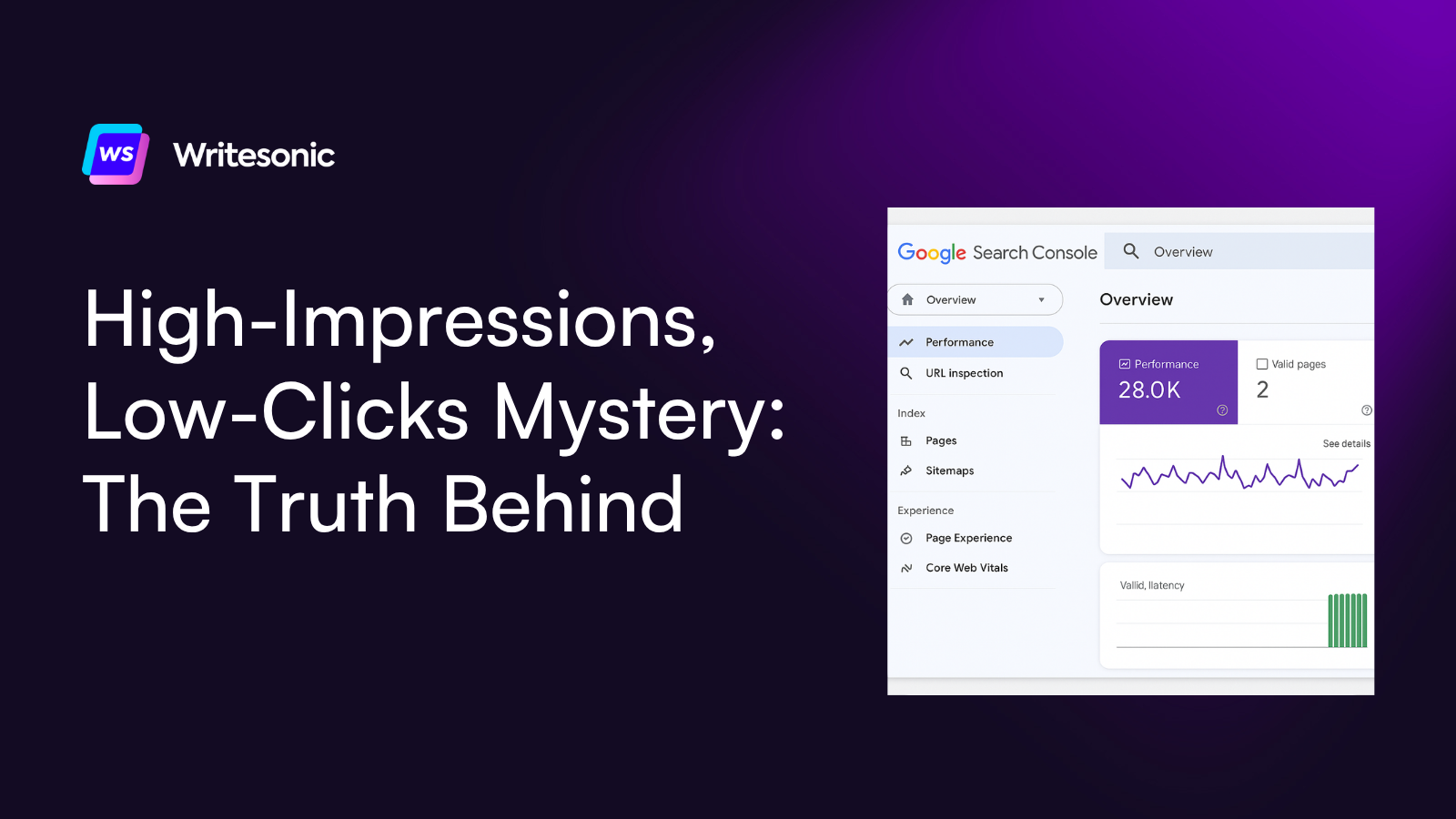
#1 rank on Google isn’t gold anymore. AIOs (AI Overviews) now dominate the prime spot, quietly stealing clicks. Here’s the truth behind your high-impression, low-click mystery.
Here’s something strange I’ve been observing with our website lately, and maybe you might have seen it too: Millions of impressions are rolling in on the Google Search Console dashboard, but the clicks aren’t following through.
This blog post covers why this is happening and also how Writesonic can help.
High Impressions, Low Clicks: What’s The Case?
Historically, Google’s SERP worked like this:
- Rank high, get seen.
- Get seen, get clicked.
- Impressions and clicks marched in lockstep.
But in 2024, that tight relationship snapped. Impressions kept rising, Google is showing your links more than ever, but actual clicks are lagging or even dropping.
Recently, I noticed something interesting on Writesonic’s Google Search Console.
Impressions are flooding, yet clicks aren’t following through like they used to. Strange, isn’t it?
Previously, impressions and clicks generally went hand-in-hand; the higher your content appeared in search results, the more clicks you’d typically receive. Recently, however, this once-reliable correlation has started breaking down dramatically.
Over the year, we have had an impressive number of impressions. But from last few months the gap between clicks and impressions started increasing. This piqued my curiosity—how could so many people see our content but decide not to click?
So, I did a quick analysis:
In the last 6 months of 2024, there had been a positive correlation between impressions and clicks, as both were rising.
But from around January 2025 (a six-month period), there started to be a negative correlation; impressions are increasing, and clicks are decreasing.
I found the answer in something SEO experts call “The Great Decoupling,” first popularized by Ahrefs. It refers to the growing gap between impressions (your content being seen in search results) and clicks (people actually visiting your site).
And the big factor causing this? Google’s new AI Overviews (AIOs).
How AIOs Are Impacting?
If you’re watching your clicks drop while impressions skyrocket, it isn’t a coincidence. Here’s why Google’s AI Overviews (AIOs) are breaking the old rules, and how they’re quietly taking away your clicks:
1. AIOs Dominate the Top (And Steal Attention Before Users Even See You)
When users search for anything now, the very first thing they see is Google’s AI Overview. These summaries are large, visually distinct, and often push organic results so far down that the “#1 ranking” barely gets any screen time.
What this means:
Even if your page is ranking first organically, it’s often out of sight. The AIO result is what users read first, and those sources (including you, maybe) count as impressions. If the AIO satisfies their query, users have zero reason to go further down the page.
2. Impressions Are Up, But Not Worth It
Every time your site is referenced in an AIO, it’s counted as an impression. This means only the citations that are visible and not all (for example, in the below example, only two citations are visible, so those two will be counted and not all).
This inflates your impression numbers, but those impressions are less meaningful than ever.
What this means:
- Your impression count goes up, but many of those impressions are “ghost impressions”; your brand appears, but isn’t seen.
- Users are getting their answers straight from the AIO summary, without ever scrolling to your organic listing or clicking through to your site.
- Clicks, meanwhile, are naturally declining because users are getting their answers at the top.
3. Trust Factor: Why Leave Google When You Trust the Answer?
AIOs aren’t just taking up space; they’re also earning trust. Users see the answer summarized by Google’s AI, backed by multiple sources, and that carries enormous weight. The need to “verify” or dig deeper has faded. If Google says it’s true, that’s enough for most users.
It’s not just about visibility, it’s about perceived authority. The trust factor is sky-high. Users see a neat summary, backed by Google’s reputation and multiple sources, and think: “That’s all I need.” There’s no urgency or incentive to click through to your site.
What this means:
Clicking through is becoming an afterthought. For most queries, the trust in Google’s summary replaces the need to visit the source site, killing the traditional click-through behavior.
4. Zero-Click Behavior: Satisfied, So Why Click?
The whole point of search used to be finding information. Now, users are being given information immediately. The AIO summarizes, sources, and satisfies most basic queries without any need to click further.
When users get everything they need without going to an actual website (or clicking on a specific link), there’s simply no incentive to click. The organic listings, even if highly relevant, are skipped because the intent has already been met. For a lot of users, curiosity is quenched right there.
What this means:
You’re still “part” of the conversation (your content might have trained the AI, or you’re cited in the overview), but you’re not getting the visit, the engagement, or the customer. And because of zero click search behaviour, all this is happening.
5. Spacing: Out of Sight, Out of Mind
The old saying “if you’re not on page one, you’re invisible” has evolved: now, if you’re not in the AIO, you’re invisible – even if you’re #1.
AIOs create so much vertical space that organic results look like footnotes. Users don’t scroll, they don’t click, and your content gets buried.
Here’s how a typical SERP looks now:
- AI Overview (sometimes taking up half the page)
- Sponsored Ads
- THEN the first organic result
- “People Also Ask”
- And so on…
In simple terms, the spacing pushes organic results down, making them less visible and less clickable.
What this means:
Ranking first is still good, but it no longer guarantees visibility or traffic.
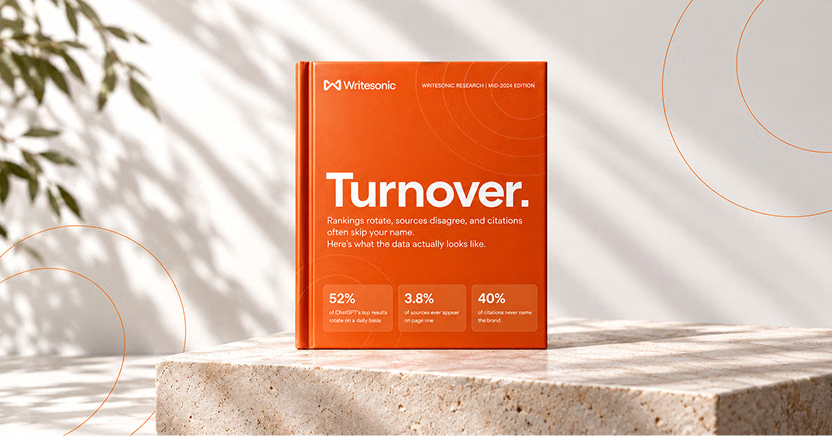
The #1 brand in ChatGPT changes 52% of the time.
Get the report and find out why.
The Net Effect: High Impressions, Low Clicks Every Time
All of these factors combine to explain the growing gap we’re seeing in our data at Writesonic (and likely in yours, too):
- More impressions because Google is referencing you in AI Overviews.
- Fewer clicks because users rarely make it past the AI box.
That’s why the old correlation between impressions and clicks has broken down.
What This Means for Marketers
Is this frustrating? Absolutely. But it’s not the end of the road for SEO or for content marketing. Here’s what we’re learning, and how we’re adapting at Writesonic.
1. Measuring What Matters: Rethink Your KPIs
Impressions alone no longer equate to interest. Clicks aren’t the only measure of impact. Are users seeing your brand cited in AI Overviews? Are you included as a trusted source? Brand visibility is becoming more important, even if it’s “zero-click.”
2. Optimize for Inclusion in AIOs
Just as we once optimized for featured snippets, it’s time to optimize for AIOs:
- Use concise, well-structured content.
- Answer questions directly in your content.
- Build topical authority so Google’s AI will choose you as a source.
Learn more about Google AI Overview Optimization.
3. Build Trust Beyond Google
Don’t put all your trust in Google’s evolving SERP. Grow your owned audiences: email subscribers, loyal blog readers, social communities. These channels are immune to the whims of search algorithms.
How Writesonic’s Generative Engine Tools Can Help?
At Writesonic, we’re not just observing these trends; we’re building tools to help brands adapt and win. With the Generative Engine Optimization Platform, you can:
- Track how often your brand appears in AI-generated results across Google, ChatGPT, and more.
- Analyze which pages are being cited or surfaced by AI, even if users never click through.
- Get clear recommendations to structure your content so it’s more likely to be featured in AI Overviews.
- Benchmark your AI visibility against your competitors, and adjust your strategy for maximum exposure.
In a world where searchers might never scroll past the AIO box, GEO makes sure your brand still gets noticed and trusted.
Why not give it a try and see the difference?
The Bottom Line
This “great decoupling” of impressions and clicks is unsettling, but it’s also a wake-up call. The goalposts have moved, but the game isn’t over.
As Google’s AI Overviews change the search landscape, the winners will be those who adapt:
- By understanding and leveraging the trust factor of AIOs
- By optimizing for inclusion, not just position
- By focusing on brand authority and multi-channel visibility
The future of SEO isn’t just about clicks, it’s about being seen and trusted, wherever Google (or its AI) puts you.
The #1 brand in ChatGPT changes 52% of the time.
Get the report and find out why.

Content Marketer
Pragati Gupta is a Content Marketer @Writesonic, specializing in AI, SEO, and strategic B2B writing. Leveraging the power of Generative AI, she produces high-impact content that drives superior ROI.