Last verified August 2026. This category ships weekly, so I re-check pricing and engine coverage on every update.
The best Profound alternatives are Writesonic for tracking plus execution, SE Ranking for AI visibility plus SEO, Peec AI for agencies with growing teams, and Ahrefs Brand Radar for large-scale research. AthenaHQ provides the most useful free sampler.
Best for agencies: Peec AI, because every paid plan includes unlimited seats.
Disclosure: I'm Samanyou Garg, founder and CEO of Writesonic, which I ranked first here. Pricing here reflects our July 2026 verification pass. Vendors in this category change plans often, so confirm current terms before you buy.
Key takeaways
- The real difference is execution. Profound has moved beyond reporting with Projects and Aim. The decision now comes down to how mature each action system is, how much work it can complete, and what happens after it finds a gap.
- Writesonic ranks first because its autonomous marketing agents combine AI visibility and SEO data, then carry work through content, outreach, technical fixes, approval, and measurement. Its limitation is a steeper first week than a focused tracker.
- Profound remains a strong choice. It has the category's best-known analytics product, broad enterprise coverage, a polished interface, and substantial customer evidence. It also ships fast.
- Self-serve engine coverage can hide the real bill. Profound Starter tracks ChatGPT. Growth adds Perplexity and Google AI Overviews. Shopping and broader engine access require Enterprise.
- Seat economics matter for agencies. Peec AI and SE Ranking both include unlimited users, while Profound Growth includes three seats. If Peec is the tool you're weighing instead, see the Peec AI alternatives comparison. For the whole category scored on one rubric, see AI visibility tools compared.
- Third-party coverage deserves its own workflow. A May 2026 Muck Rack study attributed 84% of all AI citations to earned media. Muck Rack cofounder and CEO Greg Galant said, "For communications teams, that is validation that the work they do to earn coverage in the right outlets has real consequences beyond traditional metrics."
Profound alternatives at a glance
| Rank | Tool | Best for | Entry price | Engines tracked | Main limitation |
|---|---|---|---|---|---|
| 1 | Writesonic | Teams that want tracking and execution together | $99 monthly for tracking | ChatGPT, AI Overviews, Gemini on self-serve; more on higher plans | Monthly action allowance depends on the plan |
| 2 | SE Ranking | AI visibility plus a full SEO platform | $129 monthly | ChatGPT, Gemini, AI Overviews, AI Mode, Perplexity | Weekly refresh and CSV-only exports |
| 3 | Brandlight | Enterprise multi-brand and paid-placement analysis | Custom pricing | ChatGPT, Gemini, Perplexity, Microsoft Copilot, Grok | Sales-led with no self-serve entry point |
| 4 | Conductor | Enterprise SEO governance | Custom pricing | Broad set of answer engines | AI visibility starts on Growth |
| 5 | HubSpot AEO | CRM-grounded AI visibility | $50 monthly | ChatGPT, Gemini, Perplexity | Deeper execution depends on other Marketing Hub tools |
| 6 | Peec AI | Affordable tracking for smaller teams | $95 monthly | Three selected models on self-serve; more available | Extra engines can increase the bill |
| 7 | Ahrefs Brand Radar | One-off market research, not daily monitoring | $199 monthly per AI index | AI Overviews, AI Mode, ChatGPT, Perplexity, Gemini, Copilot | Several indexes become expensive |
| 8 | AthenaHQ | Testing several engines before buying | Free credit sampler | Several engines sampled from the free allocation | Paid access jumps to $295 monthly |
| 9 | Scrunch AI | Sitecore and enterprise DXP teams | $250 monthly | Major answer engines | AXP has limited availability |
| 10 | Searchable | European small and mid-sized teams | $125 monthly | Major answer engines | Engine coverage varies by plan |
| 11 | Semrush AI Visibility Toolkit | Existing Semrush or Adobe customers | $99 monthly, billed annually | Varies by plan and domain count | Shopping requires an enterprise product |
Why teams look for a Profound alternative
Profound is the reference point for this category. It deserves that position.
The company has shipped a lot in a short period. Projects arrived on June 26, 2026, followed by Aim on July 2. Projects converts findings into ranked work. Aim runs in the background, turns signals into tasks, and measures movement. That's a genuine closed loop.
Ads Studio followed in July as an invite-only, ChatGPT-focused beta. Shopping analysis now reaches individual products and merchants. Profound is clearly building past the dashboard.
Teams still compare alternatives for four practical reasons.
The action system is new
Projects and Aim have existed for weeks, rather than years. They may become excellent. Today, buyers have less public evidence about how the loop performs across long-running programs, larger teams, and repeated approval cycles.
That's a maturity question.
Profound already has stronger analytics evidence than most competitors. It also has financial backing. Fortune reported in February 2026 that Profound raised a $96 million Series C at a $1 billion valuation, bringing total funding to $155 million.
Funding proves that serious investors believe in the category and the company. It doesn't tell a marketing team how much work will get completed next month.
Agent credits cap every self-serve plan
Profound Starter is listed at $99 per month billed annually and includes 100 agent credits. Growth is listed at $399 per month billed annually and includes 400 credits.
Those limits matter because agent work is the part buyers increasingly care about. A report can run every week without changing a page, earning a citation, or resolving a crawler problem. Each executed action has a cost in credits.
Before buying, ask Profound to map a representative month of work to its credit model. Use your own backlog. A generic product demonstration won't show whether the allowance fits your program.
Engine coverage is tiered
Starter includes ChatGPT, 50 tracked prompts, and one seat. Growth includes ChatGPT, Perplexity, and Google AI Overviews, with 100 prompts and three seats.
Enterprise expands coverage to as many as nine engines and adds Shopping, SSO, SAML, and SOC 2 support.
This structure can work well for a focused program. It becomes restrictive when a self-serve team needs Gemini, shopping results, broader model coverage, or enterprise controls without entering a custom sales process.
Off-site execution remains the harder problem
A brand can edit its own website whenever it wants. It can't directly edit the publisher pages, comparison articles, Reddit discussions, and earned-media coverage that answer engines cite.
That's why outreach depth matters. Ask each vendor to walk you through five things:
- Which third-party page to target
- Who the right author or editor is
- How it prepares contact-specific outreach
- Where the response gets recorded
- How it measures the citation change afterward
Profound has citation analysis, Agents, Sheets, Projects, and Aim. I haven't found public evidence showing author-contact citation outreach, deep user-generated-content targeting, or automatic site-audit fixes at the same level of detail. Given their release pace, that could change by the time you read this.
Profound doesn't publish trial terms
Profound doesn't publish trial terms. That's different from having no trial.
Ask what data you can import, how many prompts you can test, which engines are included, whether agent credits are available, and whether you can export results before the evaluation ends. Those details determine whether a trial can answer the buying question.
How I evaluated these Profound alternatives
I compared the products against the job a buyer hires them to do. The methodology uses six criteria.
- Execution depth. I looked at how far each product carries a finding through prioritization, production, approval, delivery, and later measurement.
- Engine coverage. I checked the engines available on the entry plan and separated self-serve access from enterprise access. A long engine list means little when the engines a team needs sit behind a custom contract.
- Search and AI in one place. AI engines build answers from pages that still have to be found, crawled, and trusted. I gave more credit to products that keep answer data next to rankings, keywords, backlinks, and content. Splitting that across two platforms costs you an integration and a second bill.
- Data usefulness. Large indexes help with discovery. Tracked prompts help with repeated measurement. Those are different jobs. I scored them separately and skipped the biggest-number contest.
- Customer evidence. Named outcomes, a substantial independent review base, and long-running deployments count more than a logo page. Small review samples are shown with their counts.
- Real cost. I compared prompt allowances, engines, seats, domains, refresh frequency, agent credits, and required add-ons alongside the advertised price.
The ranking favors products that finish more of the work. Where two products stop at reporting, I put the one that also covers the search side first, because that removes a second subscription rather than adding one. A team that already has analysts, writers, PR support, and developers has a fair case for weighting reporting depth higher.
1. Writesonic: best for execution depth, tracking from $99 per month
The product tracks ChatGPT, Google AI Overviews, and Gemini across all three self-serve plans. It combines that visibility data with SEO data, then uses autonomous marketing agents to act on the findings.
That execution layer is the reason I ranked my company first. The agents can prepare or update content, pursue third-party mentions, address technical issues with approval, and measure what changed.
Best for: Marketing teams and agencies that need a detected visibility gap turned into completed content, outreach, or technical work.
Key features:
- Tracks ChatGPT, Google AI Overviews, and Gemini across all three self-serve plans
- Combines AI visibility data with SEO data
- Prepares and updates content through autonomous marketing agents
- Pursues third-party mentions through an outreach agent
- Addresses technical issues with approval and measures what changed
Pricing:
- Starter costs $99 monthly or $79 per month annually and includes 50 prompts.
- Basic costs $249 monthly or $199 per month annually with 100 prompts.
- Growth costs $499 monthly or $399 per month annually with 200 prompts.
- Enterprise pricing is custom.
- You can evaluate the product for seven days without entering a card.
Rating: In July 2026, Writesonic had a 4.7 out of 5 G2 rating from about 2,214 reviews.
Pros:
- Playbooks store repeatable workflows, Grids support bulk analysis, and tasks coordinate work and approvals.
- AI ad visibility and shopping results sit in the same system.
- Neil Patel Digital moved its AI visibility work off Profound and onto Writesonic, while Maestra went from 0% to 31% AI visibility and closed a $350K enterprise deal.
Cons:
- The $99 entry price buys the tracking layer.
- Your plan determines how many actions you can run each month.
- A system this wide takes longer to learn than a focused dashboard.
Choose it when: You've already found the gaps. You can't get through them.
2. SE Ranking: best for combining AI visibility with SEO and content, from $129 per month
SE Ranking sells the search half too. Its AI Search Toolkit runs inside a full SEO platform, so answer-engine data arrives next to rank tracking, keyword research, backlink analysis, and competitive research in the same account.
That matters when a prompt moves the wrong way and you want to know why. You can see a competitor winning citations in an AI answer, then open the pages behind it, the keywords those pages rank for, and the links pointing at them.
The toolkit has two halves. AI Results Tracker measures mentions and links for prompts in your projects. AI Competitor Research analyzes any domain's AI presence without an active project, and adds a competitive gap analysis that names the engines and topics where rivals appear and you don't.
It has an Insights feature that provides recommendations on where to focus your efforts but I find it a bit limited. That's why it sits second rather than first.
Best for: Teams that want AI visibility and traditional SEO in one platform rather than two subscriptions with a spreadsheet between them.
Key features:
- Tracks mentions and links across ChatGPT, Gemini, AI Overviews, AI Mode, and Perplexity in all plans
- Stores cached answers so you can read the context a mention appeared in
- Suggests prompts and keywords worth tracking
- Runs competitive gap analysis across engines, topics, and prompts, with an AI Presence metric split into brand and domain presence
- Tracks which URLs are cited alongside your brand and how much citation overlap you share with competitors
- Carries the wider SE Ranking suite: rank tracking, keyword research, backlink analysis, and GA4 integration
- Offers an AI Search API for pulling visibility data into external systems and MCP for connecting with AI assistants
Pricing:
- Core costs $129 per month and includes 100 daily AI prompts and five Competitive Research domains.
- Growth costs $279 per month and includes 250 daily prompts and 15 domains.
- Enterprise pricing is custom.
- The AI Search add-on starts at $89 per month, expands prompt limits, removes the competitive research domain cap, and opens SE Visible.
- A 14-day free trial is available, with no credit card required.
Rating: G2 listed SE Ranking at 4.7 out of 5 across about 1,595 reviews in Augist 2026. That rating covers the parent SEO platform, which is much older than the AI visibility product.
Pros:
- AI visibility and the SEO work behind it live in one account, which removes an integration most teams otherwise have to build.
- API and MCP access come with every plan, which most AI-visibility tools charge separately for.
- The entry plan covers five named answer engines instead of holding them behind an enterprise contract.
Cons:
- There's no automated hallucination or accuracy detection. A wrong AI answer about your brand is something you find by reading cached responses.
- AI, organic, and GA4 data sit in one account, but SE Ranking doesn't automate the correlation between them. The datasets are there; joining them is still a person's job.
- It reports and researches. Outreach and technical fixes stay with your team.
Choose it when: You want one platform for AI visibility and SEO to track both channels in a connected way.
3. Brandlight: best for enterprise multi-brand AI visibility, with custom pricing
Brandlight serves large marketing organizations managing multiple brands and regions. It tracks organic visibility and paid placements inside AI answers, then brings the results into a portfolio-level view.
The platform also covers content work, technical health, and publisher influence. PR Newswire reported in February 2026 that Brandlight raised a $30 million Series A led by Pelion Venture Partners, with Cardumen Capital and G20 Ventures participating.
Best for: Enterprise marketing teams running multi-brand, multi-region portfolios with procurement and security review.
Key features:
- Tracks mentions, sentiment, citation sources, and query intent
- Supports content optimization and generation
- Checks AI crawler access, blocked domains, and server logs
- Maps publisher and partnership influence
- Analyzes paid AI placements and provides a multi-brand portfolio view
Pricing:
- Brandlight uses custom, sales-led pricing.
- There is no self-serve entry point.
Pros:
- Paid-placement analysis sits beside organic mention and citation tracking.
- The portfolio view addresses multi-brand and multi-region reporting.
- SOC 2 Type II supports enterprise security review.
Cons:
- The sales-led buying process puts it outside the practical range of smaller teams.
- It has no self-serve tier.
- Founded in October 2024, it's the youngest product in this comparison.
Choose it when: You manage several brands or regions and need paid AI placements included in the same enterprise visibility program.
4. Conductor: best for enterprise SEO governance, with custom pricing
Conductor places AI visibility inside an established enterprise SEO and reporting system. Large organizations can connect prompt groups and answer data with technical monitoring and content planning.
Its crawler reporting separates model-training traffic, live-search bots, and fetches initiated by users. GlobeNewswire reported in November 2021 that Conductor raised $150 million from Bregal Sagemount.
Best for: Teams replacing Profound inside a large SEO organization that must preserve established procurement, permissions, governance, and reporting.
Key features:
- Gives the replacement program coverage across a broad range of answer engines
- Lets teams organize prompts and retrieve responses through APIs
- Breaks crawler traffic into model-training, live-search, and user-triggered categories
- Flags technical SEO problems for the migration backlog
- Feeds answer-engine findings into content planning
Pricing:
- Purchasing Conductor requires a custom enterprise quote.
- You can evaluate it for three weeks without entering a card, then move into a sales-led purchase.
Pros:
- A team can move AI visibility into an enterprise SEO system with an established operating model.
- Separate reporting for model-training, live-search, and user-triggered crawlers shows which kind of automated traffic the team is dealing with.
- Its permissions and reporting model accommodates large organizations.
Cons:
- The Essentials tier carries zero AI Search credits, so buyers need Growth before AI visibility becomes available.
- It can identify technical problems, but Conductor doesn't say it will implement every fix.
- A Profound team that uses shopping or paid-placement reporting won't find dedicated analytics for either here.
Choose it when: The cost of changing enterprise SEO governance outweighs the value of self-serve pricing or a separate execution system.
5. HubSpot AEO: best for CRM-grounded AI visibility, from $50 per month
HubSpot AEO uses CRM, campaign, and deal context already stored in HubSpot to inform prompt discovery and recommendations.
A standalone beta measures ChatGPT, Gemini, and Perplexity. Teams on Marketing Hub Professional or Enterprise can add CRM context and pass recommendations into HubSpot's content and social tools. In a February 2026 investor filing, HubSpot reported $3.13 billion in fiscal 2025 revenue and 288,706 customers at year-end across its wider business.
Best for: Profound customers already centered on HubSpot who want an inexpensive three-engine visibility layer tied to CRM and campaign records.
Key features:
- Builds prompt ideas from context held in HubSpot
- Tracks appearances by the brand and its competitors
- Ranks recommended next steps
- Brings CRM and campaign information into qualifying subscriptions
- Passes recommendations into HubSpot's content tools
Pricing:
- Standalone AEO is priced at $50 per month or $45 per month with annual billing.
- Buyers on Marketing Hub Professional or Enterprise already receive AEO in their package.
- The current no-card evaluation provides 25 free prompts across the three supported engines.
Pros:
- A migration can begin with the prompt context the team has already accumulated in HubSpot.
- Marketing Hub teams can send recommendations into the content and social tools already in their HubSpot setup.
- Buyers can test 25 prompts across all three engines before procurement without providing a card.
Cons:
- The replacement monitors only ChatGPT, Gemini, and Perplexity.
- Switching to it leaves out Google AI Overviews, Google AI Mode, Claude, and Copilot.
- Carrying recommendations into deeper execution requires other Marketing Hub tools.
Choose it when: Most campaign and CRM context already sits in HubSpot, and losing coverage beyond its three supported engines won't hurt the program.
6. Peec AI: best for affordable tracking for smaller teams, from $95 per month
Peec AI is a tracking-focused product, and it does that job well at a low price. It tracks major answer engines on daily or weekly schedules and reports mentions, citations, and competitor movement without much setup.
Unlimited seats on every paid plan is the other reason smaller teams like it. Strategists, analysts, and client stakeholders can all get access without the per-seat maths that makes other tools expensive. It fits teams early in their AI visibility work more than teams running a full execution program.
Best for: Smaller teams and agencies starting AI visibility work who want solid tracking at a low price with seats included.
Key features:
- Tracks major answer engines on daily or weekly schedules
- Supports multiple projects
- Provides shopping analysis and reporting connections
- Offers an API on qualifying plans
- Identifies page, editorial, source, and user-generated-content opportunities through Actions
Pricing:
- Starter costs $95 per month and includes unlimited users.
- Pro costs $245 per month and includes unlimited users.
- Advanced costs $495 per month and includes unlimited users.
- Enterprise pricing is custom.
- A seven-day trial is available, although current card requirements aren't stated.
Rating: G2 showed Peec AI at 4.9 out of 5 across 12 reviews in July 2026.
Pros:
- Seat count won't force a tier change because every paid plan comes with unlimited seats.
- Daily or weekly tracking gives teams a choice of reporting schedule.
- TechCrunch reported in November 2025 that Peec AI raised a $21 million Series A.
Cons:
- Self-serve plans include three selected models, and another model costs extra.
- Actions identify and prioritize work, but the team still owns final execution.
- The G2 rating comes from a thin sample of 12 reviews.
Choose it when: Your client and user count grows faster than your prompt count.
7. Ahrefs Brand Radar: best for one-off market research, from $199 per month
Brand Radar's strength is its prebuilt indexes. A team can research brands, domains, citations, topics, and competitors across large collections of AI answers and Google surfaces without defining every prompt first.
Treat it as an exploration tool rather than a monitoring one. Brand Radar reads like an extension of Ahrefs' keyword explorer pointed at AI answers, which makes it strong for a market-mapping exercise and weak as the thing you open every morning. It won't run your day-to-day program, and it won't act on what it finds.
Best for: Existing Ahrefs customers running a one-off market-mapping exercise, alongside a separate tool for daily monitoring and action.
Key features:
- Researches brands, domains, citations, topics, and competitors through prebuilt indexes
- Searches large collections of AI answers and Google surfaces
- Reveals recurring publishers and competitor appearances
- Identifies topics for smaller daily tracking programs
- Connects research to search, web, Reddit, YouTube, and TikTok data
Pricing:
- A single AI index begins at $199 per month.
- Full index coverage raises the monthly package price to $699.
- Teams adding custom prompts can buy packages starting at $50 per month.
Rating: In July 2026, Ahrefs held a 4.5 out of 5 G2 rating across about 710 reviews.
Pros:
- Prebuilt indexes let teams research a market before defining every prompt.
- Ahrefs connects the work to familiar search and web data.
- Crunchbase describes Ahrefs as bootstrapped, which helps explain its product-led buying model and long focus on search data.
Cons:
- Core chatbot indexes refresh monthly.
- Estimated impressions use Google search demand as a proxy instead of measured AI query volume.
- The price climbs when a team combines several indexes, custom prompts, and the wider Ahrefs suite.
Choose it when: You need to understand the market before committing to a fixed prompt set.
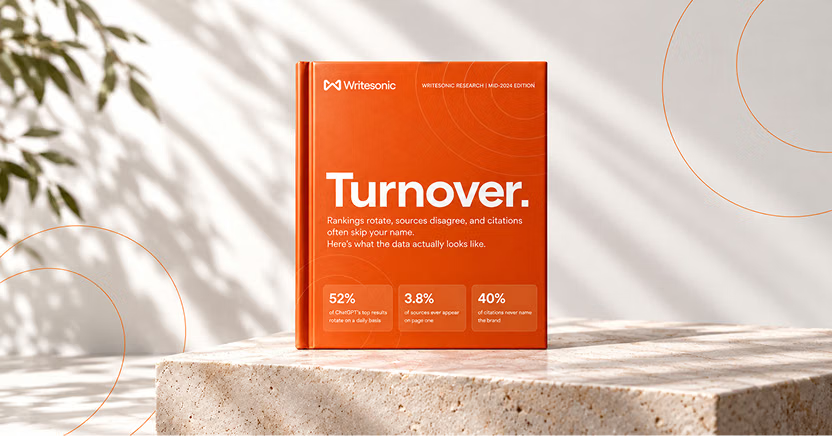
The #1 brand in ChatGPT changes 52% of the time.
Get the report and find out why.
8. AthenaHQ: best free sampler, then $295 per month
AthenaHQ's Essential allocation provides 300 free credits. It's the most useful free sampler here. Most free tiers hand you one static score. This one lets you inspect several engines.
The paid product goes further. It supports citation analysis, crawler-access work, content tasks, on-page changes, off-page actions, and publishing connections such as Shopify.
Best for: Teams that want to test several engines and an action workflow before committing budget.
Key features:
- Uses the Essential allocation to sample several engines
- Provides citation analysis
- Supports crawler-access work and content tasks
- Handles on-page changes and off-page actions
- Connects to publishing systems such as Shopify
Pricing:
- Essential includes 300 free credits.
- Starter costs $295 per month.
- Enterprise pricing is custom.
- API access and additional credits may increase the total.
Rating: G2 showed AthenaHQ at 4.9 out of 5 across 34 reviews in July 2026.
Pros:
- The free allocation supports a more useful evaluation than a single static score.
- Moving to a paid AthenaHQ plan adds workflows for taking action as well as analyzing results.
- FinSMEs reported in June 2025 that AthenaHQ raised $2.2 million in seed funding from Y Combinator and other investors.
Cons:
- Nothing sits between the free allocation and the $295 Starter plan.
- Ecommerce support doesn't reach the SKU, merchant-share, or paid-placement detail offered by dedicated shopping products.
- API access and additional credits may increase the total.
Choose it when: You need a meaningful evaluation before procurement and can tolerate the jump to the paid plan.
9. Scrunch AI: best for agent-readiness infrastructure, from $250 per month
Scrunch AI approaches the problem at the delivery layer. Its Agent Experience Platform, or AXP, can present approved site content in a format designed for automated agents.
That's a different form of execution. A marketing action tool changes content, citations, or technical settings. Scrunch also addresses the infrastructure through which automated systems receive the content.
Best for: Sitecore customers and enterprise DXP teams responsible for how approved content reaches automated agents.
Key features:
- Presents approved site content to automated agents through AXP
- Provides answer monitoring
- Analyzes citations and manages prompts
- Reports automated-agent traffic
- Produces content recommendations
Pricing:
- Core costs $250 per month and covers 125 prompts.
- Enterprise pricing is custom.
- You can take the seven-day trial without providing a card.
Pros:
- AXP addresses the infrastructure through which automated systems receive content.
- Sitecore acquired the company in 2026, and The acquisition announcement said Scrunch served more than 500 brands and agencies.
- Bloomberg reported that the transaction was worth about $225 million, although neither company confirmed that figure publicly.
Cons:
- AXP remains in limited availability.
- It can require more technical involvement than a conventional marketing dashboard.
- Its value depends on whether agent-facing delivery is a real infrastructure priority for your company.
Choose it when: Your problem sits inside the DXP and delivery stack, especially if Sitecore already runs that stack.
10. Searchable: best for European teams, from $125 per month
Searchable has built most of its traction in Europe, and small and mid-sized European teams make up a large share of its base. Its founding team is unusually visible on LinkedIn, which is how a lot of buyers in that market first come across it.
On product, it reports on individual products, prices, ratings, merchants, categories, and how often each appears.
That detail helps a retail team separate three different problems: the brand doesn't appear, the right product doesn't appear, or another merchant wins the placement.
Best for: Profound switchers at small and mid-sized European companies that need self-serve reporting on products and merchants.
Key features:
- Analyzes individual products, prices, ratings, and merchants
- Reports categories, platforms, and appearance frequency
- Shows which sellers surface in product carousels through merchant-share reporting
- Supports prompt research, planning, and content briefs
- Provides schema recommendations, technical task assignment, and early paid-placement tracking
Pricing:
- Pro costs $125 per month.
- Scale costs $400 per month.
- Enterprise costs $999 per month.
- Further controls use custom pricing.
- You can test the product for 14 days without entering a card.
Pros:
- Product Gallery provides product-level and merchant-level reporting.
- Merchant-share reporting distinguishes brand, product, and seller-placement problems.
- PR Newswire reported in May 2026 that the company secured $14 million in a round led by Headline at an $85 million valuation.
Cons:
- Its pricing FAQ and comparison table conflict on engine availability.
- Engine coverage varies by plan.
- Public materials don't show direct author outreach, Reddit execution, or automatic CMS publishing.
Choose it when: Product-level shopping data matters more than a broad organic marketing system.
11. Semrush AI Visibility Toolkit: best for existing Semrush and Adobe teams, from $99 per month
The toolkit reports brand mentions, cited sources, topics, sentiment, competitors, and estimated AI traffic. Custom prompt tracking adds repeated position measurement, although it covers fewer answer surfaces than the broader mention reports.
Its main advantage is context. Existing Semrush users can view AI visibility beside keyword, competitor, content, and site data.
Best for: Organizations that already rely on Semrush for search work or Adobe for enterprise content delivery.
Key features:
- Reports brand mentions, cited sources, topics, and sentiment
- Tracks competitors and estimated AI traffic
- Adds repeated position measurement through custom prompt tracking
- Displays AI visibility beside keyword, competitor, content, and site data
- Connects eligible Adobe customers through Adobe Brand Visibility and Adobe Experience Manager
Pricing:
- The entry toolkit costs $99 per month for one domain and 25 daily tracked prompts, billed annually.
- Extra domains cost $99 per month.
- An additional 50 prompts costs about $60 per month.
- A switch that requires Semrush One Advanced brings the price to $549 per month.
Pros:
- A team already using Semrush can add AI visibility without separating it from the rest of its search data.
- Its 2025 SEC filing reported fiscal 2024 revenue of $376.8 million, annual recurring revenue of $411.6 million, and annual revenue growth of 22%.
- Adobe agreed to acquire Semrush for about $1.9 billion, or $12 per share, according to CNBC's November 2025 report.
Cons:
- Broad self-serve mention reporting spans more surfaces than the narrower custom position tracker.
- AI Shopping requires Enterprise AIO, and paid AI-placement tracking isn't available.
- Teams may need several Semrush products to connect reporting with execution.
Choose it when: Keeping work inside your current search or Adobe system matters more than buying the strongest standalone product.
What I'd actually do
Nobody leaves Profound because the analytics are bad. Teams leave when those analytics keep returning at renewal as a cost center and nobody can point to the work they changed.
I wouldn't ask, "Is this dashboard good?" Profound's dashboard is good. I'd ask, "What did we change because of it last quarter, and could we have made those changes without this contract?" Then I'd pull the completed Projects, content updates, outreach attempts, technical fixes, and resulting citation movement. If the answer is a short list assembled the week before renewal, I'd switch.
For most teams in that position, I'd pick Writesonic. I want the visibility data and the work that follows it in one operating system. For an enterprise SEO department with established permissions, regional reporting, and technical governance, I'd pick Conductor instead. If every campaign and deal already runs through HubSpot, its AEO product offers a sensible, cheaper path. A company managing several brands, countries, and paid AI placements should put Brandlight on the shortlist.
I'd tell a team to stay on Profound when its analysts already feed Projects and Aim into a reliable delivery process, executives use the reporting, and the broader engine or Shopping coverage matters. I'd also stay if a migration would save subscription money while breaking a measurement baseline the board trusts.
Renewal should follow evidence from the previous quarter. Count the decisions, shipped changes, and measured outcomes that began in Profound. If the contract clearly caused them, renew it. If the same work started in Slack, spreadsheets, and agency calls, the dashboard has become an expensive observer.
How Profound itself compares
A fair comparison needs to state what Profound already does well.
Its analytics cover prompt research, citations, competitors, sentiment, answer details, and automated-agent traffic. Higher plans add wider engine support and detailed Shopping analysis. The interface is polished, and the company has made complex answer data easier for executive teams to consume.
Best for: Teams that value established analytics, executive reporting, and rapid product development.
Key features:
- Researches prompts, citations, competitors, sentiment, and answer details
- Reports automated-agent traffic
- Uses Agents and Sheets to investigate opportunities
- Turns findings into managed work with Projects
- Adds ongoing prioritization and measurement through Aim
Pricing:
- Starter costs $99 per month, tracks 50 prompts on ChatGPT, includes one seat, and provides 100 agent credits.
- Growth is listed at $399 per month billed annually, tracks 100 prompts across ChatGPT, Perplexity, and Google AI Overviews, includes three seats, and provides 400 agent credits.
- Agency Growth is listed at $399 per month billed annually for each client workspace.
- Enterprise uses custom pricing and can include broader engine coverage, Shopping, SSO, SAML, and SOC 2.
- Public trial terms aren't available.
Pros:
- Covers analytics, managed work, prioritization, and measurement
- Provides wider engine support and detailed Shopping analysis on higher plans
- Offers a polished interface that makes complex answer data easier for executive teams to consume
Cons:
- Projects and Aim have existed for weeks, rather than years.
- Agent credits cap every self-serve plan.
- Shopping and broader engine coverage require Enterprise.
Choose it when: Established analytics and executive reporting matter more than the narrower advantages offered by the alternatives below.
Published starting prices and seat constraints for a 10-person team
These are minimum published plan prices, not actual ten-person totals, unless unlimited seats are explicitly noted. Seat caps, quotes, workspaces, annual billing, and add-ons all move the final number.
The cleanest comparison is to separate a known bill from a buying constraint.
| Tool | Plan used for comparison | Known 10-person starting cost | Important condition |
|---|---|---|---|
| Writesonic | Basic | $249 base plus extra seats | Additional Basic and Growth seats cost $50 per user |
| Brandlight | Enterprise | Custom quote | Sales-led with no self-serve entry point |
| Conductor | Growth or above | Custom quote | AI visibility starts on Growth |
| HubSpot AEO | Standalone AEO | $50 monthly | Included with Marketing Hub Professional and Enterprise |
| Peec AI | Starter | $95 monthly | Unlimited seats included |
| SE Ranking | Basic | $99 monthly | Unlimited seats included |
| Profound | Growth | At least $399 monthly | Three seats included; seven more require a quote |
| Ahrefs Brand Radar | One AI index | At least $199 monthly | Wider index coverage and Ahrefs access can add cost |
| AthenaHQ | Starter | At least $295 monthly | Credit usage and API access can add cost |
| Scrunch AI | Core | $250 monthly | Confirm enterprise user and AXP access terms |
| Searchable | Pro | At least $125 monthly | Confirm seat allowance and required shopping capacity |
| Semrush AI Visibility Toolkit | Entry toolkit | At least $99 monthly | One domain and annual billing at entry |
Peec AI has the cleanest 10-person self-serve bill: $95 per month. SE Ranking is next at $99, also with unlimited users.
Profound Growth begins at $399 for three seats. A buyer needs a quote for the remaining seven users, and that same plan provides 100 tracked prompts and 400 agent credits. An agency managing separate clients should also account for the $399 monthly cost of each Agency Growth workspace.
For my own product, the base plan and seat additions should be calculated together. If several people only need reports, don't buy everyone a full working seat. Ask which access level each person needs.
The same rule applies across the list. A ten-person company rarely has ten daily operators. Count analysts, approvers, report viewers, external clients, and administrators separately. Then ask the vendor which roles consume paid seats.
Is there a free Profound alternative?
Not a permanent one, and you should be skeptical of anything advertised that way.
What exists is sampling. AthenaHQ gives you a free credit allocation you can spend across several engines, which is the most useful way to see real answers about your brand before paying. Most other products run a time-boxed trial instead, so you get full features for a week or two and then choose.
Free checkers are a different thing. Several vendors publish a one-off "check your AI visibility" tool that returns a single score. Those are useful for a first look and useless for tracking, because one score on one day tells you nothing about movement. AI answers vary by model, region, and rerun.
How to switch from Profound without losing your baseline
A migration should preserve the old measurement long enough to explain any change. Switching prompts, engines, locations, and tools on the same day creates noise that no dashboard can untangle.
1. Export the current operating set
Save the prompts, prompt groups, competitors, cited domains, historical reports, engine settings, markets, and any open Projects.
Also export a list of completed actions. That prevents the new system from recommending work your team already finished.
2. Mark the prompts that affect revenue
Most accounts contain a mix of commercial prompts, category research, executive curiosities, and low-value variants.
Tag the prompts tied to product discovery, vendor comparison, purchase intent, and objections. Move those first. Broad research prompts can follow after the new baseline is stable.
3. Match the measurement settings
Use the same engines, locations, language, prompt wording, and schedule in both products. Keep these settings stable during the overlap period.
Exact answer matching is unrealistic because generated responses vary. The goal is to compare direction across a consistent prompt set.
4. Run both systems in parallel
Keep Profound and the alternative active for at least one normal reporting cycle. Compare source answers, citations, brand mentions, competitors, and the date each system collected its result.
A difference isn't automatically an error. It may come from model versions, geography, account state, retrieval method, or collection time. Ask each vendor to explain the sampling method.
5. Test one real action workflow
Select one content gap, one citation opportunity, and one technical issue. Follow each through to completion.
Record:
- What the product found
- What it recommended
- What it produced itself
- Which approvals it required
- Where a person had to take over
- How it measured the finished work
- Which allowance, credit, or add-on it consumed
This test reveals more than a broad feature checklist.
6. Rebuild reports after validating the data
Move executive reports last. Stakeholders care about continuity, and an unexplained score change can damage confidence in the whole program.
Put the Profound baseline next to the replacement baseline for comparison. Document the engines, prompts, cadence, and sampling differences. Then set a clear date after which the new system becomes the reporting source.
7. Cancel after checking the archive
Confirm that exports open correctly, historical charts are saved, pending work has an owner, and finance knows the renewal date. If an agency workspace contains client data, store each client's export separately.
Also worth a look
I scored ten products in depth. Buyers in this category also shortlist Goodie, Cognizo, ZipTie.dev, Am I On AI, and Surfer's AI tracking. I haven't run them through the same six criteria, so I'm naming them rather than ranking them. If one of them fits a constraint the ten above don't, trial it alongside your shortlist and hold it to the same test: what does it do after it finds a gap.
Which alternative fits your team
Enterprise multi-brand marketing teams
Choose Brandlight when one procurement process needs to cover several brands or regions, and paid placements inside AI answers belong in the same analysis as organic mentions and citations.
Its sales-led model fits enterprise buyers. Smaller teams should choose a self-serve product instead.
Enterprise SEO organizations
Choose Conductor when AI visibility needs to sit inside an established SEO governance system with enterprise permissions, technical monitoring, and crawler-type analysis.
Its strongest case comes from organizational fit. Teams seeking self-serve pricing or dedicated shopping analytics should look elsewhere.
HubSpot customers
Choose HubSpot AEO when your CRM, campaign, and deal context already lives in HubSpot. Marketing Hub Professional and Enterprise customers can connect recommendations to the content and social tools they already use.
Three-engine coverage is the main constraint. Check that ChatGPT, Gemini, and Perplexity match the surfaces that matter to your buyers.
Teams paying for AI visibility and SEO separately
Choose SE Ranking when you're already buying a rank tracker and a separate AI visibility tool. The $99 Basic plan covers both, with unlimited users and five answer engines at entry.
Weekly refresh is the constraint. If someone checks answers daily, run a faster tracker alongside it.
Agencies with many users
Choose Peec AI when seat count is the main cost driver. The $95 Starter plan includes unlimited users, and the same seat policy continues across paid plans.
An agency should also price client workspaces, prompt allocations, white-label reporting, exports, and approval roles. Unlimited users won't help if every client requires an expensive separate workspace.
Teams that need execution capacity
Choose Writesonic when the team wants one system to find a gap and carry the work through content, outreach, or technical changes. This fits organizations whose backlog grows faster than their headcount.
Choose AthenaHQ when you want to sample an action workflow before paying. Its free credits make the initial evaluation easier, although the first paid plan costs $295 per month.
SEO teams doing one-off market research
Choose Ahrefs Brand Radar for a mapping exercise when you don't yet know which prompts, publishers, or competitors matter. Its indexes suit discovery. Pair it with something else for daily monitoring, because it reads as an extension of the keyword explorer and won't act on what it finds.
The economics work best for existing Ahrefs customers. A team combining several AI indexes should compare the full bundle cost with a dedicated tracker.
European small and mid-sized teams
Choose Searchable if you're buying in Europe and want self-serve product and merchant reporting. Most of its base sits in that market.
Profound is also strong for shopping analysis, but access sits on Enterprise. Peec AI and Writesonic include shopping visibility inside broader systems. Confirm whether you need SKU-level merchant detail or a wider brand view.
Sitecore and DXP organizations
Choose Scrunch AI when agent-facing content delivery is an infrastructure concern. Its position inside Sitecore makes it relevant to teams already running that stack.
A marketing team that mainly wants prompt tracking will probably find a conventional tracker easier to deploy.
Existing Semrush or Adobe customers
Choose Semrush AI Visibility Toolkit when avoiding another vendor matters. The toolkit connects AI reporting with a familiar search suite, and Adobe customers have a route into AEM-based workflows.
Check custom prompt coverage and Enterprise AIO pricing before assuming the entry toolkit covers shopping or every engine.
Smaller teams and anyone just getting started
Choose AthenaHQ when free evaluation matters more than the eventual paid price.
Frequently asked questions
What is the best Profound alternative?
Writesonic is my top pick when execution carries the most weight. It combines AI visibility and SEO data with autonomous content, outreach, and technical workflows. Peec AI is better for agencies prioritizing unlimited seats. Ahrefs Brand Radar is better for broad research across large prebuilt answer indexes.
Which Profound alternative is best for agencies?
Peec AI is the clearest agency choice because every paid plan includes unlimited seats. Starter costs $95 per month. Agencies should still compare client-workspace and prompt costs.
Does Profound have an execution layer?
Yes. Profound has Agents, Sheets, Projects, and Aim. Projects turns findings into ranked tasks, while Aim runs ongoing work and measures movement. These capabilities shipped in June and July 2026, so the fair concern is maturity and agent-credit capacity. The execution layer exists.
Does Profound offer a free trial?
Profound doesn't publish clear trial terms. That doesn't prove a trial is unavailable. Ask the sales team which engines, prompts, exports, and agent credits an evaluation includes. AthenaHQ offers a free credit sampler, while several alternatives publish fixed seven-day or fourteen-day trial terms.
How much does Profound cost?
Profound Starter is listed at $99 per month billed annually for ChatGPT, 50 prompts, one seat, and 100 agent credits. Growth costs $399 for three engines, 100 prompts, three seats, and 400 credits. Enterprise pricing is custom and can include broader engine coverage, Shopping, and SSO.
Which alternative has the broadest research data?
Ahrefs Brand Radar is the strongest choice for broad research. Its prebuilt indexes help teams examine brands, domains, topics, citations, and competitors before creating a tracked prompt set. The tradeoff is price: one AI index starts at $199 per month, while the complete bundle costs $699.
Which Profound alternative is best for ecommerce?
Searchable reports individual products, prices, merchants, ratings, and carousel appearances on a self-serve plan, and it's a common pick among European teams. Profound offers deep Shopping analysis on larger contracts. Writesonic and Peec AI cover shopping visibility inside broader systems, which is usually enough unless merchant-share detail is the main job.
Buy around the bottleneck
Profound is a serious product. It ships fast, has strong reporting, and now has a real action loop. A team with analysts and established delivery resources may prefer it over every alternative here.
The deciding factor is the bottleneck inside your team.
If work stalls after the report, evaluate execution. If stakeholder access drives cost, compare seats. If you haven't identified the market yet, buy research breadth. If products and merchants determine revenue, test shopping detail.
Keep the same prompts during each trial. Run one action to completion. Then buy the system that removes the delay you can already see.
The #1 brand in ChatGPT changes 52% of the time.
Get the report and find out why.

Founder @ Writesonic
Samanyou is the founder of Writesonic, a platform that helps you track & boost your brand’s visibility in AI search. Two years before the launch of ChatGPT, Writesonic was already at the forefront, helping organizations automate their entire marketing workflow through specialized AI agents for SEO and content. Samanyou is a Forbes 30 Under 30 awardee and a winner of the 2019 Global Undergraduate Awards, often referred to as the junior Nobel Prize.