When AI engines like Google’s AIOs, ChatGPT, or Perplexity generate answers, they don’t pull randomly from the web. They rely on trusted, authoritative sources like Wikipedia.
For brands, this creates both a challenge and an opportunity.
If your company is cited on Wikipedia, AI models are far more likely to recognize you, pull your information into answers, and reinforce your authority. If you’re absent or if your page is outdated, you risk being left out of the AI conversation entirely.
In this blog post, we’ll show how Wikipedia influences AI-generated answers, why it’s one of the most important reference points for LLMs, and how you can leverage Wikipedia to improve your brand’s ai visibility.
Key Takeaways
- Wikipedia is a top trust signal for AI Search, and LLMs cite it often.
- Don’t stop at one page; aim for category, comparison, and related topic mentions.
- Strong references = stronger visibility, so prioritize credible, diverse sources.
- Keep pages fresh and neutral; outdated or promotional edits hurt visibility.
- Track results with Writesonic and see when Wikipedia drives AI mentions and spot gaps.
Why Wikipedia Matters for AI Search
When large language models decide what to trust, they look for sources with authority, consistency, and structure.
Wikipedia fits all three, which is why it shows up again and again in AI-generated answers.
- Authority: With strict editorial guidelines and citations required, Wikipedia is considered one of the most trustworthy open sources online.
- Coverage: Nearly every industry, company, and product has some presence on Wikipedia, which means AI engines can easily pull it into summaries.
- Structure: Pages follow a standardized format, introductions, sections, and references that are easy for machines to parse.
Wikipedia ranks as one of the most-cited sources across Google AI Overviews, Perplexity, and ChatGPT. If your brand isn’t represented there, AI engines will default to whoever is, often your competitors.
How to Use Wikipedia to Boost AI Search Visibility
Wikipedia is one of the most frequently cited sources in AI-generated answers. If you want your brand to show up in Google’s AI Overviews, ChatGPT, or Perplexity, getting your Wikipedia presence helps a lot.
Here’s how to approach it:
1. Audit Your Existing Page (or Build One If Eligible)
If you already have a Wikipedia page, check: is the info accurate, up to date, and cited properly?
If you don’t, you’ll need independent coverage (press mentions, interviews, features) before you can qualify for a page.
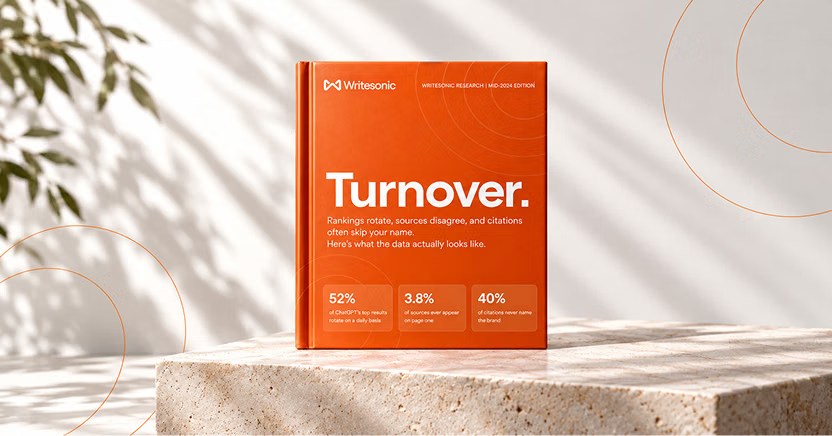
The #1 brand in ChatGPT changes 52% of the time.
Get the report and find out why.
Example: Writesonic’s Wikipedia entry is regularly updated with product launches and awards. AI engines pick this up as a trust signal.
Writesonic’s Wikipedia entry includes coverage from The Economic Times and Fintech Bloom. These references strengthen credibility and make it more likely for AI engines to pull from them.
2. Keep the Content Fresh
AI models prioritize recency when deciding which sources to cite. A page last updated in 2018 isn’t as valuable as one refreshed last month.
- Add new product launches, feature updates, funding rounds, or leadership changes; always supported by reliable references.
- Stale information weakens both Wikipedia’s usefulness and your visibility in AI Search.
Example: After updating a Wikipedia entry to reflect a new product launch, Writesonic tracked a visibility spike.
We’ve been observing an increase in the total number of AI answers citing Writesonic’s Wikipedia domain, indicating an overall improvement in AI visibility. Remember, outdated data = weaker visibility.
3. Strengthen References
Wikipedia content is only as strong as its citations. The better the references, the more AI engines trust your brand.
- Prioritize links from news outlets, tech journals, and analyst reports.
- Avoid blogs or self-published sources as they’re usually rejected by editors and ignored by AI.
- Ask: If ChatGPT were asked about my brand today, what third-party sources could it use to validate me? If the answer isn’t in your citations, update them.
Don’t treat references as an afterthought. Treat them as the real training data for AI. If Wikipedia is your brand’s summary, its references are the footnotes LLMs actually “read.”
In short, LLMs don’t just read Wikipedia; they read its sources. Better references = stronger Wikipedia credibility = higher chances of appearing in an AI search answer.
4. Build a “Wikipedia Cluster,” Not Just a Single Entry
Don’t just stop at creating a single company page. AI engines don’t just read one entry; they map relationships across multiple pages. So, focus on building a Wikipedia cluster as it increases your footprint and gives LLMs more entry points to pull from.
- Create related pages if you have enough coverage (e.g., a founder profile, tool or method pages, event or framework pages).
- Interlink those pages. For example, if you have a founder page and a product page, ensure they reference each other.
- Add meaningful sections to existing pages where it makes sense (e.g, “Integrations” on relevant technology pages).
You can also go with cross-link strategically, where you can interlink your brand, founder, and product pages with related Wikipedia articles (e.g., “natural language processing,” “AI in marketing”). This creates a semantic web that AI engines can easily parse.
Simply, the more connected and structured your cluster is, the stronger the signals for LLMs, and the higher your chance of showing up in AI-generated answers.
5. Track Your Impact with Writesonic
Editing Wikipedia is only half the battle. The real question is: Is it moving the needle in AI Search? That’s where Writesonic’s AI visibility tracker comes in.
With Writesonic, you can:
- See when Wikipedia is cited: Track how often Wikipedia pages (yours or industry-related) are pulled into AI answers across Google AI Overviews, Perplexity, and ChatGPT.
- Benchmark against competitors: Check if rival brands are being cited through Wikipedia while you’re missing, and spot exactly where.
- Identify citation gaps: Find queries where Wikipedia is influencing AI answers, but your brand isn’t mentioned. That tells you where to strengthen or expand your presence.
- Measure results over time: Monitor trends in your Visibility Score, Citation Rate, and Share of Voice to see if updates to your Wikipedia entry are translating into more AI visibility.
Simply, don’t just edit and hope. Track and prove the impact. With Writesonic, you know whether your Wikipedia presence is truly influencing AI-generated answers.
To see Writesonic in action, get in touch with our team.
Secure Your Spot in AI Search with Wikipedia + Writesonic
Wikipedia has become one of the clearest trust signals for AI search.
If your brand isn’t represented there with strong, neutral, and well-sourced content, you’re handing visibility to competitors.
With Writesonic, you can go one step further, tracking when and how Wikipedia shapes AI answers, spotting gaps, and proving the impact of every update.
The formula is simple: optimize Wikipedia, measure with Writesonic, and stay visible in the AI search era.
FAQs
The #1 brand in ChatGPT changes 52% of the time.
Get the report and find out why.

Content Marketer
Pragati Gupta is a Content Marketer @Writesonic, specializing in AI, SEO, and strategic B2B writing. Leveraging the power of Generative AI, she produces high-impact content that drives superior ROI.