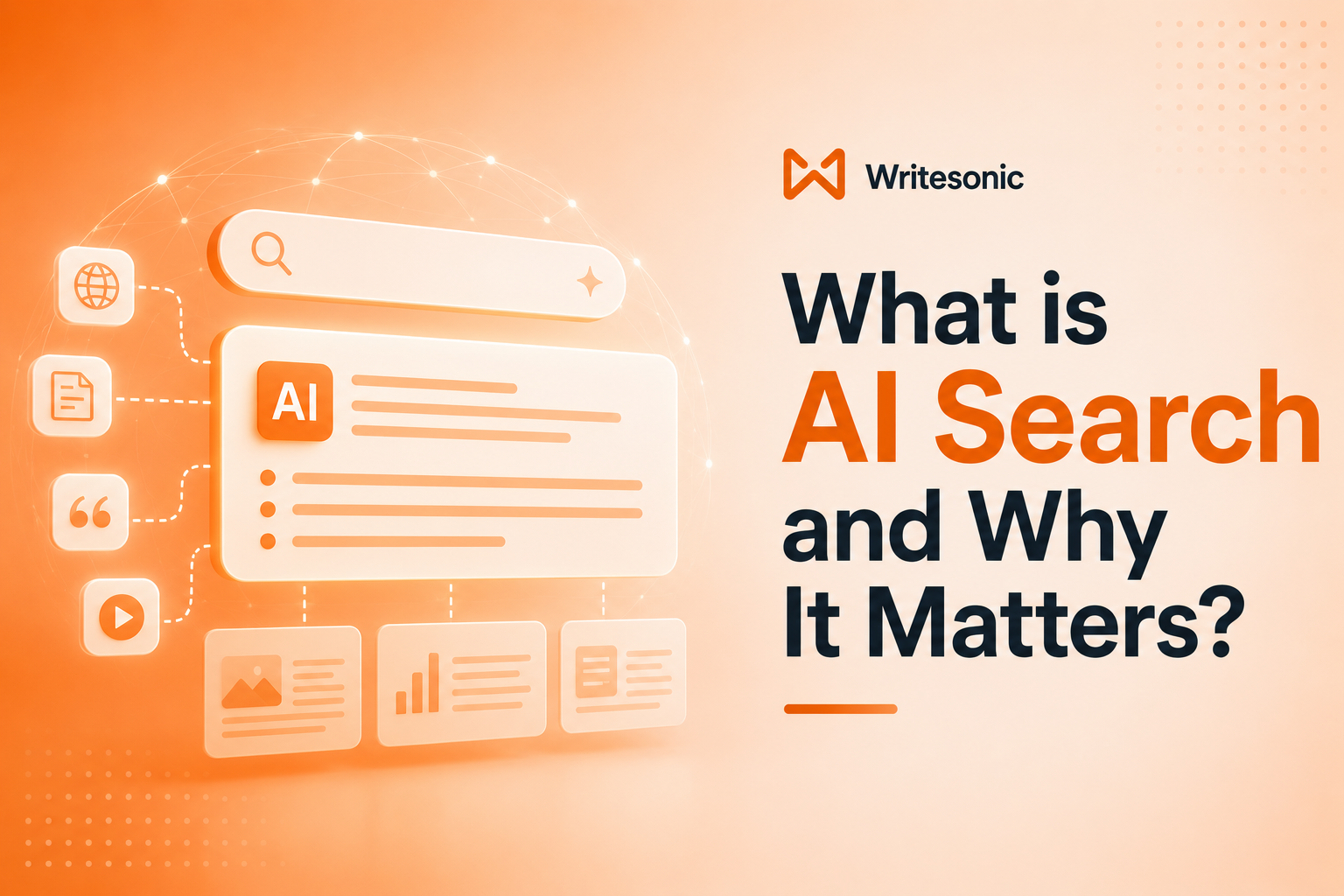
AI search is the next generation of search technology that uses artificial intelligence to understand questions, context, and intent. Then, instead of blue links, AI search delivers answers, summaries, and recommendations that feel more conversational and human.
In traditional search, asking “AI search monitoring tools” gives you dozens of links to sift through. In AI search, the engine summarizes options, compares features, and even tailors recommendations, all within the answer itself.
This is a big shift. Google’s AI Overviews, Perplexity, ChatGPT, and more are changing how users discover information and how businesses get found.
For users, it means faster, clearer answers. For businesses, it means visibility in AI results is now just as critical as ranking in traditional search.
In this post, I’ll walk you through what AI Search is, how it works, why it matters, and where it’s headed next. Plus, I’ll show you how Writesonic can help you ensure your content is discoverable, cited, and surfaced in AI-driven search experiences.
Key Takeaways
- AI search = smarter search. It uses AI to understand context and intent, delivering conversational answers instead of just links.
- It won’t kill traditional search, but it’s becoming the first layer of discovery, with links supporting AI summaries.
- Pros of AI search: faster, context-aware, personalized results. Cons of AI search: citation gaps, accuracy risks, and shifting competition.
- Businesses must adapt; visibility now means being cited in AI answers, not just ranking in SEO.
- Writesonic helps track your AI visibility, monitor competitors, and find opportunities to stay discoverable.
- The faster you prepare for AI search, the stronger your brand’s presence will be in the AI-first search era.
What is AI Search?
AI search is a search technology powered by artificial intelligence that understands language, context, and intent to deliver direct, human-like answers. It helps to make search smarter, faster, and more intuitive.
Instead of relying only on keyword matching, it uses technologies like Natural Language Processing (NLP), Large Language Models (LLMs), and Machine Learning (ML) to understand what a user really means.
This means search engines can interpret questions in plain language, grasp context, and return answers that feel conversational, often with summaries, comparisons, or recommendations, not just a list of links.
For example, if you type “best generative engine optimization tools” into Google, traditional search shows you a list of blog posts and review sites. However, AI search engines like ChatGPT might instantly generate a summary:Traditional
In short, AI search moves from finding information to explaining it.
AI Search vs Traditional Search
Traditional search engines work by crawling the web, indexing pages, and ranking them based on relevance and authority. Users type in keywords, and the engine returns a list of links to explore.
However, AI search works differently.
Instead of just matching keywords, it understands intent, context, and natural language. Using technologies like Natural Language Processing (NLP), Machine Learning (ML), and Retrieval-Augmented Generation (RAG), it can generate a direct, conversational answer, often with summaries, comparisons, or recommendations.
For example:
- Traditional Search → Query: “best laptops for students” → Returns a list of blog posts, reviews, and product sites.
- AI Search → Same query → Provides a synthesized answer:
“Top picks include the MacBook Air for performance, Lenovo IdeaPad for budget buyers, and Microsoft Surface Go for portability, each with student discounts.”
In short:
- Traditional Search = links to information.
- AI Search = information as the answer.
This shift means users get what they want faster, while businesses must adapt to being visible inside the AI’s response, not just in the rankings below it.
Why AI Search Matters
AI search changes both how people find answers and how brands get discovered.
- For users: it delivers faster, clearer, and more relevant results, often in a single, conversational answer instead of ten links.
- For businesses: visibility depends on whether AI cites or mentions you, not just on ranking in traditional search.
In short, AI search matters because it’s shifting attention and traffic from search results pages to AI-generated answers, redefining the rules of digital visibility.
How AI Search Works
AI search combines several AI technologies to move beyond keyword matching and deliver context-aware answers. Here’s how it comes together:
1. Data Collection & Indexing
AI-powered search engines first collect and organize massive amounts of data via web pages, documents, product listings, reviews, or proprietary databases. Like traditional search, this creates an index, but with added layers for semantic meaning instead of just keywords.
2. Natural Language Processing (NLP)
NLP allows search engines to understand queries written in plain language, not just exact keywords. It interprets grammar, context, and synonyms, for example, recognizing that “cheap AI tool” and “affordable AI tools” mean the same thing.
3. Machine Learning (ML)
ML algorithms learn from user interactions like clicks, dwell time, feedback and continuously refine how results are ranked. Over time, the system adapts, showing better answers as it understands patterns of what users actually want.
4. Vector Search & Semantic Understanding
Instead of just matching exact words, AI Search uses vector embeddings to understand meaning. This allows it to surface results even when the query doesn’t contain the exact words as the source. For instance, a query for “tools to boost team productivity” might surface results about project management software.
5. Retrieval-Augmented Generation (RAG)
RAG combines retrieval (finding relevant sources) with generation (LLMs creating answers). The system retrieves supporting documents, then uses a large language model to generate a synthesized, conversational answer with citations.
6. Answer Generation & Personalization
Finally, LLMs create human-like responses, often with summaries, comparisons, or recommendations. Context awareness (location, history, preferences) further tailors the answer, for example, showing Paris weather if your prior query was about Paris.
These steps allow AI search to move beyond “links” and deliver direct, context-rich answers that get smarter over time.
Pros and Cons of AI Search
AI search is changing the way people discover information online. But like any other thing, AI search also comes with both advantages and challenges.
Pros of AI Search
1. Faster answers: Instead of clicking through multiple sites, users get an immediate, conversational answer. Complex questions like “best AI search optimization tools” can be answered in seconds with clear comparisons.
2. Context-aware results: AI understands intent, synonyms, and natural language; not just keywords. It knows “affordable flights” and “cheap tickets” mean the same thing, making results far more relevant.
3. Personalized discovery: AI search can help tailor the results as per the user’s location, history, or preferences, delivering answers that feel unique to each user.
4. Decision making: Instead of leaving users to piece together information, AI Search can summarize reviews, highlight pros and cons, and recommend the best option, helping users decide faster.
Cons of AI Search
1. Shift in traffic: If AI provides the answer directly, fewer users may click through to original websites, posing a challenge for publishers and businesses that rely on organic traffic.
2. Accuracy risks: AI isn’t perfect. It can “hallucinate” (invent details), misinterpret queries, or surface outdated information if the data source is weak.
3. Bias and transparency: Users and businesses often don’t know why certain sources are chosen over others. This lack of transparency raises concerns about bias and fairness.
4. Shifting competition: Strong SEO rankings don’t guarantee AI visibility. Brands must now adapt to a new layer of optimization being cited in AI results, on top of traditional search.
In short, AI search makes finding information easier for users, but it forces businesses and marketers to rethink visibility, credibility, and optimization strategies.
Will AI Kill Traditional Search?
Every major shift in technology brings the same question: Will the new replace the old?
The short answer: NO, but their role is changing.
With AI search gaining momentum, many wonder if it will make traditional search engines obsolete. The reality is more nuanced. AI won’t kill traditional search outright, but it will reshape it.
- AI as the front door: For quick, question-based queries (“What is Generative Engine Optimization?”), AI will increasingly deliver the answer directly. Users may never need to click a link.
- Traditional search as the backbone: For tasks like finding a specific site, digging into primary sources, or exploring a wide range of options, classic search listings will remain essential.
- Hybrid models are already here: Google’s AI Overviews blend AI-generated summaries with traditional results, while Perplexity and Bing Copilot provide conversational answers alongside source links.
- The bigger shift: Attention is moving. Instead of scanning 10 blue links, users are learning to trust the AI-crafted answer first and only dig deeper if needed.
AI won’t “kill” traditional search, but it is rewriting the hierarchy. Traditional search is becoming the foundation, while AI sits on top as the first and most visible layer of discovery.
How To Stay Visible in AI Search
AI search is here to stay, and the brands that adapt early will have the advantage. Here are practical steps you can take right now:
1. Create AI-Friendly Content
- Write in clear, structured formats: FAQs, lists, comparisons, and summaries.
- Answer questions directly in your content so AI engines can extract usable snippets.
2. Keep Content Fresh
- Update high-performing pages regularly with new data, examples, and insights.
- AI models prefer timely, authoritative information.
3. Build Topical Authority
- Cover your niche deeply, not sporadically. A cluster of related articles signals expertise.
- Example: Instead of one blog on AI Search, publish a series on AI search ranking factors, what is AI visibility, and more.
4. Monitor Your AI Visibility
- Manually audit prompts to see if your brand is cited.
- Use Writesonic’s AI visibility tracker to track mentions, citations, sentiment, and competitor gaps across multiple AI engines.
5. Optimize for High-Impact Prompts
- Focus on commercial and competitor-driven queries where visibility directly drives revenue.
- Use Writesonic’s Citation Opportunities to identify the “low-hanging fruit” where AI already trusts your page but doesn’t yet mention you.
6. Double Down on Trust Signals
- Add reviews, testimonials, expert authorship, and external citations.
- The more credible your brand looks, the more likely AI is to surface you as a trusted source.
7. Strengthen Off-Page Signals
- Earn backlinks, digital PR coverage, and consistent brand mentions across authoritative sites.
- These signals help LLMs and AI systems view your brand as reliable and widely recognized.
8. Get Your Technical SEO Right
- Ensure fast load times, mobile-friendly design, schema markup, and clean site architecture.
- A technically sound site is easier for both search engines and LLMs to crawl, index, and interpret.
Simply, you can’t control how AI engines evolve, but you can control whether your brand is prepared. By creating structured, credible, and consistent content and tracking your AI Visibility with Writesonic, you ensure your brand shows up in the answers that matter.
How Writesonic Can Help
Adapting to AI Search isn’t just about creating content; it’s about knowing whether your brand is actually showing up inside AI-generated answers. That’s where Writesonic comes in.
With Writesonic, you can:
1. Track your AI Visibility: See how often your brand is mentioned or cited across AI platforms like Google AI Overviews, ChatGPT, Perplexity, and more.
2. Benchmark against competitors: Understand who’s being surfaced in AI results for your most important queries, and where you’re losing ground.
3. Measure key GEO metrics: Monitor your Visibility Score, Citation Rate, Share of Voice, and Sentiment to see how AI engines perceive your brand today.
4. Analyze AI conversations: Read real outputs from AI engines to understand how your brand is being mentioned. Is it positive? Neutral? Weak? Or buried? These insights can help you tweak messaging or content to get positioned more favorably.
5. Find citation opportunities: Discover prompts where AI already trusts the sources but doesn’t mention you yet – easy wins for optimization.
6. Instant optimization suggestions: Writesonic doesn’t just show you gaps; it helps you fix them. Get specific suggestions to improve your content, fill gaps, and optimize the pages AI already engages with.
7. Customize tracking to your priorities: You decide which topics, prompts, and competitors matter most. Instead of generic metrics, Writesonic lets you align tracking with your goals so you’re optimizing what moves the needle for you.
8. Prioritize what matters most: Focus on high-intent, commercial queries where visibility can directly translate into traffic, leads, and revenue.
In short: GEO takes the guesswork out of AI search. Instead of wondering whether you’re visible in AI-generated answers, you get real data, competitor insights, and actionable opportunities to improve.
To see Writesonic in action, get in touch with our team.
Stay Ahead in the Age of AI Search With Writesonic
AI search is not a passing trend; it’s the new reality of how people discover information. By moving beyond keywords to deliver direct, context-rich answers, it’s transforming user expectations and rewriting the rules of digital visibility.
For businesses, this means a shift in strategy. Traditional SEO alone won’t guarantee discovery. Success now depends on being cited, referenced, and trusted inside AI-generated answers; the very answers shaping decisions.
With Writesonic, you can stop guessing and start tracking your AI presence, benchmarking against competitors, and finding opportunities to improve.
The future of search is AI-driven. The question is: will your brand be part of the answer?
Frequently Asked Questions
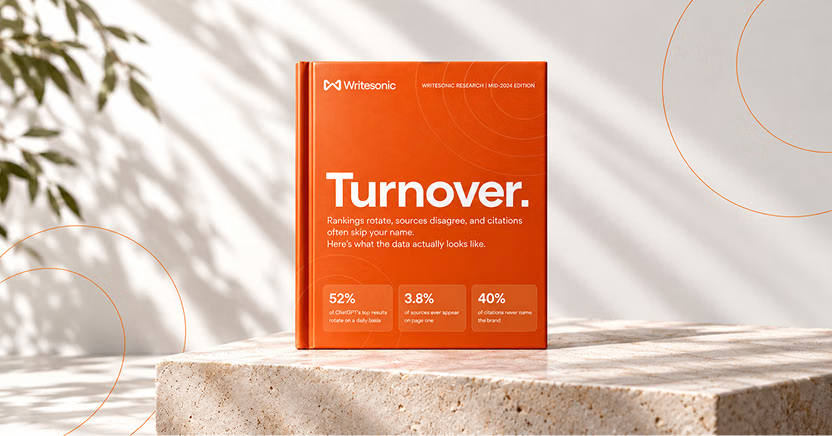
The #1 brand in ChatGPT changes 52% of the time.
Get the report and find out why.

Content Marketer
Pragati Gupta is a Content Marketer @Writesonic, specializing in AI, SEO, and strategic B2B writing. Leveraging the power of Generative AI, she produces high-impact content that drives superior ROI.