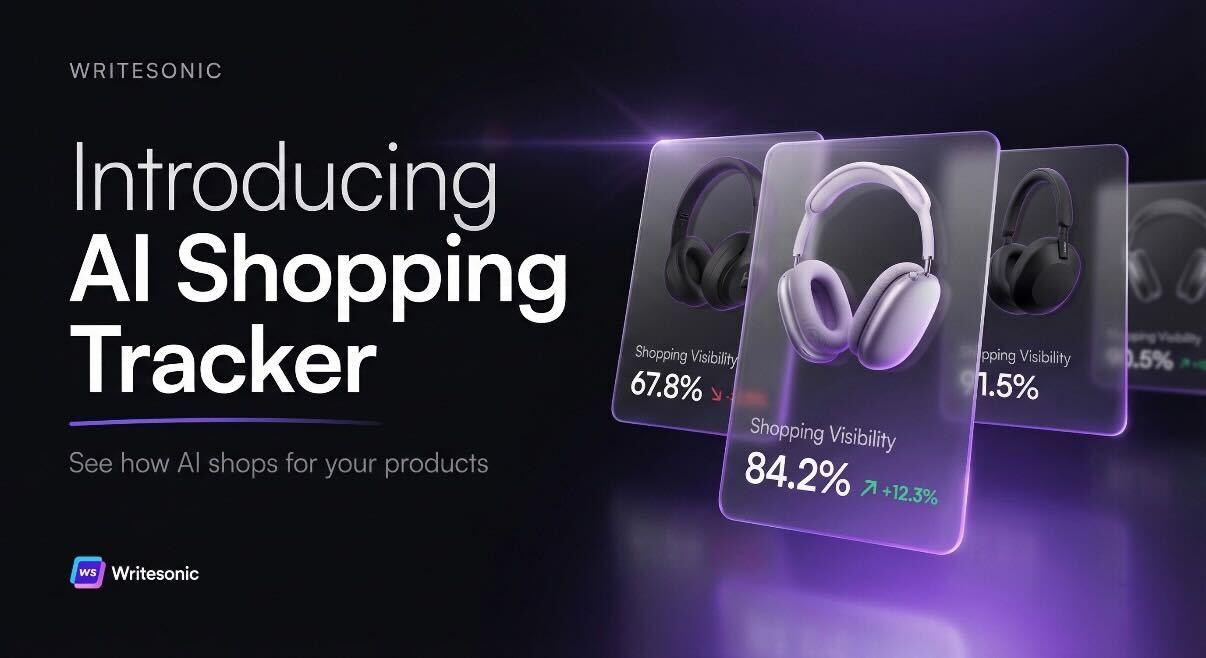
AI platforms are recommending products, linking to merchants, and enabling checkout inside conversations. We built a tracker that shows brands exactly what’s happening.
When ChatGPT recommends a laptop, it doesn’t just name one. It shows a shopping card with a product image, a price, and a buy link. That link might go to your website. Or it might go to Best Buy. Or Amazon. Or a retailer you’ve never heard of.
Until today, brands had no way to know which one.
I’ve spent the last year talking to ecommerce teams about AI visibility. The conversation always starts the same way: “We know AI is changing search. But we have zero data on what’s actually happening to our products.” They’ve built entire strategies around Google Shopping and paid search. They track every click, every conversion, every drop-off. But when it comes to AI shopping recommendations? Complete blind spot.
That blind spot is getting expensive. 45% of online shoppers already use AI for product research. OpenAI launched their Agentic Commerce Protocol in September 2025, enabling instant checkout inside ChatGPT. Google’s Universal Commerce Protocol followed in January 2026, backed by Shopify, Walmart, Target, Visa, and Mastercard. Microsoft Copilot Checkout is live in the US. Every major AI platform is building the rails for in-conversation purchasing.
Your products are either showing up in these conversations or they’re not. And if they’re not, someone else’s are.
What we built
Today we’re launching agentic commerce tracking inside Writesonic. It gives brands visibility into something that’s been completely opaque: how AI shopping engines discover, rank, recommend, and link to their products.
Here’s what the tracker shows you:
Shopping Visibility — how often your products appear when someone asks AI a shopping question. Tracked daily across platforms.
Direct Purchase Link Share — the percentage of buy links that go to your website vs. a third-party retailer. This is the metric most brands don’t know they need until they see it. If your direct purchase link share is 10%, it means 90% of the time AI recommends your product, it sends the buyer somewhere else.
Shopping Share of Voice — your brand’s slice of AI shopping recommendations vs. every competitor in your category.
Shopping Rank — where your product appears in the list when AI shows multiple options. Position 1 vs. position 5 is the difference between consideration and invisibility.
Product-level intelligence
Our AI visibility tracking tool doesn’t stop at brand visibility. We go deeper.
The All Products view shows every product AI has ever recommended in your category. Yours and your competitors’. Each product shows shopping visibility, the merchants AI links to, average pricing, and how many conversations it appeared in.
Here’s an example from the dashboard. An Asus Vivobook Go 15 laptop has 13% shopping visibility. Its direct purchase link share is 0%. That means every time ChatGPT recommends this laptop, it sends the buyer to Newegg, Walmart, or someone else. Never to Asus directly. That’s a fixable problem, but only if you can see it.
The Merchants view flips the lens. Instead of “which merchants sell my product,” it shows “which merchants does AI prefer?” You can see how often Best Buy, Amazon, Walmart, and your own website appear as the recommended purchase destination.
Competitive benchmarking
The Competitors tab is where this gets tactical.
A Market Comparison Matrix shows your brand vs. competitors across every shopping topic. Think of it as a heat map. Lenovo dominates “Business Laptops” with 90.9% visibility. You have 9.1%. But in “Lightweight Laptops,” you’re at 57.1%. That’s where to double down.
The Leaderboard ranks every brand in your category by shopping visibility and direct purchase link share. Period-over-period changes show who’s gaining ground and who’s falling.
Your performance by shopping topic tells you exactly which product categories AI associates with your brand and which ones it doesn’t. If you sell gaming laptops but AI never recommends them? Your product data, descriptions, or editorial coverage might need work.
Why this matters right now
Agentic commerce is still in its first year. The protocols are new. The shopping interfaces are evolving weekly. That makes right now the window to establish your position before the market hardens.
Three things are true today that won’t be true in 18 months:
The competitive set is small. Most brands aren’t tracking this channel yet. First-movers get to define category positioning.
The signals are learnable. Richer product data, clearer descriptions, and stronger editorial presence directly improve AI shopping visibility. These are fixable inputs, not black-box algorithms.
The buy links are up for grabs. AI platforms are still figuring out which merchants to prioritize. Brands that optimize their direct purchase paths now will lock in that advantage.
Your product pages, catalog data, and content directly shape how AI recommends you. The tracker shows you exactly where you stand and where the gaps are.
Get access
Agentic commerce tracking is available now for Writesonic Enterprise customers. If you’re a brand or agency that needs to see how AI recommends your products, book a demo and we’ll walk you through your category.
Sonakshi Garg is Chief of Staff and Growth Marketer at Writesonic, where she works directly with the founder on overall marketing strategy, influencer partnerships, and brand visibility across AI search engines like ChatGPT. She's also an expert at building and using AI agents for various marketing use cases. She holds a BSc in Business Management (Marketing) from Cardiff University.