Ever thought of YouTube as a text-based content marketing channel?
The idea may sound absurd till you learn AI engines train on and even cite YouTube content, without ever “watching” a single video. All they use is the text: titles, descriptions, transcripts, and metadata.
If you’ve been trying to improve your brand’s AI visibility, you’ve got the answer: use the “written” part of YouTube videos for answer engine optimization (AEO).
In this article, we’ll share six tips for writing AEO-friendly YouTube descriptions based on our internal research and experimentation.
6 Tips for Writing AEO-Friendly YouTube Descriptions
Here’s the Writesonic approach for writing YouTube descriptions for AEO or answer engine optimization:
1. Front-load keywords with intent
Your primary keyword (or company name) should appear within the first 25 words. This is critical for both mobile visibility and AI parsing.
Use the keyword frequently but naturally, usually 2–4 times across a 150–300 word description. Avoid desperation or stuffing.
Skip generic openings like “Welcome back to the channel.” If you use an opener, make it specific and unique, then immediately move to value.
For example, instead of starting with “Hey everyone, thanks for tuning in to another video on our channel where we talk about marketing,” try something like: “Email segmentation can double your open rates. Here’s exactly how to set it up in five minutes.”
The first option wastes valuable real estate. The second immediately tells both humans and AI systems what the video delivers. Remember, AI can’t hear your voice, but it does read transcripts.
“For B2B companies, YouTube is underutilized. A simple, utility-first video answering a specific question can get cited quickly because there’s often no competing content.” — Ethan Smith, AEO TOP VOICE and the CEO of Graphite
2. Make the value obvious to the viewer
Descriptions should clearly answer one question early: What will I get from this video?
State outcomes, not topics. This helps humans decide to watch and helps AI understand why the video exists.
Here’s the difference:
❌ “In this video, we discuss email marketing strategies.”
✅ “Learn three email sequences that increased our conversion rate by 34%, plus the exact templates we used.”
The first tells AI what you’re talking about. The second tells AI what viewers will walk away with. Answer engines prioritize the second because it’s easier to extract and cite as a direct response to a user’s question.
3. Optimize for mobile and extraction
Most users consume YouTube content on mobile devices. AI systems often preview only the first few lines of a description when generating answers.
To maximize both human engagement and AI citation potential, place all critical information within the first 2–3 sentences. This includes the primary keyword, the main value proposition, and any essential context that explains what the video delivers.
Use concise, declarative sentences that can stand alone. Even if a viewer or AI only sees this snippet, they should immediately understand the topic and benefit.
Consider formatting for readability on small screens: short sentences, minimal punctuation clutter, and clear separation of ideas help both mobile users and AI models parse the content efficiently.
Think of your first two sentences as a mini-abstract for your entire video. If someone only read those two sentences, would they know exactly what they’re getting?
4. Use the description as a content summary for AI
Think of the description as input for YouTube’s own AI systems and for external answer engines crawling your content.
Best practices for length and keywords:
- Aim for 150–300 words total
- Include a clear summary of the video’s core ideas
- Use your primary keyword 2–4 times
- Add secondary, SEO-related keywords 2–3 times
- Sprinkle in slightly related terms to help broaden query coverage
Structure matters just as much as content:
- Short paragraphs (2–3 sentences max)
- Bullet points where they make sense
- Logical section breaks
Random formatting hurts readability. Intentional formatting helps both humans skim and AI systems extract key information.
A good description reads like a condensed version of your video script: hitting the main points in order, with enough detail that someone (or something) could summarize it accurately without watching.
5. Add structural elements that increase clarity
For videos longer than 8 minutes, structural elements become especially important.
- Add timestamps. Include 2–3 timestamps that highlight key sections. This helps viewers navigate and gives AI systems clear markers for what content appears where in your video.
- Link related content. Add links to related YouTube videos — even if they’re only loosely relevant. This creates context for both the algorithm and answer engines trying to understand your content ecosystem.
- Include your social links. Add your LinkedIn, Instagram (especially important), and other profile links. This builds your authority signals across platforms.
- End with a clear CTA. Whether it’s like, share, subscribe, or buy — make the next step obvious.
- Use relevant hashtags. Start from common terms and move to niche ones. Order matters less than relevance.
- Call out collaborations. If there’s a collaboration with another creator or brand, mention it explicitly. This adds credibility and context.
6. Avoid penalties and keep descriptions fresh
AEO favors quality signals. Small errors can hurt your visibility more than you might expect.
Final checks before publishing:
- Every video must have a unique description
- No copy-pasting the same text across videos
- No spelling errors (indexing is impacted by typos)
Revisit older videos regularly:
- Update links based on current trends
- Add new products or features you’ve launched since publishing
- Check analytics and refine descriptions based on what’s performing
Your video library is an asset. Treat descriptions like living documents that can be improved over time especially for evergreen content that continues to get views months or years after publishing.
But I already invest in YouTube SEO
Great. Keep doing it. AEO builds on top of YouTube SEO.
If you had to prioritize:
- Fix SEO hygiene first
- Then layer AEO patterns (answer-first, extractable, structured)
That’s how we see teams getting consistent citation lift today, even while the field is still evolving.
Here’s where AEO goes beyond classic YouTube SEO:
Answer-first beats keyword-first
SEO optimizes for matching queries. AEO optimizes for extracting answers.
That’s why declarative sentences, Q&A-style phrasing, and “Yes, because…” structures matter more for AEO than they ever did for SEO.
Instead of writing around keywords, write toward answers. Ask yourself: If an AI system pulled this sentence to answer a user’s question, would it make sense on its own?
Descriptions work as machine-readable summaries
In SEO, descriptions were mostly for users. In AEO, descriptions act like input prompts for AI systems.
That’s why 150–300 word summaries work better than thin descriptions. Clear outcomes beat clever copy. Slight keyword repetition is useful, not optional.
Your description isn’t just metadata anymore. It’s the primary text AI systems use to understand what your video contains.
Citability matters more than ranking
In AEO, the goal isn’t to rank a page, it’s to become part of the answer itself.
“AEO isn’t about ranking your own page for a keyword. It’s about influencing which sources an AI system pulls from when answering a specific question.” — Ethan Smith, CEO of Graphite
SEO asks: Can I rank?
AEO asks: Can this sentence be quoted as-is?
Simple language beats persuasive language. One strong answer beats many weak ones. Structure beats storytelling.
Make YouTube Descriptions Work For AI
“If an AI can quote your sentence without rewriting it, you’re doing AEO right.” — Ethan Smith
YouTube SEO gets you discovered. YouTube AEO gets you cited.
YouTube descriptions don’t “guarantee” AEO success. They significantly reduce ambiguity for answer engines. In a world where citations matter more than clicks, clear, structured, keyword-aligned descriptions make your videos easier to understand, extract, and reference.
Until AEO matures into a formal system, this is the most reliable way we’ve seen to earn citation lift, by making answers obvious, not optimized.
Want to earn more AI citations? Try Writesonic.
FAQs on YouTube Descriptions for AEO
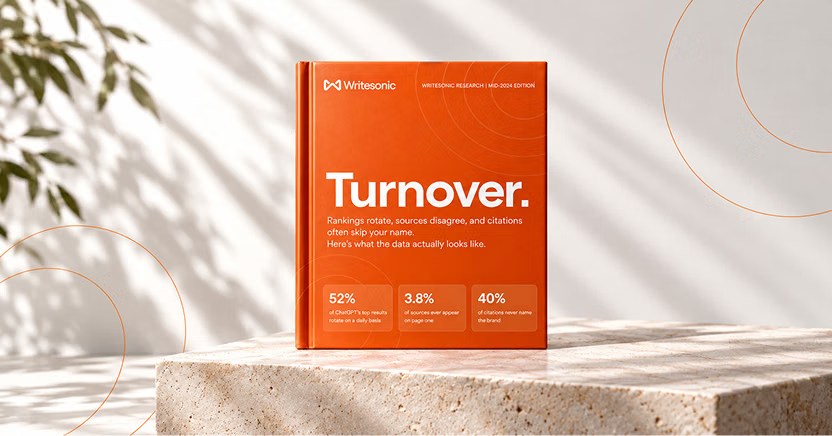
The #1 brand in ChatGPT changes 52% of the time.
Get the report and find out why.

Growth Marketer
Growth marketer at WriteSonic passionate about scaling content and building high-performing funnels. Ex-MoEngage, Whatfix, Tata AIG, Product Fruits, and TripleDart.