TL;DR:
Answer engine optimization (AEO) is the practice of structuring content so AI engines can extract and cite it. The 35 steps below cover the five things that drive citation: answer-first content structure, schema markup, technical AI crawler access, E-E-A-T signals, and ongoing measurement. Each step is ordered within its phase by measured impact. Skip to any phase using the headings.
What is AEO?
Answer engine optimization is the process of making your content legible to AI engines (ChatGPT, Perplexity, Claude, Google AI Overviews, and Gemini) so they extract and cite you in their responses, not a competitor.
AEO differs from SEO in what it optimizes for. SEO optimizes for rankings in a list of ten blue links. AEO optimizes for extraction: can an AI pull a clean, accurate, attributable answer from your page and surface it in a conversational response?
AEO is a subset of GEO (Generative Engine Optimization). GEO covers the full system: visibility tracking, content optimization, citation outreach, and technical fixes. AEO is the content and structural layer of that system.
Why this matters right now
Three data points explain why AEO has moved from experiment to necessity:
58.5% of US Google searches end without a click (SparkToro & Datos, 2024), meaning AI summaries are absorbing traffic that used to reach your pages.
AI-referred traffic converts at 14.2% versus 2.8% for organic search (AuthorityTech / Attrifast field data, 2026). Visitors arriving from an AI citation are already pre-qualified by the answer.
Only 12% of AI citations overlap with Google's top-10 organic results overall, though 76% of Google AI Overview citations come from pages that rank. Optimize for both, and Perplexity or Claude may cite you even when you're not in Google's top 10.
The competitive window is open. Most pages rank on SEO signals built over years. AI citation is a structural problem you can fix in weeks.
The 35-step AEO checklist
Phase 1: Content structure (Steps 1–9)
This phase has the largest measured effect on citation rate. A WhyIQ study found structural optimization alone increases citation rates by 17.3% and quality ratings by 18.5%.
Step 1: Write an answer-first opening block
Your first paragraph should answer the page's main question in 40–120 words. State the definition, the direct answer, or the core claim before any context or backstory. AI engines extract from the first 30% of page body content at a disproportionate rate; AuthorityTech data puts it at 44.2% of LLM extractions. If the answer isn't near the top, it often won't be pulled at all.
The format: one sentence that names the thing, two to three sentences that explain it, one sentence that states the scope or limits.
Step 2: Use question-based H2 and H3 headings
Phrase your headings as the questions your audience actually types into AI engines. "How does schema markup help AEO?" outperforms "Schema markup benefits" because AI engines match query intent at the heading level before extracting the passage below it.
Target: 70–80% of your H2s phrased as questions. The rest can be descriptive.
Step 3: Write self-contained answer blocks under each heading
Each section should answer its heading question without requiring the reader to have read previous sections. AI engines pull passages, not full pages. A passage that needs context from three paragraphs earlier won't get extracted cleanly.
Target: 40–80 words for the core answer under each H2, followed by detail if needed.
Step 4: Build a dedicated FAQ section
A properly structured FAQ section is the single highest-weight AEO signal. AuthorityTech's research assigns FAQ Quality a 20% weight in citation likelihood, more than any other individual signal. Four to six questions with 40–60 word answers is the optimal range. More than six shows no additional lift.
Place the FAQ at the bottom of the page, mark it with FAQPage JSON-LD, and make sure the question text in the schema matches the visible H3 text exactly.
Step 5: Include statistical density every 200–300 words
Pages with named statistics get cited more often. The Princeton GEO paper (KDD 2024) found that adding statistics to content increases citation rates by 30–40% on a position-adjusted basis. Name the source, name the number. "Studies show" is not a statistic.
Step 6: Add named quotations from credible sources
The same Princeton paper found that adding direct quotations from named sources increases citation rates by 41%. A quoted practitioner or researcher gives AI engines an attributable claim to surface.
Step 7: Use short paragraphs and scannable formatting
Keep paragraphs under 80 words. Use bullet lists and comparison tables when comparing three or more items. Use numbered lists for sequential steps. AI engines parse structured content more reliably than dense prose blocks.
Step 8: Include a TL;DR or key takeaways block
Six of the top ten pages on this SERP include a TL;DR or key takeaways block. It works because it's the most extractable part of any page: a short, self-contained summary the AI can surface verbatim. Place it directly below the introduction, before the first H2.
Step 9: Define your key terms explicitly
Write a one-sentence definition of every specialist term you use, in the same paragraph where you first use it. AI engines build entity graphs from definitional statements. "X is Y that does Z" is the form. Don't assume the reader knows the term; don't outsource the definition to a hyperlink.
Phase 2: Schema markup (Steps 10–15)
Schema tells AI engines what your content is, who wrote it, and how to classify it. AuthorityTech's research assigns Schema Coverage a 7% weight, lower than content signals, but it's binary: missing schema is a structural exclusion, not a ranking disadvantage.
Step 10: Implement FAQPage schema with JSON-LD
FAQPage JSON-LD is the most directly AEO-relevant schema type. Mark up every FAQ section. The name property in each Question object must match the visible H3 text exactly; paraphrasing breaks the match. Validate with Google's Rich Results Test before deploying.
Step 11: Add Article schema with author attribution
Implement Article or BlogPosting schema with author pointing to a Person entity that includes name, url, and sameAs (LinkedIn profile, personal site, or Twitter/X). This ties the content to a real person, which strengthens E-E-A-T signals and satisfies the Author Attribution signal (6% weight in the AuthorityTech framework).
Step 12: Add Organization schema on your homepage
Your homepage Organization schema should include name, url, logo, sameAs links to your LinkedIn, Twitter/X, and Crunchbase profiles, and a description that matches how you describe yourself on other platforms. Consistent entity definition reduces the chance that AI engines attribute your content to the wrong company or omit the brand name entirely.
Step 13: Mark up HowTo content where appropriate
If a section walks through a process in discrete steps, use HowTo schema with individual HowToStep items. This gives AI engines a structured representation of the steps, not just the prose.
Step 14: Consider Speakable schema for voice-accessible content
Speakable schema marks specific passages as suitable for text-to-speech. It's a lower-priority step, but if voice search is in scope for your audience, it signals to Google which passages to read aloud. Only GEOClarity covers this explicitly among the top-10 results; it's an underused signal.
Step 15: Validate all schema before publishing
Use Google's Rich Results Test and Schema.org's validator. Broken or mismatched schema (e.g., question text in schema that doesn't match the visible heading) does more harm than no schema. Run validation on every new page and after any CMS template changes.
Phase 3: Technical AI crawler access (Steps 16–21)
If AI bots can't crawl your pages, citation is impossible regardless of content quality. This phase takes less than a day to audit and fix; yet AirOps research found citation volatility is partly driven by pages falling in and out of crawl scope.
Step 16: Audit your robots.txt for AI bot access
Check that none of the following bots are blocked: GPTBot (OpenAI/ChatGPT), ClaudeBot (Anthropic), PerplexityBot, Google-Extended (Google AI Overviews), OAI-SearchBot, Applebot. If you haven't explicitly reviewed robots.txt since 2024, check now; some CMSes added blanket AI bot blocks in response to scraping concerns.
To verify access, check your server logs for these user agents. Absence doesn't mean you're blocked; it may mean they haven't crawled yet. But a block in robots.txt is immediate and fixable.
Writesonic's AI Crawler Audit audits your robots.txt, schema, and broken-page status for all major AI bots and surfaces one-click fixes where access is blocked.
Step 17: Ensure server-side rendering
Content that loads only through JavaScript may not be extracted by AI crawlers, which often don't execute JS the way a full browser would. If your pages use client-side rendering, test them by fetching the raw HTML source. If the answer blocks, headings, and FAQ content aren't present in the HTML before JS executes, you have an extraction gap.
Step 18: Check max-snippet and nosnippet meta tags
Some pages that were optimized to limit Google snippet length also block AI extraction. Check for nosnippet and max-snippet meta tags, especially on older pages. A max-snippet of 50 words cuts off most answer blocks before they're complete.
Step 19: Confirm LCP under 2.5 seconds
Page speed isn't a primary AEO signal, but slow pages are crawled less frequently and indexed with less depth. Target Largest Contentful Paint under 2.5 seconds. Use Google PageSpeed Insights to check.
Step 20: Verify mobile content parity
AI crawlers largely follow Google's mobile-first indexing approach. If your mobile page hides content behind accordions or tabs that don't render in the HTML, that content won't be extracted. Check that your answer blocks and FAQ sections are present in the mobile HTML.
Step 21: Submit your updated sitemap
After publishing new or restructured AEO-optimized content, submit your sitemap in Google Search Console and Bing Webmaster Tools. This accelerates crawl discovery. Bing Webmaster Tools now includes an AI Performance report (launched February 2026) that shows how your pages perform in Bing Copilot.
Phase 4: Authority and E-E-A-T signals (Steps 22–28)
E-E-A-T (Experience, Expertise, Authoritativeness, Trustworthiness) isn't a single signal; it's a cluster of signals AI engines use to decide whether your claims are credible enough to surface to users. AuthorityTech found entity disambiguation across four matched profiles (website, LinkedIn, a directory listing, and a third-party mention) correlates with a 3x citation lift.
Step 22: Name and credential every author
Every piece of content should have a named author with a bio, a credential statement, and a link to their LinkedIn or personal site. This isn't about satisfying Google; it's about giving AI engines a real person to attribute the claim to. Anonymous content is cited less often because AI engines can't verify its provenance.
Step 23: Build an About page with entity clarity
Your About page should state, in plain text: what you do, who you serve, when you were founded, and where you're based. These are the anchor attributes AI engines use to resolve your entity. Vague mission statements don't help. "Writesonic is an AI search growth engine that helps marketing teams track and improve brand visibility across ChatGPT, Perplexity, and Google AI Overviews" is more extractable than "We help brands win in the age of AI."
Step 24: Maintain consistent entity information across platforms
Your name, description, and key attributes should match across your website, LinkedIn company page, Crunchbase, G2, and any sector directory you're listed in. AI engines cross-reference these sources to verify identity. Inconsistent information (different founding years, different product descriptions) creates ambiguity that reduces citation confidence.
Step 25: Earn and monitor third-party citations
AI engines don't only cite pages they find through your sitemap. They cite what other credible pages link to and mention. For Perplexity specifically, 46.7% of citations come from Reddit threads. Building presence in the places your audience discusses problems (Reddit, Quora, community forums, and sector directories like G2 and Capterra) is an AEO strategy, not just a brand awareness play.
Step 26: Publish original data
Pages that contain proprietary research, original analysis, or first-party data get cited at higher rates because they're primary sources, not summaries. Conduct surveys, analyze your product data, or run controlled tests and report the findings. Original data is also a "citation magnet" for other sites, which earns the third-party mentions covered in Step 25.
At Writesonic, we've analyzed data from 2B+ real AI conversations to surface how different AI engines select and attribute content; that kind of first-party data is what makes a page worth citing.
Step 27: Keep a 30-day content refresh cadence for high-priority pages
AirOps research found that 70%+ of AI-cited pages were updated within the last 12 months, and AI-cited content averages 1.2 years more recent than Google-ranked content. AuthorityTech's data puts the citation half-life at roughly three months: pages refreshed quarterly are 3x less likely to lose citations than pages refreshed annually. For your most important AEO pages, a 30-day review and update cycle is worth the investment.
Step 28: Replace promotional language with verifiable claims
Phrases like "industry-leading," "best-in-class," and "cutting-edge" are not extractable. AI engines can't verify them and won't cite them as facts. Replace every promotional claim with a specific, verifiable statement. "Trusted by Amazon, Unilever, and 13,000+ marketing teams" is verifiable. "The best AI marketing platform on the market" is not.
Phase 5: Measurement and iteration (Steps 29–35)
You can't improve what you can't see. The measurement phase is where most AEO programs fail: they track rankings (an SEO metric) but not citations (the AEO metric).
Step 29: Establish your AI visibility baseline before making changes
Before you touch any content or schema, run 20–50 representative queries across ChatGPT, Perplexity, Claude, and Google AI Overviews and record whether your brand is cited. This is your baseline. Without it, you won't know whether changes are working.
Writesonic's AI Visibility Analytics tracks your brand's Visibility Score, Share of Voice, and Citation Sources across 10 AI platforms using data from 2B+ real AI conversations, giving you a continuous baseline rather than a manual snapshot.
Step 30: Track citation rate as your primary KPI
Citation rate is the percentage of AI engine responses to your target queries that include your brand or a link to your content. Track it across platforms separately. Google AI Overviews, ChatGPT, and Perplexity have different citation behaviors; only 11% of citations overlap across all three AI engines, per AuthorityTech's platform divergence data.
Step 31: Track AI Share of Voice
AI Share of Voice (AI SoV) measures what percentage of AI citations in your category go to you versus your competitors. A rising citation rate in absolute terms can still mean losing ground if competitors are rising faster. AI SoV gives you the competitive picture.
Step 32: Segment AI referral traffic in GA4
Create a custom channel grouping in GA4 for AI-referred traffic. The default "Referral" channel groups all referrals together. You need to separate traffic arriving from chatgpt.com, perplexity.ai, claude.ai, and gemini.google.com to measure conversion rates and engagement separately. AI-referred sessions convert at roughly 5x the rate of organic search, and you want to see that clearly, not buried in aggregate referral data.
Step 33: Monitor Bing AI Performance in Bing Webmaster Tools
Bing Webmaster Tools now includes a dedicated AI Performance report, released February 2026. It shows how your pages are surfaced in Bing Copilot responses. Because ChatGPT uses Bing's index for web search, Bing AI Performance data is a proxy for ChatGPT citation potential. Check it monthly.
Step 34: Run quarterly A/B tests on answer format
Test different answer-first structures, FAQ question phrasing, and statistical density levels on similar pages. AI citation behavior shifts as engines update their models; what works in Q1 may underperform in Q3. Quarterly tests with controlled page pairs give you a signal faster than waiting for citation rates to drift.
Step 35: Set a monthly AEO review loop
At the end of each month: check citation rates across your target queries, identify any pages that have lost citations, check whether competing pages have been updated, and run the structural audit on any page that dropped. AirOps found that 40% of pages that lose citations can resurface with targeted structural fixes, so a monthly review catches drops before they compound.
What doesn't work (and the research behind it)
Most AEO advice focuses on what to do. Equally useful is knowing what to skip. Three commonly recommended tactics have no measured effect on citation rate:
llms.txt files
The llms.txt specification lets you create a structured file that describes your site's content to AI agents. Four independent studies have found it has no measurable effect on citation frequency: Limy found 408 AI agent hits from 515M total bot events; OtterlyAI found 84 hits from 62,100 bot visits; ALLMO found 0.00106% of cited URLs had an llms.txt file; SE Ranking found no correlation between llms.txt presence and citation frequency across their tracked sites. Create one if you want organizational clarity for your AI agent workflows, but don't expect citation lift.
Word count padding
There's no evidence that longer pages get cited more often. AirOps's 48-factor framework, the most detailed on the SERP, doesn't include word count as a factor. The research consistently points to passage-level extractability, not total page length. A 600-word page with clear answer blocks outperforms a 3,000-word page with buried answers.
AI-generated content at volume
Pages generated in bulk by AI without human review and editing get downweighted by AI citation models. The signal AI engines look for is evidence of genuine expertise: original data, named sources, specific claims, real author credentials. Mass-produced AI content lacks all of these. Use AI to draft and accelerate; invest human review and expertise to make it citable.
Platform-specific notes
Each major AI engine cites differently. Optimize for all four in parallel, but know where the differences lie:
Google AI Overviews: Primary index: Google organic. Citation onset: Days (follows crawl). Key signals: Traditional SEO authority + answer structure.
ChatGPT (web search): Primary index: Bing index + web. Citation onset: 7–21 days. Key signals: Bing ranking, brand mentions, Wikipedia presence.
Perplexity: Primary index: Real-time web. Citation onset: 2–7 days. Key signals: Freshness, Reddit/Quora mentions, direct crawl.
Claude: Primary index: Training + web. Citation onset: 14–30 days. Key signals: Academic sources, long-form content, citations.
Gemini: Primary index: Google organic. Citation onset: Days (follows crawl). Key signals: Structured data, Google Knowledge Graph.
Perplexity is fastest to respond to structural changes. Claude takes longest. If you're launching a new page, expect Perplexity citations to appear first and Claude citations to come last.
ChatGPT has 87% citation overlap with Bing's top 10 results, so Bing ranking matters for ChatGPT visibility in a way it hasn't mattered for traditional SEO strategy.
Where Writesonic fits in this workflow
Running this checklist manually is time-intensive. Most teams find the bottleneck isn't knowing what to do; it's doing it at scale and tracking whether it worked.
AI Crawler Audit audits your robots.txt, schema, and indexing status for all major AI bots (GPTBot, ClaudeBot, PerplexityBot) and surfaces one-click auto-fixes.
Content Optimization rewrites pages for AEO, adding FAQ blocks, comparison tables, and self-contained answer passages.
AI Visibility Analytics tracks your Visibility Score, Share of Voice, and Citation Sources across 10 AI platforms, powered by 2B+ real AI conversations.
Action Center ranks your optimization opportunities by citation impact and connects each finding to a workflow: content gaps to creation, citation gaps to outreach templates, technical issues to instant fixes.
The checklist above is the strategy. Writesonic is the execution layer.
Frequently asked questions
What is AEO and how is it different from SEO?
AEO (answer engine optimization) is the practice of structuring content so AI engines (ChatGPT, Perplexity, Claude, Google AI Overviews) can extract and cite it in their responses. SEO optimizes for rankings in a list of blue links; AEO optimizes for passage extraction and citation. The two overlap significantly (authority signals help both) but differ in content format: AEO requires answer-first structure, question-based headings, and schema markup that SEO doesn't strictly require.
How long does it take to see AEO results?
Depends on the platform. Perplexity typically cites updated content within 2–7 days. ChatGPT (via Bing) takes 7–21 days. Claude takes 14–30 days. Google AI Overviews follow Google's crawl cadence, so timing depends on your crawl frequency. AuthorityTech's data puts the citation half-life at roughly three months; pages refreshed quarterly are 3x less likely to lose citations than pages refreshed annually.
What's the difference between AEO and GEO?
AEO is the content and structural layer: answer-first writing, question-based headings, FAQ sections, and schema markup. GEO (Generative Engine Optimization) is the broader discipline: it includes AEO but also covers AI visibility tracking, citation outreach, technical AI crawler access, and competitive Share of Voice measurement. If AEO is the playbook for individual pages, GEO is the system for managing AI search visibility across your entire site and brand.
Do I need schema markup for AEO to work?
Schema helps but it's not a magic lever. AuthorityTech's research assigns Schema Coverage a 7% weight in citation likelihood, which is real but lower than content structure (FAQ Quality at 20%, Answer Clarity at 19%). The higher-ROI move is to get your content structure right first, then layer in FAQPage and Article schema. That said, missing FAQPage schema on a page with a well-formed FAQ section is leaving easy signal on the table.
How do I measure AEO performance?
Three primary metrics: Citation Rate (what % of AI responses to your target queries include your brand or a link), AI Share of Voice (your citations as a % of total citations in your category), and AI-referred traffic in GA4. Secondary: featured snippet positions in Google Search Console (correlated with AI Overview citations), and Bing AI Performance in Bing Webmaster Tools. Don't use organic rankings as a proxy for AEO performance; only 12% of AI citations overlap with Google's top-10 organic results overall.
Which AI engines should I prioritize?
Prioritize Google AI Overviews, ChatGPT, and Perplexity first, as they account for the largest share of AI-referred traffic. Perplexity is worth treating as its own channel because it cites differently (heavy on Reddit, Quora, and fresh content) and responds to structural changes faster than the others. Claude and Gemini are lower-volume but worth monitoring. If you're in a category with heavy voice search usage (healthcare, local services), add Google Assistant and Siri to your tracking set.
What's the most common AEO mistake?
Optimizing for AI Overviews only and ignoring ChatGPT and Perplexity. Only 11% of citations overlap across all three major AI engines, per AuthorityTech's platform divergence data. A page that dominates Google AI Overviews may have zero presence on Perplexity. AEO requires a multi-platform strategy, not just traditional SEO signals applied to AI.
Track your brand's AI citation rate across ChatGPT, Perplexity, and 8 more AI platforms with Writesonic's AI Visibility Analytics. Start your free trial at writesonic.com.
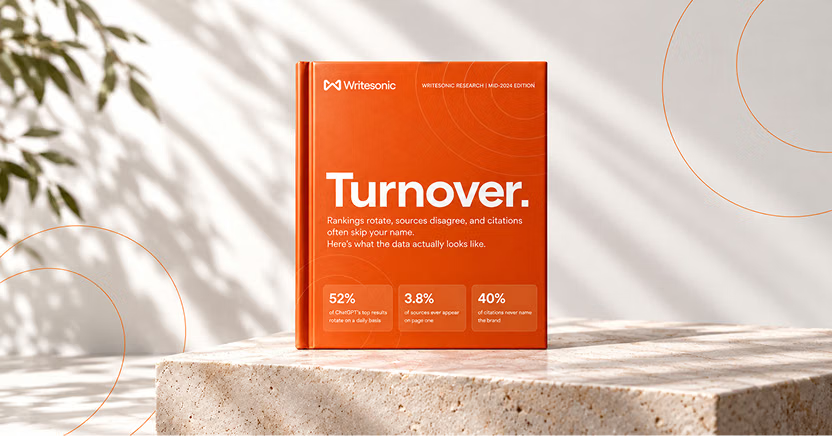
The #1 brand in ChatGPT changes 52% of the time.
Get the report and find out why.

GEO Strategist at Writesonic
Rohit is an GEO Strategist at Writesonic with nearly a decade of experience driving organic growth across industries. Over the past 9 years, he has partnered with brands across BFSI, ecommerce, and B2B SaaS, helping them turn search visibility into measurable revenue. His expertise lies in Generative Engine Optimization (GEO) and AI Search, where he crafts strategies that help brands earn placement in answers from ChatGPT, Perplexity, Google AI Overviews, and beyond.