Most marketers already know answer engine optimization exists. Fewer understand why their content still isn't showing up in ChatGPT, Perplexity, or Google AI Overviews, even after they've "done AEO."
The gap between knowing AEO matters and actually getting cited is wider than most teams realize. And it's not always the obvious mistakes. A content team can get schema right, structure their FAQs correctly, and still get passed over entirely because they're measuring the wrong thing, or because AI engines simply can't verify the brand exists outside its own website.
This post covers the 10 AEO mistakes that show up repeatedly in audits, including several that almost no article in this space addresses. Fix them and you're building the kind of content infrastructure that AI engines are actively built to find and cite.
Mistake 1: You're still tracking clicks as your primary AEO metric
This is the root mistake. Everything else on this list compounds it.
Organic sessions made sense as a KPI when search meant clicking through to a page. But AI engines answer the question directly. Your brand can be cited in the response, influencing a purchasing decision, without generating a single session in your analytics dashboard.
The right metrics for AEO are citation rate (how often your brand or content appears in AI responses), Share of Model (the proportion of AI answers in your category that mention your brand), and source attribution. If you're not tracking these, you have no feedback loop. You can't tell what's working.
The fix:
- Set up AI visibility tracking across ChatGPT, Perplexity, Gemini, and Claude, not just Google Search Console
- Track which pages earn AI citations, not just which pages rank
- Report Share of Model to leadership alongside organic traffic; treat them as separate channels
Mistake 2: Burying your answer
AI engines extract answers. They don't read essays. They scan for the most direct, extractable response to a query and surface it. If your answer lives in paragraph seven, after 400 words of background context, it won't be cited, even if it's the best answer on the page.
This is the BLUF principle (Bottom Line Up Front) applied to content. The claim comes first. The supporting evidence follows.
Muck Rack's "What Is AI Reading?" study, published July 2025, found that more than 85% of AI citations come from earned media sources rather than brand-owned pages. Part of what makes third-party content so citable is structure: independent editorial content tends to open with clear declarative answers, not preamble. Your owned content needs to do the same.
The fix:
- Open every section with a direct, declarative sentence that answers the section's implied question
- Keep your core answer within the first 50 words of each section
- Use 200-400 word self-contained passages (sometimes called RAG blocks) so an AI engine can extract the response without losing context
Mistake 3: Thin schema or the wrong schema types
Schema is the most-covered topic in every AEO article, which means most teams have some schema deployed. The mistake isn't missing schema entirely. It's treating it as a one-time checkbox rather than a living layer that needs maintenance and depth.
FAQPage schema is the most commonly cited fix, but SpeakableMarkup, HowTo, and Article schema with proper author attribution are frequently missing. When brands add schema to some pages but not others, AI engines encounter schema that conflicts with actual page content. That's a bigger problem than no schema at all.
The fix:
- Audit schema across high-priority pages, not just your homepage; include author markup and Article type
- Add FAQPage schema to any page with Q&A content
- Use SpeakableMarkup on pages targeting voice and conversational queries
- Add
sameAsentity markup connecting your brand to Wikidata or Wikipedia entries - Check that schema matches the actual page content; mismatched schema is penalized
Mistake 4: Blocking AI crawlers in your robots.txt
A surprising number of sites do this without realizing it. The most common cause is a wildcard disallow rule added years ago to block scraper bots. That same rule also catches GPTBot (OpenAI), ClaudeBot (Anthropic), OAI-SearchBot (OpenAI's search crawler), and PerplexityBot, meaning those AI engines either can't read your content at all, or are working from a cached version that's months out of date.
If an AI engine can't crawl your site, it can't cite it.
The fix:
- Check your robots.txt for rules that block:
GPTBot,OAI-SearchBot,ClaudeBot,PerplexityBot,Google-Extended - Explicitly allow these crawlers on content you want cited
Mistake 5: Optimizing only for informational queries
Most AEO content answers "what is X" questions. That's where most content teams start, and it's useful. But the queries that drive purchasing decisions are different: "best [tool] for [use case]," "[brand A] vs [brand B]," "how do I solve [specific problem]."
If your content doesn't appear in AI responses to those commercial and comparison prompts, you're invisible at the moment your buyer is making a decision. Being cited in an informational response builds awareness. Being cited in a comparison response builds pipeline.
The fix:
- Map your AEO content to all three intent types: informational ("what is AEO"), comparative ("AEO tool vs SEO tool"), and transactional ("best AEO tools for SaaS")
- Create dedicated comparison pages and use-case pages that AI engines can cite when those prompts come up
- Check whether AI responses to key commercial queries in your category mention your brand; if they don't, that's the content gap to fill first
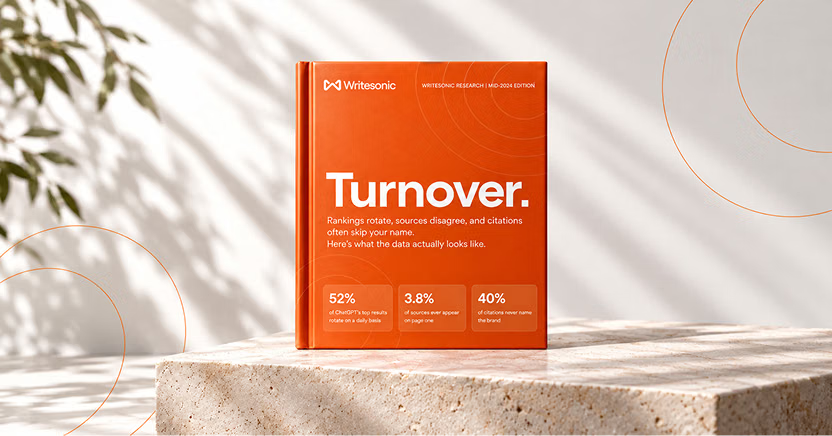
The #1 brand in ChatGPT changes 52% of the time.
Get the report and find out why.
Mistake 6: No off-site validation signals
AI engines don't take your word for it. If the only sources confirming your brand's credibility are your own website, AI retrieval systems have no way to independently verify that credibility. They'll default to brands with stronger external footprints.
A Semrush study analyzing over 150,000 AI citations across ChatGPT, Perplexity, Google AI Mode, and AI Overviews (June 2025) found that Reddit alone accounted for 40.1% of all AI citations. Wikipedia was second at 26.3%. Your brand's own domain doesn't appear on that list. If you have no genuine presence on Reddit or third-party review platforms, you're operating with a significant structural blind spot.
The fix:
- Publish genuine, helpful contributions to relevant Reddit communities in your space, not promotional posts, but actual answers to real questions
- Build your G2, Capterra, and Trustpilot review volume; AI engines treat third-party review sites as independent validation
- Pursue coverage in trade publications and niche industry sites your audience trusts
- Use PR to generate branded mentions in publications that AI training data and retrieval pipelines already pull from
Mistake 7: Publishing AI-generated content with no original input
This problem is getting worse, not better. As teams use AI writing tools to scale content, they're generating pages that AI engines have effectively already seen: synthesized versions of content that already exists on the web. That creates a circular citation problem. AI cites the sources it already knows, and AI-washed rewrites of those sources add nothing new to the pool.
Muck Rack's "What Is AI Reading?" study (July 2025) confirmed this dynamic. The content that got cited consistently had one thing in common: it was independently verified, editorially distinct, and contained information AI engines couldn't find in a dozen other places. Original data, named expert positions, specific case findings. Repackaged content doesn't clear that bar.
This doesn't mean AI writing tools are the problem. It means using them to repackage existing content, rather than to structure and scale original material, is the mistake.
The fix:
- Anchor your most important content around first-party data: proprietary surveys, original analysis, internal benchmarks, customer findings
- Use AI writing tools to structure and scale content that starts from original material, not to generate derivative content from scratch
- Add at least one citable statistic, named expert quote, or original case result to every piece you want AI engines to cite
Mistake 8: Hiding your subject matter experts
E-E-A-T (Experience, Expertise, Authoritativeness, Trustworthiness) is well-understood for Google rankings. It matters just as much for AI citations, and many teams still publish anonymously or under generic "Editorial Team" bylines.
AI engines assess the credibility of claims. Content attributed to named experts with verifiable credentials (LinkedIn profiles, publication history, professional affiliations) signals a different level of trust than content with no author at all. When a named expert can be cross-referenced outside your site, on LinkedIn, in a press mention, in an academic context, the credibility signal extends beyond your own domain.
The fix:
- Every piece of content you want cited should have a named, credentialed author
- Build out author pages with verifiable credentials and link them to the author's LinkedIn profile
- Where possible, get your subject matter experts quoted in external publications; those quotes become independent validation that AI engines can find
Mistake 9: Inconsistent brand entity signals across the web
AI engines build a picture of your brand from everything they can find about it: your website, your social profiles, third-party mentions, review platforms, and knowledge bases like Wikipedia and Wikidata. When those sources contradict each other — different company descriptions, inconsistent product names, mismatched founding dates — AI retrieval systems either cite you with low confidence or skip you entirely in favor of a brand they can resolve cleanly.
Entity clarity is the AEO equivalent of NAP consistency in local SEO. The problem is rarely deliberate inconsistency; it's usually years of slightly different boilerplate copied from one press release to the next.
The fix:
- Audit how your brand is described across your own website, LinkedIn company page, Crunchbase, G2, Wikipedia (if applicable), and any industry directories
- Standardize your company description, product names, and category language across all of them
- If your brand has a Wikipedia or Wikidata entry, make sure it's accurate and up to date; AI engines use these as anchor references for entity resolution
- Use consistent
sameAsschema markup on your site to link your brand entity to its authoritative external references
Mistake 10: Treating AEO as a one-time project
AEO is not a setup task. AI engines are updated continuously: new crawl data, new training batches, new query patterns. A piece of content that earns citations in January may lose them by April if a competitor publishes something fresher, more specific, or better sourced.
The brands that sustain AI visibility treat it the same way strong SEO teams treat rankings: a continuous monitoring and refresh cycle, not a launch-and-forget campaign.
The fix:
- Schedule quarterly content refreshes for your highest-performing AEO pages; update statistics, add new examples, confirm schema is still accurate
- Monitor citation performance monthly; when a page drops out of AI responses for key queries, treat that as a ranking drop and investigate
- Track when competitors gain citations for queries where you previously appeared
Quick-reference summary
| Mistake | Core fix |
|---|---|
| Tracking clicks instead of citations | Measure Share of Model and citation rate |
| Burying the answer | BLUF structure; direct answer in first 50 words |
| Thin or mismatched schema | Full schema audit; add SpeakableMarkup and author attribution |
| Blocking AI crawlers | Explicitly allow GPTBot, ClaudeBot, OAI-SearchBot, PerplexityBot |
| Informational-only content | Add comparison and commercial-intent pages |
| No off-site validation | Build Reddit presence, reviews, and press coverage |
| AI-washed content | Anchor all citable content in first-party data |
| Anonymous authorship | Named experts with verified credentials on every key page |
| Inconsistent entity signals | Standardize brand descriptions and use `sameAs` markup |
| One-time setup | Quarterly refresh cycle and monthly citation monitoring |
Frequently asked questions (FAQs)
The #1 brand in ChatGPT changes 52% of the time.
Get the report and find out why.

GEO Strategist at Writesonic
Rohit is an GEO Strategist at Writesonic with nearly a decade of experience driving organic growth across industries. Over the past 9 years, he has partnered with brands across BFSI, ecommerce, and B2B SaaS, helping them turn search visibility into measurable revenue. His expertise lies in Generative Engine Optimization (GEO) and AI Search, where he crafts strategies that help brands earn placement in answers from ChatGPT, Perplexity, Google AI Overviews, and beyond.