If you run a small website, you’ve probably noticed: AI tools like ChatGPT, Perplexity, and Gemini love mentioning big brands.
But here’s what most site owners don’t realize—AI traffic matters more for small websites. Data from Ahrefs indicates that sites with fewer than 10,000 monthly visitors receive a higher percentage of their traffic from AI than larger websites.
But most small businesses miss out on AI citations because they don’t understand how these tools choose what to reference.
Let’s break down exactly how that works.
How AI search engines cite content (and why it matters for small websites)
AI search engines like ChatGPT, Perplexity, and Gemini don’t just list websites like Google does. They generate direct answers, overviews, or summaries, and pick specific sources to cite within those synthesized answers.
According to data from Ahrefs, 63% of websites receive AI traffic, meaning you have a 2 in 3 chance of receiving a visit via AI. Interestingly, their analysis also shows that smaller brands (<999 monthly visitors) capture more AI traffic as a percentage of their total traffic.
Getting cited by AI tools is how your website shows up in those results. If your site doesn’t get picked, your content stays hidden—even if it ranks well in regular search.
Here’s how the citation process works, step by step:
1. AI tools rely on Google search results to find sources
Most AI platforms scan Google’s top-ranking pages to decide which content to cite. According to data from our Writesonic GEO tool (an AI visibility platform):
- Over 53% of AI citations come from pages ranking in Google’s top 10.
- Pages in the #1 position have the highest chance of being cited—about 40.8%.
- By position 10, that chance drops to just 14.7%.
2. AI prefers well-structured, easy-to-understand content
Even if your page ranks well, AI tools still assess how clearly your content is organized. Pages with clear headings, short sections, lists, and simple formats are easier for AI systems to process—and more likely to be cited.
3. AI leans toward recognizable, authoritative sources
Big brands have an advantage because they’re seen as trustworthy. AI search engines are trained on large datasets, including user behavior, where people tend to click on familiar names. That influences which sites get chosen for citations.
4. AI shows only a few citations per answer
Unlike Google’s long list of links, AI search results only show a handful of sources, sometimes just three or four. That makes getting cited even more competitive.
In fact, analysis of over 1 million Google AI Overview search results using our GEO tool reveals that AI Overviews typically include 4 to 5 citations on average, with at least one source always present.
Smaller sites often assume they can’t compete in AI search results—but they can. The same AI tools that favor big brands still send proportionally more traffic to smaller websites—if those sites create the right type of content and follow the right structure.
💡Also check out: What Data Reveals on the Impact of AI Search on SEO
Why big brands still dominate AI citations
It’s no surprise that big brands dominate AI search results. You see them everywhere—in ChatGPT answers, Perplexity summaries, and Gemini overviews. But it’s not just because they’re well-known.
AI tools rely on specific patterns when deciding what to cite, and big brands happen to check most of those boxes.
Here’s a breakdown of why that happens—and what small sites can learn from it:
1. Top-ranking sites capture most AI citations
The biggest advantage for large brands is that they rank higher in traditional Google SERPs, and AI tools heavily rely on these results when selecting citations.
In fact, data from our GEO tool shows that 53.74% of Google’s AI Overviews cite content directly from the top 10 search results. Meanwhile, 92.65% of SERPs have at least one result that ranks in AI Overviews—meaning most search results pages have a chance of being cited.
The data also shows:
- Positions 1-3 in Google search account for 47.58% of all AI citations.
- Position 1 alone carries a 40.80% chance of being cited.
- By position 10, your chances drop to just 14.68%.
Since established brands tend to dominate those top spots, they naturally get cited more often by AI systems. It’s a cycle—high rankings lead to more citations, which in turn build authority, helping them maintain those top positions.
2. Marketing resources give big brands an unfair advantage
Capturing AI visibility isn’t just about ranking on Google—it’s about authority signals.
Larger companies can invest in PR, content production, and link-building at a scale most small websites can’t match. This creates stronger domain authority, which LLMs use as a signal of trust.
As Olaf Kopp, co-founder of Aufgesang, explains:
“Large brands are likely to hold substantial advantages in search engine rankings and generative AI outputs due to their superior PR and marketing resources.”
That visibility doesn’t happen by accident—it’s the result of consistent brand-building, partnerships, and media exposure that smaller sites struggle to replicate. That’s why PR for AI visibility is crucial.
💡 Pro tip: If PR management is out of your reach, focus on building topical authority for your brand by creating valuable, unique, and research-driven content, such as e-books, guide pages, in-house research reports, and collaborations like high-quality link building.
3. UGC: The back door to AI visibility
It’s no secret that big brands and established domains dominate AI citations. AI models are trained to mimic human trust patterns, and people naturally trust recognizable and authoritative sources.
However, buried in the data is a silver lining for smaller websites: user-generated content (UGC) is one of the largest sources AI draws from, second only to broad, uncategorized “other” sites.
Here’s what the numbers from Writesonic tell us:
- 21.7% of cited content comes from UGC platforms like forums, reviews, Reddit, and community Q&As.
- That’s more than the sum of news, educational, government, or e-commerce sites individually.
- Support content accounts for 9.5%, which is less than half of UGC’s share.
Small businesses might not own a globally recognized brand or an authoritative .gov domain, but they can still influence AI outputs by tapping into UGC spaces by:
- Encouraging real reviews and product discussions on trusted platforms.
- Join relevant Reddit threads, Quora questions, or niche forums.
- Contribute to community support spaces where people are actively searching for answers.
- Collaborate with real users and customers for testimonials, reviews, case study content, or social media posts.
The reality is that AI models scrape and learn from the places where real conversations happen, not just polished corporate websites.
4. AI learns human behavior, and that reinforces the bias
AI citation patterns aren’t random. They’re shaped by how people behave online.
When users consistently click on certain brands in search results, AI tools learn to favor those same brands in their generated answers. This creates a feedback loop:
- Recognizable sites get more clicks
- AI sees those sites as trustworthy
- Those sites get cited more often
The more a brand shows up, the more AI “trusts” it, whether that brand truly has the best answer or not.
💡Learn more about: 9 Key Factors That Affect AI Search Rankings
Why your site isn’t getting cited by AI
Even with these advantages for larger websites, AI search traffic represents a real opportunity for small sites.
Here’s why: tools like ChatGPT send 67.4% of AI traffic to smaller websites, compared to 43.4% for larger ones. The key is understanding the patterns that AI follows—and creating content that fits them.
AI tools like ChatGPT, Perplexity, and Gemini follow specific rules when deciding what to cite. But most small websites don’t meet those requirements, which is why their content rarely gets referenced. There are three main reasons this happens:
1. Your site lacks the content formats AI prefers
AI prioritizes specific content types that directly answer user questions. The most commonly cited formats are:
- How-to guides
- FAQs
- Troubleshooting articles
- Tutorials
These formats are structured to solve problems, which aligns with how AI tools generate responses.
The data proves how important this is:
- When support-style content appears in search results, it gets cited by AI 58.44% of the time.
- When that content is missing, the citation rate drops to 17.05%.
Many small websites focus on promotional pages or basic blog posts. AI rarely cites these formats because they don’t provide direct, structured, and helpful answers that LLMs find useful and easily extractable.
If your site doesn’t include support-style content, your chances of being cited are significantly lower.
2. Your pages aren’t ranking in the top search results
AI search engines primarily pull their sources from Google’s first page of results. Pages that don’t rank in the top 10 are usually excluded entirely from generative AI answers.
Here’s what the numbers show:
- 53.76% of AI citations come from the top 10 Google results.
- Pages in position 1 have a 40.80% chance of being cited.
- By position 10, the chance drops to 14.68%.
If your content isn’t ranking in those positions, AI tools don’t see it as a reliable source. This applies even to well-written content. If it doesn’t rank well, it won’t get cited. But that doesn’t mean AI will never cite your content if it’s not appearing in the top 10 Google search results.
This just goes to show that traditional SEO practices shouldn’t be overlooked, even with the emergence of LLM optimization or GEO. SEO and GEO should work together to boost overall brand visibility.
3. Your content lacks clear structure and markup
AI tools need to quickly understand the structure of your content. Pages that lack clear formatting or schema markup are harder for AI to process and are often ignored.
Proper structure includes:
- Clear headings using H1, H2, H3 tags
- Short, scannable paragraphs
- Lists, bullet points, or step-by-step instructions
- Schema markup for FAQs, How-to content, or articles
Without these elements, AI struggles to extract useful information from your site, even if the content itself is relevant.
Schema markup plays a particularly important role. For example:
- Pages with FAQ or How-to schema provide AI tools with structured, easy-to-parse information.
- Sites without schema leave AI to guess at the page’s structure, increasing the chances they’ll skip your content altogether.
What this means for your site:
If your site doesn’t contain the right content types, doesn’t rank on the first page of search results, and lacks proper structure, your chances of being cited by AI are low.
The good news is that all three of these issues are within your control.
💡Learn more about: How to Get Brand Mentions in AI
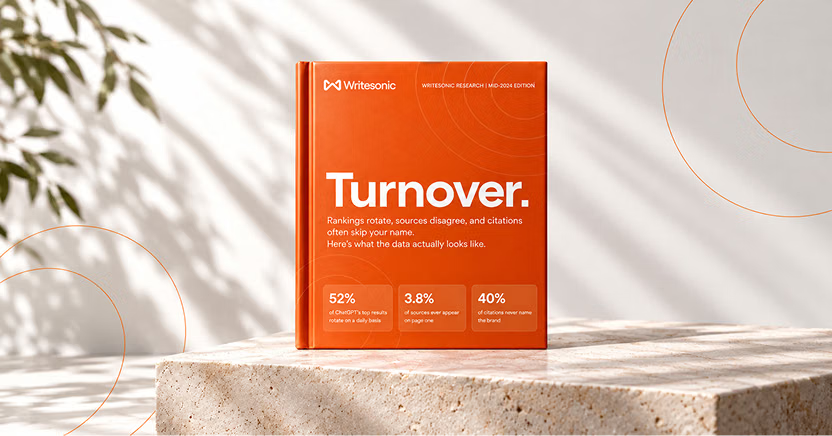
The #1 brand in ChatGPT changes 52% of the time.
Get the report and find out why.
How to do AI search optimization for small websites
Competing for AI citations as a small website isn’t about following generic SEO checklists. AI search platforms like ChatGPT, Perplexity, and Gemini use specific, measurable signals to decide what content deserves a mention.
Here’s a detailed, realistic breakdown of how small websites can actually increase their chances of being cited by AI tools—and why each step matters:
1. Target the content formats AI algorithms cite most
AI tends to prioritize sources that directly answer user questions, especially in structured formats. But this goes beyond just writing FAQs.
The data shows that support-style content, including help docs, how-to guides, and troubleshooting resources, consistently earns more AI citations. This type of content:
- Matches the question-answer structure AI models are trained to reproduce.
- Contains actionable, verifiable information AI tools can extract without interpretation.
- Avoids subjective or promotional language that AI struggles to process.
If your site focuses only on product pages, promotional blogs, or unstructured opinion pieces, you’re invisible to AI models.
💡 Pro tip: Audit your site. If less than 30% of your indexed content is formatted as structured, support-style material, AI likely can’t use you as a source.
2. Understand AI’s dependency on traditional search rankings
Many small site owners assume AI scans the entire web for sources. In reality, most AI citations come straight from Google’s top results.
Our data analysis of 500,00+ AI Overview results shows:
- 53.76% of AI overview citations are pulled from pages in the top 10 search results.
- Position 1 alone gives you a 40.80% chance of being cited.
But AI search engines don’t just favor high-ranking pages—they weigh citations toward the most dominant positions. Meaning, even if you sneak onto page one, the odds remain stacked toward the top 3.
For small websites, the practical implication is this:
Ranking in position 7-10 likely isn’t enough to secure AI citations unless your content has exceptional authority signals or fills a specific content gap.
Actionable step: Don’t just aim for page one—optimize aggressively for positions 1-3 on niche, high-intent keywords where larger competitors are weak. And remember, traditional SEO should still remain a priority even while optimizing for AI.
3. Structure your pages the way AI models process information
AI doesn’t “read” web pages like humans do. They parse content hierarchically, using headings, lists, and schema markup to understand structure.
But structure isn’t just about good UX—it’s directly tied to citation likelihood.
Here’s how to align your site structure with AI processing:
- Use H1 for your primary topic or title only.
- Break sections with clear H2 and H3 subheadings reflecting common search queries.
- Summarize key points in bullet lists or numbered steps—AI models extract these cleanly.
- Use clear and direct language. Provide answers to questions at the very beginning, so it’s not buried away, and reduce fluff language.
- Include tables for comparative information; structured data gets prioritized in AI outputs
- Use FAQ, HowTo, and Article schema wherever possible—this explicitly signals content purpose to AI crawlers.
AI-generated answers often cite content pulled directly from these structured sections, not full paragraphs or unstructured prose.
Many small websites stuff long, unstructured articles with keywords, assuming AI tools will parse them for answers. In reality, poorly structured pages get skipped entirely, even if they rank decently.
Plus, keyword stuffing is no longer an effective way to rank for SERPs or AI. Instead, websites should focus on search intent.
In fact, we analyzed over 660,000 Google AI Overview search results and found that 84% of the AI-generated results did not contain exact match keywords in the content. This goes to show that context is more important than an exact keyword match if you want to appear in AI search results.
4. Invest in original data and research, even at a small scale
AI search favors sources that add something unique to the conversation. That doesn’t always mean large-scale research. Even small websites can create original data that earns citations.
For example:
- Publish aggregated customer feedback trends.
- Run small, relevant polls with transparent methodologies.
- Analyze niche public datasets with clear, actionable takeaways.
- Document internal product usage statistics (if relevant and safe to share).
- Publish in-house eBooks and guides with in-depth data and statistics.
Why this works:
- AI models are trained to cite authoritative, verifiable data.
- Unique research gets cited by others, improving domain authority—a key AI ranking input.
- Original statistics reduce duplication, making your content a more attractive, unique, and credible AI source.
For example, our in-house analysis from the GEO tool itself is regularly cited across niches such as AI visibility and generative engine optimization, as it provides original insights that no other tool replicates.
💡 Actionable step: Identify 1-2 expert areas where your business can produce original, verifiable insights within the next 60 days, no matter how small the dataset.
5. E-E-A-T isn’t optional—AI models mirror human trust signals
Generative AI tools don’t inherently “trust” your content. They’re trained on vast web datasets that reflect human trust behavior. That means content showing clear Experience, Expertise, Authoritativeness, and Trustworthiness (Google E-E-A-T framework) has a higher chance of being cited.
Key trust indicators that impact AI citations:
- Author bylines with relevant expertise
- References to reputable third-party sources
- Clear, factual claims with citations
- Up-to-date content (AI tools favor freshness in most search categories)
- Secure, technically sound websites (slow or outdated sites get deprioritized)
For small sites, visibly demonstrating expertise is critical. AI tools don’t assume credibility—they calculate it based on structural signals and link equity.
6. Track AI visibility with GEO tools built for the job
Most AI platforms, including ChatGPT, Perplexity, and Gemini, strip referral data when they send users to your site. That traffic shows up as “direct” in Google Analytics, making it nearly impossible to track how your content is performing in AI search.
This is exactly where Writesonic’s GEO tool becomes useful, especially for small websites that can’t afford to guess where their traffic is coming from.
Here’s what GEO lets you track that your regular analytics tools can’t:
- When your content gets cited by ChatGPT, Perplexity, Gemini, or other AI platforms.
- Which specific pages on your site are being referenced by AI.
- What type of prompts, questions, or search topics are triggering those citations.
- Which prompts are not mentioning your brand.
- Historical data changes in AI visibility over time, so you know if your optimization efforts are working.
- Competitor AI visibility data and where they are appearing.
Most small site owners assume AI isn’t sending them traffic, when in reality, it’s happening in the background, invisible to their standard reports.
GEO takes the guesswork out. It gives you clear, page-level insights into how visible your site is in AI-generated answers and summaries.
That means you can:
- Identify your highest-performing content in AI search.
- Spot content gaps where your competitors are being cited but you’re not.
- See exactly which types of questions or prompts commonly surface your site.
For small websites, this is critical. Without this visibility, it’s impossible to know if your AI optimization efforts are paying off—or if you’re being completely overlooked.
The takeaway: AI search traffic may be hard to see, but it’s not impossible to track. GEO gives small websites a clear window into AI visibility, helping you spot early wins, fix blind spots, and build a real strategy for competing in AI search.
Most small site owners underestimate how much AI traffic they already receive because they can’t see it clearly in standard tools like Google Analytics.
Wrapping up
Smaller websites may get overlooked in traditional search, but AI tools like ChatGPT send a higher share of their traffic to small sites than to large ones.
The data proves it:
- Sites with fewer than 999 monthly visitors get a bigger percentage of their traffic from AI tools.
- ChatGPT alone drives nearly 67% of AI traffic to small websites.
But to get cited, your content needs to meet AI standards:
- Structured, support-style formats like FAQs and guides.
- Strong search rankings, especially in the top 10.
- Clear organization with proper headings and schema.
- Original, trustworthy information.
Tracking AI visibility with tools like Writesonic’s GEO helps you measure what’s working and where you’re getting cited.
Small sites can compete in AI search—but only if they approach it deliberately. The opportunity is real. The tactics are clear. Now it’s about execution.
Start with monitoring your AI visibility with Writesonic!
The #1 brand in ChatGPT changes 52% of the time.
Get the report and find out why.

Content Strategist
Saloni Kohli is a Content Strategist with over four years’ experience in B2B SaaS content marketing and SEO.
She has shaped and executed end-to-end content strategies—ranging from editorial planning and long-form thought leadership to conversion-focused landing pages and email campaigns.
At Writesonic, Saloni combines creativity with data-driven insights to elevate brand voice, drive organic growth, and maximize audience engagement.