
Key Takeaways
- You get cited by AI by being clear, credible, and consistent. Structure your content so it’s easy to understand, quote, and trust.
- Authority now extends beyond SEO. Strong branding, external validation, and factual precision help AI recognize and trust your content.
- GEO isn’t one-and-done; visibility shifts fast, so track, update, and refine it as part of your marketing strategy.
- Technical hygiene matters. Crawlability, schema, and structure determine whether AI can even find your content to begin with.
- Writesonic makes AI visibility measurable. From prompt tracking to citation insights, the dashboard shows exactly how visible and how credible your brand is inside AI answers.
Even if your brand is everywhere on Google, it might still be invisible to AI.
We’ve seen it across categories: companies that rank for every high-intent keyword don’t make it to ChatGPT, Gemini, or Perplexity-generated answers.
This “ranking on Google but vanishing in AI” gap is widening fast because visibility now means showing up in two ecosystems: traditional search and generative engines.
And AI engines don’t index like Google. They interpret. They look for content they can understand, verify, and trust; not just what’s keyword-optimized or backlink-rich.
But the problem is that most content wasn’t created to be understood by AI. Hence, why marketers far and wide now have to adopt Generative Engine Optimization: the process of making content citable by AI systems, not just crawlable by search engines.
AI Citations vs Mentions
It’s easy to treat every brand name appearing in an AI answer as a win, but that’s a dangerous shortcut. There’s a huge difference between being mentioned and being cited.
- Brand Mentions: Your name shows up in an AI response (for example, “Tools like Writesonic are popular for X”). No link, no deeper attribution, just a nod.
- AI Citations: Your content is explicitly referenced, often with a link, quote, or footnote, e.g., “According to [Brand X’s 2025 report]…” That’s a mark of trust.
In short, mentions get you in the conversation. Citations make you the source.
If you’re curious about optimizing for both, and why they matter in different ways, check out our deeper dive: AI Brand Mentions vs AI Citations
Why AI Citations Matter (for Marketers)
AI engines like ChatGPT, Gemini, and Perplexity are now redefining how people discover information. They don’t list search results; they generate answers, and in those answers, only a few sources get named. Those names are the new winners.
When an AI model cites a page, it’s essentially vouching for it (shortcut to trust). If a generative engine uses your content to explain something, it’s telling users, “Hey, this brand knows its stuff.” That kind of credibility used to take years of SEO, PR, and backlinks to build.
For marketers, that changes everything. That tiny line of text beneath an AI-generated paragraph does three big things:
- Builds instant credibility. If an AI system trusts your content, users likely will too.
- Drives warm, qualified traffic. People reading AI answers are already mid-research, often closer to a decision than a casual searcher.
- Doubles your visibility. At the end of the day, AI engines are a new discovery surface. If you optimize for LLMs as you optimize for Google, you’re visible across the most popular search channels.
While there’s overlap between SERP results and AI citations, the brands consistently showing up in AI answers aren’t necessarily the ones dominating Google. They’re the ones whose content AI can parse, verify, and quote without hesitation.
Early adopters are already reaping the benefits: higher authority perception, consistent referral traffic from AI engines, and first-mover advantage while everyone else is still arguing about whether “SEO is dead.”
Also, read our blog how GEO is different from Traditional SEO.
How AI Engines Pick Citations: Top 8 AI Ranking Factors
We’ve analyzed hundreds of pages that consistently get cited in AI answers, and found that the pages that consistently get cited tend to share eight common signals (the new “ranking factors” for generative search).
1. Semantic Relevance & Intent Alignment (Beyond Keywords)
When someone asks, “What’s the best time to post on LinkedIn?”, ChatGPT isn’t hunting for those exact words. It’s looking for content that addresses the underlying question: audience behavior, engagement peaks, posting patterns, and time zones.
Your content needs to demonstrate that it understands what the user is actually asking instead of just matching surface-level terms. This means answering the why, when, and how behind queries, and providing context that shows you grasp the full scope of the question.
The goal is to be the clearest, most complete answer to the user’s actual need.
2. Content Depth, Coverage & Topical Authority
AI can spot shallow content a mile away.
When engines like ChatGPT or Gemini pull information, they’re looking for sources that cover a topic completely, not just neatly. If your article only grazes the surface, it gets skipped for one that gives the full picture.
Comprehensive, well-organized explanations make the cut. If your page covers a topic like “email deliverability,” it shouldn’t stop at definitions. It should explain causes, metrics, tools, troubleshooting steps, everything a reader (or an AI) needs to form a complete answer.
But don’t mistake depth with word count. It’s about completeness: framework, context, examples, counterpoints, and data that backs up your take.
The goal is to make your page so comprehensive that an AI doesn’t need to stitch three others together to finish the thought. That’s how you build topical authority. The digital version of “Oh, this person actually knows what they’re talking about.”
AI engines reward that confidence, and they show it by citing you.
3. Format & Parseability
Humans and AI read differently.
When a generative engine scans your page, it’s not admiring your storytelling flair; it’s breaking your content into patterns it can recognize and reuse. Headings, bullet points, tables, and short, self-contained paragraphs act like breadcrumbs for the model to follow.
If your page is a single wall of text, AI will move on. But if it’s structured clearly, with logical headers, clean hierarchy, and bite-sized explanations, it becomes infinitely easier to extract and cite.
Content structure = accessibility for machines. The easier you make it for AI to “see” what matters, the more likely it is to quote you.
Also read: How LLMs interpret content.
4. Trust & Authority Signals
AI has trust issues, seriously.
When models like ChatGPT or Gemini decide what to cite, they’re quietly asking, “Can I trust this source?” That’s where your authority signals kick in.
Credibility for AI looks a lot like credibility for humans:
- Author or brand identity
- References or outbound links to reputable sources
- Mentions across other trusted sites
- Content that demonstrates experience, not just opinions
In SEO, this falls under E-E-A-T (Experience, Expertise, Authoritativeness, Trustworthiness). In GEO, it’s the same E-E-A-T principle, just verified by LLMs instead of Google’s algorithm.
If your insights come from real data, real expertise, or recognized coverage, AI notices. And when it trusts you, it cites you.
5. Freshness & Update Cadence
AI models strongly favor current information. If your article hasn’t been updated since 2021, it’s essentially invisible, no matter how good it once was.
Freshness doesn’t mean rewriting everything every month. It means keeping your best pages updated by adding new data, refining examples, updating screenshots, and signaling the date of those changes.
Each refresh is a reminder that your content isn’t collecting dust. And over time, that steady upkeep builds a pattern AI engines start to trust.
Simply put, if your site looks active and reliable, AI is far more likely to quote it.
6. Technical Accessibility
You can’t get cited if the model can’t reach you. Your content might be brilliant. But if it lives behind broken markup, you’ve basically published it into a void.
A lot of great content never makes it into AI answers because it’s trapped behind bad tech, slow load times, heavy JavaScript, or robots.txt settings that quietly tell crawlers to stay away.
Generative engines need clean, accessible pages they can actually parse. That means:
- Fast-loading, mobile-friendly layouts
- Text that renders in HTML (not hidden in images or scripts)
- Logical URLs and internal linking that help engines map your content
7. Multi-Source Corroboration & External Validation
When generative engines build answers, they don’t rely on a single source. They look for corroboration. If multiple credible sites reference the same data, insight, or brand, that signals reliability to the LLMs.
This is why your visibility outside your own domain matters. Media mentions, research citations, guest posts, podcast features, even Reddit discussions. All of it contributes to the same goal: showing AI that your expertise is recognized and validated externally.
Also Read: Reddit AI Visibility Playbook
One source is an opinion. Multiple independent sources become a consensus. If your perspective appears across varied, authoritative domains, you look like an expert worth citing rather than just another brand making claims on its own blog.
To maximize citation potential, you need to publish externally, collaborate, and get quoted. Make your authority impossible to ignore.
8. Structured Data & Schema
Structured data in AI search gives models an instant read on your content: here’s the headline, here’s the author, here’s the actual answer.
Tags like FAQ, HowTo, Article, and Product turn your page from a wall of text into something AI can parse in seconds. And if a model doesn’t have to work hard to interpret your content, it’s far more likely to cite it.
Schema is basically the difference between handing someone a labeled filing cabinet versus a pile of loose papers. One’s just easier to work with.
How to Get Cited by AI: 8 Strategies That Actually Work
This is where the real work begins. We’re breaking down the eight strategies behind brands that consistently get mentioned, cited, and trusted by generative engines (drawn from thousands of prompt tests, AI citations, and real data).
1. Audit & Benchmark Your AI Citations
Before you optimize for GEO, you need to know where you actually stand. Spoiler: most brands don’t.
So, start by acting like your audience. Find and run prompts on ChatGPT, Gemini, and Perplexity. The same kind of questions real users ask, for example: “what are the best generative engine optimization tools,” “how to improve AI visibility,” “top AI content platforms”, and so on.
Now look at who shows up. Which brands get mentioned? Which pages get cited? Which ones don’t? Keep noting these points.
Take note of the patterns: are the cited pages structured as lists or how-tos? Are they recent? Do they come from big-name domains or specialists? This tells you what kind of content AI trusts.
Then, reverse-engineer those layouts for your own content.
If ChatGPT consistently cites “Top 10” or “Best X for Y” articles in your niche, publish your own version, just better, clearer, and fresher.
You don’t need to “trick” the system. You just need to structure information the way machines naturally read it. Or you can skip the manual digging and use tools like Writesonic to see which pages are earning citations across your category and save hours of trial and error.
Skip the manual prompt testing altogether. Switch to Writesonic and automate the whole audit, we benchmark your mentions, citations, and visibility across AI engines so you can see where you stand and what you need to succeed.
2. Craft an AI-Friendly Content Structure
The majority of content that’s ignored by AI isn’t bad per se, just very hard to parse.
AI mostly pays attention to the patterns, structure, clarity, and other factors, and to ensure AI cites your content, all you need to do is make the process effortless:
- Break your content into digestible blocks
- Use short sections and clear subheads
- Include tables or lists where it makes sense
- Keep definitions crisp
A single line like “GEO is the process of optimizing your content to appear in AI answers” is easier for models to pick up than three paragraphs that dance around the point.
Use schema markup where it makes sense, FAQ, HowTo, Article. It’s not a silver bullet, but it helps AIs understand relationships between questions, steps, and definitions.
3. Strengthen Entity and Brand Signals
No matter how good your content is, if your brand name, product, or key entities are vague or inconsistent, AI won’t understand what to connect to you. As a result, you get skipped in answers even if your content deserves to be there.
So, focus on strengthening your entity and brand signals. Add trust signals that give AIs confidence:
- Mention awards or recognition: “Writesonic was named among the top AI content platforms by G2.”
- Reference unique features or tools: “Writesonic’s Brand Presence Explorer measures AI mentions and citations in real time.”
- Link to credible third-party sources like media mentions, podcasts, or research collaborations, external validation helps AI engines connect your name with authority.
And don’t ignore the tone. AI also interprets how you describe yourself. If your copy sounds scattered or self-contradictory, models will reflect that confusion.
4. Earn External Validation & Shape AI Sentiment
AI engines read everything said about you. If your brand only exists on your own site, you’re invisible in the wider ecosystem that models use to measure authority.
Mentions in reputable sources like industry blogs, podcasts, news outlets, research reports, and more act as credibility signals. They tell AI engines you’re real, active, and trusted beyond your own domain.
Let’s say, if Gemini finds “Writesonic’s latest study was cited by Search Engine Land,” that reference doesn’t just add visibility, it boosts perceived authority.
And just like humans, AI doesn’t stop at what is said; it analyzes how it’s said.
If the web consistently frames your brand as credible, reliable, and leading, that tone compounds inside AI answers. But if it frames you as outdated or irrelevant, that perception follows you, too.
This is where sentiment analysis comes in. With tools like Writesonic, you can see if AI describes your brand positively, neutrally, or negatively and take actionable steps to improve it.
5. Keep Content Fresh
Generative models are trained to prioritize recency and reliability. If your data’s old or your examples reference trends from two years ago, you’re signaling to AI that your content may no longer be relevant.
The fix is simple, but it requires discipline:
- Set a refresh cadence. Audit your top-performing content every quarter. Update stats, screenshots, and examples to keep them current.
- Add new data or insights. If your last study was in 2023, include 2025 benchmarks. Fresh input = fresh visibility.
- Make updates visible. Add a “last updated” timestamp to show both users and crawlers that your content is alive.
- Reframe outdated claims. If a tool, trend, or regulation has changed, address it directly. AI engines value factual precision.
And if you want to stop playing calendar roulette, Writesonic’s dashboard tracks when your AI citations start dipping, giving you a clear sign your content’s due for a refresh.
6. Technical Optimization
A few silent blockers can kill your AI visibility without you noticing.
Start with the basics:
- Crawlability: Make sure your important pages aren’t blocked in robots.txt. AI engines often rely on open access to index and understand content.
- Speed & structure: Slow pages and broken links are visibility killers. Fix 404s, clean up redirects, and compress heavy assets.
- Readable markup: Keep headers logical (H1 → H2 → H3), use descriptive alt text, and ensure metadata accurately summarizes your page. These help AI interpret your hierarchy, not just your keywords.
- API & embedding readiness: Generative engines often pull from structured sources and APIs. Ensuring your site has clean, accessible data endpoints (or at least well-marked structured content) helps models surface your info faster.
Or, to avoid technical blind spots, use Writesonic’s Action Center to automatically find technical issues tied to AI visibility drops. It flags crawl errors, missing metadata, or sudden declines in citations.
7. Test & Iterate Based on Your GEO Insights
Much like SEO, GEO is a continuous process. Even more so, given how prone to change the field still is—that gets cited today might disappear tomorrow; so you don’t just need to optimize once, you need to adapt as per the changes.
Start by tracking what’s working:
- Which queries or prompts cite your brand most often?
- Where are your competitors gaining visibility while you’re fading?
- Which content formats and topics consistently get referenced by AI engines?
Analyze and then act on these insights. Let’s say:
- If you’re getting mentions but not citations, strengthen entity clarity.
- If your citations drop, check freshness or technical signals.
- If competitors suddenly appear where you don’t, study their structure and replicate what works, better.
Tools like Writesonic can help you track brand mentions, citations, sentiment, and competitor visibility, then optimize as per the recommendations and boost AI visibility.
How Writesonic Helps You Get Cited in AI Answers
Let’s walk through what GEO actually looks like in action and how Writesonic helps you go from invisible to cited.
Step 1: Add and Track Customized Prompts
Start with the prompts you actually want to be cited in, the high-intent ones your audience uses most. You can either add your own custom prompts or start tracking the ones we suggest based on millions of user data points.. Head to Prompts Overview, where you’ll see:
- How many AI answers mention your brand
- Which competitors dominate those prompts
- Which engines you’re missing from
This gives you a baseline, where you stand and where you’re silent.
Step 2: Find Citation Gaps
Next, go to the Citations Overview tab. Here’s where you see exactly which domains AI engines are citing, how often your pages appear, and what authority scores they carry.
You’ll spot which content earns citations and where competitors are winning, the perfect hit list for optimization. Next, you can go to citation opportunities to find sites that cite your competitors but not you. Or, you can directly go to the Action Center (covered in the next step!)
Step 3: Take Action via Action Center
Once you know what’s missing, it’s time to fix it. Head to Action Center, where Writesonic automatically surfaces opportunities like:
- Prompts where you’re missing but competitors appear
- Pages that lost citations week-over-week
- Mentions that aren’t yet linked back (potential citation gains)
- Content flagged as stale or structurally weak for AI parsing
From here, you can prioritize quick wins, refresh content, earn mentions on UGC, or get mentioned on high-authority third-party sites, all without leaving the dashboard.
Step 4: Monitor the Overall Impact
Finally, track how those changes perform. Go back to the Overview Dashboard to watch your AI visibility trend over time, across engines, prompts, and competitors.
Metrics like AI Visibility, Answers Mentioning Me, and Your Share show real movement as your brand starts getting cited more often and more positively.
This is how Writesonic can help you do every day: track, optimize, and own your visibility inside AI answers.
Be the Brand AI Can’t Ignore
Getting cited by AI isn’t magic. It’s the byproduct of clarity, credibility, and consistency.
Generative engines reward understanding; they pull from sources that are structured, recent, and trusted across the web. That means the path to AI visibility looks a lot like good marketing has always looked: say something worth repeating, and make it easy to quote.
The difference now is the reader. You’re no longer writing just for people; you’re writing for the machines shaping what people see, believe, and buy.
Writesonic shows you how AI interprets your brand, where you’re being mentioned (or missed), and what to fix to earn citations that stick. Because in the end, the brands that will dominate AI search aren’t the loudest, they’re the clearest.
See Writesonic in action.
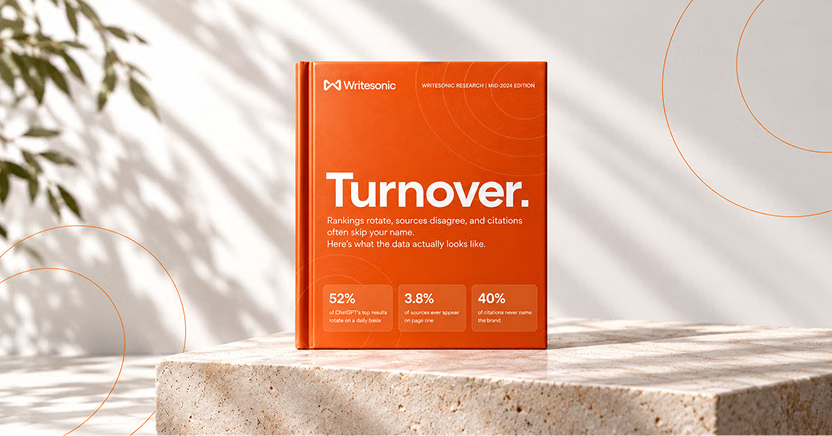
The #1 brand in ChatGPT changes 52% of the time.
Get the report and find out why.

Content Marketer
Pragati Gupta is a Content Marketer @Writesonic, specializing in AI, SEO, and strategic B2B writing. Leveraging the power of Generative AI, she produces high-impact content that drives superior ROI.