Your customers are asking ChatGPT, Claude, and Perplexity about your industry every day. The problem isn't that AI search is happening. It's that you can't see it.
Which prompts drive real volume? Which ones carry genuine purchase intent? Is your brand showing up when those questions get asked, or is a competitor?
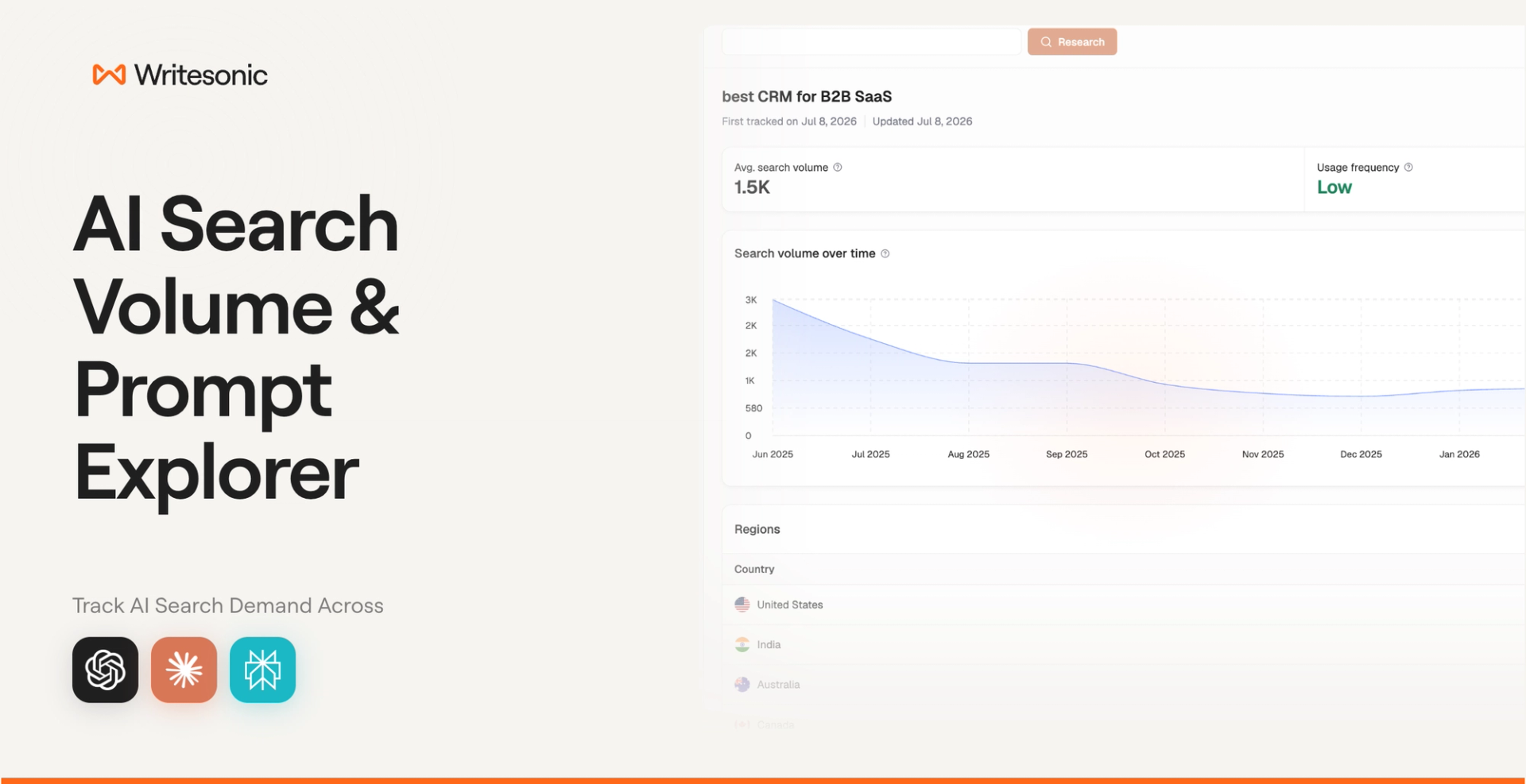
Prompt Explorer answers all three. Enter any prompt, get the estimated monthly volume behind it, see which regions are driving demand, and find out which brands are winning those answers. It also surfaces thousands of related prompts you haven't thought to target yet.
What is AI search volume?
AI search volume is the estimated number of times a specific prompt is asked across AI platforms like ChatGPT, Claude, and Perplexity in a given month.
It's not borrowed from Google keyword data. It comes from how people actually talk to AI engines, and that's a meaningfully different behavior. Someone asking "best CRM for a remote startup with 15 people" and someone asking "what CRM works well for small distributed teams" have identical intent but produce completely different strings. AI search volume groups them together and counts the total.
Why your Google keyword data doesn't transfer
Navigational queries like "Monday.com login" or "Asana pricing" get millions of Google searches because people want a direct link. Those same queries show near-zero volume on AI platforms. Nobody asks ChatGPT for a URL.
Commercial queries go the other way. "Best tool for tracking team projects" has modest Google search volume but significant AI platform usage. That's where real purchase intent lives on AI engines: recommendation questions, comparisons, use-case queries. The kind of question someone asks when they want a considered answer, not a link.
Tools that assume Google keyword volume maps proportionally to AI chat volume produce estimates that work fine for Google and mislead you everywhere else. The intent structures are different, the query lengths are different, and the user behavior is different.
The fragmentation problem
Here's what makes AI search tracking harder than it looks.
A head term like "project management tool" doesn't appear in AI conversations as one phrase. It fans out into dozens of distinct natural-language expressions, each reflecting a different persona or use case:
- "suggest a project management tool for small teams"
- "which project management software is most user-friendly?"
- "best tool to manage agile development teams"
- "free project management tools for startups"
- "what's the best project planning software?"
Each one looks different. The underlying need is the same.
Tools doing simple keyword matching only capture the head term. They miss every long-tail variation, which is also where most real commercial intent sits in AI conversations. You end up drastically underestimating actual demand, and you optimize for the prompts that are easiest to find rather than the ones that convert.
The Solution: Prompt Explorer with AI Search Volume Data
Our new Prompt Explorer combines AI prompt discovery with real search volume data, giving you both the questions to target and the volume to prioritize them.
It’s your AI prompt research tool that reveals exactly what questions people ask AI platforms about your industry. For every prompt you enter, you can find the total volume and its country-wise distribution.
That’s what makes it revolutionary: AI Search Volume.
Our new AI Search Volume feature shows you exactly how many people ask each prompt across all major AI platforms on a month-on-month basis. Powered by our dataset of 2B+ real AI conversations, we can predict monthly volume for any AI prompt, even highly specific ones like:
- “best CRM for remote startup with 15 people” → 5770 monthly queries
- “project management software for agencies under $50/month” → 6600 monthly queries
- “what’s the most user-friendly tool to manage client projects” → 33810 monthly queries
This isn’t guesswork. Our predictions are based on patterns observed from real user behavior across platforms like ChatGPT, Claude, Perplexity, and other platforms to give you the most accurate AI search volume predictions available.
Where Writesonic's prompts come from
Most AI search analytics tools generate their prompt sets synthetically, using AI to produce representative variations of what users might ask. Writesonic builds its prompt universe from real market signals instead.
Before any volume estimation runs, candidate prompts are sourced from Google Keyword Planner, Reddit threads, People Also Ask results, and actual chat data drawn from a 2B+ conversation dataset (a combination of Writesonic's proprietary data and contracted third-party datasets).
Those signals aren't used as raw keywords. They're converted into natural, full-length prompts that reflect how people actually phrase things when talking to an AI engine. The 2B+ dataset acts as a grounding layer throughout, so the final prompts mirror the personas, phrasings, and question structures that appear most frequently in real conversations. They read the way a real person types, not the way an AI model predicts someone might.
Every candidate prompt is then vetted for relevance against the specific topic being researched. Anything that doesn't represent genuine user interest gets removed before volume estimation begins.
The practical result: prompts that sound like what humans actually ask, not polished synthetic variations built to look comprehensive.
How Writesonic predicts AI search volume
Intent matching, not keyword matching
Most volume tools do keyword matching. Search "project management tool" and they return the volume for that exact phrase.
Writesonic's Volume Prediction AI Agent does intent matching. For the same head term, it identifies the full set of distinct intents that appear against it in the 2B+ dataset: recommendation queries, comparison queries, pricing questions, use-case queries, team-size queries. Each intent cluster carries its own observed frequency from actual chats.
Those frequencies aggregate into a single volume estimate, representing total addressable demand for that intent, including every long-tail variation that keyword approaches never see. One number. The full picture.
A two-part ensemble, not three
Volume estimation runs on two signal types, not three.
The first is a keyword-based volume estimate, built the way traditional tools like Google Keyword Planner build theirs. The second is the 2B+ real-chat dataset itself: a mix of Writesonic's proprietary conversation data and data licensed from contracted third parties.
Pairing the two matters because search behavior and chat behavior diverge. Someone searches "Asana login" because they want a URL, fast. Nobody phrases that as a chat prompt. A keyword-only estimate would treat that term as high-volume everywhere. Chat data alone wouldn't tell you how a term performs on the channel that most volume tools were built for. Reconciling the two corrects for the behavioral gap between search and chat.
Quality controls before you see any number
Four checks run on every estimate:
- Automated anomaly detection and outlier flagging
- Confidence scoring per prediction
- Intent cluster validation across multiple data sources
- Source attribution with reliability metrics
Knowing the confidence behind a number matters as much as the number itself. Volume data without quality signals leads to bad prioritization, and bad prioritization is the whole problem AEO is trying to solve.
Why some prompts show "Low volume"
Run a genuinely niche prompt through Prompt Explorer and you'll sometimes see "Low volume" instead of a specific number.
That's not a sign demand doesn't exist. It means the prompt is specific enough that it falls below what we can measure with confidence. The 2B+ conversation dataset is large, but it isn't infinite, and a narrow enough long-tail prompt, a specific persona paired with a specific use case, can produce too few observed instances to turn into a reliable number. Below that threshold, we show "Low volume" rather than guess at a figure we can't stand behind.
What Prompt Explorer shows you
Enter "What are the best design tools" and click Research. You get back:
- 22k average monthly volume across ChatGPT as a platform
- A 12-month trend showing how global interest in that prompt has moved
- Region-wise demand breakdown (India, US, UK, Canada, Australia rank highest)
- Top brands appearing in AI answers for that prompt: Canva, Adobe Firefly, Figma, Sketch, Adobe Express
Specific prompts carry real volume too. "Best CRM for remote startup with 15 people" pulls 5,770 monthly queries. "Project management software for agencies under $50/month" pulls 6,600. "What's the most user-friendly tool to manage client projects" pulls 33,810.
Those numbers tell you what to build content around. Without them, you're making AEO decisions the way SEOs made keyword decisions before Google Keyword Planner existed.
How Writesonic compares to single-source tools
Some AI search analytics tools pull from one verified third-party data source. That gives you clean provenance for one stream. What it doesn't give you is breadth across how people actually talk to AI engines across contexts, platforms, and use cases.
The more fundamental difference is in how prompts are generated. Tools that build their prompt sets using AI models produce statistically plausible representations of what users might ask. Writesonic starts from real observed language in actual AI conversations, so the prompts reflect the specific phrasings, personas, and question structures that appear most in real chats.
Both approaches involve modeling. The gap is in what you're modeling from.
The Result
While most competitors rely on a single source or average volumes blindly, our ensemble methodology, keyword-based estimates reconciled against 2B+ real chat conversations, grounds your decisions in observed behavior, not a single, incomplete signal.
How to get started
- Open Prompt Explorer in your Writesonic dashboard
- Enter any prompt you want to research (e.g. "best CRM for remote teams")
- Review the monthly volume estimate, confidence indicator, and geographic breakdown
- Explore the related prompts Writesonic surfaces for that intent cluster
- Use the volume and trend data to prioritize which prompts to build content around
- Track brand mentions and competitor rankings in AI answers for your highest-volume prompts
The early movers in SEO dominated search for 15+ years. This is that moment for AI search.
Questions about AI Search Volume or Prompt Explorer? Our team is here to help. Reach out to [email protected]
Prompt Explorer immediately shows you the estimated monthly AI search volume across platforms.
The #1 brand in ChatGPT changes 52% of the time.
Get the report and find out why.

Founder @ Writesonic
Samanyou is the founder of Writesonic, a platform that helps you track & boost your brand’s visibility in AI search. Two years before the launch of ChatGPT, Writesonic was already at the forefront, helping organizations automate their entire marketing workflow through specialized AI agents for SEO and content. Samanyou is a Forbes 30 Under 30 awardee and a winner of the 2019 Global Undergraduate Awards, often referred to as the junior Nobel Prize.