For years, search ran on a symbiotic relationship. Google freely accessed the internet’s content to attract people and, in turn, sent traffic to the respective websites.
With AI’s arrival, that has become pretty one sided. AI uses the content but doesn’t credit or cite the source, meaning — a win for AI but a loss for content creators, publishers, and website owners.
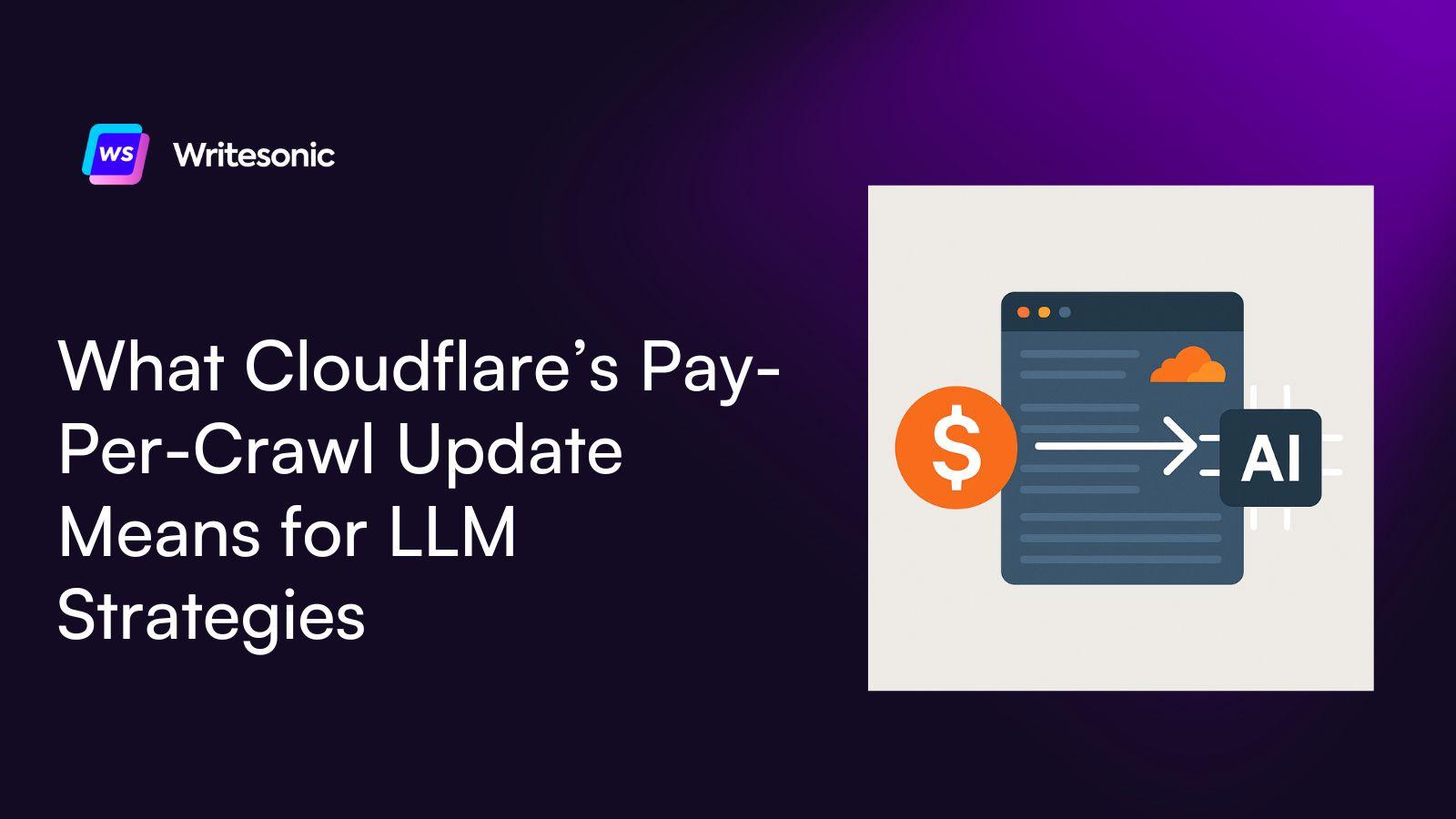
Cloudflare decided to change that with its newly introduced “pay-per-crawl” — making content payable for AI crawlers and giving website owners a much-deserved new source of revenue.
But does it affect your LLM strategy? Let’s find out.
What is Cloudflare’s Pay-Per-Crawl?
Cloudflare’s Pay-Per-Crawl is a new feature that lets website owners charge AI companies every time their bots crawl a website. In simple terms, it turns your content into something AI tools have to pay to access, instead of getting it for free.
Right now, large language models (LLMs) like ChatGPT or Claude scan websites across the internet to gather content.
They use this content to train their models or generate answers when someone asks a question. The problem? They do this without asking, without paying, and without giving you traffic or credit.
Cloudflare decided it’s time for a change.
With Pay-Per-Crawl, any site using Cloudflare can now control which AI bots are allowed in — and set a price if they want to get in. That means AI companies that want to crawl your site for data will have to follow your rules, and in many cases, pay per request.
Here’s why that matters:
- You get to decide who uses your content — and how.
- You can finally monetize the value your content provides to AI search engines.
- You gain more control over your data, brand, and traffic.
It definitely gives you more control over who can access your content. But it also comes with a catch:
Pay-per-crawl will make AI engines more selective. They won’t pay to crawl everything. They’ll focus on the best, most useful, most trustworthy content.
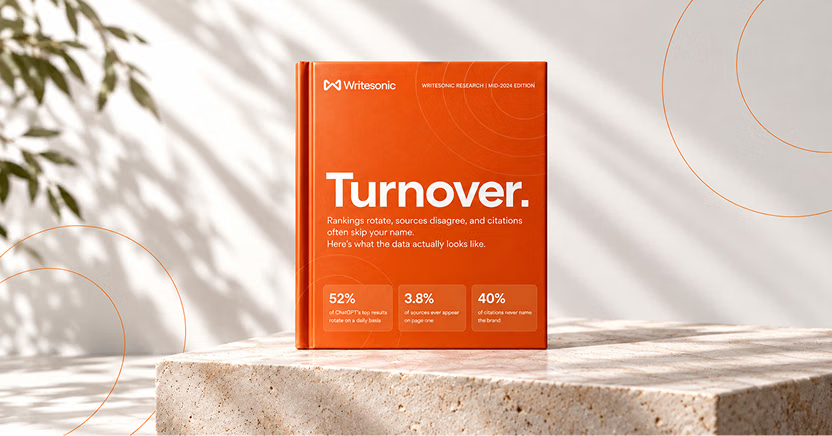
The #1 brand in ChatGPT changes 52% of the time.
Get the report and find out why.
Impact of Pay-Per-Crawl on Your LLM Strategy
Cloudflare’s Pay-Per-Crawl will change how LLMs approach data:
Diminished Free Training Data for LLMs
As more websites block or charge AI crawlers, the amount of freely available training data for large language models (LLMs) is shrinking. This directly impacts how models learn, update, and choose which content to reference.
- LLMs will rely more on older training data, which may be outdated or incomplete.
- The variety and diversity of content used to train models will narrow, limiting coverage across industries and topics.
If AI models didn’t favor your website during initial training, probably because your content was difficult to read or not optimized for AI search engines, featuring in the AI model’s answers can become difficult.
Even if AI can access most content freely through search engine integrations like Bing or Google, it might end up favoring only those sites that were part of its initial training.
If you want to be part of the AI engine database, optimizing for it early on is your best bet.
Increased Expense Drives AI Crawler Selectivity
As crawling becomes a paid activity, AI companies will become far more selective about what they choose to access. When every request costs money, models will stop crawling broadly and start prioritizing content that offers clear, measurable value.
This marks a shift in how content is evaluated.
AI crawlers won’t treat all pages equally. They’ll prioritize content that meets specific criteria — the same way Google filters for quality, relevance, and authority before ranking a page.
Expect models to favor content that is:
- High quality — factually accurate, deeply researched, and clearly written
- Authoritative — backed by a strong domain, credible authorship, and consistent topical expertise
- Well-structured — easy to parse, with clean formatting, clear hierarchy, and semantic markup
- Exclusive or differentiated — offering information or insight not easily available elsewhere
If your content doesn’t meet these standards, it’s unlikely to be considered worth the crawl — especially when cost is a factor. Generic, outdated, or surface-level content will likely be skipped entirely.
This puts added pressure on not just content creation, but content optimization.
Websites that are optimized for generative engines (GEO) are better positioned to be selected. GEO helps you align with what AI crawlers look for — clarity, structure, and value. It’s not just about being accessible. It’s about being understandable, trustworthy, and useful enough to justify the crawl cost.
In a pay-per-crawl environment, inclusion isn’t free — it’s earned. GEO is how you prove your content deserves to be in the model.
I Want to Keep My Content Free. Should I Still Invest in GEO?
It might seem easier to keep your content freely accessible and avoid investing time or resources into optimizing it for AI. But in the long run, that approach can lead to greater losses — both in visibility and revenue.
Here’s why:
- AI engines are becoming the default way people search.
As more users shift from traditional search engines to generative platforms, zero-click answers are rising. That means fewer people are visiting websites directly. If your content is free but not favored or cited by AI systems, you lose traffic — and with it, the opportunity to convert, retain, or monetize.
- Paid content is more likely to be valued.
When AI crawlers are forced to pay, they’ll assume that the content behind that paywall has value. Models may begin to associate paid access with higher quality — especially if that content consistently meets criteria for clarity, accuracy, and depth.
- Perception matters.
If AI systems start labeling or distinguishing paid sources, users may begin to view paid content as more trustworthy by default. If your content is free and unoptimized, your brand could get sidelined — not because of quality, but because of how the ecosystem frames value.
- Long-term loss vs. small, upfront investment.
The cost of not being included in AI answers is much higher than the effort required to make your content more AI-readable. A small investment in structuring and formatting your content — even modest changes — can make a significant difference in whether you’re selected, cited, or excluded entirely.
You don’t need to overhaul everything. But you do need to ensure your content can be understood, trusted, and chosen by AI systems — whether it’s behind a paywall or not. Ignoring that will cost more than optimizing for it.
Final Thoughts: What Cloudflare’s Pay-Per-Crawl Update Means for Your LLM Strategy
Pay-per-crawl signals a clear shift: AI will no longer index everything. Only the most valuable, structured, and accessible content will make it through.
If your site isn’t optimized for how LLMs evaluate and reference content, you risk being left out — even if your content is excellent. The good news? You can stay ahead by making your content machine-readable and AI-preferred from the start.
Use Writesonic to structure, optimize, and future-proof your content — so it’s not just available, but actually used by the AI systems that matter.
The #1 brand in ChatGPT changes 52% of the time.
Get the report and find out why.

Niyati Mahale is a SEO/GEO Content Writer @Writesonic. She specializes in artificial intelligence and B2B, with a flair for combining effective storytelling and SEO best practices to create impactful content.