Google has officially launched its second Core Update of 2026, and as expected, the SEO industry is already analyzing ranking fluctuations, traffic shifts, and visibility changes. While those short-term movements will dominate discussions over the next few weeks, I believe the bigger story lies in what this update reveals about Google's long-term direction.
Google's messaging hasn't changed. The company says the update is designed to surface more relevant and satisfying content for users. However, the search landscape of 2026 looks very different from the one we optimized for just a few years ago. With AI Overviews, AI Mode, and AI-powered search experiences becoming increasingly prominent, Google is no longer simply ranking webpages. It is retrieving, evaluating, and synthesizing information before presenting it to users.
The Real Challenge Facing Google Today
Historically, Google's job was relatively straightforward: identify the most relevant page for a query and rank it accordingly.
Today, the challenge is much more complex.
When AI-generated answers become part of the search experience, Google is no longer simply choosing which page ranks first. It is deciding which sources deserve to influence the answer itself.
That means Google's systems need to answer questions such as:
- Can this information be trusted?
- Does this source demonstrate genuine expertise?
- Is the content adding value beyond what already exists?
- Would this source be safe to cite within an AI-generated response?
These questions go beyond traditional SEO signals and explain why Google's focus on "helpful content" continues to evolve.
Why Generic Content Is Becoming Increasingly Vulnerable
One of the biggest misconceptions in SEO today is that Google is actively fighting AI-generated content.
I don't think that's the case.
What Google appears to be fighting is content that lacks differentiation.
Over the last two years, the internet has been flooded with content covering the same topics, using the same frameworks, and often reaching the same conclusions. Whether that content was written by humans or AI is almost irrelevant.
The bigger issue is that much of it adds little new value.
As AI-generated content becomes easier to produce, originality becomes more important. Google needs a reliable way to identify content that contributes genuine expertise, unique insights, first-hand experience, or meaningful analysis.
The websites most likely to benefit from future updates are those that can answer a simple question:
"What makes this page worth surfacing instead of the hundreds of similar pages available online?"
Authority Is Becoming More Important Than Volume
Perhaps the clearest trend emerging from recent updates is Google's growing emphasis on authority.
For years, SEO success was often associated with content scale. More content created more opportunities to rank, which created more opportunities to generate traffic.
That approach is becoming less effective.
Increasingly, Google appears to be evaluating not only the content itself but also the credibility of the source behind it.
This includes signals such as:
- Topical expertise
- Brand recognition
- Author authority
- External citations and mentions
- Consistency across a subject area
In other words, Google is moving closer to evaluating entities rather than simply evaluating pages.
For brands, this means visibility is no longer purely an SEO challenge. It is also a reputation challenge.
What This Means for SEO Teams
If my interpretation of this update is correct, then many SEO strategies will need to evolve.
The focus should shift away from publishing as much content as possible and toward creating content that demonstrates expertise and builds trust over time.
That means investing more heavily in:
- Original research and data
- Expert-led content
- Digital PR and brand visibility
- Topical depth rather than keyword expansion
- Content that offers unique perspectives rather than summarizing existing information
The objective should no longer be to simply rank.
The objective should be to become a source that Google consistently trusts.
The Final Say
The May 2026 Core Update doesn't look like a dramatic change in Google's direction. Instead, it looks like another confirmation of where Search is heading.
Google's challenge is no longer just finding relevant content. It is identifying trustworthy sources in a world where content can be created faster and at greater scale than ever before.
That's why I believe the biggest winners from this update won't necessarily be the websites with the most content or the most aggressive SEO strategies.
They will be the websites that have invested in expertise, built authority within their niche, and earned trust both on and off their website.
As AI becomes more deeply integrated into Search, those qualities are likely to matter even more.
And if there's one lesson marketers should take from the May 2026 Core Update, it's this:
Trust is no longer a supporting ranking signal. It's becoming the foundation of search visibility.
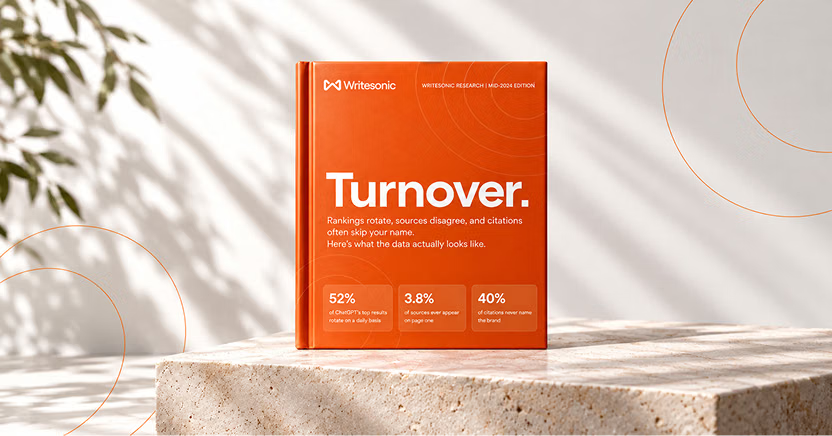
The #1 brand in ChatGPT changes 52% of the time.
Get the report and find out why.

GEO Strategist at Writesonic
Rohit is an GEO Strategist at Writesonic with nearly a decade of experience driving organic growth across industries. Over the past 9 years, he has partnered with brands across BFSI, ecommerce, and B2B SaaS, helping them turn search visibility into measurable revenue. His expertise lies in Generative Engine Optimization (GEO) and AI Search, where he crafts strategies that help brands earn placement in answers from ChatGPT, Perplexity, Google AI Overviews, and beyond.