Despite investing heavily in SEO and content creation, many brands find their content missing from AI Overviews – the concise, authoritative summaries generated by Google’s AI.
This isn’t due to chance.
Your content might be overlooked because it’s not ranking high enough on SERPs, lacks the authority AI models trust, isn’t structured for AI to easily interpret, or simply doesn’t match the specific intent behind user queries.
So if you’re investing time and resources in content creation but noticing your content isn’t showing up in these AI overviews, this blog is for you.
Plus, you will also see how Writesonic’s Generative Engine Optimization (GEO) tool can help you monitor and improve your AI visibility. Let’s get started.
What Are AI Overviews And Why Do They Matter?
AI overviews are short, informative summaries generated by Google’s AI model, Gemini, in response to user queries. Unlike traditional search engines that simply list links, AI assistants synthesize content from various high-authority sources to deliver concise answers.
This means your content being featured in these overviews can significantly increase brand awareness, credibility, and drive traffic. But, as of now, only a fraction of online content makes it into these coveted AI citations.
Here’s a quick guide on Google AI Overview Optimization and how to rank in AI Overviews.
What Influences Inclusion in AI Overviews? The Data Speaks
Inclusion in AI Overviews isn’t random; it’s driven by multiple key factors that AI models and algorithms prioritize when selecting content. Here are the most critical, data-backed influences:
1. SERP rankings matter more than ever
Data from Writesonic’s analysis of over 1 million AI overviews confirms that AI assistants overwhelmingly cite pages ranking in the top 3 organic positions on Google. Ranking high is a prerequisite because AI models rely on trusted, authoritative SERP results as source material.
Our research analyzing over 1 million AI Overviews shows a strong correlation between your organic search position and AI Overview citations.
- There’s a staggering 81.10% chance that at least one URL from Google’s top 10 SERP results will be cited in an AI Overview.
- If you are ranking #1 on SERP results, there’s a 33.07% chance that you will be in AIOs.
Read more about how SERP ranking affects AI citations.
This means your traditional SEO efforts are foundational; you need to rank organically first before AI can include your content in overviews.
2. High DA (Domain Authority) is a key factor
A recent Writesonic study on the top 200 cited domains found:
- Domains with a Domain Rating (DR) between 88-100 averaged 6,000+ AI citations, far outpacing domains with lower DRs.
- Sites in the 63-88 DR range had fewer citations by a large margin, with those below 63 rarely cited at all.
What this means: AI assistants rely heavily on established domain authority as a trust signal. High DR sites are more likely to be featured in AI Overviews.
3. Content length and depth still matters
As per our study, nearly 60% of AIOs are 100-300 words.
This suggests that AI assistants prioritize content that thoroughly addresses a topic, providing detailed explanations, data, and examples.
Thin, superficial content lacks the substance AI needs to confidently extract and summarize answers, resulting in lower chances of citation.
4. Use of long-tail and question-based keywords aligns with user intent
Our study shows that long-tail keywords and question-based queries are dominating, reflecting more specific, intent-rich queries.
AI systems prioritize content that precisely answers these targeted questions. Content optimized around these keywords with clear, direct answers is more likely to be chosen, making keyword strategy vital for AI inclusion.
5. Context matters more than exact keyword matches
One of the most surprising insights from Writesonic’s analysis is that nearly 85% of AI overviews do not contain the exact original search query.
This means AI models prioritize understanding the context and intent behind queries rather than looking for exact keyword matches in the source content.
The data shows only about 15.8% of AI overviews include the exact query terms, indicating that semantic relevance, topical authority, and contextual alignment outweigh strict keyword presence. This shows that content that offers rich context and comprehensive answers is far more likely to be cited by AI systems.
Why Your Content Might Be Missing From AI Overviews (Beyond Basics)
If your content isn’t showing up in AI overviews despite solid SEO efforts, the issue often goes deeper than surface-level tactics. Here’s why your content might be overlooked by AI, with a focus on nuanced, data-backed factors that many miss:
1. You’re ranking well, but not in the crucial top 3 positions
AI overviews predominantly cite content from the top 3 organic search results. Ranking on page one but outside this top tier drastically reduces your chances. AI models favor the highest-trust sources, so even a slight dip in rank can mean invisibility in AI citations.
2. Your domain authority isn’t competitive enough
Having a decent backlink profile helps, but AI systems heavily weigh domain rating (DR) as a proxy for trustworthiness. If your domain sits below the 80+ DR range, you’re competing against far stronger signals from high-authority sites, making AI citation less likely.
3. Content lacks semantic depth and contextual richness
AI assistants seek content that fully covers a topic, addressing related subtopics and user intent holistically. Thin or narrowly focused pages may not provide enough context, causing AI to source from more comprehensive competitors instead.
4. Poor or missing structured data and semantic markup
Without clear semantic cues like FAQ, HowTo, or Article schema, AI models struggle to understand the hierarchy and importance of your content. This reduces your chances of being extracted as a clean, credible source for AIOs.
5. Your content’s context doesn’t match user intent
Writesonic’s research shows exact keyword matches appear in only about 15.8% of AI overviews. AI prioritizes context and intent over exact terms, so if your content doesn’t address the broader topic or related concepts comprehensively, it won’t be selected.
6. You’re not monitoring or optimizing for AI-specific visibility signals
Traditional SEO metrics don’t tell the full story in the AI search era. Without tracking how and where AI platforms cite your content, and which keywords trigger those mentions, you miss key opportunities to adapt and optimize for AI-specific signals.
How Writesonic Platform Can Boost Your AI Visibility
Writesonic is uniquely designed for the AI search era:
- AI Citation Tracking: Monitor exactly how often AI platforms mention your content and for which keywords.
- Competitor Benchmarking: Compare your AI visibility against competitors and uncover gaps.
- Optimization Suggestions: Receive data-driven tips to boost AI overview inclusion, including content length, keyword focus, and structure.
- AI Traffic Analytics: Understand which AI platforms drive traffic to your site.
If you are new to this, here’s a quick guide on what is generative engine optimization and how to do GEO.
Why not give it a try and see the difference?
Actionable Tips to Get Your Content Included in AI Overviews
- Rank in the top 3 on Google for your target keywords
- Build DA (Domain Authority) through quality backlinks and content
- Optimize content length (aim for 500+ words) and depth
- Structure content for easy AI parsing (Headings, Schema, Lists)
- Use long-tail & question keywords to match user intent
- Update content regularly to signal freshness to AI
- Monitor AI mentions with Writesonic and adapt accordingly
Final Thoughts
Getting featured in AI Overviews isn’t about gaming the system; it’s about building trustworthy, authoritative, and well-structured content that ranks organically. The synergy between SEO fundamentals and AI-specific optimization is key.
By combining traditional SEO best practices with Writesonic’s cutting-edge platform, you can maximize your chances of making it into AI overviews, getting a new channel for brand exposure and traffic growth.
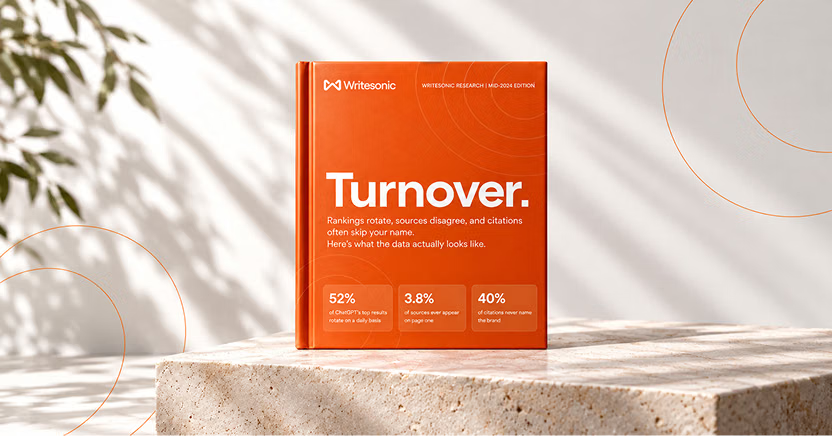
The #1 brand in ChatGPT changes 52% of the time.
Get the report and find out why.

Content Marketer
Pragati Gupta is a Content Marketer @Writesonic, specializing in AI, SEO, and strategic B2B writing. Leveraging the power of Generative AI, she produces high-impact content that drives superior ROI.