Key Takeaways:
- GEO is an extension of work your SEO, content, and PR teams are already doing. The skills exist, but the workflow probably doesn’t.
- Your content team already writes for featured snippets, your technical SEO foundation already makes your site parseable and your PR team already manages third-party presence. Point these at AI platforms and you’re 80% there.
- What’s missing for a lot of teams is the tooling, a lightweight experiment tracking process, ownership, and permission to deprioritize something else so GEO gets real focus.
- Hire when you’re at enterprise scale with thousands of prompts to manage, when GEO is already a major channel in your category, or when your team genuinely has no bandwidth. Otherwise, look to structure.
Most marketing teams follow a similar pattern when a new channel becomes popular. First, they see industry folks talk about it on places like LinkedIn. Maybe they even notice the channel driving a few initial sales.
Then, a discussion happens, and someone almost always asks the question:
“Do we need to hire someone to manage this?”
There’s a similar pattern taking root inside a lot of marketing teams thanks to the rather bombastic arrival of GEO (Generative Engine Optimization) on the scene.
But what if we told you your existing team has almost everything you need to succeed with GEO?
Those who are in charge of SEO, content, and PR already have the skills they need to handle GEO. It’s just a matter of setting up a proper workflow, a sturdy tech stack and a measurement process.
And, of course, spending some time learning how AI platforms attribute and cite information.
So, before you go ahead and post a job description for a GEO specialist, ask yourself this:
“Do we lack the capability to do GEO? Or do we just lack structure?”
We’re willing to bet it’ll be the latter.
GEO Is Additive SEO, Not a Reinvention of It
There’s a popular narrative (often spread by self-proclaimed AI search gurus) that generative engine optimization is a completely new discipline that requires a specialized team. It’s not.
GEO is an extension of SEO. Your team is already improving content structure, strengthening authority signals, updating content regularly. Those same practices drive AI citations. The content just gets surfaced in AI answers instead of search results.
A few things are different, though. AI platforms have a different way of citing information; they rely more on structured data and third-party sources, and they require content to be highly specific.
But the instances where these differences justify a new role are few and far between.
What You Already Have
If you care to look closely, most of the GEO skill set already lives inside your team.
Creating Effective Content
Your content team or specialist already knows how to make information clear, factual, and structured.
They’re writing authoritative and scannable content, optimizing for featured snippets, and using optimized headings and structure.
These are the same qualities large language models (LLMs) look for when deciding which pages to surface. They reward clear, factual answers and rely heavily on authority signals and content structure. (If you’ve been paying attention to featured snippet optimization over the past few years, congratulations—you’ve been doing proto-GEO without knowing it.)
So if your team knows how to write a good “What is X” section for an SEO article, they already know how to write citable definitions. The adjustment is minor: a bit more specificity, a bit more concision, a bit less fluff. Less “our industry-leading solution transforms workflows” and more “this tool does X, Y, and Z.”
Technical SEO
Your technical foundation is pulling double duty as you read this.
Site architecture, internal linking and schema markup (aka the essential elements of technical SEO) are what influences how LLMs process and attribute information. They use schema to extract structured data and they rely on logical site hierarchy and clean HTML to discover and parse content.
The good news is that most of this work compounds. If you’ve invested in technical SEO over the past few years, you’re not starting from zero with GEO. You’re starting from a foundation that AI platforms already know how to read. The teams that neglected technical SEO in favor of content volume are the ones going in circles now.
Competitive Intelligence and Visibility Tracking
You know that thing where you’re staring at a SERP, trying to figure out why that one competitor keeps outranking you despite having content that’s objectively worse? The “how is this page ranking” spiral that every SEO person has fallen into at least once?
GEO has its own version of that. Except instead of rankings, you’re looking at citations. Instead of “why do they rank,” you’re asking “why did ChatGPT cite them and not us.” The existential frustration is the same, it’s just the surface that’s different.
Your team is already tracking keyword rankings, analyzing SERPs, identifying content gaps. GEO requires all of that, but pointed at AI platforms instead of search engines. Which prompts are you showing up for? Which ones are you invisible on? Why does your competitor keep getting cited in answers about your category when your product page is objectively more helpful?
The analytical muscle is identical. The tooling is still catching up, honestly. We’ve had keyword tracking infrastructure for decades and AI visibility tracking is maybe two years old. But if your in-house SEO ever obsessed over why a competitor ranks, they already know how to obsess over why they get cited.
Keyword Research
Speaking of your SEOer, they have a process for keyword research. They know how to pull data, prioritize by intent, group related queries, build a tracking system. That entire workflow transfers to GEO with one adjustment: the inputs.
In SEO, keyword research usually starts with tools. In GEO, prompt research often starts with your support tickets, sales calls, customer interviews. The questions people ask AI platforms aren’t always the same ones they type into Google. They’re often longer, more conversational, more specific. “What’s the best CRM for a 20-person sales team that already uses HubSpot for marketing” isn’t a keyword anyone’s bidding on, but it’s absolutely a prompt someone’s typing into ChatGPT.
The strategic logic is similar: prioritize commercial intent, group related prompts, track visibility. Your team already knows how to do this. They just need access to different source material.
Third-Party Visibility and Brand Management
This is the one that catches people off guard.
Brand management has always mattered in SEO. Backlinks, mentions, reviews…none of this is new per se. But in SEO, you had a fallback. Even if your third-party presence was weak, you could still rank. You control your site, optimize your pages, fix your technical issues, and sometimes manage to brute-force your way up the SERP through sheer on-page effort.
GEO doesn’t give you that fallback.
AI platforms pull from everywhere, and we do mean everywhere. Your site, yes, but also review sites, Reddit threads, comparison articles, news coverage, Quora answers, analyst reports. They’re triangulating across sources to build an answer. And you can’t control most of those sources. Your owned channels can be perfect—structured data in place, content optimized, everything technically sound—and you’ll still get passed over if the third-party ecosystem doesn’t back you up.
It’s not that brand management suddenly became important, it’s that you can no longer compensate for weak third-party presence by being really good at the stuff you control.
Your PR team already knows how to work this ecosystem. They’re tracking mentions, building journalist relationships, monitoring review sites. The work is the same, but the margin for error just got smaller.
What’s Missing
So your team has the skills. What they probably don’t have is the infrastructure.
Let’s break it down.
The Tech Stack
Your SEO team lives in Google Search Console and GA4, tools that have been refined over the course of fifteen-plus years. They know precisely where to look to understand what’s working and what isn’t.
GEO is maybe two years old, tops. The tooling is still being built, and frankly, a lot of what’s out there are half-baked dashboards slapped together to ride the hype cycle.
Yes, you need visibility tracking across AI platforms, i.e., where you’re showing up, for which prompts, how often, and who’s being surfaced instead of you. Citation patterns, competitive benchmarking. Everyone building in this space offers some version of that.
What most tools don’t give you is the “now what.” A dashboard tells you you’re invisible, but it doesn’t tell you why, what to fix first and how. You end up with a PDF full of data and no actionable next step.
This is what we built Writesonic to solve. Visibility tracking, yes, but also an Action Center that tells you what’s blocking citations and prioritizes fixes by impact. Dashboard plus execution layer. We’re biased, but do your own comparison.
An Effective Workflow
GEO is new enough that best practices are still being written. Which means your team is going to be experimenting. A lot. And experiments without documentation are more vibes than science. You need:
- A way to track what you’re testing, what happened, and what you learned. A spreadsheet works fine, as long as there’s something more substantial than “I think we tried that and it didn’t work.” That isn’t institutional knowledge as much as a hunch that leaves the company when someone quits.
- Ownership. Who’s responsible for prompt selection? Who handles content optimization when a gap is identified? Who’s monitoring visibility and flagging changes? GEO touches SEO, content, PR, sometimes product. If everyone assumes someone else is handling it, no one is.
None of this is complicated. You probably have similar processes for other channels already. The work is applying them to something new before the lack of structure turns into six months of unrepeatable, unscalable effort.
Time and Permission
Here we hit the uncomfortable point.
Your team can probably handle GEO. The question is whether they have the bandwidth to do it well, or whether it becomes another thing they squeeze in between everything else and half-heartedly do for six months before someone asks why it’s not working.
Marketing teams are already stretched as is. Adding GEO to the pile without removing something else means it’ll get the scraps—an hour here, a task there, no sustained focus. And GEO in its current state rewards sustained focus, teams who’ve carved out dedicated time to experiment, track, and iterate.
Permission to reprioritize is the actual blocker. Not capability. So you need to sit down and decide what you’re willing to deprioritize that isn’t driving business value.
When Hiring Actually Makes Sense
There are a few edge cases where hiring for a GEO-focused role might make sense:
You’re Enterprise-Scale
Enterprise-scale businesses have multiple product lines, overlapping audiences, complex product documentation, and thousands of relevant AI prompts that need to be managed.
At this scale, doing GEO properly is a volume problem due to the sheer number of prompts and content pieces that need to be managed.
Even if you build a strong workflow, managing GEO at this scale will likely be too much for your existing SEO or content team.
In this case, hiring a dedicated person to own GEO can help you maintain consistency, prioritize work, and ensure you’re not missing out on any opportunities for improved AI visibility.
Your Team is Already at Capacity
Some teams don’t have the bandwidth to dedicate time to GEO without impacting existing channels that do drive value.
If your team is already at full capacity and there’s nothing you’re willing to deprioritize, then you’ll struggle to gain traction with GEO.
In this case, you’ll need to make a dedicated hire simply to increase your team’s capacity and be able to execute an effective GEO strategy consistently.
You Have the Budget to Experiment Aggressively
Some companies are in the fortunate position of having money to throw at emerging channels. If that’s you, the advantage isn’t necessarily a dedicated GEO hire, but more so speed.
Budget means you can run more experiments simultaneously and invest in better tooling earlier. It means your existing team can spend more hours on GEO without sacrificing other priorities, whether that’s through backfilling their current workload or bringing in freelance support for the grunt work.
That said, money doesn’t guarantee you’ll figure it out first. Plenty of scrappy teams with tighter budgets are running smarter experiments and learning faster than enterprise teams drowning in process.
Budget is an accelerant but it won’t replace good thinking.
You Probably Don’t Need a GEO Team
The instinct to hire when something new shows up is understandable. It feels like action, like taking the channel seriously.
But GEO isn’t a completely new capability. Your team already has a lot of the necessary skills, poised to be honed into something that works on this surface.
What’s actually missing is the infrastructure. The visibility layer that shows you where you’re showing up and where you’re not, the prioritization that tells your team what to fix first. The connective tissue that turns “we’re not getting cited” into specific tasks for specific people.
Your team can do this. They just need the setup to make it happen.
If you want help figuring out what that looks like, we’ve built a lot of this into Writesonic, i.e., visibility tracking, gap analysis, prioritized actions for content, SEO, and PR. We’re happy to show you around.This is where Writesonic can help. Get in touch if you’d like to learn more.
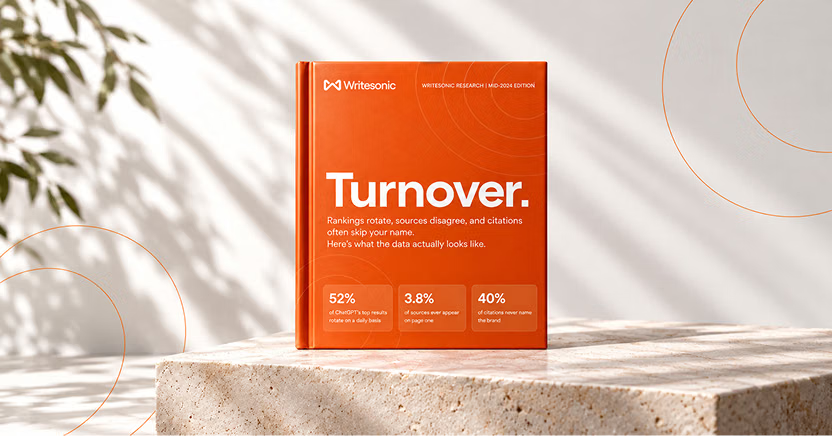
The #1 brand in ChatGPT changes 52% of the time.
Get the report and find out why.

Content Marketer
Mariana is a creator and strategist making ICPs, CEOs, SERPs, LLMs (and many other acronyms) happy all at once. Over the past seven years, she's designed, deployed and scaled content programs that deliver measurable growth for B2B and B2C brands alike.
Quality-first (always), AI-curious (not AI-dependent) and just the right amount of stubborn about what makes content worth reading.