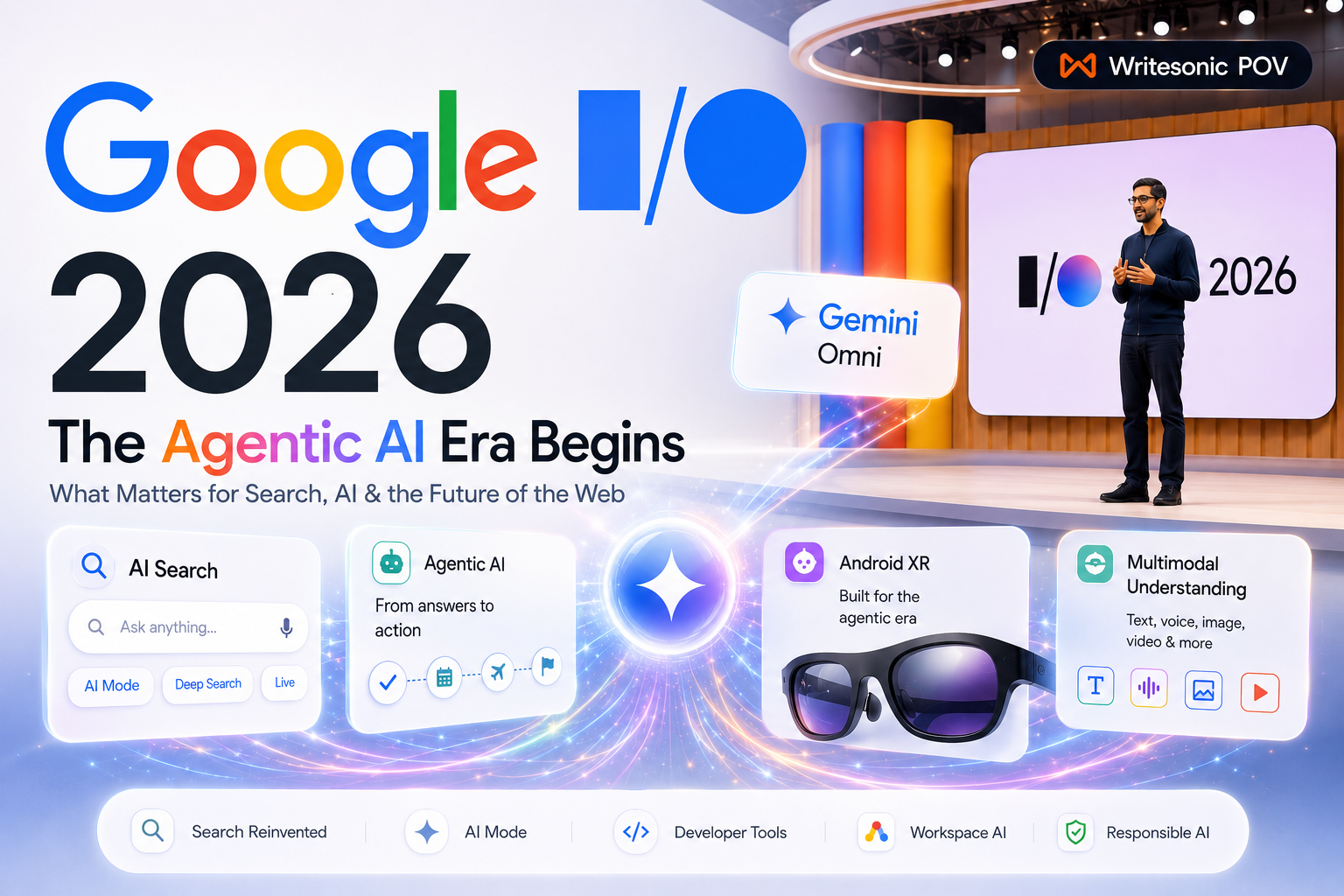
Google's I/O 2026 keynote ran two days. If you watched it for product updates, you got plenty. If you watched it as someone who works in search, you should have been taking notes the entire time.
The keynote rewired how content gets discovered, cited, and acted on. SEO playbooks built around classical search are going to need rewrites. AEO playbooks (Answer Engine Optimization, the practice of optimizing for AI answer engines like AI Overviews, Perplexity, ChatGPT Search, and Gemini) are getting written for the first time.
These are the announcements that matter for search teams, in the order they matter.
Information agents in Search are the headline you missed
The Search rebuild got most of the airtime. A new search box that expands as you type. AI-powered query suggestions that go past autocomplete. AI Mode running on Gemini 3.5 Flash globally.
The thing nobody is talking about loudly enough: information agents.
Set up an information agent on a topic and it monitors blogs, news, social posts, and real-time data feeds in the background. It updates the user when something changes. The user no longer searches. The agent does, on a schedule, against fresh content.
For SEO teams, this is a different game. Ranking once and harvesting clicks for six months stops working when an agent pulls from your URL weekly, monthly, daily. The page either stays fresh and structured enough to be re-cited, or it falls out of the agent's summary by month three.
The AEO question is the more interesting one. Information agents do not return ten blue links. They return synthesized answers with citations. Your goal moves from "rank on page one" to "get cited in the answer." Those are not the same problem.
AI Mode on Gemini 3.5 Flash changes the citation calculus
Google moved AI Mode to Gemini 3.5 Flash globally on day one of I/O. Flash is faster, cheaper to run at scale, and now powers a much larger share of answer-side traffic.
What this looks like in practice: more queries returning AI-generated answers instead of link lists. Fewer clicks overall. Different click patterns when clicks do happen, often going to citations rather than top-ranked organic.
Two things follow. Brand-name and high-intent informational queries will lose more click volume to AI Overviews. And the citations that do drive traffic come from a smaller set of sources than the old top-ten organic list. The winner-takes-most dynamic that already existed in featured snippets is accelerating.
The new Search box is a query-pattern shift in disguise
Google rebuilt the Search box so it expands as you type and predicts intent past basic autocomplete. The framing has moved from "type keywords" to "describe what you need."
If users start writing longer, more conversational queries because the UI rewards it, your keyword strategy has to follow. Short-tail keyword targeting matters less. Question-shaped content, comparison content, and content mapped to specific user intents matter more.
We have been watching this shift for two years through AI search referrals. I/O 2026 just made it official.
Personal Intelligence breaks the universal SERP
Personal Intelligence, launched in Gemini in January and brought to AI Mode in March, lets opt-in users connect Gmail, Calendar, and Photos to AI Mode. The result: personalized answers based on past bookings, recent purchases, travel plans.
You can no longer assume two users searching the same query see the same answer. The SERP was never truly universal, but the variance is about to widen by an order of magnitude.
For content teams, the practical change is this: optimizing for the average user gets you average results. Content that wins under personalization is content that handles a specific user state well, the way a hotel recommendation page might handle "first-time business traveler with corporate card" differently than "family of four on a budget."
Gemini Spark and the agent context window problem
Spark is Google's 24/7 personal agent. It starts with Workspace and expands to third-party apps via MCP over the summer.
The SEO implication is not Spark itself. The SEO implication is the pattern Spark represents.
Every major AI platform is building toward the same product. When a user asks an agent "find me a CRM under $50 per seat that integrates with HubSpot," the agent does not show ten options. It picks one or two and explains why.
Your brand needs to look credible inside that context window. Not at the top of a SERP. Inside the model's working memory. That requires structured comparison data, specific feature claims with sources, transparent pricing pages, third-party review citations, and documentation that reads like documentation instead of marketing copy.
AEO is the discipline of making your brand legible to that working memory.
Universal Cart turns product pages into model inputs
The Universal Cart, powered by the new Universal Commerce Protocol, lets users complete purchases inside Search and the Gemini app. Checkout happens on Google's surface.
For e-commerce SEO, this is a structural change. Your product page no longer needs to win the click. It needs to win the model's recommendation. The inputs to that recommendation are different.
Specs, compatibility data, return policies, third-party reviews, structured pricing, and clear feature tables all become higher-value content. Hero animations and brand photography do less work when the buyer is an LLM filtering ten products into one.
SynthID is the AEO trust signal nobody is pricing in yet
SynthID detection is moving beyond the Gemini app into Search and Chrome. C2PA Content Credentials support is coming with it.
Two minutes of keynote time. Worth ten.
As AI-generated content saturates every channel, models are going to weight content from verified sources more heavily. Google does not need to publicly label "this site uses AI" to factor provenance into AI Mode citations. The signal is already there. The detection infrastructure just got better.
The takeaway: disclose your AI usage transparently now. The teams that built clear disclosure into their content workflows in 2025 will look prescient by 2027.
Writesonic's POV: What SEO and AEO Look Like After I/O 2026
I have been doing this long enough to remember when SEO meant keyword density and backlink counts. The version of search Google announced at I/O 2026 plays by different rules. Here is what we are telling our team and our customers.
SEO and AEO are now two jobs, not one
For years, AEO was a subset of SEO. Optimize for search, and the AI answers would follow because they pulled from the same index. That assumption is breaking.
AI Mode citations follow different patterns than organic rankings. We have seen our own pages cited in AI Overviews without ranking in the top 10 organic results for the same query, and ranked top three organically while getting zero AI citations on the same query. The signals diverge.
If your team is treating AEO as "do SEO, but better," you will miss the citation share that matters most over the next 18 months. Build two scorecards. Track organic ranking and citation frequency as separate metrics.
What actually gets cited
We ran the analysis on thousands of cited pages across AI Overviews, Perplexity, ChatGPT Search, and Claude. The pattern is more boring than people want it to be.
Cited pages tend to have clear factual claims with named sources. They use tables and structured data. They answer specific questions in the first 200 words. They cite primary sources instead of recycling other blogs. They get updated when the underlying facts change.
That last one is the one most teams miss. A 2023 stat in a 2026 article reads as a red flag to a citation model. The fresher and more sourced your facts, the more likely you land in the answer.
Information agents demand a content lifecycle, not a content calendar
Most editorial calendars track when content publishes. The teams winning AEO are tracking when content was last verified.
If Google's information agents crawl your URLs on an ongoing basis (and Perplexity's, and ChatGPT's, and Claude's), every piece of evergreen content is now a living document. Pick your top 50 pages. Set a verification cadence. Update facts, refresh sources, version the page so the model sees freshness signals.
It is more work than the old publish-and-forget model. It is also where the citation share is going.
Personalization kills generic content faster
Personal Intelligence will widen the variance between what two users see for the same query. The practical impact is direct: content written for "everyone" gets cited for nobody.
The answer is not writing 50 versions of every page. Write deeply for specific user states and let the model pick which version to surface. Buyer personas were a marketing crutch in classical SEO. They are now a structural requirement for AEO.
What we would actually do this quarter
I keep getting asked for a playbook. Here is the one we are running internally.
Audit your top 50 pages for citation-readiness. Look for clear claims, named sources, structured data, factual freshness, and answer-shaped content in the first 200 words. Score each on a 1 to 5 scale. Fix the lowest scorers first.
Set up tracking for AI referral traffic by source. Gemini, ChatGPT, Perplexity, and Claude all send measurable traffic now. Most analytics setups bucket it as "direct" or "other." You cannot optimize what you cannot see.
Build a citation scorecard. Track how often your domain shows up in AI Overviews, Perplexity answers, and ChatGPT Search citations for your target topics. Weekly check, manual sample of 20 queries to start. You will spot patterns by month three.
Pick five evergreen pages and run a verification cadence on them for 90 days. Monthly refresh, visible "last updated" dates, version notes when you add new data. Watch what happens to AI citation share against pages you leave alone. The lift, if it appears, will tell you whether to scale.
Disclose your AI usage in your content workflow publicly. Add a methodology page. Note where AI assists in research, drafting, or editing. The teams that get ahead of provenance signals now will not have to retrofit them later.
Writesonic's final take
Google's I/O 2026 keynote will be remembered as the moment AI search stopped being a feature and became the default. Whether that is good for the open web, for content creators, for advertisers, or for Google itself remains an open question. The directional shift is not.
For SEO and AEO teams, the read is simpler than the noise around it suggests. The work is splitting into two disciplines that share a starting point and diverge fast. SEO still matters. AI Mode citations matter on top of it. The teams that resource both will pull ahead of the teams that pick one.
Four things worth holding onto as the dust settles.
Ranking and citation are not the same outcome. A page can rank top three and never get cited, or get cited weekly without ranking on page one. Track them separately or you will optimize for the wrong signal.
Freshness is becoming a citation signal. Information agents reward content that gets verified and updated on a cadence. Static pages from 2022 will fade from AI answers faster than they fade from organic results.
Personalization will fragment the SERP further than most teams have planned for. Average-user content gets average citation share. Content built for specific user states wins disproportionately under Personal Intelligence.
Provenance signals are coming whether you opt into them or not. SynthID, C2PA, and whatever the model providers ship next will sort content by verifiability before they sort by quality. The teams that disclose AI usage transparently in 2026 will not have to retrofit it later.
Classical SEO is not dead. It is the foundation that the next five years of content discovery will be built on. AEO sits above it. Both deserve a real strategy and a real budget.
I/O 2026 announced a new contract between content and discovery. The terms are different from the ones that have governed search for the last two decades. The teams writing themselves into the new contract early are the ones who will look obvious in retrospect.
The #1 brand in ChatGPT changes 52% of the time.
Get the report and find out why.

GEO Strategist at Writesonic
Rohit is an GEO Strategist at Writesonic with nearly a decade of experience driving organic growth across industries. Over the past 9 years, he has partnered with brands across BFSI, ecommerce, and B2B SaaS, helping them turn search visibility into measurable revenue. His expertise lies in Generative Engine Optimization (GEO) and AI Search, where he crafts strategies that help brands earn placement in answers from ChatGPT, Perplexity, Google AI Overviews, and beyond.