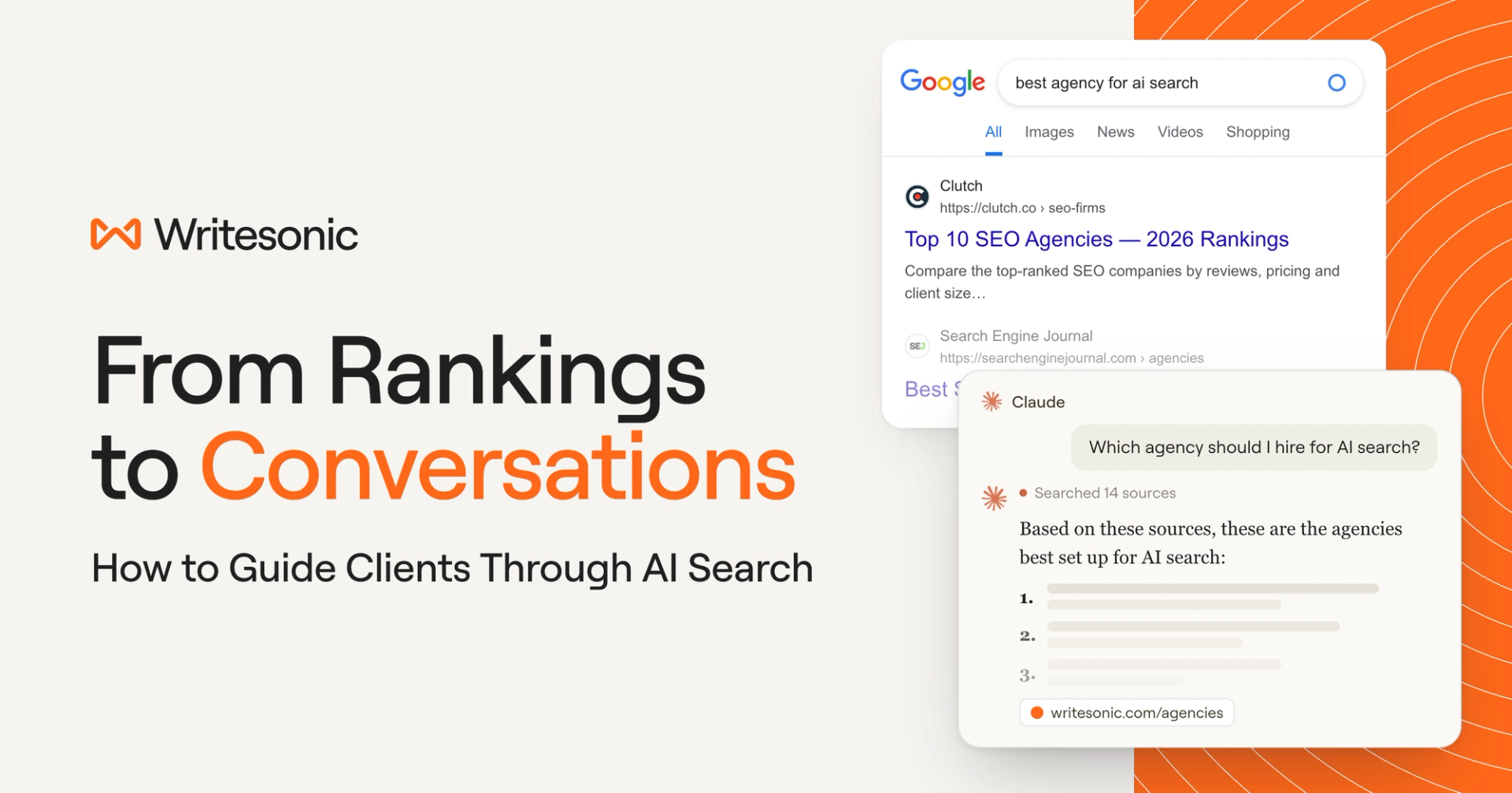
Static organic rankings are making way for fluid, AI-driven conversations, and it is leaving a lot of agencies struggling to explain this to their clients.
Even within the industry there’s a divide. Some dismiss this as “Just SEO," while others recognise the massive technical gulf between an information retrieval system designed to sort documents and a neural network designed to synthesise concepts.
Regardless of which side of the fence you sit on, the immediate challenge remains the same: how do you effectively guide your clients through this transition?
And more importantly, how do you balance your strategy and fundamentally rework your reporting to prove you are still providing value?
Trading destinations for answers: Shifting the client mindset from clicks to citations
The easiest way to educate clients on the difference between organic and AI search is to shift them from a destination mindset to an answer mindset. SEO is built on sending users somewhere. GEO is built on answering the user right there and then.
Think of organic search like a librarian. When you ask them a question, they look through their archive, hand you a list of books, and tell you to "Read them." The librarian’s job is to send you to a destination. That’s SEO.
GEO is like a senior consultant. You ask them a complex question and instead of giving you a list of books to read, they read all the books for you, evaluate the consensus, and deliver a tailored, synthesised summary in real time citing the specific experts they trusted most to build that answer.
For most agencies, one of the biggest challenges they currently face is addressing declining organic sessions. As more and more people turn to LLMs, fewer users need to click through to a website. If clients view this purely through a traditional SEO lens, they will see a drop in sessions as a failure.
You have to reframe the narrative. The objective is no longer solely about driving sessions, it is ensuring your brand is the trusted authority cited by the AI.
Building for both: Optimising for organic sessions and AI citations
A common misconception clients might have is that in order to grow in AI search, they need to abandon or cut back on traditional SEO.
In reality, LLMs still use crawlers to discover content, rely on site architecture to understand topical relationships, and lean on structured data to parse context.
Search-enabled AI systems can use web results to ground their answers, so strong organic search visibility remains valuable. However, not every AI-generated response involves a live web search.
Technical SEO & GEO: If crawlers can't find it, LLMs can't synthesise it
A technically sound website is the absolute prerequisite for inclusion in both organic and AI search. Here are the priorities to communicate to your client.
- Crawling - I've encountered websites unintentionally blocking AI search crawlers in their robots.txt. Check which bots your site allows. For example, OpenAI uses OAI-SearchBot to discover content for ChatGPT Search, while GPTBot is primarily used for model training. Make sure the crawlers relevant to your client's search visibility goals can access their content.
- Indexing - Generative engines like Google's AI Overviews and Perplexity rely on real-time web results to ground their answers. If your pages suffer from technical issues preventing indexing, they won't be synthesised into the AI's answers.
- Parsing - Once a bot is on the page, how easily can it extract the information it needs? Clean HTML, strict heading hierarchies, and structured data can help remove the guesswork. Your job here is to make it crystal clear for the AI to understand the entities, data, and relationships it needs to confidently cite your content.
- Rendering and page speed - Fast, accessible pages make it easier for search engines and AI crawlers to retrieve your content reliably. Slow server responses can create crawling challenges, particularly when systems operate under strict time constraints. While Googlebot can render JavaScript, some AI-focused crawlers may not reliably process content that depends on client-side rendering. This includes crawlers such as OpenAI's OAI-SearchBot, which is used for ChatGPT Search. Ensure your most valuable content is available in the initial HTML rather than relying entirely on JavaScript.
Writing in the AI era: Balancing content for humans with machine readability
While solid technical foundations guarantee the AI can access your site, your content strategy dictates whether the AI will actually use it.
Traditional SEO often rewards comprehensive content centred around a primary topic. AI search systems may also use Retrieval-Augmented Generation (RAG) to retrieve relevant information from external sources when generating answers. This makes clear, factual, and verifiable content particularly valuable.
Crucially, this isn't an "either/or" choice. Optimising for AI search at the expense of organic search or vice versa puts your client’s overall visibility at risk. Worse still is trying to optimise for one LLM in favour of another meaning your approach must be holistic, covering universal best practices and not narrow, platform specific tactics.
To successfully bridge the gap between ranking in search engines and being cited in LLM answers, your content strategy must serve both - it should ultimately prioritise people and user search intent above all else. Here’s how you need to execute that dual strategy and frame it clearly, so your clients understand the value and approach.
- Clarity - Create crystal clear, unambiguous, easily-parsed content built around key concepts the AI models can recognise, understand, and use. Break your content down into clear semantic units using subject-predicate-object relationships to help the AI’s understanding. FAQs, bullet point lists, tables, charts, and short summaries are ready-made snippets for AI to parse and incorporate into its output. This more digestible form of content will also please people.
- Authority - Demonstrate your authority and become a trusted source the AI models will cite time and time again. The models are far more likely to cite trustworthy, well-sourced content from brands who demonstrate their authority. Create high-quality, authoritative content that is helpful, reliable and people-first.
- Topical relevance - LLMs understand the context and relationships between concepts. Build content hubs that demonstrate your breadth of knowledge on the topics that matter most, helping you become a trusted voice in both organic and AI search.
- Query fan-out - When a user types a prompt into an LLM, the system uses a technique called query fan-out. It doesn't just run one search, it breaks the prompt down into hidden, related sub-queries and your content must anticipate this. By answering a primary question and addressing related sub-queries within the same piece of content, you remain the cited authority.
- Uniqueness and information gain - While creating insightful content should already be the foundation of your SEO strategy, it is now a strict requirement for GEO. LLMs actively seek new information to enrich their answers, a concept known as information gain. If your page merely regurgitates the same facts as the top ten organic search results, the AI has no reason to single you out. To force the LLM to cite you, you must provide what your competitors cannot: original research, unique first-hand experiences, proprietary data sets, or custom tools and software.
Metrics that matter: Blending SEO and GEO data to see the full picture
As AI search captures more top-of-funnel queries, traditional organic traffic will inevitably plateau or decline for many websites. If you walk into a client meeting armed only with GA4 and Google Search Console data, you are setting yourself up for a difficult conversation.
To retain and reassure your clients, you must pivot the conversation from sessions towards brand visibility and influence. Here is the exact reporting framework we use to blend traditional SEO performance with GEO metrics:
The foundation: Tracking business objectives and organic search in GA4 & GSC
- Conversions and key events - Regardless of how search evolves, your client will always care most about their bottom line. Lead with the important conversions and key events tracked in GA4 to prove the site is still generating leads and revenue.
- Sessions, clicks and impressions - While in decline for many sites, these metrics still provide vital context. If you can demonstrate growth in organic clicks and sessions despite the current climate, you will immediately stand out.
- Brand search - Users often discover a brand in an LLM response, then open a new tab to search for that brand directly. Tracking sustained increases in branded search volume serves as a reasonable secondary indicator of AI discovery.
The evolution: Tracking citations, sentiment, and AI visibility using Writesonic
Citation share - Track how frequently your client’s brand or specific URLs are actively cited across platforms like Google AI Overviews, ChatGPT, and Gemini.
Share of voice - Measure how often your client appears in AI-generated answers compared directly against their top competitors across a defined set of prompts.
Topic visibility - Show visibility across clusters of prompts related to a given subject, assessing your client’s brand presence across their core areas of expertise.
Sentiment analysis - Visibility without context is dangerous. Evaluate how the brand is perceived by LLMs across key topics. Is the context overwhelmingly positive, strictly neutral, or critical?
Citations - Identifies the powerful third-party websites citing both you and your competitors. This reveals where the AI is sourcing its information and highlights high-value targets for digital PR campaigns.
Moving from passive SEO to proactive GEO
The shift from static organic rankings to fluid AI conversations is a natural evolution in search.
The agencies currently struggling are those trying to defend outdated tactics and metrics in a rapidly changing landscape. The agencies succeeding are those taking the lead and guiding their clients through this transition with clarity and authority.
Regardless of how users search, the underlying goal remains unchanged: connecting people with the best possible answers. Success in this new era comes down to three core actions:
- Reframe the narrative: Shift your clients from a destination mindset to an answer mindset. Help them understand that plateauing or declining organic sessions isn't a failure if their brand is becoming the definitive, cited authority in AI answers.
- Balance optimisation: Treat SEO and GEO as two sides of the same coin. Ensure your technical foundations such as crawling, indexing, parsing, and server-side rendering are on point so LLMs can access your site. Then, build human-first content that is also optimised for machine readability using semantic clarity and unique information gain.
- Evolve your reporting: Protect your agency’s strategic value by grounding your reports in conversions and key events while introducing insightful GEO metrics like citation share, share of voice, topic visibility, and sentiment analysis.
Don't be passive and wait for your clients to confront you about declining performance. Take the initiative, re-educate them, and formulate a strategy and reporting structure that delivers on both sessions and citations.
This article is a guest contribution by James Munro, SEO & GEO Lead at Extreme.
The #1 brand in ChatGPT changes 52% of the time.
Get the report and find out why.

SEO & GEO Lead at Extreme
James Munro has over 15 years’ experience and is the SEO and GEO Lead at Extreme, a full service digital agency who blend creativity, technical skill, and passion to deliver exceptional results for their clients.