Large Language Models (LLMs) don’t read content the way humans do.
Instead of scanning your page like a human, they break it down into patterns, entities, and structures, looking for signals they can use to generate accurate, conversational answers.
That’s why structure matters.
Today, tools like Google’s AI Overviews, ChatGPT, and Perplexity rely on LLMs to decide which content gets surfaced. And, if your content is organized with headings, lists, and concise explanations, it’s far more likely to be cited or recommended.
In this post, I’ll cover how LLMs actually interpret content, why structure matters more than ever in an AI-first search world, and practical ways to organize your information so it’s not just human-friendly, but AI-friendly too. Plus, how Writesonic can help you stay ahead in AI search.
So, let’s get started!
Key Takeaways
- LLMs don’t read like humans; they interpret patterns, structure, and context.
- Content structure matters; clear headings, lists, FAQs, and schema make your content easier for AI to parse and cite.
- Poor formatting costs visibility; like walls of text, they are less likely to appear in AI-generated answers.
- Schema adds clarity; structured data signals exactly what type of content you’re offering.
- Writesonic helps you win. You can easily track your AI visibility, benchmark competitors, and identify optimization opportunities.
What Are LLMs and How They Work?
Large Language Models (LLMs) are advanced AI systems trained on massive amounts of text, from websites and books to research papers and forums. Their job isn’t to memorize content but to understand patterns in language so they can predict, generate, and interpret text in a human-like way.
Here’s how they work at a high level:
1. Training on huge datasets: LLMs are fed billions of words to learn how language is structured, grammar, meaning, and context.
2. Creating embeddings (language maps): They break the text into “tokens,” and then these tokens are converted into numerical vectors.
3. Understanding context: LLMs use a self-attention mechanism to determine the relevance of each word in a sequence, enabling deep understanding and responding based on intent, not just exact matches.
4. Generating answers: Using what they’ve learned, LLMs can summarize, compare, or recommend information in natural-sounding sentences, powering tools like ChatGPT or Google’s AI Overviews.
In short: LLMs don’t just find information, they make sense of it. And the way your content is structured determines how easily they can pull it into an answer.
Learn more about how to choose the best AI visibility tool in 2026.
How LLMs Actually Interpret Web Content
LLMs don’t “read” a page like humans do. They process it as tokens, small chunks of text, and rely on patterns and relationships to understand meaning. Instead of focusing on keywords alone, they look at the overall flow, context, and structure of the content.
When asked a question, the model retrieves the most relevant segments, identifies the clearest passages, and uses them to generate a response. This is why structured, scannable content is far more likely to be surfaced in AI-generated answers than long, unbroken blocks of text.
Key Signals LLMs Use To Interpret Content
1. Heading Hierarchy & Order: LLMs rely on logical heading structure (H1 → H2 → H3) to discern topic flow. Proper flow helps them understand which sections are primary versus supporting.
2. Context and relationships: LLMs connect ideas, not just words. They understand that “AI Search” is related to “LLMs” and “Generative Engine Optimization,” so linking concepts together strengthens how your content is interpreted.
3. Entities over keywords: Instead of just counting keywords, LLMs recognize entities like brands, people, locations, and products. If you write about “Google’s AI Overviews,” the model knows it’s connected to “AI Search” and “search engine features.”
4. Formatting Cues (Lists, Tables, FAQs): Content in lists, tables, or FAQ blocks is easier for LLMs to extract as concise facts. For example, a bulleted list of “Top Features of X Tool” is far more likely to be integrated into AI summaries than the same information buried in prose.
5. Focused Paragraphs: LLMs prefer short, self-contained paragraphs, each centered on a single idea. Huge text reduces the likelihood of accurate extraction.
6. Semantic and Redundancy Cues: Phrases like “In summary,” “Step 1,” or “The most important point” help LLMs identify key insights. Repetition of emphasized terms throughout headings and body reinforces a concept’s importance.
7. Supportive signals: Credible citations, internal links, and schema markup help LLMs see your content as trustworthy and organized.
Example: Structured vs Unstructured Content
- Unstructured:
A long paragraph mixing features, history, and benefits without clear divisions.
→ LLMs may misinterpret or miss core points due to a lack of clear signals.
Structured:
H2: Features
Feature A: …
Feature B: …
H2: Benefits
Benefit 1
Benefit 2
→ LLMs can easily pull out “Features” and “Benefits” as distinct, important information segments.
Why It Matters
When responding to queries, LLMs construct answers by stitching together relevant segments rather than giving full pages. Clean structure ensures your content is selectable for citation or summarization, even if the rest of the page isn’t used.
In short: to get surfaced in AI-powered answers, your content must be structured, clear, and scannable, not buried under poor formatting.
How To Structure Content For AI Search
If you want LLMs to pick up your content for AI-generated answers, think less about stuffing keywords and more about clarity and structure. The easier it is for a machine to parse, the more likely it will surface in AI Search.
Here’s how to do it:
1. Use Clear Headings and Subheadings: Break your content into logical sections with H2s and H3s. Each heading should introduce one main idea; this makes it easier for LLMs to map the flow of your content.
Instead of vague labels like “More Info,” write “Benefits of Generative Engine Optimization.” Headings act as signposts for LLMs.
2. Keep Answers Short and Direct: AI prefers content that gets to the point quickly. Open each section with a concise definition or summary (1–2 sentences), then expand if needed.
Example:
- Bad: “Our platform offers many pricing tiers, which are designed for flexibility…”
- Good: “Writesonic pricing starts at $49/month, with free and enterprise plans available.”
3. Use Lists, Steps, and Tables: Wherever possible, convert dense text into bullet points, numbered steps, or comparison tables. Structured formats are much easier for LLMs to extract and summarize.
4. Use FAQs to Address Common Queries: LLMs often pull directly from FAQ sections because they mirror user search behavior.
Adding questions like “What is AI Search?” or “How do LLMs interpret content?” with short, clear answers can dramatically improve your chances of surfacing in AI search.
5. Highlight Key Takeaways: Flag important insights with cues like “In summary” or “The main takeaway is…”. These signals tell the model that this sentence should be prioritized when generating an answer.
Rule of thumb: Write for people, format for machines. If a human can skim your page and instantly find answers, chances are an LLM can too.
Learn more about LLM Optimization.
How Schema Boosts AI Visibility
Formatting your content with headings, lists, and FAQs helps LLMs parse text, but adding structured data (schema) takes it a step further. Schema tells both search engines and AI models exactly what type of content they’re looking at whether it’s a product, review, FAQ, or how-to guide.
- FAQ Schema → helps AI extract question-and-answer pairs directly for conversational answers.
- How-To Schema → makes step-by-step instructions easier to pull into AI results.
- Product & Review Schema → highlights pricing, ratings, and features, which AI engines often use in comparisons.
- Article Schema → ensures your content is categorized properly as authoritative information.
Example: Without a schema, a pricing section might just look like text. With Product schema, AI knows the exact product name, price, rating, and description, making it far more likely to surface in AI Overviews or shopping-related queries.
Schema isn’t a replacement for good formatting, but it’s an extra layer of clarity that tells LLMs: “Here’s the structure, and here’s what it means.”
How Writesonic Can Help
Structuring your content for LLMs is only the first step. The bigger challenge is knowing whether your content is actually being seen, cited, and trusted by AI search engines.
That’s where Writesonic comes in. With Writesonic, you can:
- Track your AI Visibility: See how often your content is mentioned or cited across Google AI Overviews, ChatGPT, Perplexity, and more.
- Benchmark against competitors: Discover which brands are being surfaced in AI results for the same queries, and where you’re falling behind.
- Spot missed opportunities: Writesonic identifies prompts where AI already trusts your content’s source type but doesn’t yet cite you, so you know exactly where to optimize.
- Analyze sentiment in AI answers:
Learn how your brand is being framed in AI-generated responses – positively, negatively, or neutrally, and take action to improve. - Measure impact over time: Monitor key GEO metrics like Visibility Score, Citation Rate, Share of Voice, and Sentiment so you can see whether your structural changes are making a difference.
In short, Writesonic shows you how LLMs are interpreting and surfacing your content, and gives you the data you need to refine your structure, improve your authority, and secure a stronger presence in AI Search.
To see Writesonic in action, get in touch with our team!
Improve AI Visibility With Writesonic
LLMs reward content that’s clear, structured, and easy to parse.
If you want to show up in AI search results, focus on formatting your information in a way machines can understand – headings, lists, FAQs, and schema. The opportunity is simple: the better your structure, the higher your chances of being cited in AI-generated answers.
With Writesonic, you can go beyond best practices. You’ll know whether your structured content is actually being cited, how you compare against competitors, and where to focus your optimization efforts.
Ready to improve your AI visibility? Explore Writesonic’s AI visibility tracker today.
Frequently Asked Questions
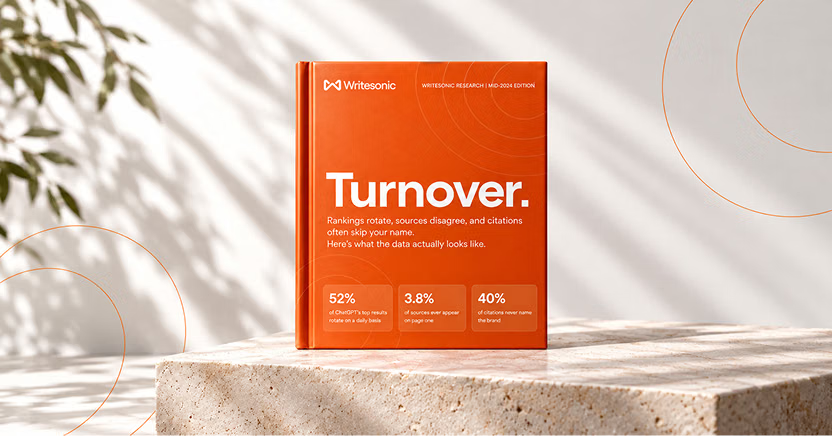
The #1 brand in ChatGPT changes 52% of the time.
Get the report and find out why.

Content Marketer
Pragati Gupta is a Content Marketer @Writesonic, specializing in AI, SEO, and strategic B2B writing. Leveraging the power of Generative AI, she produces high-impact content that drives superior ROI.