Did you know that 82% of the Gen Z people now prefer ChatGPT for finding information rather than simple navigation. AI prompts have become the new currency of digital visibility?
This piece will teach you how to identify prompts on AI that are high performing and focus on relevance, accuracy, consistency, and user satisfaction – metrics that deliver real business results. Additionally, we’ll be showing how to automate the process with our GEO tool to find the right prompts to monitor AI visibility.
The Shift from Keywords to Prompts
Research shows traditional Google searches average just 4.2 words. ChatGPT prompts, however, contain an average of 23 words. Google searches now show that all but one of these searches use long-tail queries—phrases with four or more words.
Key differences:
| Aspect | Keywords | Prompts |
| Length | 2-5 words | 10-25 words |
| Style | Fragmented phrases | Natural questions |
| Context | Minimal | Rich with details |
| Intent | Implied | Explicitly stated |
| Format | Search-optimized | Conversational |
What is a prompt in AI?
AI prompts are inputs given to large language models through generative AI platforms. These prompts go beyond simple search queries. They can be questions, commands, statements, code samples, or other text formats. Your prompt’s quality directly shapes the AI’s output quality and relevance. Studies show AI responses become 60% more accurate with well-crafted prompts. The subtle details in prompts guide the AI to deliver relevant and accurate information.
Significance of Context and Intent in AI Prompts
Context orchestrates the interplay between AI and human interaction. It covers past interactions, conversation tone, and core objectives. Here’s why context matters:
- Contextual understanding helps AI provide accurate, meaningful responses
- Prompt framing creates clear boundaries and expectations
- Specificity makes interactions work better
Intent analysis helps identify the purpose behind prompts—whether they seek information, request specific actions, or generate creative content.
How to Identify Prompts of Different Types
Your business’s AI strategy can improve dramatically by knowing how to identify prompts that deserve attention. Here are the four most valuable prompt categories you should keep an eye on.
Informational prompts
Informational prompts are straightforward questions or instructions that look for specific knowledge. These prompts usually start with “What is,” “How to,” or “Explain” and focus on getting facts, definitions, or explanations. These prompts show what potential customers need to know about your industry, products, or services. You can create targeted content by tracking these questions and identifying knowledge/content gaps.
Comparison and decision-making prompts
Comparison prompts mostly ask AI engines to analyze different concepts, products, or ideas. Users often present these prompts in table format with terms like “compare,” “contrast,” and “better” to guide the AI’s response. Users who choose this prompt type are usually closer to making a decision.
Problem-solving and task-based prompts
Problem-solving prompts tackle specific challenges or complete defined tasks. These prompts use actionable instructions with constraints that guide the AI toward real solutions. They often use step-by-step methods that make complex tasks easier to handle.
Brand and product-specific prompts
Brand-specific prompts mention your company or products directly, which shows high-intent interactions. Users ask for comparisons, reviews, or specific details about your offerings. These opportunities let you shape perception and give accurate information.
How to Identify Prompts That Drive Business Value
Business outcomes should guide your approach on how to identify prompts that are valuable in AI search. You need to understand what prompts are and their types before you can determine which ones drive results for your organization.
Step 1: Finding the topic of a prompt
Good prompts have clear goals – they either seek information, solve problems, or help make decisions.
Look past the surface-level request to find the real business need. A prompt like “Explain the differences between product X and Y for someone considering an upgrade” shows a comparison that helps decision-making and could boost sales conversions.
Step 2: Evaluating prompt intent and specificity
Clear intent and specificity make prompts work better. Key areas to check include:
- Relevance: The prompt matches what users want
- Accuracy: Outputs stick to facts
- Consistency: Results stay the same each time
- User satisfaction: Responses meet real user needs
Did you know that well-tailored prompts can elevate AI responses by over 40% in relevance and accuracy? Here are a few ways how prompts elevate answers for user satisfaction.
- Using specific conversational keywords improve relevancy by approximately 50%.
- A/B testing prompts in the same thread can identify effective formulations of the same query, improving output quality by up to 40%.
- Models that process multimodal prompts achieve a 30% increase in depth across different topics.
- 65% of users prefer platforms that are open to receiving feedback and making iterations to responses.
- Time-sensitive queries, i.e., a query that is given a deadline, or requires specific data from a period, has a 50% faster response time.
- Asking prompts in conversational or informal styles improves repeat users by 25% as the answers are almost always detailed.
Step 3: Avoiding generic or low-impact prompts with Writesonic
One of the biggest mistakes many prompt-generation tools make is relying on basic keyword-stuffing techniques. They simply slap on predictable prefixes to target phrases:
- “presentation software” becomes “what is presentation software”
- “logo generator” turns into “best logo generator
Sounds logical — but the problem is, this isn’t how people naturally interact with AI platforms like ChatGPT or Gemini. AI search is more conversational, contextual, and nuanced than old-school SEO or Google search queries. To cite an instance, rather than asking “Tell me about marketing“, try “What are three innovative digital marketing strategies for small businesses in 2025?“.
That’s where Writesonic’s approach is radically different.
- Powered by Real User Behavior — Not Assumptions
Because Writesonic operates Chatsonic — one of the leading ChatGPT alternatives for marketers — it gains a powerful advantage that most other tools can’t offer: direct access to millions of real prompts written by actual users in real contexts.
What does this mean in practice?
- It doesn’t guess how people prompt — it knows.
- It understands the language patterns users really use.
- It catches marketer-specific searches that general AI models miss.
- It spots the subtle intent clues hidden in natural language phrasing.
- Pattern Recognition at Scale
By analyzing millions of these user prompts, Writesonic detects common structures, phrasing styles, and recurring patterns. This means that the AI-generated prompts you get are not only relevant — they’re finely tuned to your audience’s language and intent.
- Multi-Source Intelligence — Beyond Just AI Data
While most prompt tools stop at scraping keywords, Writesonic enhances its data stream from multiple sources:
- Chatsonic Data: Real-world user prompts, constantly updated.
- Google Keyword Planner: Hard numbers on search volume and related variations.
- Ahrefs: Competitor keyword insights and organic keyword gaps.
- Reddit Discussions: Community-driven, real-people phrasing and question structures.
- Google’s “People Also Ask” Boxes: Popularly related queries as asked in real search.
- Google Search Console: Actual traffic-driving queries from your own site.
This multi-source blending ensures that your prompt ideas are based not only on AI search behavior — but also on what people search in Google, discuss socially, and click on in real life.
Tracking and Evaluating Prompt Performance With Writesonic GEO Tool
Writesonic GEO tool helps you track AI search activity by monitoring brand mentions on platforms like Google AI Overviews, ChatGPT, and Perplexity. You’ll get daily, weekly reports and monitoring data from multiple topic clusters that give an explanation of your AI visibility.
Here’s how you can track AI search prompts on the GEO tool:
- Go to the Writesonic Dashboard and click on “GEO” on the left task bar.
- Check for which prompts your brand is being mentioned and which prompts have excluded mentioning or citing you, under the tab “AI Brand Visibility”.
Monitoring visibility and brand mentions
Brand monitoring on AI platforms matters just as much as traditional SEO now. Tools like the Writesonic GEO tool shows you when and how AIs talk about your brand. These tools also help you learn about:
- Keywords that make AIs mention your brand
- Your brand’s appearance next to competitors
- Sources AIs use when discussing your company
- Tone and sentiment in product descriptions
Conclusion
Business success in this new era of digital visibility depends on how well you understand and master AI prompts. The prompts that really matter line up perfectly with user intent and business goals. Forward-thinking business owners should track prompt performance regularly. Tools like the Writesonic GEO tool are a great way to get insights about AI visibility and track how well prompts work.
FAQs on How to Identify Prompts on AI Search
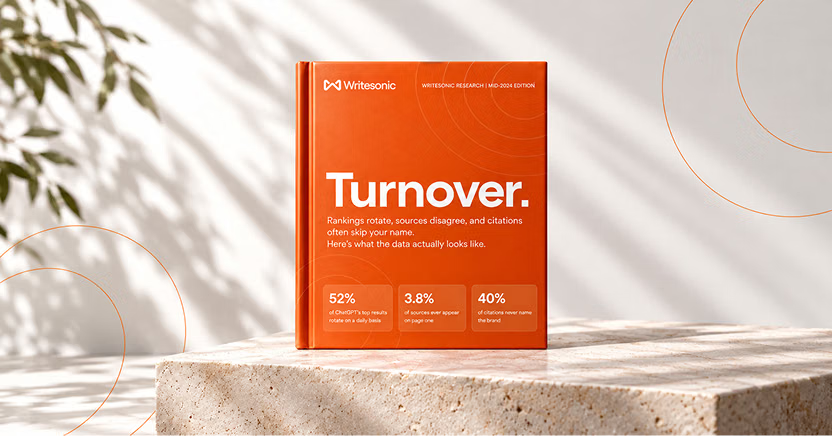
The #1 brand in ChatGPT changes 52% of the time.
Get the report and find out why.

Sumana Sarmah is a Content Writer @ Writesonic, with 5+ years of hands-on experience in B2B content writing and copywriting.
With a knack for creative brainstorming, she strategizes and curates impactful content that brings in exceptional engagement.