ChatGPT can recommend your company to someone and still not count it as a “mention” in its new business analytics.
I thought that was a pretty interesting detail.
On November 10, 2026, OpenAI introduced Businesses in ChatGPT, giving companies a way to claim their business, update information, and see how people discover them through ChatGPT.
Think of it as a combination of Google Business Profile and an early version of Google Search Console, built for AI search.
There's also a third piece: eligible businesses can offer their own agents that customers can talk to inside ChatGPT.
All three are interesting developments. But I think the bigger story is what they tell us about where AI search is heading, and what businesses will actually need to measure.
Because being mentioned, being recommended, getting cited, and getting a customer are four very different things.
And we're only beginning to figure out how to connect them.
First, what did OpenAI actually launch?
There are three major components.
1. Business profiles: Something like Google Business Profile for ChatGPT
Companies can now claim and verify their business through ChatGPT's Business Hub.
Once verified, they can submit updated details about their website, description, product or service category, and relevant policies. Businesses selling products can also connect a product feed, including Shopify or a supported CSV feed, to share prices and availability.
This is probably the part I'm most excited about.
Here's why.
We've experienced something interesting at Writesonic.
We started as an AI writing product years ago. Since then, we've expanded considerably and are now focused on AI search visibility.
Our website has been updated. We've changed our positioning. We've published information explaining what we do today.
Yet some AI assistants still describe Writesonic as an AI writing tool.
Why?
Because changing your website doesn't immediately erase years of older information scattered across the internet.
The model may reflect historical information encountered during training. It might retrieve an outdated article. Or a third-party page may still describe your company the way it existed three years ago.
The new Business Hub gives brands an additional way to provide current information directly.
That's meaningful.
But providing accurate information isn't the same as controlling what ChatGPT says.
OpenAI's Business Hub documentation says updates are reviewed, can take time to appear, and don't guarantee changes to independent answers or more recommendations.
So this isn't a magic button that fixes your brand's AI visibility overnight.
But it may make one problem easier: keeping the basic facts about your business current.
And that's something every brand should care about.
2. Business insights: An early Search Console for ChatGPT
This is where things get particularly interesting for marketers.
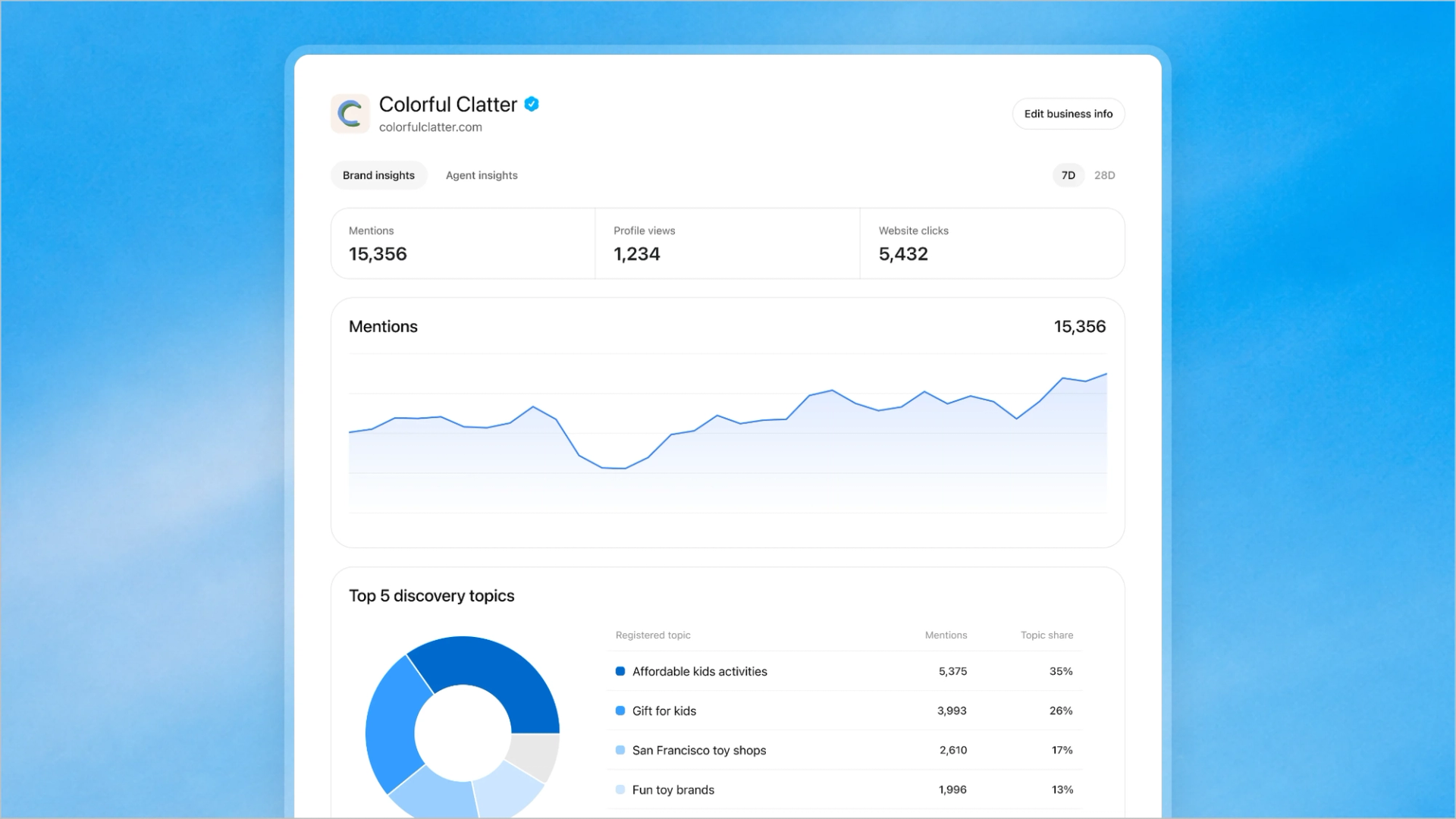
OpenAI is now providing aggregated data about how businesses appear in ChatGPT.
The initial insights include:
- Mentions: How often ChatGPT references a business under OpenAI's reporting definition.
- Website clicks: How often people click through to a business's site.
- Discovery topics: Broad themes in answers where that business is mentioned or cited.
It's a meaningful step forward.
Until recently, much of AI search measurement depended on external tools sampling AI answers, analyzing citations, or examining referral traffic.
Now we're starting to get first-party data from ChatGPT itself.
But before everyone gets too excited about their new mention count, there's a detail worth understanding.
The most interesting part: What exactly counts as a mention?
According to OpenAI's documentation, for an online business, a mention is counted when ChatGPT references the business's website.
Simply naming the brand doesn't count.
Think about that.
Imagine someone asks ChatGPT:
What's the best project management software for a 50-person startup?
ChatGPT recommends three companies.
Your brand is one of them. It explains why your product is a good fit and compares you with competitors.
But it doesn't reference your website.
Under OpenAI's current definition for online businesses, that recommendation doesn't count as a mention.
That's quite different from how marketers commonly think about brand mentions.
A brand being named, a website being cited, and a product being recommended are related events, but they aren't interchangeable.
We explored this distinction in our guide to AI brand mentions versus AI citations.
There's another nuance: the definition differs for local businesses. A local business result can count as a mention even without a website visit.
And a blank metric doesn't necessarily mean zero activity. Reporting thresholds, availability, and ongoing data collection can affect what is shown.
None of this makes OpenAI's data bad.
It just means you need to understand what a metric measures before using it to make decisions.
What the dashboard still doesn't tell you
You don't currently get individual customer prompts or private conversations.
You also don't get the complete competitive context behind each discovery topic.
For example, the dashboard may tell you that your website is referenced in conversations about project management.
But that doesn't necessarily tell you:
- Which competitors are being recommended more often.
- Whether your product is being described accurately.
- Which third-party articles or reviews are influencing those recommendations.
- Why ChatGPT favors one product over another.
- Whether a change you made improved your competitive position.
Those are different questions requiring different kinds of analysis.
It's similar to how Google Search Console gives you valuable first-party search data, while SEO teams use other tools for competitive research, content gaps, and technical audits.
I suspect AI search measurement will evolve in a similar direction.
First-party analytics will give us more direct signals about activity on individual platforms. Independent analysis will help explain the broader competitive picture across platforms.
And neither will fully replace understanding what happens when a customer actually engages with your business.
Not every business should optimize for the same metric
This is something I've been thinking about a lot recently.
The GEO industry has become fairly obsessed with AI visibility scores.
But what does a higher visibility score actually mean for your business?
Consider three different companies.
A SaaS company wants its product recommended when someone is evaluating solutions. The quality of those recommendations and the resulting leads might matter more than citation volume.
A deals marketplace wants ChatGPT to cite its product pages as places where customers can compare prices or make purchases. Referral traffic and purchase-intent clicks might matter more than brand mentions.
A publisher might care most about its articles being cited and people visiting its website to read more.
Same AI platform. Completely different goals.
This is why I don't think we'll end up with one universal metric for AI search success.
Different businesses will need different definitions of success, based on how they actually make money.
And the more first-party data these platforms provide, the more important it becomes to connect those signals with business outcomes.
If you're working on measurement today, I'd recommend starting with the framework in our guide to the GEO KPIs brands should track.
The #1 brand in ChatGPT changes 52% of the time.
Get the report and find out why.
3. Business Agents: The beginning of a different customer journey
The third announcement is easy to overlook, but I think it could eventually become the most consequential.
OpenAI is letting eligible US ecommerce and online-service businesses launch branded AI agents inside ChatGPT.
Here's a practical example.
Imagine you're looking for running shoes.
You ask ChatGPT for recommendations, compare a few brands, and narrow down your options.
Now you could potentially open one of those businesses' agents directly inside ChatGPT.
You ask about sizing, returns, warranty, or which model is better suited to your needs.
The agent can answer using information provided by the business.
And you might do much of that research without visiting the brand's website.
That's a pretty significant shift.
For years, we've built marketing around getting customers to click through to websites.
SEO, paid search, content, PR, social media. Different channels, but often the same goal: bring someone to your website.
Now parts of that discovery and consideration journey can happen somewhere else.
The website isn't going away. In the current Business Agent experience, purchases, bookings, and order lookups don't happen directly inside the agent; the agent can link customers to the business's website for those actions.
And the business agent is clearly separate from ChatGPT's independent answers. Businesses can also sponsor their agents through clearly labeled ad placements.
But the direction is worth paying attention to.
If customers increasingly discover, compare, and evaluate products inside AI platforms, how should businesses measure those interactions?
A referral click may be only one small piece of the customer journey.
What I would do if I were responsible for a brand's AI search strategy
I wouldn't overhaul the entire marketing strategy because of one product announcement.
But I would make a few changes immediately.
1. Claim and verify your business
If your business is eligible, start with ChatGPT Business Hub.
Review your company description, product categories, website, policies, and other available information.
Make sure they're accurate and reflect what you actually offer today.
For ecommerce, check whether connecting a product feed makes sense.
2. Audit how AI describes your business
Ask the AI platforms your customers use about your brand.
Don't just ask, “What is our company?”
Ask more useful questions:
- Who is our product best suited for?
- How does it compare with competitors?
- What are its weaknesses?
- What does it cost?
- What are the best alternatives?
Look for outdated claims, missing capabilities, inaccurate comparisons, and recurring misconceptions.
We've built Fact Check and expanded Sentiment analysis in Writesonic around exactly these kinds of problems, including tracing claims to cited pages and passages.
3. Separate mentions, citations, recommendations, and clicks
Don't combine everything into a single AI visibility number.
A useful measurement framework should distinguish whether AI names your company, cites your pages, recommends your product, and sends people to your website.
Then connect those signals to the outcomes your business cares about.
4. Investigate the sources behind the answers
Updating your own business profile is useful. But it doesn't replace the broader information ecosystem.
If AI is repeatedly describing your brand inaccurately, find out where that information appears.
It might be on your own documentation, an old comparison article, a review website, or a third-party publication.
Our guide to ChatGPT citation analysis explains how to investigate those sources and identify opportunities to improve them.
5. Track improvements over time
Finally, don't assume that publishing updated information automatically fixes an AI answer.
Establish a baseline. Record the claims and recommendations that matter. Make the relevant changes.
Then monitor what happens over the following weeks.
Look for improvements across repeated observations, not one favorable answer.
And where possible, connect those changes to traffic, qualified leads, sales, or other meaningful outcomes.
That's ultimately the point.
What this means for the GEO industry
Whenever a major platform starts providing its own analytics, there's a predictable reaction.
Some people celebrate it. Others worry that third-party tools will become unnecessary.
I think both reactions miss the bigger picture.
Google Search Console didn't eliminate SEO. It gave marketers access to better first-party information and made search performance easier to understand.
The industry then built more sophisticated ways to analyze competitors, identify gaps, prioritize work, and measure results.
I suspect something similar will happen in AI search.
We're moving from a world where brands had very little visibility into AI discovery toward one with more first-party data, clearer definitions, and new ways for businesses to participate.
That's good news.
But data is only useful if it helps someone make a better decision.
A marketer doesn't wake up wanting another dashboard.
They want to know where they're losing customers, what they can improve, which actions are worth their time, and whether the work made a difference.
That's the part I find most interesting.
Not just measuring AI search, but figuring out how to make those measurements actionable.
At Writesonic, that's the problem we've been spending so much time building around, with an Action Center that prioritizes opportunities across content, citations, and technical improvements.
But it's a much bigger problem than any one company or product.
My bigger takeaway
I think OpenAI's launch is an important milestone, even though Business Hub is still early.
Businesses are getting a more direct way to manage their information within ChatGPT and see some of the activity happening around them.
That's valuable.
But I wouldn't confuse the data we're starting to receive with a complete picture of how AI influences buying decisions.
A mention isn't necessarily a recommendation.
A citation isn't necessarily a click.
A click isn't necessarily a customer.
And a business profile doesn't automatically change how an AI model evaluates your company.
We're going to need better measurement across all of those stages.
The next generation of successful AI search strategies won't be built around maximizing one arbitrary score.
They'll be built around understanding which interactions actually matter for each business, improving them, and learning what works.
OpenAI has given marketers some new numbers. The more interesting question is what we're going to do with them.
Samanyou Garg is the Founder and CEO of Writesonic, an AI search visibility platform helping brands understand how they appear in AI search and identify opportunities to improve.
Frequently asked questions
Is ChatGPT Business Hub the same as Google Search Console?
Not exactly. It's a useful analogy, but Business Hub currently offers more limited, aggregated information, including mentions, website clicks, and discovery topics. It doesn't provide a complete prompt-level equivalent of Search Console.
Will claiming my business improve its ChatGPT rankings or recommendations?
Not necessarily. OpenAI explicitly states that claiming a business does not guarantee increased visibility or control over independent recommendations.
Does ChatGPT count every brand recommendation as a mention?
No. For online businesses, the current metric counts references to the business's website. Naming a company without referencing its website doesn't count as a Business Hub mention.
Can any business launch a Business Agent?
No. The initial Business Agent rollout is limited to eligible US ecommerce and online-service businesses. Business profile claiming has broader eligibility, subject to verification and availability.
Can Business Agents complete purchases?
Not currently. The agent can answer questions about offerings and policies and direct customers to a website to complete a purchase or booking.
The #1 brand in ChatGPT changes 52% of the time.
Get the report and find out why.

Founder @ Writesonic
Samanyou is the founder of Writesonic, a platform that helps you track & boost your brand’s visibility in AI search. Two years before the launch of ChatGPT, Writesonic was already at the forefront, helping organizations automate their entire marketing workflow through specialized AI agents for SEO and content. Samanyou is a Forbes 30 Under 30 awardee and a winner of the 2019 Global Undergraduate Awards, often referred to as the junior Nobel Prize.