When you generate non-branded prompts for your brand, one thing matters more than volume:
do those prompts actually sound like your buyers?
Until now, the answer was not always yes.
Generic prompts can give you a broad read on AI visibility. But a college student researching a product does not ask the same questions as an enterprise buyer comparing vendors. Someone discovering a category asks very different questions from someone who is ready to buy.
That is what Prompt targets changes.
You can now decide who your non-branded prompts should sound like, so the questions you track better reflect the people, buying stages, and markets that actually matter to your business.
Target prompts by persona
You can create personas around the buyer types you actually care about.
That could be college students, homeowners, marketers, procurement teams, IT leaders, or any other audience relevant to your business.
For each persona, you can define details like age group, industry, seniority, motivations, and pain points.
A student and a procurement lead might be researching the exact same category, but the questions they ask, and potentially the brands AI recommends, can be very different.
See where you show up across the funnel
You can also split prompts by top, middle, and bottom of funnel.
This helps answer a much more useful question than simply, “Are we visible?”
When are we visible?
Maybe AI mentions you when someone is first learning about the category, but competitors take over when the buyer starts comparing options.
Or maybe you perform strongly with high-intent questions but barely appear during early research.
That difference matters.
Track the markets that matter to you
For businesses where geography matters, prompts can also be targeted by locality.
Choose a city or region and generate questions that reflect that market.
If Miami is important to your business, for example, you can specifically track how you appear in questions relevant to buyers there instead of relying on one overall visibility number.
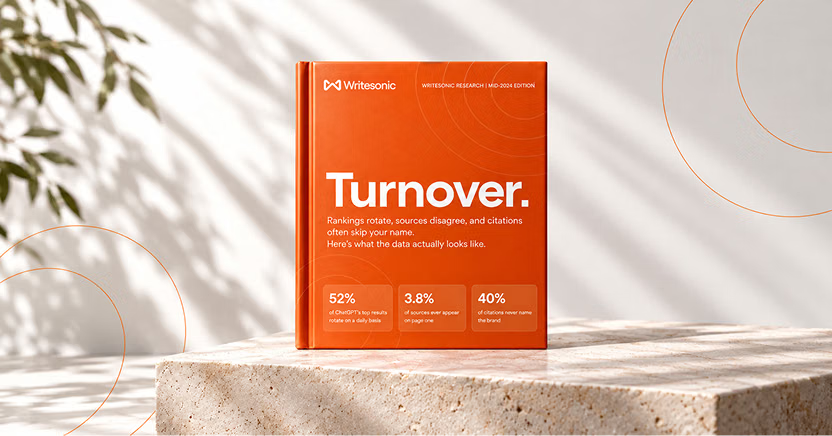
The #1 brand in ChatGPT changes 52% of the time.
Get the report and find out why.
Control the mix
Not every audience needs to make up the same percentage of your prompt set.
If enterprise buyers account for most of your revenue, you might want 60% of your prompts focused on them and 40% on another segment.
Prompt targets lets you control that split.
That means your tracking can better match where your business is actually focused instead of treating every segment equally.
Turn one visibility score into something you can act on
This is where Prompt targets becomes especially useful.
Every tracked answer carries its target, so you can break down visibility by persona, funnel stage, or locality.
Instead of just seeing:
“Our AI visibility is 60%.”
You can start seeing:
“We perform well overall, but competitors are winning in a market we care about.”
That gives your team a much clearer next move.
You can create content for a missing audience, improve bottom-of-funnel coverage, or focus on a region where competitors are consistently getting recommended instead of you.
How to get started
You can configure Prompt targets while generating new prompts or manage them anytime from Topics and Prompts → Prompt targets.
Start with the audience that matters most.
If one persona drives most of your pipeline, begin there. If you want to understand whether AI recommends you when buyers are close to purchasing, start with bottom-of-funnel prompts. If a specific market matters, start with locality targeting.
You do not need to model everything at once.
The point is to make the questions you track look a little more like the questions your actual buyers are asking.
The #1 brand in ChatGPT changes 52% of the time.
Get the report and find out why.

Growth Marketer
Tanay covers the intersection of AI and marketing at Writesonic.
His work focuses on how LLMs and AI Agents are reshaping search, and how marketing teams can adapt their SEO and content strategies for an AI-first search landscape.