If you’re using Ahrefs Brand Radar, you’re likely trying to measure how visible your brand is in AI search, whether tools like ChatGPT or Perplexity mention you, and how to show up more often in the right prompts.
That’s exactly what I was hoping for when I tried Brand Radar. I expected a clear view of where my brand stood and what I could do to improve it. But the more I used it, the more I realized it wasn’t built for that. It gave me a few metrics, some scattered mentions, and not much else.
If you’re in the same spot, wondering what else is out there, this list is for you. I’ve curated a list of the best Ahrefs Brand Radar alternatives that help both track and improve your AI visibility.
Top Ahrefs Brand Radar Alternatives To Improve Your AI Visibility
- Writesonic: Best Ahrefs Brand Radar alternative overall (all-in-one tracking, measuring, and action)
- Profound: Best tool like Ahrefs Brand Radar for content creation and prompt insights
- RankScale: Best Ahrefs Brand Radar alternative for budget-friendly monitoring
- Scrunch AI: Best platform with features similar to Ahrefs Brand Radar for AI-ready site optimization (AXP)
- Peec AI: Best Ahrefs Brand Radar alternative for simple brand mention tracking
- AthenaHQ: Best alternative to Ahrefs Brand Radar for prompt volume and competitor monitoring
- Goodie AI: Best tool like Ahrefs Brand Radar for AI Shopping and sentiment tracking
- Knowatoa: Best Ahrefs Brand Radar alternative for question-level monitoring
Why Look for an Ahrefs Brand Radar Alternative?
If you’re trying to improve how your brand shows up in AI-generated answers, Brand Radar won’t give you what you need.
It’s built for basic monitoring. It shows whether your brand is mentioned in tools like ChatGPT or Google AI Overviews, but it stops there.
You don’t see what triggered the mention. You don’t know if it helped or hurt your brand. And there’s no support for fixing anything.
Here’s where Brand Radar falls short:
- No prompt-level visibility
AI platforms respond to natural language prompts, not keywords. Brand Radar doesn’t show which prompts triggered your brand or your competitors. Without that, you can’t know what people are actually asking or why you’re showing up, or not.
- No citation insights
AI models often cite sources when making recommendations. If your competitor’s blog is being cited and yours isn’t, that’s important. Brand Radar gives you almost no detail on which sources are being used or what content is driving visibility.
- No sentiment analysis
Just being mentioned isn’t enough. You also need to know how you’re being mentioned. Are you being recommended, criticized, or listed alongside better-known competitors? Brand Radar doesn’t tell you.
- No recommendations or fixes
If something’s broken, outdated, or missing, you won’t know. And even if you do, Ahrefs Brand Radar gives you no way to address it. There are no action items and no optimization tips.
- Poor accuracy for AI platforms
In my own tests, Brand Radar underreported mentions in ChatGPT and Perplexity. Other tools showed dozens of mentions across key prompts whereas Brand Radar only showed two or three.
Read my full review of Ahrefs Brand Radar.
If you’re just looking for a basic snapshot of your brand’s presence in AI search, it’s fine. But if you want to improve that presence, you’ll need something more capable.
How I Chose These Ahrefs Brand Radar Alternatives
There’s no shortage of tools promising to help you understand your AI search presence. Some are built for monitoring. Others lean into content creation. A few claim to do everything. But for this list, I focused on one core question:
Can this tool actually help you improve your visibility in AI search?
To answer that, I looked at each option through a specific lens. Here’s what I prioritized:
- Prompt-level tracking
Does the tool show the real questions people ask tools like ChatGPT and Gemini? Not just keywords or branded queries, but actual prompts that trigger AI-generated answers? - Citation visibility
Can you see what content is being cited by AI platforms? Do you know whether it’s your content or a competitor’s? - Sentiment and context
Does the tool tell you whether your brand is being recommended, ignored, or misrepresented? - Recommendations and actionability
Does it help you figure out what to fix? Does it give you suggestions, templates, or workflows to improve your results? - AI platform coverage
Does it cover multiple models like ChatGPT, Claude, Gemini, and Perplexity? Or does it only track one or two? - Execution features
Can you take action in the same tool: create content, update pages, do outreach, or fix technical SEO issues? - Usability and pricing
Is it easy to use? Is the pricing clear and realistic for what it offers?
After checking these details, I found 8 tools that would be great alternatives to Ahrefs Brand Radar. Of course, one tool doesn’t fit everyone’s requirements. So, take a quick glance at this table and pick a few tools to read about in more detail.
Best Ahrefs Brand Radar Alternatives: A Quick Glance
| Tool | Features | Pros & Cons | Pricing |
| Writesonic | • Tracks prompts, citations, sentiment, share of voice, and traffic• AI Visibility Action Center with ranked tasks• Built-in tools for content, SEO, outreach, and technical GEO | Pros:• All-in-one platform with tracking, measuring, and action• GEO + SEO features combined• Execution built-in, no extra tools neededCons:• May have initial learning curve | Starts at $199/month |
| Profound | • Tracks citations, share of voice, and sentiment• Conversation Explorer for prompts• Blog and prompt content generation | Pros:• Strong visibility tracking• Content generation built in• Intuitive interfaceCons:• No technical SEO or on-page optimization• No outreach tools• Expensive for limited execution | $499/month, no free trial |
| Rankscale | • Tracks citations, sentiment, and share of voice• Competitor benchmarking• Basic site audit to see how AI interprets your site | Pros:• Affordable entry price• Easy to use• Good for basic monitoringCons:• Search-term based, not prompts• No suggestions or action tools• Very limited depth | Starts at $20/month, no free trial |
| Scrunch AI | • Competitive share of voice tracking• Sentiment and citation monitoring• AXP (Agent Experience Platform) for AI-optimized version of your site• Detects misinformation and outdated data | Pros:• Ensures AI interprets your site accurately• Good for monitoring competitors• Strong for content accuracyCons:• No new content creation tools• No SEO or technical optimization• Limited platform coverage | Starts at $300/month |
| Peec AI | • Tracks brand mentions and competitor visibility• Monitors sources and citations• Conversation tracking• Limited platform coverage with paid add-ons | Pros:• Simple and easy to use• Includes competitor comparison• Offers a 7-day trialCons:• Weak focus on citations (key for GEO)• No optimization or action tools• Limited AI platform coverage | €89/month (~$100), 7-day trial (credit card required) |
| AthenaHQ | • Tracks prompt volume, mentions, and citations• AI bot traffic insights• Competitor monitoring• Action Center with suggestions• Basic AI content drafts | Pros:• Good for prompt-level tracking• Includes competitor insights• Helpful for monitoring AI bot visitsCons:• Credit-based pricing can get costly• Limited execution tools• No technical SEO or full on-page optimization | Starts at $295+/month, no free trial |
| Goodie AI | • Tracks visibility, sentiment, and competitor comparisons• Monitors AI Shopping performance• Identifies AEO opportunities• Blog content writing tool | Pros:• Covers AI Shopping use case• Includes competitor benchmarking• Surfaces brand gapsCons:• Only supports blog writing• No technical SEO or optimization features• Pricing hidden | Pricing only via demo |
| Knowatoa | • Tracks mentions and citations across AI platforms• Monitors question-level visibility• Competitor ranking comparisons• Free plan available | Pros:• Simple and straightforward• Includes competitor tracking• Free plan to testCons:• No sentiment analysis• No suggestions or optimization tools• Limited scope | Free plan (ChatGPT only); Paid plans from $99/month |
The 8 Best Ahrefs Brand Radar Alternatives
There are a lot of tools entering the GEO space right now, but not all of them are useful if your goal is to actually improve your brand’s presence in AI search.
Some focus only on tracking. Others give you content tools but no insight into how AI is interpreting your brand.
Below are the eight tools I’ve tested or researched that offer a better experience than Ahrefs Brand Radar.
For each one, I’ll break down what it does, what it doesn’t, and whether it’s worth your time.
1. Writesonic (Best Overall Alternative)
Writesonic is the only platform that gives you tracking, measuring, and action all in one place.
It starts with complete visibility into how your brand shows up across AI platforms like ChatGPT, Claude, Gemini, and Perplexity. You get real prompt-level data (not just keywords) so you can see which questions your brand appears in, and which ones you’re missing.
You can measure share of voice, sentiment, citation sources, and traffic from both bots and humans. It also shows which competitors are getting cited instead of you and includes search volume predictions for each prompt to help you prioritize.
The Action Center turns those insights into ranked tasks—like fixing weak pages, targeting missing prompts, or updating content that’s being ignored. And you don’t need another tool to implement the fixes.
Writesonic includes a full suite of built-in tools to take action: content creation, internal linking, outreach, schema fixes, and technical audits.
It’s GEO-ready by design, giving you everything you need to improve how AI platforms understand, crawl, and recommend your brand.
Key features:
- Real prompt-level tracking across ChatGPT, Gemini, Claude, Perplexity, and more
- Share of voice, sentiment analysis, citation tracking, and traffic breakdown
- AI search volume predictions for AI prompts
- AI Visibility Action Center with prioritized tasks
- Built-in AI article writer (fact-checked, SEO and AI optimized)
- Internal linking tools, technical site audits, schema markup, broken link detection
- Citation outreach workflows and prompt targeting
- GEO features built for how AI search works
Pros:
- The only platform with full tracking, measuring, and action in one place
- Designed for both SEO and GEO in a single workflow
- Deep visibility paired with execution—no external tools needed
- Built-in content engine + optimization tools = faster results
Cons:
- There might be an initial learning curve due to the large number of features
Pricing: Starts at $199/month.
Is Writesonic the best Ahrefs Brand Radar alternative?
Yes, and not just because it has more features but because it lets you do more with what you see.
Ahrefs Brand Radar only shows you whether your brand shows up in AI. Writesonic shows you why, what’s missing, and how to fix it.
You can act immediately, without switching platforms or copying reports into other tools. It’s the only platform that lets you track, measure, and improve AI visibility in one place. And, it’s the only one I’d recommend if your goal is to grow your brand across AI search.
2. Profound
Profound is another tool that helps you monitor your brand’s visibility across AI platforms. It tracks citations, sentiment, and share of voice—like any good AI visibility tool should.
You also get access to a Conversation Explorer to see what kinds of prompts people are asking and whether your brand shows up in those answers.
It includes some built-in content tools as well. You can create blog posts and prompt-specific content directly inside the platform.
However, that’s about as far as it goes. While it gives you insights and some suggestions, you can’t use it to update existing content, run technical SEO fixes, or handle citation outreach. You’ll need other tools to actually implement most of what Profound points out.
Key features:
- AI visibility tracking across ChatGPT, Claude, Perplexity
- Conversation Explorer for prompt discovery
- Sentiment, citation, and share of voice tracking
- Built-in blog writing tools
Pros:
- Clean, easy-to-use interface
- Useful for discovering prompt-level opportunities
- Includes blog-focused content generation
Cons:
- No tools for technical or on-page SEO
- Doesn’t help with outreach or implementation
- Expensive for what’s essentially visibility + writing
Pricing: $499/month, no free trial
Is Profound the best Ahrefs Brand Radar alternative?
It’s better than Brand Radar when it comes to visibility depth and content creation.
But if you’re looking for a full GEO workflow—tracking, fixing, optimizing—it falls short.
For $499/month, I expected more. It looks like a complete platform at first, but once you dig in, you realize most of the heavy lifting still needs to happen elsewhere.
Check out our complete review for Profound here.
3. Rankscale
Rankscale is a visibility tracker that helps you monitor how your brand appears in AI-generated answers over time. It tracks citations, brand mentions, sentiment, and share of voice across platforms like ChatGPT, Claude, and Perplexity.
The platform is positioned as a way to identify content gaps and optimization potential, but it’s all based on search terms, not prompts, just like Brand Radar.
That’s a key limitation, because AI platforms don’t operate like traditional search engines. Without prompt-level tracking, it’s hard to know what users are actually asking and why your brand shows up (or doesn’t).
It also doesn’t offer any suggestions or guidance on how to improve visibility. There are no workflows, no content tools, and nothing built in to help you act on the data. You’re left with a read-only dashboard.
Key features:
- Citation and sentiment tracking
- Share of voice across AI platforms
- Competitor benchmarking
- Site audit to see how AI interprets your brand
- Visibility trends over time
Pros:
- Clean interface and easy to navigate
- Helpful for benchmarking brand vs. competitors
- Tracks sentiment and citation frequency
Cons:
- Based on search terms, not real prompts
- No visibility improvement suggestions
- No built-in tools to take action
- Limited if you’re trying to actually optimize
Pricing: Starts at $20/month, no free trial
Is Rankscale the best Ahrefs Brand Radar alternative?
It’s a budget-friendly upgrade from Brand Radar if you’re only looking for basic tracking. But once you need anything more, like understanding what prompts you’re missing or how to improve, Rankscale hits a wall.
The search term-based model doesn’t align with how AI platforms actually work, and the lack of suggestions or action tools makes it feel incomplete.
Read our detailed Rankscale review to know more.
4. Scrunch AI
Scrunch AI is designed to help brands understand and improve how they appear in AI-generated answers.
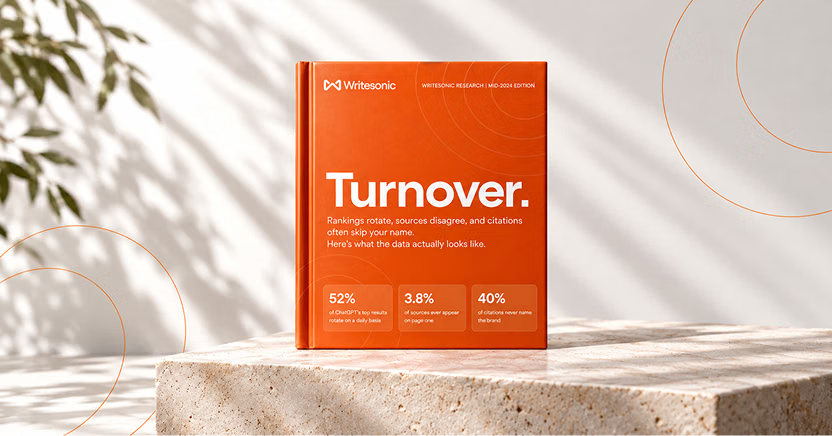
The #1 brand in ChatGPT changes 52% of the time.
Get the report and find out why.
It focuses heavily on competitive visibility, showing you how your brand compares to others in AI responses, where you’re losing share of voice, and what kind of content AI is referencing.
Scrunch AI also offers the Agent Experience Platform (AXP), which creates a parallel, AI-optimized version of your website. This AI-facing version is structured to help AI models better understand your site.
But while Scrunch helps you detect issues and monitor performance, it doesn’t give you much help beyond that.
It doesn’t support creating new content, which means if you’re missing from key prompts, it’s on you to figure out what to write and where.
The same goes for technical SEO or off-page optimization; none of that is built in. And although AXP is useful, it only replicates your existing site; anything new still has to be created and published through other tools.
Key features:
- Competitive share of voice tracking across AI platforms
- Sentiment and citation monitoring
- AXP (Agent Experience Platform) for AI-optimized site structure
- Misinformation and outdated content alerts
- AI model coverage: ChatGPT, Claude, Perplexity (Gemini monitoring only)
Pros:
- Strong on AI accuracy and source consistency
- Great for brands wanting better control over what AI sees
- Useful for tracking competitive visibility
Cons:
- No content creation tools
- Doesn’t support technical SEO or on-page optimization
- Limited AI model coverage (no support for Google AI Overviews, Grok, etc.)
- High cost for monitoring-only functionality
Pricing: Starts at $300/month
Is Scrunch AI the best Ahrefs Brand Radar alternative?
It’s a strong monitoring tool if your focus is controlling how AI understands your site. But, it stops there. Scrunch does a good job identifying problems, but no tools are included to help you fix them.
You’ll still need another platform for content creation, SEO, and GEO execution, which can quickly become expensive.
Want to know more? Check our full Scrunch AI review.
5. Peec AI
Peec AI is a simple AI visibility tracker that helps you monitor brand mentions, citations, and performance compared to competitors.
The platform focuses heavily on brand mentions, but doesn’t offer much when it comes to deeper insights.
While it technically tracks citations and sources, those features aren’t prioritized in the experience, which is a major gap if you’re looking at GEO seriously. Citations are often the backbone of AI-generated responses, and here, they feel like an afterthought.
Platform coverage is also limited unless you pay extra. Support for Gemini or Anthropic, for example, is only available as a paid add-on.
Key features:
- Tracks brand and competitor mentions in AI answers
- Monitors sources and citation frequency
- Conversation tracking for AI-generated discussions
- Performance comparisons across supported platforms
Pros:
- Straightforward interface
- Helpful for basic brand visibility reporting
- Includes competitor comparison
- 7-day free trial available (credit card required)
Cons:
- No optimization tools or implementation features
- Weak citation tracking from a GEO perspective
- No prompt-level data or visibility direction
- Limited platform support unless upgraded
Pricing: €89/month (approx. $100), 7-day free trial with credit card
Is Peec AI the best Ahrefs Brand Radar alternative?
It’s fine if all you want is brand-level visibility reporting, but it doesn’t go much further than that. For nearly $100/month, I expected more than just a metrics dashboard. There’s no prompt data, no citation-focused analysis, and no tools to help you improve your position.
If you’re approaching GEO seriously, you might need more tools in addition to Peec.
Check out our complete Peec AI review to know more.
6. AthenaHQ
AthenaHQ is a visibility and monitoring tool that also includes some light AI content generation features.
It also includes an Action Center, which offers suggestions on how to improve visibility. You can generate content drafts to target specific prompts, monitor your competitors, and see when AI models visit your site.
But beyond content creation, there’s not much you can act on directly within the platform.
You can’t fix technical issues, run on-page SEO updates, or refresh your existing content unless you leave the platform and do it elsewhere.
And unless you’re on the enterprise plan, everything works on a credit-based system, which can get expensive fast if you’re running a lot of queries or creating multiple drafts.
Key features:
- Tracks how often relevant AI prompts are being asked so you can spot trends and target high-visibility queries.
- Monitors brand mentions and citations across multiple AI platforms.
- Shows bot traffic data to help you understand how often AI crawlers are visiting your site.
- Offers competitor monitoring to see how your brand stacks up in AI visibility.
- Includes an Action Center with general suggestions to improve performance.
- Lets you generate content drafts to respond to prompts and fill visibility gaps.
Pros:
- Good for prompt monitoring and competitive tracking
- Helpful for spotting high-volume AI queries
- Includes basic AI writing tools
Cons:
- Limited to content drafting—no full content or SEO implementation tools
- No support for technical or on-page fixes
- Credit-based pricing can get expensive quickly
Pricing: Starts at $295+/month, no free trial
Is AthenaHQ the best Ahrefs Brand Radar alternative?
It’s more advanced than Brand Radar when it comes to prompt tracking and visibility insights, but it stops short of being a full solution. The suggestions are helpful, but you can’t fully act on them inside the tool, which makes the $300/month plan way more expensive.
7. Goodie AI
Goodie AI helps you monitor how your brand performs in AI-generated answers across search and shopping experiences. It gives you visibility into brand mentions and also tracks how your products show up in places like ChatGPT Shopping.
The only actionable feature it offers is blog content generation, like AthenaHQ. There are no tools for auditing your existing website, which means you don’t get suggestions for technical SEO or on-page GEO improvements.
If you’re missing citations, if AI can’t crawl your content properly, or if your structure is blocking visibility, you won’t know. From a GEO perspective, that’s a major limitation.
Pricing also isn’t listed publicly. You’ll need to book a demo just to find out the cost, which can be a time-waster if you already have a clear budget or are comparing multiple platforms.
Key features:
- Tracks AI visibility and sentiment across multiple platforms
- Compares your brand performance to competitors
- Monitors how your products appear in ChatGPT Shopping
- Surfaces AEO opportunities and content visibility gaps
- Includes blog-focused content writing
Pros:
- Helpful for high-level AI search and shopping insights
- Covers sentiment and competitor benchmarking
- Surfaces where your brand is missing from key answers
Cons:
- No audit of your existing site for technical or on-page GEO
- No support for SEO fixes, outreach, or optimization
- Blog writing is the only action tool
- Pricing hidden behind a demo
Pricing: Not publicly listed, demo required
Is Goodie AI the best Ahrefs Brand Radar alternative?
It gives you a broader snapshot than Brand Radar, especially if you’re interested in AI Shopping or sentiment insights. But it doesn’t go beyond reporting.
Without an audit of your existing site, you’re missing crucial technical and on-page guidance—things that directly affect how AI platforms understand and cite your content.
For a GEO-focused workflow, it’s not enough. And without upfront pricing, it’s hard to know if it’s even worth pursuing.
Read our detailed review on Goodie AI.
8. Knowatoa
Knowatoa helps you track how your brand shows up across different AI platforms.
The tool emphasizes question-level visibility, which can be useful if you’re focused on high-value prompts.
But overall, it’s limited to monitoring. It doesn’t provide sentiment analysis, so you won’t know if your brand is being mentioned positively or negatively. And it doesn’t offer any suggestions, recommendations, or tools to improve your visibility.
If your brand is showing up in the wrong way (or not at all) Knowatoa won’t help you fix that. There’s a free plan, but it only tracks 10 questions on ChatGPT, so you’re very limited unless you upgrade.
Key features:
- Tracks brand mentions and citations across multiple AI platforms
- Compares performance on key sales-focused questions
- Monitors competitor rankings and side-by-side visibility
- Offers a free plan with limited access for testing
Pros:
- Simple, focused tracking on question-level visibility
- Competitive comparison included
- Free plan available
Cons:
- No sentiment tracking
- No suggestions, no optimization tools, no execution layer
- Free plan is very limited; paid plan starts at $99/month
Pricing: Free plan (limited to 10 questions and ChatGPT only); paid plans start at $99/month
Is Knowatoa the best Ahrefs Brand Radar alternative?
It’s a basic monitoring tool with a few useful features, especially around question-level tracking. But it doesn’t go beyond visibility reporting. If you just want to monitor a few prompts, it’s fine. But if you’re serious about improving how AI platforms represent your brand, you’ll need something more capable.
Final Thoughts: Which Is the Best Ahrefs Brand Radar Alternative?
Ahrefs Brand Radar was a solid starting point for monitoring brand mentions in AI search. But if you’re here, you probably already know that it’s not enough. Tracking is just the first step. What you really need is a way to understand what’s happening, why it’s happening, and how to fix it.
If you’re ready to go beyond reporting and actually improve how AI platforms see and recommend your brand, Writesonic is the tool to start with.
It gives you real prompt-level tracking, clear visibility metrics, prioritized recommendations, and a built-in suite of tools to execute—across both SEO and GEO. No duct-taping dashboards to content tools. No manual fixes. Just one platform built for results.
Try Writesonic and see exactly where your brand stands in AI search—and how to take control of it.
FAQs for Ahrefs Brand Radar Alternatives
The #1 brand in ChatGPT changes 52% of the time.
Get the report and find out why.

Niyati Mahale is a SEO/GEO Content Writer @Writesonic. She specializes in artificial intelligence and B2B, with a flair for combining effective storytelling and SEO best practices to create impactful content.