Key Takeaways
- Answer engine optimization tools are platforms that track and improve your brand's presence in AI-generated responses, from ChatGPT to Perplexity to Google AI Overviews.
- The best AEO tools make AI visibility measurable. They show when, where, and how often AI engines cite your brand, which is the metric that actually matters in generative search.
- AEO tools split into two camps: watchers and movers. Some only monitor citations (Peec, Otterly, Nightwatch). Others help you change them through optimization workflows (Writesonic, AirOps, Gauge).
- Writesonic is the top pick for end-to-end AEO. It shows your AI visibility, explains why you're missing citations, and helps you fix the underlying content and authority gaps.
Best Answer Engine Optimization (AEO) Tools at a Glance
Here are the most popular answer engine optimization tools in 2026, compared by coverage, depth, and price:
| Tool | Best for | Starting price | AI engines covered |
|---|---|---|---|
| Writesonic | End-to-end visibility + optimization | $249/mo ($199/mo billed annually) for the Professional (GEO) plan | ChatGPT, Gemini, AI Overviews. Perplexity and Claude on Enterprise |
| GetCito | Open-source visibility audits | $299/mo | ChatGPT, Gemini, Perplexity, AI Overviews |
| Gauge | Visibility + content execution | $99/mo | ChatGPT, Gemini, Perplexity, Copilot, AI Overviews/Mode |
| Profound | Enterprise multi-brand tracking | $99/mo Starter, $399 Growth | ChatGPT on Starter. Perplexity and AI Overviews on Growth. Up to 9 plus Shopping on Enterprise |
| Goodie AI | High-volume prompt coverage | $495/mo | 12 LLMs incl. ChatGPT, Gemini, Perplexity |
| Otterly.AI | Solo founders and lean teams | $29/mo | ChatGPT, Perplexity, Gemini, Copilot, AI Overviews |
| Peec AI | Visibility, position, sentiment | $95/mo ($80 yearly) | Pick 3 of 6: ChatGPT, AI Mode, AI Overviews, Copilot, Perplexity, Gemini |
| Scrunch AI | Multi-brand, multi-region | $250/mo | ChatGPT, Gemini, Perplexity, others |
| Nightwatch | SEO teams adding AEO | $39/mo | ChatGPT, Claude, Gemini |
| AirOps | Content teams that want to act | Custom | ChatGPT, AI Overviews, others |
| HubSpot AEO | All-in-one AI visibility tied to CRM data | $50/mo ($45/mo yearly); included with Marketing Hub Pro/Enterprise | ChatGPT, Gemini, Perplexity |
| Semrush AI Visibility Toolkit | Teams already on Semrush who want AI + SEO in one place | $99/mo add-on; Semrush One bundle from $199/mo | ChatGPT, AI Overviews, AI Mode, Gemini, Perplexity, Copilot |
| Ahrefs Brand Radar | Ahrefs users layering on AI-search tracking | From $199/mo per AI index (plus $129/mo Ahrefs Lite base); $699/mo for all indexes | ChatGPT, Gemini, Perplexity, Copilot, Google AI Overviews |
| Conductor Intelligence | Large enterprises unifying AEO with an existing SEO/content stack | Custom (demo-led) | ChatGPT, Perplexity, Gemini, Google AI Overviews |
| AthenaHQ | Enterprise teams needing AEO plus compliance/governance | From $295/mo self-serve (credit-metered); custom Enterprise | ChatGPT, Perplexity, Gemini, Claude, Google AI Overviews |
Why You Need AEO Tools in 2026
Nobody wakes up thinking, "I need an Answer Engine Optimization tool."
But if you're measuring visibility through rankings and traffic alone, you're missing where the game moved. Search has split in two. Traditional Google sits on one side, and AI-generated answers from ChatGPT, Perplexity, Gemini, and AI Overviews sit on the other. These engines rarely send clicks. They cite sources, and if your brand isn't in the answer, you don't exist to anyone using AI as their primary research tool.
The brands showing up aren't lucky. They're tracking mentions, monitoring citations, and treating AI engines like the distribution channel they've become. They know which prompts trigger their content, how often they get cited versus buried, and where competitors beat them in the answers that matter.
That's the job of the best AEO tools. They show when your content is cited, by which models, and for what prompts. They make the invisible visible, mapping your brand's footprint across LLMs the way SEO tools once mapped SERPs.
If you’re new to this, here’s a quick guide on what is Answer Engine Optimization.
What Are AEO Tools (and Why They Matter)
An Answer Engine Optimization software tracks how AI systems talk about your brand.
AEO tools answer four questions:
- Are you appearing in AI answers at all? ChatGPT, Perplexity, Gemini, Google AI Overviews.
- Which prompts surface your content? The exact questions that trigger your brand instead of a competitor's.
- Is your visibility growing or quietly eroding? Week over week, model by model.
- Are those citations real (linked, attributed) or hollow mentions that build zero trust?
The mechanics work differently from SEO. AI engines don't send traffic based on position. They pull from multiple sources, synthesize an answer, and cite whoever seems most credible or structurally clear. You could rank first in Google and stay completely absent when someone asks ChatGPT the same question.
The best AEO tools fix that blind spot. Without them, you might be publishing strong content, earning authority, and structuring everything correctly while none of it registers in the new discovery layer.
Before you pick a tool, avoid these 10 AEO mistakes that cost brands visibility.
How We Picked the Best AEO Softwares
We didn't rank these on feature lists or marketing claims. We tested them.
Over the past few months we tracked how each platform measures AI visibility, how accurate the citation data is, and whether the insights help anyone make better optimization decisions. We ran the same prompts across multiple tools to see which ones surfaced the most complete picture of where brands show up.
Every tool below was evaluated against one question: does it actually help brands understand and improve their AI visibility?
Our shortlist used five criteria:
- Coverage: Which AI engines does it track, and how many of them?
- Depth: Does it show real citation data or just repackaged SEO metrics?
- Actionability: Does it tell you what to do next?
- Ease of use: Can a marketer use it without engineering help?
- Value: Does the pricing match what it delivers?
We didn't crown a single winner. GEO is too new and too context-dependent for that. A startup testing AI visibility has different needs than an enterprise team managing thousands of pages. The goal is to show which of the best AEO tools solves the problem you're actually facing.
The 13 Best Answer Engine Optimization (AEO) Tools to Use in 2026
We tested the platforms that marketers are actually using to track AI visibility. Some are purpose-built for GEO. Others are SEO tools adapting quickly. A few are still figuring out their footing.
1. Writesonic
Best for: Enterprises and growth teams that want a single platform to track, benchmark, and optimize AI visibility.
Pricing: Free trial available; the AI-visibility (GEO) features covered in this list require the Professional plan, $249/month billed monthly or $199/month billed annually. Lower tiers (Lite, Standard) are AI-writing/SEO only, with no GEO dashboard.
Full disclosure: This is our tool. We built it because we kept running into the same problem our customers were hitting. Everyone wanted to know how to get cited in AI answers. Nobody had a reliable way to measure whether it was happening.
Writesonic is an AEO platform that tracks, benchmarks, and improves your brand's visibility in AI search engines, including ChatGPT, Gemini, Perplexity, and AI Overviews. It shows which prompts trigger your brand, how often you're cited versus mentioned, and whether those citations carry authority or get lost in a list of alternatives.
Key Features:
AI Visibility Dashboard: Writesonic’s AI visibility dashboard tracks your brand presence across major AI platforms in real time. You see your visibility percentage, which prompts surface your content, and how your share of AI voice compares to competitors. Trend data shows whether you're gaining ground or losing it as models update.
Prompt Explorer: The Prompt Explorer reverse-engineers your visibility gaps by identifying prompts where competitors appear but you don't, then maps those gaps to content or authority deficits.
Citation Tracking: Writesonic’s AEO tool has citation tracking which separates high-authority citations (linked, attributed) from passing mentions. The first kind builds trust. The second is mostly noise.
Sentiment Analysis: Shows whether AI engines frame your brand in positive, neutral, or negative sentiment, and which topics drive each tone.
Competitor Benchmarking: Compares your AI visibility to competitors by topic, platform, and prompt type.
Action Center: The Action Center in Writesonic’s AEO tool turns data into direction with content refreshes, schema updates, and authority-building opportunities that improve citation odds.
Pros
- Goes beyond tracking into root-cause analysis and optimization recommendations.
- Strong competitor and prompt-level insights.
- Built for marketers, not engineers.
Cons
- Pricing is higher than monitoring-only tools.
- Best value for teams with the content capacity to act on recommendations.
Who it's for: Marketing teams at B2B SaaS companies, agencies managing multiple clients, and enterprise brands with large content libraries.
What makes it different: Most AEO tools tell you if you’re visible. Writesonic tells you why you’re not, and what to do about it. The platform is built for teams that aren’t just dipping their toes into GEO. It’s for marketers who’ve accepted that AI search is a legitimate discovery layer and need a system to measure, optimize, and defend their position in it.
Why not give it a try and see the difference?
2. GetCito (Formerly AI Monitor)
Best for: Brands that want a transparent, open-source approach to AI visibility monitoring.
Pricing: From $299/month.
GetCito calls itself the first open-source solution for tracking and optimizing presence in generative search. It covers ChatGPT, Gemini, Perplexity, and Google AI Overviews, and bundles tooling with strategy services for brands that want to be cited by AI rather than only found by humans.
Key features
- AI Visibility Dashboard for real-time brand tracking across multiple AI engines, with benchmarking and trend insights.
- Competitor Radar to map which rivals are cited where you're not.
- Sentiment Analysis scoring how AI answers portray your brand.
- AI Crawlability Clinic auditing structured data, schema, and entity signals.
Pros
- Open-source transparency for technically curious teams.
- Pairs tooling with strategy services.
Cons
- More of a visibility audit tool than a true optimization engine.
- Higher entry price than competing trackers.
3. Gauge
Best for: Growth and SEO teams that want AI visibility data, analysis, and published content from one platform.
Pricing: Starter $99/month (100 prompts, ChatGPT only); Growth $599/month (600 prompts, 6 platforms); Enterprise custom. Free trial available.
Gauge monitors hundreds of customized prompts daily across ChatGPT, Google AI Overviews, AI Mode, Gemini, Perplexity, and Copilot. The real difference shows up after the tracking. Most platforms hand you dashboards and walk away. Gauge built an AI marketing agent, Ask Gauge, that connects your AI visibility data with Google Search Console and GA4 in one conversational interface and draws conclusions across all three sources.
Ask why a competitor is gaining visibility, and it analyzes citation patterns, traffic signals, and content gaps to recommend a specific response. Ask it to build a content plan, and it pulls from your AI visibility gaps, GSC keyword performance, and GA4 referral data to draft articles directly inside the platform.
Gauge also tracks a distinction most platforms miss: citation rate versus mention rate. AI models often pull your content as a source but strip your brand name from the generated answer. Gauge surfaces both metrics so you can identify when you're shaping answers invisibly.
Key features
- Ask Gauge AI agent that merges visibility data with GA4 and GSC.
- End-to-end content engine (calendar, briefs, outlines, published articles).
- Citation and mention rate tracking at domain and URL level.
- Query fan-out visibility showing the searches ChatGPT runs when processing a prompt.
- GA4 integration for AI referral traffic with source breakdowns.
Pros
- Closes the loop from insight to published content.
- Distinct mention versus citation tracking.
- Cross-data analysis (visibility, GSC, GA4) in one agent.
Cons
- Starter tier limits you to ChatGPT only.
- Growth tier jumps to $599/month for full coverage.
4. Profound
Best for: Enterprises tracking AI visibility at scale across multiple brands or markets.
Pricing: Starter: $99/month (ChatGPT only). Growth: $399/month (ChatGPT, Perplexity, and AI Overviews). Enterprise: custom. Profound has no "Lite" tier.
Profound is the enterprise-grade platform built to help brands understand, measure, and grow their presence across ChatGPT, Gemini, Claude, Perplexity, and ChatGPT Shopping. It offers real-time monitoring of how AI sees your brand, where your content is cited, and how AI crawlers access your site.
Key features
- Answer Engine Insights with citation analysis, visibility score, share of AI voice, and sentiment.
- Prompt Volumes & Conversation Explorer to understand what users actually ask AI.
- Agent Analytics and AI Crawler Visibility for bot access patterns and technical readiness.
- Competitive Benchmarking across AI responses.
Pros
- Deep data and enterprise-ready infrastructure.
- Strong coverage that includes ChatGPT Shopping.
Cons
- High cost and steep learning curve.
- Overkill for smaller teams.
Compare Alternatives: Profound AI Alternatives
5. Goodie AI
Best for: Mid-market and enterprise CMOs, AEO/SEO leaders, content and PR teams.
Pricing: Custom, from $495/month based on prompt volume and model coverage.
Goodie AI is an AI-first platform built around high-volume prompting, citation intelligence, and presence optimization across 12 LLMs including ChatGPT, Perplexity, Gemini, and Google AI Overviews. It's designed for teams that need confidence no mention, citation, or competitive gap is going unnoticed, and it pairs the tech with hands-on strategic and engineering support.
Key features
- Agentic Commerce Optimizer that makes products discoverable inside AI shopping agents.
- High-volume prompting frameworks that mirror real user behavior.
- Optimization Hub and citation tracking to fix presence gaps.
- Custom onboarding and engineering support to operationalize insights.
Pros
- Exhaustive prompt and model coverage.
- Includes commerce-specific optimization.
- Hands-on support included.
Cons
- Not a lightweight starter tool.
- Custom pricing means longer sales conversations.
6. Otterly.AI
Best for: Solopreneurs, small teams, and agencies that need affordable AI visibility tracking.
Pricing: Free trial. Paid plans from $29/month.
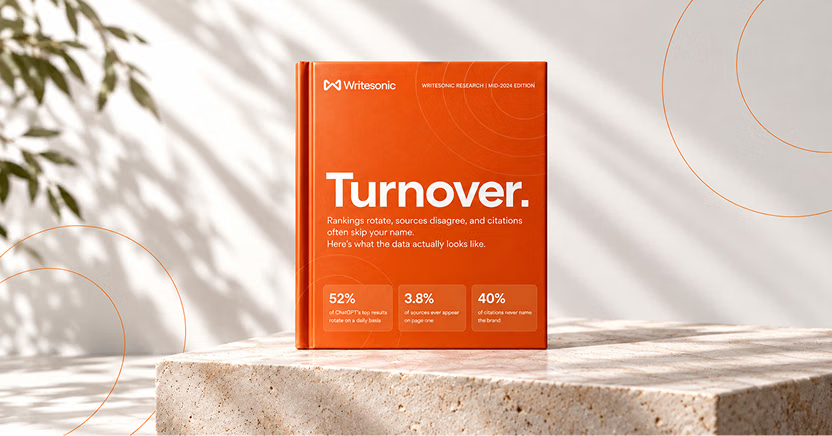
The #1 brand in ChatGPT changes 52% of the time.
Get the report and find out why.
Otterly.AI monitors how your brand is referenced across ChatGPT, Perplexity, Gemini, Microsoft Copilot, and Google's AI Overviews. You see where your brand shows up, which prompts trigger mentions, and how your visibility compares to competitors over time. It's fast and accessible for teams that don't have big budgets but still need to know where they stand.
Key features
- AI Search Monitoring of brand mentions and citations across major AI engines.
- Prompt & Keyword Research that converts traditional keywords into conversational prompts.
- Link Citation Analysis showing which URLs are cited.
- Brand Visibility Index & Benchmarking versus competitors.
- GEO Audit to identify why you're not being cited.
Pros
- Cheapest entry point in the category at $29/month.
- Friendly for small teams and agencies.
Cons
- Limited workflow automation for larger operations.
- Less depth than enterprise tools.
7. Peec AI
Best for: Marketing teams that want three core metrics: visibility, position, and sentiment.
Pricing: Tier-based, €89 to €199+/month.
Peec AI tracks where, how, and in what tone your brand appears in generative results across ChatGPT, Gemini, Claude, and Perplexity. It focuses on three things: visibility (how often you show up), position (where you rank in AI answers), and sentiment (how you're framed).
Key features
- Visibility Tracking of brand share in AI search answers.
- Position Analytics measuring placement inside AI-generated lists.
- Sentiment Insights scoring how AI engines describe your brand.
- Prompt Organizer for monitoring high-value prompts across markets.
- Source Attribution identifying which pages models pull from.
Pros
- Clean three-metric focus that's easy to operationalize.
- European pricing tiers suit smaller teams.
Cons
- Limited optimization guidance. It tells you where you stand, but not what to do.
- No content production workflow.
8. Scrunch AI
Best for: Enterprises managing AI visibility across multiple brands, regions, and languages.
Pricing: Starter plan from $300/month.
Scrunch AI is a full visibility platform for AI-driven discovery. It tracks how your brand appears across ChatGPT, Perplexity, Gemini, and other engines, with features spanning prompt analysis, bot-crawl monitoring, and auditing.
Key features
- Brand Citation Tracking with prompt-level visibility trends.
- Competitive Benchmarking of citation share.
- Agent Experience Platform (AXP) that creates a machine-readable parallel version of your site for AI agents.
- Bot/Agent Traffic Insights flagging structural issues.
Pros
- Strong technical depth that includes a parallel agent site layer.
- Good fit for multi-brand and multi-region operations.
Cons
- Needs technical resources to act on the insights.
- Lean teams may not use the full depth.
Compare Alternatuves: Scrunch AI alternatives
9. Nightwatch AI Tracking
Best for: SEO teams and agencies already tracking rankings that want to add AI-answer visibility to the mix.
Pricing: 14-day free trial. Paid plans from $39/month.
Nightwatch built its reputation on SEO monitoring: ranking across search engines, site audits, and keyword tracking. It now offers dedicated AI/LLM tracking that lets you monitor how your brand appears in AI-generated summaries from ChatGPT, Claude, and Gemini.
Key features
- AI/LLM Visibility Monitoring across LLM responses.
- Prompt & Engine Comparison for content performance across models.
- Unified Dashboard combining traditional rank tracking with AEO metrics.
Pros
- Cheapest dual-purpose (SEO + AEO) tracker.
- Easy add-on for existing Nightwatch users.
Cons
- AEO depth is shallower than purpose-built platforms.
- Better for monitoring than for owning citations.
10. AirOps
Best for: Content and SEO teams that want to act on visibility data instead of only tracking it.
Pricing: 14-day free trial. Contact sales for pricing.
AirOps is a full lifecycle AEO/GEO platform that moves you from insight to action. It tracks visibility across ChatGPT, Google AI Overviews, and other engines, and then layers on workflows that identify content gaps, suggest optimizations, and help you engage in the Reddit threads, forums, and review sites AI engines cite most.
Key features
- Visibility Dashboard showing share of voice, trends, and prompt-level data.
- Prioritization Engine ranking visibility gaps by impact.
- Action Workspace to refresh content and publish updates inside AirOps.
- Workflow Automation for content updates, prompt tracking, and performance checks.
Pros
- Strong "data to execution" workflow.
- Includes off-page engagement opportunities.
Cons
- Custom pricing reduces transparency.
- Probably too much tool if you're early in AEO.
11. HubSpot AEO
Best for: Marketing teams, especially those already on Marketing Hub Pro or Enterprise, who want AI-visibility tracking tied directly to CRM data.
Pricing: $50/month ($45/month billed annually); a 28-day free trial (25 ChatGPT prompts) is available. Included at no extra cost for existing Marketing Hub Pro and Enterprise customers.
HubSpot AEO tracks how a brand shows up in AI answers across ChatGPT, Gemini, and Perplexity, and ties recommendations directly to HubSpot's CRM data and content tools. Because it's connected to a customer's CRM from day one, it suggests prompts automatically based on their industries, competitors, and customer segments rather than relying only on generic industry questions, and runs those prompts daily.
Key features:
- Multi-engine coverage (ChatGPT, Gemini, Perplexity).
- CRM-connected prompt suggestions drawn from industries, competitors, and customer segments, plus custom prompts.
- Brand visibility and sentiment analysis.
- Prompt tracking and competitor/citation analysis.
- Prioritized recommendations that connect to HubSpot's content tools.
Pros
- Lowest entry price of any full-featured tracker in this list, and genuinely usable on the standalone $50/month tier.
- Recommendations get sharper the more CRM data is connected.
- Free if you're already on Marketing Hub Pro or Enterprise.
Cons
- Full value (deep CRM-linked recommendations, built-in content tools) really requires Marketing Hub Pro or Enterprise, which costs far more than the AEO add-on alone.
- Narrower engine coverage than dedicated trackers like Goodie AI or Scrunch AI.
12. Semrush AI Visibility Toolkit
Best for: Teams already running Semrush for SEO who want AI-search visibility layered onto the same projects and reporting instead of a second subscription.
Pricing: AI Visibility Toolkit add-on from $99/month (requires a base Semrush subscription); Semrush One bundles it with the SEO Toolkit starting at $199/month (Starter), scaling to $299/month (Pro+) and $549/month (Advanced), plus custom Enterprise AIO pricing.
Semrush's AI Visibility Toolkit tracks brand and competitor visibility across ChatGPT, Google AI Overviews, AI Mode, Gemini, and Perplexity, plus Copilot, sharing projects, competitor sets, and reporting with Semrush's existing SEO Toolkit so AI-search and traditional-search work happen in one platform. Site Audit also flags whether a domain is blocking AI crawlers such as ChatGPT-User and Perplexity-User.
Key features:
- Multi-engine tracking: ChatGPT, Google AI Overviews, AI Mode, Gemini, Perplexity, Copilot.
- Shared projects and competitor sets with Semrush's SEO Toolkit.
- AI-crawler blocking checks built into Site Audit.
- Sentiment and competitor positioning analysis.
- Enterprise AIO extends to Claude, DeepSeek, and Grok across 38 countries and 28 languages.
Pros
- One platform for both SEO and AI-search visibility, useful for teams that don't want a second subscription.
- Large prompt database (Semrush cites 260M+ prompts at the Enterprise tier).
Cons
- Standalone AI Visibility Toolkit pricing ($99/month) is on top of, not instead of, a base Semrush plan.
- Full value depends on already running (or being willing to run) Semrush for SEO.
13. Ahrefs Brand Radar
Best for: Ahrefs users who want AI-search visibility layered onto backlink and keyword data they already track.
Pricing: A paid add-on to an Ahrefs subscription: a single AI-platform index starts at $199/month, all six bundled at $699/month, on top of an Ahrefs Lite base plan ($129/month) — a realistic minimum around $328/month for one index, and well over $800/month for full coverage.
Ahrefs Brand Radar tracks brand visibility, share of voice, and sentiment across ChatGPT, Gemini, Perplexity, Copilot, and Google AI Overviews, drawing on a database Ahrefs cites at 470M+ search-backed prompts — the largest prompt database publicly cited in this category. It's a tracking layer, not an optimization workflow: any fixes happen elsewhere in the Ahrefs suite.
Key features:
- Visibility and share-of-voice tracking across five to six AI surfaces.
- 470M+ search-backed prompt database, the largest publicly cited figure in the category.
- Custom prompt tracking, billed as metered "checks."
- Reddit and YouTube mention tracking.
- Integrates with Ahrefs' existing keyword and backlink data.
Pros
- Largest publicly cited AI-prompt database in the category.
- Plugs directly into an SEO team's existing Ahrefs workflow.
Cons
- The most expensive entry point in this list once the required base plan and add-on are combined.
- Watcher only — no built-in optimization or content workflow.
- Some independent testing has flagged undercounting versus other trackers.
How to Choose the Best AEO Tool for Your Team
Five questions cut through the marketing copy:
- How many AI engines do you need to track? Otterly and Nightwatch cover the majors. Goodie AI covers 12 LLMs. Match the breadth to where your buyers actually search.
- Do you need visibility or visibility plus action? Peec, Otterly, and Nightwatch are trackers. Writesonic, Gauge, and AirOps build optimization into the workflow.
- What's your content capacity? Tools like Writesonic and Gauge are highest-value when you have writers ready to act on recommendations. If you can't ship content this quarter, a cheaper tracker buys you time.
- Do you need multi-brand or multi-region support? Scrunch and Profound were built for this. Most others weren't.
- What's your budget reality? Solo founders should start with Otterly at $29. Enterprises with multiple brands will see ROI from Profound or Goodie AI faster than from a tracker.
For a hands-on execution plan, see our AEO for B2B playbook.
The Bottom Line
AI answers are doing what page one used to do. Buyers ask ChatGPT or Gemini what to evaluate, and the names that show up in the response are the ones that get into the consideration set. If your brand isn't in those answers, you're not in the running.
The best AEO tools turn that visibility into a number you can move. They show what models say about your brand, where competitors are taking your spots, and what to fix first. The teams that adopt them early are the ones getting cited by default by the time the rest of the market catches up.
Still not sure? Start a free trial on one tracker and one optimizer. Run the same prompts across both. The one whose data you actually use after week two is the one to buy.
Frequently Asked Questions (FAQs)
The #1 brand in ChatGPT changes 52% of the time.
Get the report and find out why.

GEO Strategist at Writesonic
Rohit is an GEO Strategist at Writesonic with nearly a decade of experience driving organic growth across industries. Over the past 9 years, he has partnered with brands across BFSI, ecommerce, and B2B SaaS, helping them turn search visibility into measurable revenue. His expertise lies in Generative Engine Optimization (GEO) and AI Search, where he crafts strategies that help brands earn placement in answers from ChatGPT, Perplexity, Google AI Overviews, and beyond.