AI search is already rewriting the rules of SEO, and most marketers are flying blind. This Otterly.ai review digs into one of the few tools claiming to track how often your brand is mentioned by platforms like ChatGPT, Claude, and Perplexity. If your competitors are being cited and you’re not, you’re already losing visibility.
The question is: can Otterly.ai actually help you catch up? Here’s a deep dive into it’s features and how it stacks up against Writesonic GEO.
Why you need an AI search visibility tool
AI-generated traffic is growing faster than traditional search, like Google SERPs and Bing. Platforms like ChatGPT and Perplexity now account for a significant share of referral traffic across industries. But standard tools like GA4 and GSC can’t tell you:
- Which prompts mention your brand in AI
- Which pages AI search engines are reading
- How your brand ranks or compares to competitors in AI responses
AI platforms don’t function like Google—they generate answers and cite sources. If your content isn’t being referenced, your competitors are taking the lead. You need tools built specifically for this new form of search visibility.
That’s where Otterly.ai and Writesonic GEO come in. Let’s break down how they stack up.
Otterly.ai: A quick glimpse
What does Otterly.ai do?
Otterly.ai helps you monitor how your brand appears across AI search engines, including Google AI Overviews, ChatGPT, and Perplexity.
It turns SEO keywords into AI prompt variations, tracks which prompts surface your content, and shows how often your brand and backlinks appear. Key features include prompt-level tracking, sentiment analysis, brand ranking, weekly link tracking, and exportable reports that break down domain-level citations across engines.
You can also monitor performance by geography, identify top-performing prompts, and measure position changes over time. Otterly is designed for teams that want to track, report on, and improve AI visibility in generative AI outputs, without manual prompt testing.
What does Writesonic GEO do?
Writesonic GEO is also an AI search visibility tool that shows how often your brand appears in AI-generated responses. The difference with this tool is that it is part of the Writesonic ecosystem, which also offers built-in SEO and content optimization features.
With Writesonic GEO, you can track your brand sentiment across AI search engines and which pages are being accessed by AI crawlers like ChatGPT, Claude, Perplexity, and Google AI Overviews. It provides you with an AI visibility score, average position, and sentiment trends, while also surfacing missed prompts and citation gaps.
You get prompt-level tracking, competitor benchmarking, topic-level share of voice, and AI-powered recommendations. GEO is tightly integrated with Writesonic’s content suite, so you can fix underperforming content, add schema, or publish AI-optimized articles, all in the same platform.
Here’s how the two platforms compare:
| Feature | Otterly.ai | Writesonic GEO |
| Core focus | Brand safety and monitoring | Full AI visibility + content optimization |
| AI engines tracked | ChatGPT, Gemini, Bing Chat | ChatGPT, Claude, Perplexity, Gemini, Bing AI |
| Crawler detection | ❌ | ✅ Cloudflare-based tracking |
| Prompt-level tracking | ✅ | ✅ |
| Sentiment analysis | ✅ | ✅ |
| Hallucination detection | ✅ | ❌ (not a core feature) |
| Competitive benchmarking | ✅ | ✅ For topics + prompts |
| Visibility score + trends | ✅ | ✅ with deeper prompt insights |
| Content optimization tools | ❌ | ✅ Built-in tools (writer, optimizer, schema) |
| Integration | Basic API + email | Full CMS + Zapier + Writesonic content suite |
| Best for | PR, brand, and risk teams | SEO, content, marketing, and PR management teams |
| Pricing | Starts at $29/month | Starts at $16/month (with content tools) |
Feature-by-feature Otterly.ai review in detail
1. Brand visibility tracking
How Otterly.ai tracks AI mentions:
Otterly.ai focuses on monitoring brand mentions across AI platforms. The tool tracks:
- Direct brand mentions in AI responses
- Sentiment analysis of those mentions
- Incorrect information (hallucinations) about your brand
- Competitor mentions alongside your brand
The platform uses a query-based monitoring system that systematically tests prompts across AI platforms to track how you are being cited by AI. This approach allows for comprehensive coverage but has limitations in terms of scalability and real-time monitoring.
While Otterly.ai provides valuable insights into brand representation, its approach is primarily focused on monitoring rather than optimization. The platform excels at identifying potential brand safety issues but offers limited guidance on improving visibility and basic AI search analytics insights.
How Writesonic GEO tracks AI mentions:
Writesonic GEO takes a more technical approach to visibility tracking:
- Direct crawler-based detection across multiple AI platforms
- Percentage-based visibility scoring for easy benchmarking
- Multi-language support for global brand monitoring
- Topic-level tracking beyond just brand mentions
- Historical trend analysis to identify patterns
What sets Writesonic GEO apart is its Cloudflare integration for direct AI crawler detection. Rather than estimating visibility from output, it directly tracks AI crawlers visiting your site.
This gives you page-level data on which URLs are getting accessed by AI engines like ChatGPT, Perplexity, and Google AI Overviews.
This comprehensive tracking approach gives Writesonic GEO users a more complete picture of their AI visibility. Rather than simply monitoring AI mentions, GEO provides context around those mentions and how they compare to competitors.
When it comes to AI visibility tracking, Writesonic offers more accurate monitoring at the page level, as it also allows for monitoring specific topics.
2. Analytics & reporting
Otterly.ai’s analytics approach:
Otterly.ai provides a data-rich dashboard that includes:
- Weekly reporting on brand mentions
- Link tracking across AI platforms
- Keyword performance metrics
- Competitive mention analysis
The platform’s analytics focus primarily on data presentation rather than actionable insights. Users get access to valuable information but may need to interpret that data themselves to determine next steps.
Writesonic GEO’s analytics approach:
Writesonic GEO takes a different approach to analytics:
- Real-time insights with immediate updates
- Share of voice analysis across topics and brands
- Sentiment tracking with trend analysis
- Clear visualization of visibility changes over time
- Actionable recommendations based on data
The AI traffic analytics dashboard breaks down visits by different AI platforms, showing you exactly which pages are being accessed by which AI engines. This level of detail allows for more targeted optimization efforts.
It also shows you exactly which prompts mention your brand and what kind of response appears for these queries, offering a much more in-depth approach to Otterly.ai.
The key difference is that Writesonic GEO doesn’t just tell you what’s happening, it tells you what to do about it, plus you can directly apply those changes using the built-in content and SEO tools the platform provides. This focus on actionable insights makes it easier for marketing teams to translate data into strategy.
When evaluating GEO tools, it’s important to consider both tracking capabilities and actionable insights that drive improvement.
3. Competitive intelligence
Otterly.ai’s competitive analysis:
Otterly.ai offers competitive benchmarking at the brand level:
- Side-by-side comparison of brand mentions
- Competitive share of voice metrics
- Mention frequency analysis
- Sentiment comparison
This approach provides valuable insights into how your brand compares to competitors in AI-generated responses, but remains focused on monitoring rather than strategic advantage.
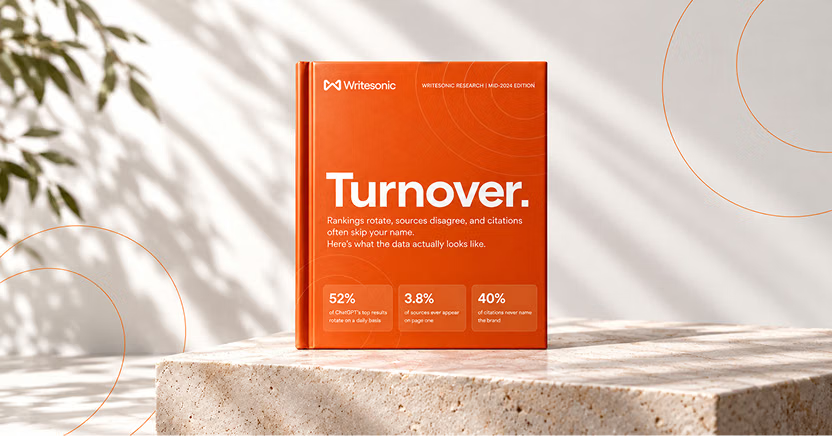
The #1 brand in ChatGPT changes 52% of the time.
Get the report and find out why.
Otterly.ai will show you where your competitors stand in terms of AI visibility, but it does not provide an in-depth analysis of the topics and AI queries for which they are appearing, unlike Writesonic GEO.
Writesonic GEO’s competitive analysis:
Writesonic GEO expands competitive analysis to include:
- Topic-level competitive benchmarking
- Content gap analysis between you and your competitors
- Visibility leaderboards across industries
- Actionable recommendations to outperform competitors
The platform’s competitive intelligence tools help you understand not just where you stand relative to competitors, but also what you can do to improve your position. The topic-level analysis is particularly valuable for content strategists looking to identify opportunities for new content or optimization.
In terms of competitor tracking, Writesonic GEO provides more detailed and actionable competitor insights.
If you’re trying to outrank a competitor in AI search, GEO gives you a clear path. You can see the topics they’re dominating and how their content structure or depth differs from yours. Then use built-in tools to close the gap.
💡Also check out: Writesonic GEO vs Peec AI Review
4. AI content optimization features
Otterly.ai’s optimization approach:
Otterly.ai’s approach to content optimization is primarily recommendation-based, but it does not offer actionable strategies or tools to help you implement changes to your AI metrics.
While valuable, these recommendations require users to implement changes using separate tools and platforms, creating potential workflow inefficiencies.
The platform is designed to help you understand what needs to be optimized, but the actual optimization process happens outside of Otterly.ai. This disconnect can slow down the implementation process and make it harder to track the impact of changes.
Writesonic GEO’s optimization approach:
Writesonic GEO takes optimization a step further:
- Provides specific content recommendations based on AI visibility data
- Offers integrated SEO and content creation tools within the same platform
Effective AI content optimization requires both visibility tracking and actionable recommendations that can be implemented quickly. Writesonic GEO’s integrated approach allows you to go from insight to action without switching platforms.
When the tool flags a visibility issue, you can:
- Open the relevant page’s analysis
- Review suggested improvements
- Use integrated content tools to rewrite, expand, or optimize
- Track updated performance over time using the GEO dashboard
This integrated approach significantly reduces the time from insight to implementation, making it easier to improve your AI visibility quickly and effectively.
5. Measuring AI traffic analytics
Otterly.ai’s traffic insights:
Otterly.ai doesn’t provide direct AI traffic analytics. Instead, it focuses on monitoring brand mentions and visibility in AI-generated responses. While this provides valuable insights into how your brand appears in AI search results, it doesn’t give you visibility into actual AI crawler activity on your site.
This limitation means you can’t see which pages AI crawlers are accessing or how often they’re visiting your site. You’re limited to monitoring the output of AI platforms rather than the input they’re using to generate responses.
Writesonic GEO’s traffic analytics:
Writesonic’s AI traffic analytics feature provides unprecedented visibility into how AI crawlers interact with your content. The platform uses Cloudflare integration to track actual AI crawler visits to your site, giving you page-level data on which URLs are being accessed by AI engines.
Key metrics include:
- Total AI visits
- Pages indexed by AI crawlers
- Visit trends over time
- Top AI sources
- Top pages accessed by AI crawlers
This level of detail allows you to understand not just how your content appears in AI-generated responses, but also which content AI platforms are actually using to generate those responses. This is a significant advantage for content optimization, as it allows you to focus your efforts on the pages that matter most to AI platforms.
The AI traffic analytics dashboard breaks down visits by different AI platforms, showing you exactly which pages are being accessed by which AI engines. Plus, you get more detailed insights on your competitors, whether it’s tracking the AI prompts that mention them, or which topics they hold authority in.
This level of detail allows for more targeted optimization efforts.
6. Pricing structure and value analysis
Otterly.ai pricing structure:
Otterly.ai offers a tiered pricing model based on search prompt volume:
- Lite Plan: $29/month for 10 search prompts
- Standard Plan: $189/month for 100 search prompts
- Pro Plan: $989/month for 1000 search prompts
- Limited free trial available (14 days)
Additional search prompts can be purchased as needed, but costs can escalate quickly for comprehensive monitoring. The pricing structure is based on the number of prompts you want to monitor, which can be limiting for brands that need to track a large number of keywords or topics.
Writesonic GEO pricing structure:
Writesonic GEO pricing plans start at just $16/month (billed annually) and is included in all paid plans starting from the Basic tier. While Otterly is primarily focused on AI monitoring, Writesonic GEO is part of a broader AI-powered SEO and content suite, offering significantly more value at every pricing level.
With any paid plan, you get access to GEO’s AI search visibility tracking, brand presence insights, and Google Search Console sync. Higher plans include full access to Writesonic’s AI agents for SEO, automated audits, content scoring, writing style tuning, and API access.
The best part is, you get an unlimited free trial.
Here’s a quick breakdown:
- Basic ($16/mo): Includes GEO tracking, site audit, AI SEO agent, 5 articles/month, and visibility tracking for 100 pages.
- Standard ($79/mo): Designed for SEO teams. Includes unlimited GEO tracking, AI agent generations, 15 audits/month, and 750 pages tracked.
- Professional ($199/mo): Adds API access, advanced project support, and higher volumes for scaling teams.
- Advanced ($399/mo): Supports 5+ users and 2500 tracked pages, ideal for agencies and marketing departments.
Why Writesonic offers better ROI
Both Otterly.ai and Writesonic help you track performance in AI search, but Writesonic GEO helps you improve it too.
Otterly.ai is excellent if your goal is basic AI brand monitoring. But if you’re looking to actually grow traffic from AI engines, you need more than just visibility metrics. You need content-level insights and the tools to act on them.
Writesonic GEO closes the loop from tracking to execution. You get:
- Real AI crawler data
- Content recommendations tied to visibility
- Optimization tools inside the same platform
- Competitive benchmarking at a topic level
- A price point that fits startups, scale-ups, and enterprises
For teams focused on outcomes, not just reporting, Writesonic GEO delivers faster results with less overhead. The best part is that Writesonic is far more cost-effective, as you get an entire SEO and content suite along with the GEO platform.
If AI visibility is on your radar, test the tools and see the difference for yourself.
✅ Try Writesonic GEO for free
No credit card. Full tracking. Built-in content tools.
The #1 brand in ChatGPT changes 52% of the time.
Get the report and find out why.

Content Strategist
Saloni Kohli is a Content Strategist with over four years’ experience in B2B SaaS content marketing and SEO.
She has shaped and executed end-to-end content strategies—ranging from editorial planning and long-form thought leadership to conversion-focused landing pages and email campaigns.
At Writesonic, Saloni combines creativity with data-driven insights to elevate brand voice, drive organic growth, and maximize audience engagement.