![15 Best ChatGPT Alternatives That’ll Blow Your Mind in 2026 [Free & Paid]](https://cdn.sanity.io/images/uvdgu5ti/production/f6bea0b0f7be34d607d09fcfdf4f90094c088e14-2000x1125.jpg?w=1920&fit=max&auto=format&q=75)
Remember when ChatGPT launched and everyone lost their minds? The AI world has been on fire ever since.
But here's the thing: there's a whole universe of equally impressive (some even better) ChatGPT alternatives out there in 2026.
Whether you're a content creator, a developer, or a business leader, there's an AI assistant tailored to your specific needs, and it might not be the one you're currently using.
In this no-fluff guide, you'll explore:
- Why you should look for ChatGPT alternatives
- A quick-reference comparison of the top tools
- In-depth analysis of each tool's strengths and weaknesses
- How to choose the right AI assistant for your use case
Ready? Let's get started.
Why Go for ChatGPT Alternatives?
ChatGPT alternatives offer benefits ChatGPT alone cannot match:
- Specialization: Some alternatives excel in specific domains. Need a coding partner? There's an AI for that. Looking for a creative writing collaborator? There's one for that too.
- Up-to-date information: Many alternatives include real-time web access, returning current information instead of training-cutoff answers.
- Privacy and data control: If you handle sensitive information, some tools offer stronger privacy protections, on-premise deployment, or open-weight models you can self-host.
- Cost efficiency: API prices in 2026 vary by more than 100x between providers. The right model can cut your spend by 80-90%.
The goal isn't replacing ChatGPT entirely. It's matching the right tool to the right job.
ChatGPT Alternatives: A Quick Glimpse
Here's a side-by-side comparison of all 15 ChatGPT alternatives covered in this guide. Pricing in 2026 ranges from completely free to $200+/month for premium research tiers.
TABLE
The 15 tools span six categories: end-to-end marketing platforms, general-purpose assistants, coding-focused tools, research engines, multi-model aggregators, and specialized companions.
What to Look for in an AI Tool
Before diving into each alternative, here's what separates a useful AI tool from a wasted subscription.
1. Purpose and Specialization
- What's your primary use case?
- Does the tool excel in that area, or is it generic?
2. Accuracy and Reliability
- How often does it return correct information?
- Are outputs consistent across similar prompts?
- Does it cite sources?
3. User Interface and Experience
- Is the interface intuitive?
- Does it offer features like conversation history, prompt templates, or canvases?
4. Integration Capabilities
- Does it connect to your existing tools (CRM, docs, email, code repo)?
- Does it offer an API and MCP support?
5. Privacy and Security
- How is your data handled?
- Are training opt-outs available?
- Is on-premise or open-weight deployment possible?
6. Customization Options
- Can you fine-tune the model?
- Does it support persona creation or system prompts?
7. Multilingual Support
- Which languages does it handle natively?
- How accurate are translations?
8. Pricing Model
- Is it cost-effective for your usage volume?
- Are free tiers or trials available?
- Is pricing flat-rate, usage-based, or compute-based?
9. Update Frequency
- How often is the model updated?
- Does it have real-time web access?
10. Ethical Considerations
- Does the company publish AI safety research?
- How transparent is it about model limitations?
11. Community and Support
- Is there an active user community?
- What support channels are available?
12. Scalability
- Can it handle increased workloads?
- Are there enterprise-grade features and SLAs?
The most advanced tool is not always the right tool. Match the capability to the requirement.
15 Best ChatGPT Alternatives to Try Out in 2026
Here are the 17 best ChatGPT alternatives that you can try in 2025:
1. Chatsonic
Best suited for: Marketing teams, SEO professionals, content creators, and business owners looking to automate and streamline their entire content marketing and SEO workflow.
Chatsonic is an advanced AI chat like ChatGPT that combines multiple AI models (GPT-4o, o1, Claude, Gemini) with marketing tools like Ahrefs and WordPress to help businesses research, create, optimize, and publish content through automated workflows.
Chatsonic by Writesonic isn’t just another Chat GPT alternative – it’s the first end-to-end AI marketing platform that combines advanced AI chat with complete content marketing capabilities. You can do keyword research, analyze competitor content, write blog posts, find backlink opportunities, and do all things SEO with Chatsonic.
Built specifically for marketers, SEOs, business owners, and content creators, it transforms how businesses grow by connecting their entire marketing stack into seamless, automated workflows.
Key features that set Chatsonic apart from ChatGPT:
AI Marketing Agent: Unique to Chatsonic, the AI Marketing Agent acts as a 24/7 marketing team that connects and automates the entire marketing stack.
While ChatGPT can only suggest strategies, Chatsonic’s agent executes them – from researching in Ahrefs to optimizing content and publishing to WordPress, all through natural conversation.
Multi-model: Chatsonic provides access to the most advanced AI models in one unified interface, including OpenAI’s latest O1 and GPT-4o, Claude 3.5 Sonnet for complex analysis, and Google’s Gemini 1.5 Pro for advanced reasoning.
State-of-the-Art AI Image Generation: Create professional marketing visuals using Flux 1.1 and DALL-E 3 for photorealistic images all directly integrated within your content workflows.
Factual SEO-optimized Content Creation: The platform includes AI Article Writer 6.0 for factual, well-researched content that seems perfectly written by a human.
In-depth web and competitor research: Take marketing to the next level with in-depth market and web research, competitor analysis using real data, content gap identification, and automated marketing workflows.
Brand Voice & Style Control: Chatsonic adapts to any brand’s unique writing style after analyzing just a few content samples.
Enhanced Writing with Canvas: Chatsonic’s Canvas feature combines ChatGPT’s canvas functionality with Claude’s artifacts in a collaborative workspace.
Pricing:
Chatsonic, the best free ChatGPT alternative is available on Writesonic in free trial and other paid plans. Upon signing up, you get 25 generations for free.
Moreover, you can also go for a paid plan starting at $16/month, billed annually. Doesn’t this make Chatsonic one of the top ChatGPT alternatives out there?
For more information about this, see Writesonic’s pricing plans!
The bottom line?
While ChatGPT gives users a general-purpose chatbot, Chatsonic provides a complete AI-powered marketing ecosystem. It’s the only platform that truly connects the entire marketing stack – from research to optimization to publishing – into automated workflows that drive real business growth.
Hear from the users
Ready to try out the best free ChatGPT alternative?
2. Google Gemini
Best suited for: A multimodel AI model with problem-solving capabilities.
About the tool
Google Gemini, formerly Bard, is Google's flagship conversational AI. The current flagship is Gemini 3.1 Pro (released February 19, 2026), with Gemini 3.5 Flash following on May 19, 2026 for cost-efficient workloads. Gemini 3 Pro originally launched on November 18, 2025.
Gemini is built as a multimodal system from the ground up. It processes text, code, images, audio, and video in a single model, and integrates directly with Google Search, Workspace, and the broader Google ecosystem.
The 2026 version uses a 1M token context window on Pro, and at Google I/O 2026 the company moved from fixed daily prompt caps to compute-based usage limits that refresh every 5 hours until weekly limits are reached.
Key features
- Real-time web grounding through Google Search
- Native multimodal input and output (text, image, audio, video)
- 1M token context window on Gemini 3.1 Pro
- Deep Research agent that browses hundreds of sites and writes structured reports
- Gemini Live voice mode and Gems (custom personas) on all paid tiers
- Veo for video generation and Nano Banana 2 for images, metered by AI credits
- Antigravity coding platform for agent-based development
- Tight integration with Gmail, Docs, Sheets, and Drive on Workspace tiers
Pricing
- Free tier with daily limits
- Google AI Plus: $7.99/month
- Google AI Pro: $19.99/month
- Google AI Ultra: $99.99/month (reduced from $249.99 in May 2026)
What we like
- Strong real-time grounding through Google Search
- 1M context window without the usual context-tax pricing
- Tight Workspace integration eliminates copy-paste workflows
- Free tier is genuinely useful, not just a demo
What we don't like
- Pricing tier names still confuse first-time buyers
- Compute-based usage limits can be hard to predict
- Video generation quotas remain tight even on Ultra
What sets it apart
Gemini's strength is breadth. Few competitors match its combination of search grounding, Workspace integration, native multimodal input, and a 1M context window at this price point. If your work already lives in Google Docs, Sheets, and Gmail, Gemini removes the friction other assistants add.
Rating: G2: 4.4/5
3. Claude (Opus 4.8, Sonnet 4.6, Haiku 4.5)
Best suited for: Complex reasoning, long-context analysis, and agentic coding.
About the tool
Claude, developed by Anthropic, sits at the top of most coding and reasoning benchmarks in 2026. The current lineup is Claude Opus 4.8 (released May 28, 2026), Claude Opus 4.7 (April 16, 2026, still generally available), Claude Sonnet 4.6 (February 17, 2026), and Claude Haiku 4.5 (October 15, 2025).
Opus 4.8 is Anthropic's most capable production model, with Anthropic reporting it is roughly four times less likely than Opus 4.7 to ship code with unflagged flaws. Sonnet 4.6 matches Opus-class performance on many real-world tasks at a fraction of the cost, and is the default in claude.ai. Haiku 4.5 runs at roughly 97 tokens per second for high-volume routing and classification.
All three Opus and Sonnet models support a 1M token context window. As of March 2026, Anthropic also removed the long-context pricing surcharge, so the full 1M context is available at standard rates.
Key features
- 1M token context window (Opus 4.7, Opus 4.8, Sonnet 4.6)
- Extended thinking mode for deep reasoning
- Computer Use for desktop and browser automation
- Native multimodal input (text, images, documents)
- Claude Code for terminal-based agentic coding
- Available across Claude API, Amazon Bedrock, Google Vertex AI, and Microsoft Foundry
- 87.6% on SWE-bench Verified (Opus 4.7), the highest published score for a commercial model
Pricing
- Free tier with Sonnet 4.6 access
- Pro: $20/month ($17/month annual)
- Max 5x: $100/month
- Max 20x: $200/month
- Team Standard: $25/seat/month (annual)
- Team Premium: $100/seat/month (annual)
- API: Opus 4.8 and Opus 4.7 at $5/$25 per million tokens, Sonnet 4.6 at $3/$15, Haiku 4.5 at $1/$5
- Prompt caching reduces input cost by up to 90%, Batch API saves 50%
What we like
- Best-in-class code generation and debugging
- Strong instruction following, especially on multi-step tasks
- Transparent safety research and clear model behavior
- 1M context window at flat pricing enables full-codebase reasoning
What we don't like
- Opus 4.7 introduced a new tokenizer that produces up to 35% more tokens for the same input, raising effective costs
- Some refusal behavior is more cautious than competitors
What sets it apart
Claude is the model most agentic coding products are built on. GitHub Copilot defaults to Sonnet 4.6 for coding work, and Cursor, Cognition's Devin, and Perplexity's Comet browser agent all rely on Claude. For software engineering, document analysis, or long-form reasoning, Claude is the strongest option in 2026.
Rating: G2: 4.7/5, Capterra: 4.8/5
4. Meta AI
Best suited for: Social media workflows, open-source deployment, and multilingual tasks.
About the tool
Meta AI is powered by the Llama 4 herd, released in April 2025: Scout (lightweight, 10M token context, 109B total / 17B active parameters), Maverick (balanced, 400B total / 17B active parameters, 128 experts), and Behemoth (~2T total / 288B active parameters, still in training as of mid-2026). All variants use a Mixture-of-Experts architecture and natively support text and image input.
The consumer Meta AI assistant lives inside Facebook, Instagram, WhatsApp, and Messenger. The models themselves are open-weight, available on Hugging Face and through cloud providers like AWS Bedrock, Together AI, and Fireworks. Meta announced in April 2026 that a new model called Muse Spark would power Meta AI going forward, with a private-preview API available to select partners.
Key features
- Native multimodal input (text and image)
- 10M token context window on Llama 4 Scout (largest in any open or closed model at launch)
- Mixture-of-Experts architecture for efficient inference
- Multilingual support including Arabic, English, French, German, Hindi, Indonesian, Italian, Portuguese, Spanish, Tagalog, Thai, and Vietnamese
- Deep integration with Meta's social platforms
- Open-weight models for self-hosting and fine-tuning
- Multi-image input (up to 8 images per prompt in post-training)
Pricing
- Free across all Meta platforms
- API costs vary by hosting provider (AWS, Together, Fireworks)
- Maverick API pricing roughly $0.49 per million tokens at several providers
What we like
- One of the most capable open-weight model families available
- No usage caps in consumer Meta apps
- 10M context window on Scout is unmatched in the open-source world
- Self-hosting eliminates vendor lock-in
What we don't like
- Llama 4 trails GPT-5.5, Claude Opus 4.7, and Gemini 3.1 Pro on the hardest reasoning benchmarks
- Some features unavailable in the EU due to regulatory restrictions
- Llama community license restricts use above 700M monthly active users
- Requires technical skill to self-host effectively
What sets it apart
Llama 4 remains one of the few frontier-adjacent open-weight model families in 2026. For organizations that need data sovereignty, customization, or escape from API vendor lock-in, Meta AI's underlying models are an obvious choice. The 10M context window on Scout is still unmatched in the open-source world.
5. Microsoft Copilot
Best suited for: Microsoft 365 users, enterprise productivity, and Windows workflows.
About the tool
Microsoft Copilot is the AI layer across Word, Excel, PowerPoint, Outlook, Teams, and Windows. Microsoft launched Microsoft 365 Premium in October 2025 at $19.99/month, consolidating Copilot Pro features with the Family subscription. Enterprise customers still get Microsoft 365 Copilot as an add-on.
Copilot now includes computer use (GA May 2026) for automating desktop and web apps, MCP-compliant tools for agent workflows (GA October 2026), and agents optimized for specific Microsoft 365 surfaces.
Key features
- Deep integration with Word, Excel, PowerPoint, Outlook, Teams
- Computer use for automating web and desktop applications
- MCP-compliant tool integration for agent workflows
- Multi-modal capabilities (text, image, voice)
- Custom agent builder for enterprise workflows
- Microsoft Purview integration for compliance and governance
- Free Copilot Chat at copilot.microsoft.com
- Researcher, Analyst, and Office Agent features included in Premium and enterprise tiers
Pricing
- Free: Copilot Chat at copilot.microsoft.com
- Microsoft 365 Personal with Copilot: $9.99/month
- Microsoft 365 Premium (consumer): $19.99/month or $199.99/year
- Copilot Pro: $20/month (still offered as standalone)
- Microsoft 365 Copilot Business: $21/user/month annual, $25.20/user/month monthly
- Microsoft 365 Copilot (Enterprise): $30/user/month, annual billing required
- Pricing increases scheduled for July 1, 2026
What we like
- Seamless integration across the Microsoft 365 suite
- Strong enterprise security and compliance posture
- Computer use brings genuine workflow automation
- 15 million paid Microsoft 365 Copilot seats by Q1 2026 signals broad enterprise adoption
What we don't like
- Requires existing Microsoft 365 license to unlock full value
- "Copilot" is a brand name applied to seven different products
- Annual commitment required for enterprise pricing
What sets it apart
Copilot's value comes from where it lives. Anyone deep in the Microsoft ecosystem gets AI assistance inside the apps they already use, with data permissions inherited from existing roles. For enterprises that have standardized on Microsoft 365, no other AI assistant offers comparable integration.
Rating: G2: 4.3/5, Capterra: 4.6/5
6. Grok
Best suited for: Real-time analysis of trends on X, less-filtered creative work, and cost-efficient reasoning.
About the tool
Grok is xAI's conversational AI. The current flagship is Grok 4.3, released to the public API on April 30, 2026, with a 1M token context window and pricing of $1.25/$2.50 per million input/output tokens. Grok 4.1 Fast remains available at $0.20/$0.50 per million tokens with a 2M token context window.
Grok pulls real-time data from X (formerly Twitter), making it the strongest assistant for current event analysis and trend monitoring. It also retains a less restrictive content policy than most competitors. SpaceX acquired xAI in February 2026 in an all-stock deal.
Key features
- Real-time access to X data stream
- 1M token context window on Grok 4.3, 2M on Grok 4.1 Fast
- Native video input (an industry first for the model class)
- Native PDF, PPTX, and XLSX file generation
- DeepSearch for live web research
- Big Brain mode for extended reasoning
- Voice mode for spoken conversation
- Grok Imagine for image and video generation
- OpenAI SDK compatibility for easy migration
Pricing
- Free tier on grok.com
- SuperGrok Lite: $10/month
- SuperGrok: $30/month or $300/year
- X Premium+: $40/month (includes Grok plus X platform features)
- SuperGrok Heavy: $300/month (full Grok 4.3 access, 16-Agent Heavy mode)
- API: $1.25/$2.50 per million tokens on Grok 4.3
- Free API credits available via data-sharing program (around $150/month)
What we like
- Real-time information from X is genuinely useful
- Aggressive API pricing undercuts most reasoning-capable competitors
- Less restrictive on edgy or hypothetical queries
- Free credits make it startup-friendly
What we don't like
- Scores 53 on the Artificial Analysis Intelligence Index, trailing GPT-5.5 (60) and Gemini 3.1 Pro (57)
- Roughly 20-second time-to-first-token on reasoning calls
- Quality of X data depends on the topic
What sets it apart
Grok is among the cheapest reasoning-capable frontier-adjacent models in 2026. Combined with real-time X data and 1M-2M token context windows, it's the right pick for cost-sensitive workloads and any task that needs current social signals.
7. Perplexity AI
Best suited for: Research, fact-checking, and AI-native browsing.
About the tool
Perplexity is an AI answer engine that combines real-time web search with frontier language models. Every response includes citations, making it the default tool for research where source attribution matters.
In 2026, Perplexity also operates Comet, a Chromium-based AI browser. Comet launched in July 2025 as a $200/month exclusive but dropped its paywall on March 18, 2026 and is now free on iOS, Android, Windows, and Mac.
Key features
- Real-time web search with citations on every claim
- Comet AI browser, free on all platforms
- Deep Research for multi-step investigations
- Model Council on Max tier dispatches one query to Claude Opus 4.6, GPT-5.2, and Gemini 3 Pro simultaneously
- Spaces for organizing research projects
- Pages for publishing research outputs
- Choice of Opus 4.6, Sonnet 4.5, and other frontier models in the browser agent
Pricing
- Free: roughly 5 Pro Search queries per day
- Pro: $20/month or $200/year
- Max: $200/month (unlimited Labs, Model Council, browser agent)
- Education Pro: $10/month
- Enterprise Pro: $40/user/month
- Comet Plus: $5/month standalone, included in Pro and Max
What we like
- Citations on every answer make verification trivial
- Comet browser is a genuine Chrome alternative for research-heavy work
- Model Council surfaces disagreements between top models
- Strong publisher revenue-share program
What we don't like
- Free tier query cap is restrictive
- Max tier is expensive for occasional research
- Comet still lags Chrome on developer tooling
What sets it apart
Perplexity is the most reliable research tool in 2026 because of one design choice: it shows its sources. For academic work, journalism, due diligence, and any task where "where did this fact come from" matters, no other AI gets closer to a research-grade workflow.
Rating: G2: 4.6/5, Capterra: 4.3/5
8. Poe
Best suited for: Comparing multiple AI models on the same prompts under one subscription.
About the tool
Poe, built by Quora, is the largest multi-model AI aggregator. A single Poe subscription gives access to GPT-5.5, Claude Opus 4.7, Gemini 3.1 Pro, Llama 4, Mistral, DeepSeek V4, and 200+ other models, plus image and video generators.
The 2026 update shifted pricing from per-model caps to a Compute Points system, so heavy models burn points faster than lightweight ones. Users can also build custom Prompt Bots and Server Bots, and monetize them.
Key features
- 200+ models from every major provider in one interface
- Multi-bot chat to query several models in the same thread
- Custom bot creation with system prompts and knowledge bases
- Monetized bots earn creators up to $20 per subscriber
- Per-message price option for paid custom bots
- Mobile apps for iOS and Android
- Compute Points pricing scales to actual model cost
Pricing
- Free tier with daily Compute Points allocation
- Annual subscription starts at $4.99/month
- Monthly subscription: $19.99/month
- Poe Teams: $249.99/month
- Add-on points: $30 per 1M
What we like
- One subscription replaces five separate AI bills
- Side-by-side comparison across models surfaces real differences
- Custom bot ecosystem is genuinely useful
- Annual pricing is one of the best AI deals available
What we don't like
- Some provider-specific features (OpenAI Code Interpreter, Claude Projects) are unavailable through Poe
- Premium models burn points faster, so heavy users hit caps
- New model launches sometimes lag direct provider access
What sets it apart
Poe is the only platform where you can run the same prompt through GPT-5.5, Claude Opus 4.7, and Gemini 3.1 Pro and compare outputs in seconds. For anyone evaluating models, building prompts, or running a small team that needs flexibility, it's the highest-leverage subscription in AI.
Rating: G2: 4.5/5
9. GitHub Copilot
Best suited for: Software developers writing, reviewing, and debugging code.
About the tool
GitHub Copilot is the AI coding assistant developed by GitHub with Microsoft and Anthropic. The 2026 default model for agentic work is Claude Sonnet 4.6, with GPT-5.4, Gemini 3.1 Pro, and Claude Opus 4.7 available for premium requests.
Effective June 1, 2026, GitHub Copilot moved from flat-rate subscriptions to usage-based billing. Each plan now includes a monthly allotment of GitHub AI Credits (1 credit = $0.01), with the option to purchase additional usage. Code completions and Next Edit Suggestions remain unlimited.
Key features
- Real-time code completion across 40+ languages
- Copilot Chat for in-editor conversation
- Coding agent that opens PRs autonomously
- Code review on pull requests
- Multi-model support (Claude, GPT-5, Gemini)
- Deep IDE integration (VS Code, JetBrains, Neovim, Visual Studio)
- Copilot CLI for terminal workflows
- Model Context Protocol support
Pricing
- Copilot Free: 2,000 code completions and 50 chat/agent requests per month
- Copilot Pro: $10/month with $10 in monthly AI Credits
- Copilot Pro+: $39/month with $39 in monthly AI Credits
- Copilot Business: $19/user/month plus AI Credits usage
- Copilot Enterprise: $39/user/month plus AI Credits usage
- Copilot Max: Higher-allowance tier launched June 1, 2026 (pricing varies)
What we like
- Tight IDE integration removes context-switching cost
- Sonnet 4.6 default delivers strong code quality
- The coding agent handles full feature work, not just suggestions
- Code review catches bugs reviewers miss
What we don't like
- New usage-based billing is harder to predict than flat rates
- Pro+/Max tiers can get expensive for agentic workflows
- Pro and Pro+ new sign-ups paused as of June 2026
What sets it apart
GitHub Copilot remains the most deeply IDE-integrated coding assistant in 2026. The combination of Sonnet 4.6 as default, the coding agent's ability to open PRs, and native MCP support gives developers a coherent loop from idea to merged code without leaving the editor.
Rating: G2: 4.5/5
10. DeepSeek
Best suited for: Cost-conscious developers and teams wanting frontier-class open-weight models.
About the tool
DeepSeek V4 launched on April 24, 2026 as the most capable open-weight model family of the year. It ships in two variants: V4-Pro (1.6 trillion total parameters, 49B active) and V4-Flash (284B total, 13B active). Both use a Mixture-of-Experts architecture with a hybrid attention design, support a 1 million token context window by default, and are released under the MIT license.
V4-Pro scores 80.6% on SWE-bench Verified, competitive with top closed-source frontier models on coding benchmarks. DeepSeek acknowledges V4 "falls marginally short" of closed-source flagships by roughly three to six months of development. V4 was notably trained on Huawei Ascend chips rather than NVIDIA hardware.
Key features
- True open weights under MIT license
- 1M token native context window
- Hybrid Compressed Sparse Attention for efficient long-context inference
- Strong agentic coding capability (state-of-the-art among open-source models on coding)
- Compatible with OpenAI and Anthropic API formats
- Web interface at chat.deepseek.com
- Available on Hugging Face, vLLM, SGLang, and major cloud providers
- Hardware flexibility (NVIDIA and Huawei Ascend support)
Pricing
- Free at chat.deepseek.com
- API: V4-Pro at approximately $3.48 per million output tokens; V4-Flash at approximately $0.28
- Self-hosting: Open weights, infrastructure cost only
What we like
- True open weights, not just open-source code
- Frontier-class performance at a fraction of API costs
- Strong math and coding performance
- OpenAI/Anthropic API compatibility simplifies migration
- Text-only focus keeps the model lean
What we don't like
- Text only, no vision, audio, or video capabilities
- Trails Gemini 3.1 Pro and Claude Opus 4.7 on the broadest knowledge benchmarks
- US State Department warnings about Chinese-origin AI models in some procurement contexts
- Anthropic and OpenAI have alleged capability distillation (unverified)
What sets it apart
DeepSeek V4 made it economically irrational to pay frontier prices for tasks open-source can handle. If your stack can run on open weights and your compliance posture allows it, DeepSeek delivers near-frontier coding performance at a small fraction of proprietary API costs.
11. Character.AI
Best suited for: Role-play, language practice, creative writing, and conversational entertainment.
About the tool
Character.AI is the largest AI roleplay platform with more than 10 million user-created characters and 20 million monthly users. The free tier allows unlimited messaging with any character. The c.ai+ subscription adds speed, priority access, and exclusive features.
In 2026, Character.AI added Imagine Gallery (in-conversation image generation, March 2026), Chat Memories for long-term context, and c.ai labs for early access to experimental features. The platform's underlying model is PipSqueak 2 (default for free users since April-June 2026 updates), with content filters that block sexual content on all accounts.
Key features
- 10M+ user-created characters
- Persistent chat memories for context across sessions
- Imagine Gallery for AI image generation in chat (c.ai+ only)
- Voice calls with characters on c.ai+
- Lorebook for worldbuilding (RAG-style context injection)
- Mobile apps for iOS and Android
- Multilingual support
Pricing
- Free: Unlimited messages with all characters
- c.ai+: $9.99/month or $94.99/year (~$7.92/month effective)
What we like
- Massive character library
- Engaging for language learning and creative writing
- Free tier is genuinely unlimited
- Strong community of character creators
What we don't like
- Full-screen ads now appear mid-conversation on free tier
- Content filters can break immersion
- Founding team left for Google, slowing pace of improvement
- Several 2026 updates have shifted features behind the paywall
What sets it apart
Character.AI is the only platform where building and chatting with personas is the entire product, not a side feature. For language learners, fiction writers, and casual users who want personality over capability, nothing else comes close.
12. Mistral Le Chat
Best suited for: Enterprises wanting European AI sovereignty, advanced reasoning, and agentic workflows.
About the tool
Mistral Le Chat is the consumer interface for Paris-based Mistral AI's models. The 2026 lineup centers on Mistral Medium 3.5 (a dense 128B parameter model with a 256K context window, released April 29, 2026), Mistral Small 4 (configurable reasoning, March 2026), and Mistral Large 3 (a sparse MoE with 675B total and 41B active parameters, Apache 2.0 license, released December 2025).
Medium 3.5 unifies what were previously three separate models (Magistral for reasoning, Pixtral for vision, Devstral 2 for coding) into a single set of weights with configurable reasoning effort. It scores 77.6% on SWE-Bench Verified, close to Sonnet 4.6's 79.6%.
Le Chat 2026 added persistent memory, agent mode, a hosted code interpreter, Canvas-style editing, web search with citations, and Connectors for MCP integration. Mistral Vibe is the new long-running coding agent that runs cloud-based async tasks.
Key features
- Mistral Medium 3.5: dense 128B parameters, 256K context, native multimodal input
- Configurable reasoning effort on Medium 3.5 and Small 4
- Agent mode with built-in tool use
- Hosted code interpreter
- Web search with inline citations
- Canvas for collaborative document editing
- Persistent memory across conversations
- MCP connectors for enterprise integrations
- Open-weight models (Apache 2.0 for Large 3, modified MIT for Medium 3.5) for self-hosting
- Mistral Vibe for autonomous cloud coding
Pricing
- Free tier on chat.mistral.ai
- Pro tier with higher limits
- API: Medium 3.5 at approximately $1.50 input / $7.50 output per 1M tokens
- Enterprise: Custom pricing with on-prem options
What we like
- European data residency by default
- Open weights on flagship models (Apache 2.0 on Large 3, modified MIT on Medium 3.5)
- Configurable reasoning effort saves money on simple tasks
- ARR grew to approximately $400M by January 2026
What we don't like
- Trails Claude Opus and Gemini 3 on the hardest benchmarks
- Modified MIT license on Medium 3.5 routes high-revenue enterprises through Mistral's paid channel
- Smaller third-party tool ecosystem than US providers
What sets it apart
Mistral is the European AI alternative. For regulated industries, EU AI Act compliance, or organizations that need on-prem deployment without sacrificing capability, Mistral delivers genuinely frontier-adjacent models at significantly lower prices than US flagships.
13. GroqChat
Best suited for: Real-time AI applications where latency matters more than model selection.
About the tool
GroqChat is the consumer interface for Groq's custom LPU (Language Processing Unit) hardware. The pitch is speed: 280 to 1,000 tokens per second on open-source models, roughly 5-14x faster than equivalent GPU-based providers.
In March 2026, NVIDIA acquired Groq's core engineering team. GroqCloud continues operating independently under new CEO Simon Edwards, and the first NVIDIA-Groq chip (Groq 3 LPU) shipped as part of the Vera Rubin platform at GTC 2026.
Key features
- 280 to 1,000+ tokens per second inference on open-source models
- Sub-100ms time to first token on smaller models
- LPU hardware optimized for deterministic latency
- Open-source model catalog: Llama, Qwen, Mixtral, Gemma, DeepSeek R1 Distill, Kimi K2
- Free tier with 30 RPM, no credit card required
- 50% discount via Batch API
- 50% discount via prompt caching (stack to ~25% of on-demand)
- OpenAI-compatible API
Pricing
- Free tier: 30 RPM, all supported models
- Llama 3.1 8B Instant: $0.05 input / $0.08 output per 1M tokens
- GPT-OSS 120B: $0.15 / $0.60 per 1M tokens
- Llama 3.3 70B Versatile: $0.59 / $0.79 per 1M tokens
- Kimi K2: up to $1.00 input per 1M tokens
- Enterprise: Custom pricing via groq.com/enterprise-access
What we like
- Fastest inference latency in the market
- Cheapest tier among production-grade APIs
- Free tier is genuinely usable
- OpenAI SDK compatibility makes adoption trivial
What we don't like
- No GPT, Claude, or Gemini access (open-source models only)
- Long-term roadmap uncertain after NVIDIA team acquisition
- SOC 2 and HIPAA still pending in some regions
What sets it apart
Groq is the only API where latency is the headline feature. For voice agents, real-time chat UX, live translation, and any application where the user feels the delay, no other provider competes. The price is the bonus.
14. Cursor
Best suited for: Software developers who want an AI-native code editor with multi-file editing and agentic workflows.
About the tool
Cursor is the dominant AI-native code editor in 2026, built by Anysphere as a fork of VS Code. More than half of Fortune 500 companies use it, with Salesforce alone deploying it to 20,000+ developers. Cursor reached approximately $2B ARR in 2026.
The 2026 Cursor experience runs on Claude 4.x (Sonnet 4.6 and Opus 4.7 are default for premium requests), GPT-5.4, Gemini 3.1 Pro, and Cursor's own proprietary models for tab completion. Composer mode handles multi-file edits, Agent mode runs background tasks, and Cloud Agents continue work even when the editor is closed.
Key features
- VS Code-based editor with all existing extensions and themes supported
- Tab completion that predicts your next edit based on recent changes
- Composer mode for multi-file edits across the codebase
- Agent mode for autonomous task execution
- Cloud Agents that run background tasks
- Codebase-aware AI that reads and references your full project
- Privacy mode where code is never stored or used for training
- Multi-model access (Claude, GPT, Gemini, xAI) under one subscription
- Native MCP support
Pricing
- Hobby: Free (limited completions + slow requests)
- Pro: $20/month ($16/month annual)
- Pro+: $60/month
- Ultra: $200/month
- Teams: $40/user/month
- Enterprise: Custom pricing with SCIM, audit logs, AI code tracking API
What we like
- Tab completion remains the best in the industry
- Composer handles complex multi-file refactors that other tools can't
- VS Code foundation eliminates switching costs
- Cloud Agents enable a genuinely parallel workflow
What we don't like
- Credit system changes in 2025 created friction for existing subscribers
- Performance on very large projects can lag vanilla VS Code
- IDE lock-in excludes JetBrains and Vim users
- The AI still makes mistakes, especially on niche frameworks
What sets it apart
Cursor's combination of fast tab completion, multi-file Composer edits, and Cloud Agents creates a coding workflow no other tool matches. For professional developers writing production code daily, the ROI is measurable within a week.
15. You.com (YouChat)
Best suited for: AI-powered research, content generation, and multi-model workflows with strong privacy.
About the tool
You.com is an AI productivity platform built around YouChat, custom AI agents, and ARI (Advanced Research & Insights), the company's professional research agent. YouChat blends traditional web search with conversational AI responses, always with cited sources.
ARI processes up to 500 sources simultaneously and produces polished PDF reports in under five minutes. In head-to-head tests, You.com claims ARI outperforms OpenAI's Deep Research in 76% of evaluations.
Key features
- ARI deep research agent (400-500+ sources, PDF reports)
- Access to 20+ models including Claude, GPT, Gemini
- Custom AI agents with proprietary data via RAG (up to 10 GB)
- Cited sources on every answer
- YouImagine for AI image generation
- YouWrite for AI-assisted writing
- Privacy-first design with transparent data handling
- iOS, Android, web, and AWS Marketplace availability
Pricing
- Free: Basic search and AI features, no account required
- You.com Pro: $15/month (annual billing)
- You.com Max: $175/month (annual billing)
- Enterprise: Custom pricing
What we like
- ARI delivers consulting-grade research output in minutes
- 20+ models behind one subscription
- Privacy-focused design without giving up capability
- Custom agents with proprietary data are genuinely powerful
What we don't like
- Free tier limits ARI access
- Image generation quality varies by model
- Max tier is expensive for occasional use
What sets it apart
You.com is the only AI platform built around deep research as a first-class product. For consultants, analysts, investment researchers, and anyone whose deliverable is "a thorough report on X," ARI compresses what used to be a week of work into minutes.
Rating: G2: 4.4/5
How We Analyzed and Selected ChatGPT Alternatives
The selection process combined four lenses:
- Market scan: We tracked every consumer and developer-facing AI assistant active in 2026, including new entrants and updated incumbents.
- Hands-on testing: We used each tool for representative tasks (coding, research, writing, analysis) and measured quality, latency, and accuracy.
- Industry signals: We weighed benchmark performance (SWE-bench, GPQA, MMLU, AIME, Artificial Analysis Intelligence Index), user reviews on G2 and Capterra, and adoption among developers and enterprises.
Total cost of ownership: We compared not just headline prices but also context windows, rate limits, and add-on costs.
Try out the #1 ChatGPT-like conversational AI – Chatsonic
Overall, while ChatGPT is a powerful AI-powered chatbot, there are still some great alternatives out there. From content writing and chatbots to coding and ad creation, these innovative solutions can be a total lifesaver.
But with countless AI options out there, the key to efficient productivity lies in selecting a tool that not only automates but elevates your work. A tool that slots perfectly into your tasks, understanding and enhancing your processes.
Now, you cannot rely on auto-generation anymore; instead, you need to come up with content that’s personalized, relevant, and, most importantly, favored by Google.
And this is where Chatsonic, one of the best alternatives to ChatGPT steals the show. It’s driven not just by AI but by understanding the ins and outs of content requirements – be it blogs, social media, ad copy, or detailed articles.
So why settle for less when you can have a tool that’s fluent in keyword-seo-language, maintains brand consistency, and produces human-like quality content? Ready to take content creation to the next level?
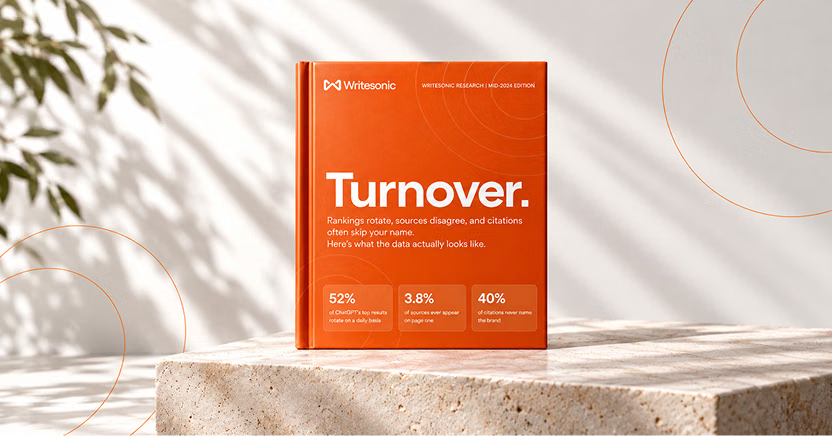
The #1 brand in ChatGPT changes 52% of the time.
Get the report and find out why.

Founder @ Writesonic
Samanyou is the founder of Writesonic, a platform that helps you track & boost your brand’s visibility in AI search. Two years before the launch of ChatGPT, Writesonic was already at the forefront, helping organizations automate their entire marketing workflow through specialized AI agents for SEO and content. Samanyou is a Forbes 30 Under 30 awardee and a winner of the 2019 Global Undergraduate Awards, often referred to as the junior Nobel Prize.