A content strategist at a growing SaaS startup ran an SEO audit last quarter. Traffic looked great. Rankings were stable. But when her CEO asked, “Why isn’t our tool mentioned in ChatGPT’s suggestions?”, she had no answer.
Welcome to the AI search era, where visibility is no longer about blue links, but whether large language models (LLMs) even know you exist. This blog explores three tools, Profound vs PEEC vs AthenaHQ, designed to help you reclaim your voice in generative search. And by the end, we’ll even introduce a smarter alternative.
KEY TAKEAWAYS
- Profound is the most expensive GEO tool out of the three, but delivers the deepest insights with multi-engine coverage and competitor graphing. Best for enterprise GEO teams.
- PEEC AI has the most affordable pricing with strong entity and product-level tracking. Ideal for tactical product marketing, but less strategic than Profound.
- AthenaHQ is the easiest to use tool, but lacks advanced features like competitor analysis. Works best for small teams or PR monitoring.
- All three tools—Profound, PEEC, and AthenaHQ—offer capabilities for improving Generative Engine Optimization (GEO), but Writesonic takes AI search visibility to a whole new level.
- With Writesonic, it’s not just about tracking — it’s about turning every gap into a win. From identifying citation opportunities and uncovering missing prompts to monitoring sentiment and share of voice, Writesonic gives you the full picture of your AI presence and the steps to dominate it.
Factors to Consider Before Choosing a GEO Tool
Look for GEO tools that help you:
- Track how your brand appears in AI-generated content
- Analyze competitor visibility in AI tools like ChatGPT and Claude
- Identify brand mentions, content gaps, and opportunity keywords
- Influence AI answers through content, backlinks, and credibility signals
Now let’s break down how Profound vs PEEC AI vs AthenaHQ each tackle this.
Tool #1: Profound
Profound is a high-powered platform built for enterprise marketing and SEO teams. It’s all about deep visibility; not just whether your brand appears, but how it appears across different AI engines.
Key Features:
- Multi-engine coverage: Tracks mentions across ChatGPT, Claude, Perplexity, Gemini, and more.
- Brand perception graphing: Understands tone, context, and frequency of mentions.
- Answer graph: Visualizes how often and where your brand appears in user prompts and AI replies.
- Daily updates + trend tracking: Identifies dips or spikes in brand presence.
- Competitor gap analysis: Shows where competitors are mentioned and you aren’t.
Strengths:
- Ideal for agencies managing multiple clients
- Custom dashboards, team collaboration features
- Insights into entity-level positioning (not just name mentions)
Weaknesses:
- Pricing is high — targeted at mid-to-large enterprises
- Complex UI and data-heavy dashboards require training
- More of an intelligence platform than an actionable optimization suite
What does this mean?
Profound is positioned at the premium end of the GEO market, with pricing that’s noticeably higher, when checking Profound vs PEEC vs AthenaHQ. In exchange, you get enterprise-grade detail: multi-engine coverage, brand perception graphing, and deep competitor mapping.
While PEEC AI offers some entity-level tracking at a lower cost, it doesn’t come close to Profound’s data depth or customizable dashboards. On the other hand, AthenaHQ is far more detailed — but its it has limitations in advanced competitor intelligence.
- Verdict: If budget isn’t a concern, Profound delivers unmatched strategic analysis. But for smaller teams, PEEC AI or AthenaHQ may be easier to adopt.
Tool #2: PEEC AI
PEEC AI zeroes in on entities, tags, and products. Instead of focusing only on your brand name, it identifies how individual product names, features, or categories are represented in generative answers.
Key Features:
- Tag-based monitoring: Track visibility of products, people, features, and entities.
- Real-time answer parsing: See how often you’re mentioned — and whether those mentions are favorable.
- Answer delta tracking: Find where you lost a position to a competitor and why.
- Content gap suggestions: Highlights missing product features or topics that AI engines favor elsewhere.
- Competitive benchmarking: Compares visibility between you and top rivals on the product level.
Strengths:
- Great for SaaS, D2C, and feature-driven brands
- Highly visual dashboard with tag cloud overlays
- Good balance of simplicity and tactical depth
Weaknesses:
- Limited export/reporting functionality
- Not built for managing multiple brand accounts at once
- Less effective at strategic brand storytelling
What does this mean?
PEEC AI positions itself as the most affordable out of itself, when tallying Profound vs PEEC vs AthenaHQ in terms of pricing; more affordable than Profound’s enterprise plans, and detailed than AthenaHQ’s GEO + Action Center.
Where it shines is entity and product-level tracking. Unlike Profound, which focuses on brand-wide strategy, PEEC AI drills into individual SKUs, features, or even sub-brands. This makes it more tactical — especially for SaaS or e-commerce brands that care about how specific offerings appear in AI answers.
Compared to AthenaHQ, PEEC AI offers far more granular insights and real-time tracking, though it lacks Profound’s big-picture brand sentiment analysis.
- Verdict: Ideal for product marketers who want quick, actionable fixes at the feature level. But if you’re looking for broad brand positioning data like Profound’s, or need simplicity of use like AthenaHQ — PEEC AI might not be enough.
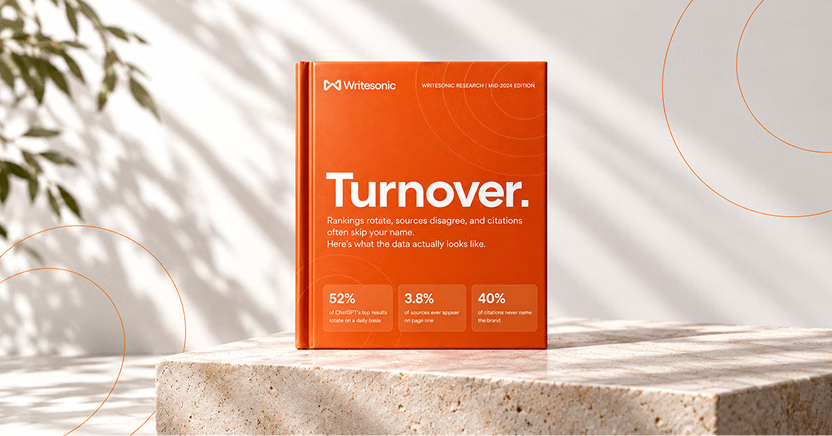
The #1 brand in ChatGPT changes 52% of the time.
Get the report and find out why.
Tool #3: AthenaHQ
AthenaHQ approaches GEO from a reputation and PR standpoint. Instead of analyzing content or keyword opportunities, it helps brands understand how they’re being described in AI-generated narratives.
Key Features:
- AI-generated summaries: Quickly see what AI tools “believe” about your brand.
- Media coverage signals: Identifies source attribution in AI content (if any).
- Quick competitor snapshots: Get high-level comparisons on visibility and tone.
- Simple alert system: Notifies users of new mentions or shifts in AI tone.
Strengths:
- Super easy setup and navigation
- Very lightweight (no need for SEO knowledge)
- Great for founders, PR teams, and comms departments
Weaknesses:
- Doesn’t track entities or features
- Limited engine coverage
What does this mean?
AthenaHQ is the easiest GEO option out of the three, costing significantly less than Profound but slightly more than PEEC AI. But that affordability comes with challenges: AI coverage is narrower, and there’s no deep entity tracking or sophisticated competitor graphing.
Where it outperforms both, when comparing Profound vs PEEC vs AthenaHQ is ease of use. There’s virtually no learning curve; a PR team can start tracking mentions within minutes. Additionally, if you need ongoing optimization recommendations or content gap analysis, AthenaHQ also has an Action Center in place.
- Verdict: Great for early-stage startups or PR-focused teams that want quick visibility checks without complexity. But brands aiming for long-term GEO strategy along with competitor analysis will find PEEC AI or Profound more viable.
Writesonic – A Better, Scalable Alternative for Full-Stack AI Visibility
Why consider an alternative?
While Profound, PEEC AI, and AthenaHQ are solid players, each has limitations:
- Profound is expensive and suited mostly for agencies or enterprises
- PEEC is too focused on entities for brands needing broader positioning
- AthenaHQ is lightweight but lacks depth and actionability
Writesonic, in contrast, brings everything together — monitoring, analysis, and content generation — under one roof.
What Is Writesonic?
Writesonic is the leading platform for Generative Engine Optimization (GEO) — helping brands track, improve, and dominate their visibility in AI search results. It monitors how often your brand is cited or recommended by AI platforms like ChatGPT, Claude, Perplexity, and Gemini, then turns those insights into precise actions to boost your presence. By combining advanced AI prompt tracking, citation gap detection, and sentiment analysis, Writesonic ensures your brand isn’t just visible — it’s the trusted answer in the AI era, making it an authority across AI-driven search engines.
Writesonic is a full-featured Generative Engine Optimization toolkit built for marketers, content teams, and SEO strategists who want to:
- Audit their brand’s presence across generative AI tools
- Benchmark against competitors
- Understand AI search sentiment
- Generate optimized content that improves AI rankings
Key Features of Writesonic:
1. GEO Audit Tool
- Get a detailed snapshot of your brand’s visibility across ChatGPT, Gemini, Claude, and Perplexity.
- Identify if your competitors are showing up instead of you — and why.
2. Brand Radar
- Track how often your brand is mentioned, what tone AI engines use, and what sources they’re referencing.
- Monitor changes over time — weekly, monthly, or campaign-specific.
3. Content Gap Suggestions
- Uses real AI-generated responses to suggest missing content or metadata that could improve your answer visibility.
- Prioritizes fixes based on what AI models favor (trust, relevance, freshness).
4. Answer Influence Engine
- AI visibility into how your content affects generative answers.
- Measure before-and-after impact of PR coverage, new blog posts, or backlink campaigns.
5. Competitor Intelligence
- Analyze up to 5 competitors at once.
- Understand their AI visibility score, mention frequency, and brand positioning.
6. Writesonic AI Integration
- Once a content gap is identified, you can generate optimized blog posts, PR articles, landing pages, or FAQs using Writesonic’s own advanced AI.
- Write content tailored for both users and AI search engines.
Writesonic: Key Benefits
✅ Unified platform: Monitoring + action in one place
✅ Scalable: Perfect for agencies, solopreneurs, and brands
✅ Budget-friendly: No enterprise plans
✅ Actionable: Not just what’s broken — but how to fix it fast
✅ Future-ready: Constantly updated for evolving LLMs and answer engine behavior
Final Thoughts: Which GEO Tool Is Right for You?
| Tool | Best For | Not ideal for |
| Profound | Agencies, enterprise brand | Small teams, fast execution workflows |
| PEEC AI | Product-led SaaS and e-com brands | Strategy-level brand work |
| AthenaHQ | PR and early-stage startup monitoring | SEO and marketing optimization |
| Writesonic | Marketers, content teams, SEOs, agencies | None — built for scalability & full-stack GEO |
If you’re serious about owning your space in AI-generated answers, it’s no longer optional to monitor how LLMs talk about your brand.
And while Profound vs PEEC AI vs AthenaHQ offer great starting points depending on your needs, Writesonic is the most holistic, efficient, and scalable tool built for this new world of AI search.
FAQs on Profound vs PEEC vs AthenaHQ
The #1 brand in ChatGPT changes 52% of the time.
Get the report and find out why.

Sumana Sarmah is a Content Writer @ Writesonic, with 5+ years of hands-on experience in B2B content writing and copywriting.
With a knack for creative brainstorming, she strategizes and curates impactful content that brings in exceptional engagement.