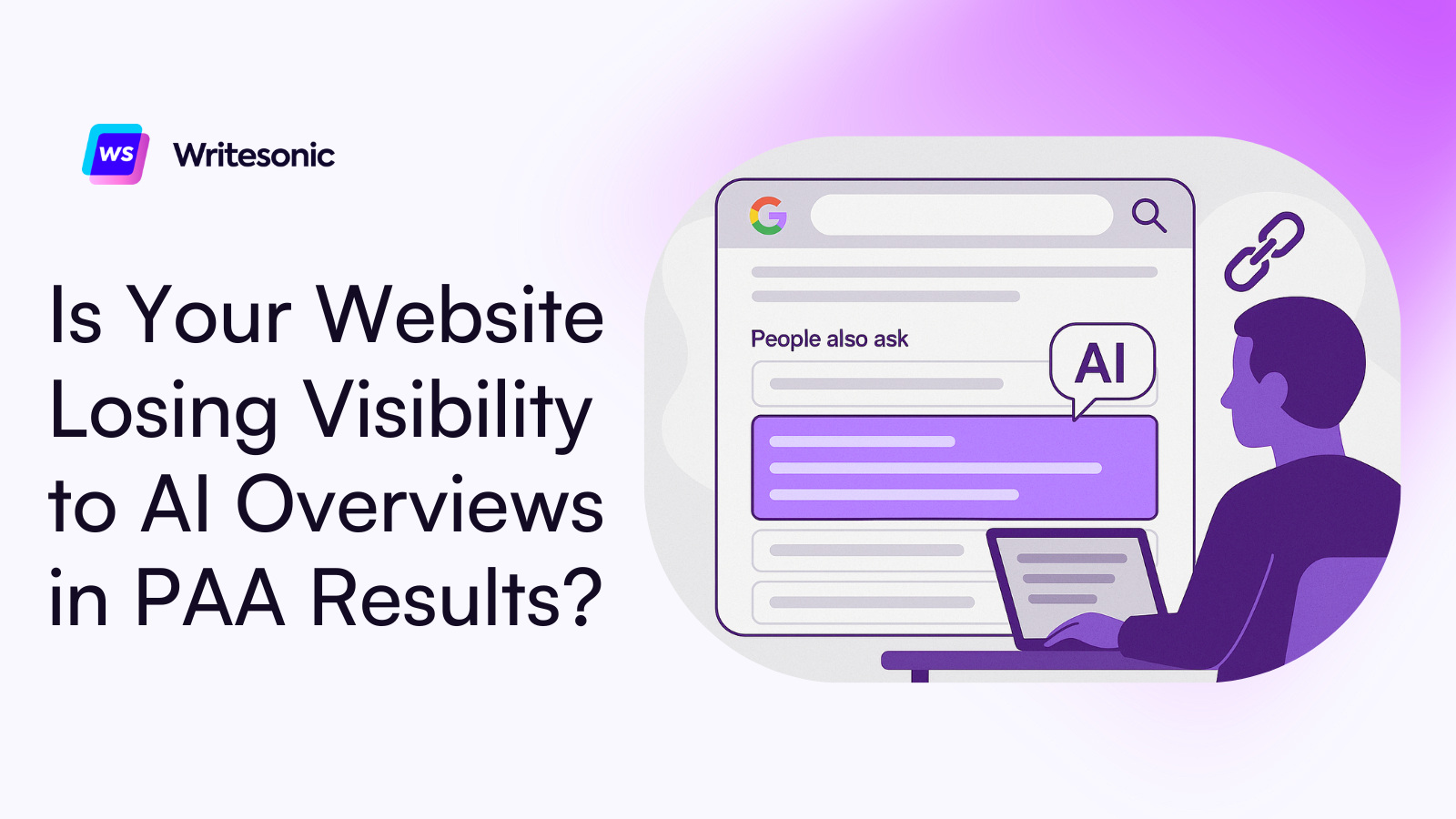
Your page might show up in search, but AI could be answering the question before users even see your link.
Google’s People Also Ask (PAA) boxes are no longer just pulling in featured snippets from websites. In many cases, they now generate their own answers, without linking to any source.
If your content isn’t optimized for this shift, you could be losing visibility, traffic, and trust without even knowing it.
Here’s what’s changing — and how to stay relevant.
Key takeaways:
- AI-generated answers are replacing website links in Google’s PAA boxes: 12.6% of PAA answers now come directly from Google’s AI, with no source citation.
- Clickthrough rates are falling: Desktop CTR drops from 13% to 5%, and mobile CTR from 20% to 7% when AI Overviews appear.
- Traditional SEO isn’t enough: Ranking on page 1 doesn’t guarantee AI visibility. AI prioritizes clear, structured, answer-first content.
- Most content isn’t AI-ready: Vague intros, keyword stuffing, and poor formatting prevent your pages from being cited by AI.
- To get cited by AI, your content must be modular, answer-focused, schema-supported, and formatted for extraction (e.g. H3 + short answer blocks).
- New metrics matter: AI citation rate, prompt coverage, and competitor AI mentions are more useful than clicks or impressions in the AI search era.
How AI search is affecting your organic visibility
AI Overviews are replacing real links with AI-generated answers, and it’s costing your website organic visibility and traffic.
Even when your website ranks high in SERPs, it might not be shown if Google’s AI decides to summarize answers instead. This shift is already affecting how often your content appears and how often users click through.
Before the emergence of AI search, earning a featured snippet or ranking in the top 3 of SERPs usually meant traffic. Today, not so much.
In People Also Ask (PAA) boxes, users now see a mix of sources: some are still linked to websites, while others are written entirely by AI, with no attribution or click path.
What the data shows:
In June 2025, Mark Williams-Cook from AlsoAsked analyzed 8.5 million English-language PAA boxes. His team found that:
- 12.6% of answers were generated by Google’s AI (no link, no source)
- 87.4% were still pulled from websites
He visualized the split in a pie chart shared on LinkedIn, showing a growing chunk of answers that no longer send traffic anywhere.
Sometimes the People Also Ask answer boxes include a source, like a Guinness World Records link. Other times, the entire summary comes from Google’s generative AI and just mentions “Quora” or another brand without linking out.
The problem is that users get the information they need without ever landing on your site.
Why this matters for SEO:
Google AI Overviews don’t just affect visibility inside PAA boxes. They’re changing how users interact with traditional search results across the platform.
- A Search Engine Land study reveals that Desktop CTR falls from about 13% to less than 5% when an AI Overview appears, and mobile CTR drops from about 20% to 7%.
- Ahrefs has reported a 34.5% lower average clickthrough rate (CTR) for top-ranking pages, compared to similar informational keywords without an AI Overview.
- According to SparkToro, almost 60% of Google searches end in zero clicks—a number that’s only going up with the increase of AI-generated answers.
But there is still an upside to this. Websites that rank for AI Overviews or are paraphrased in the summary can still benefit if the content is structured correctly.
Even when users don’t click, they still notice the name. They associate that source with authority, which can drive indirect conversions through branded search, trust signals, or word of mouth.
But that only happens if your content is formatted in a way that AI can actually use.
💡Learn more about how: AI Overviews Reduce Clicks
Why your SEO strategy might be invisible to AI
Ranking on Google’s first page isn’t enough if your content can’t be extracted or summarized by AI search engines.
Most website content today is built for human readers and Google’s traditional ranking system, not for AI Overviews. But AI doesn’t “rank” content the same way. It scans, chunks, and rewrites based on clarity, structure, and how well your content aligns with the query intent.
So even if you’re technically visible on the page, your content might be ignored by AI. Here’s a detailed breakdown of why your content gets overlooked by large language models and AI crawlers:
Most content today isn’t built for extraction
Here’s what holds a lot of pages back:
- Intros packed with fluff and SEO filler
- No clear answer to the core question
- Overuse of SEO keywords without context
- Weak or missing structure: no subheadings, lists, or schema
- Paragraphs that wander without making a specific point
This kind of writing might help you rank in Google SERPs. But AI Overviews are trying to give users direct, answer-like summaries — and they’ll skip over anything they can’t easily reframe.
What AI is actually trained to favor:
- Answer-first content: Clear, factual responses at the top of each section.
- Structured formatting: Proper use of headers (H2s, H3s), bullet points, numbered steps, and short paragraphs.
- Question-based organization: Content organized around real user queries, especially those found in PAA boxes.
- Schema and markup: Use of FAQPage, HowTo, QAPage, and other schemas to signal structure to search engines.
- Topical authority: Not just backlinks, but contextually strong content with helpful internal links.
For example, if someone searches: “How long does it take to get a work visa for Canada?”
Compare these two types of answers:
❌ Long-form blog post that takes 300 words to explain eligibility, then delays the actual answer until the end.
✅ Structured FAQ block with a bold H3: “How long does it take to get a Canadian work visa?”, followed immediately by a clear answer like: “Processing time ranges from 4 to 12 weeks, depending on the program and applicant’s country.”
Only one of those is going to make it into an AI Overview.
What we’ve learned from AI visibility tests
When we tracked how different content formats performed using Writesonic’s GEO (Generative Engine Optimization) tool, content that used clear subheads, structured Q&A blocks, and direct phrasing was far more likely to appear in AI answers, even when those pages weren’t ranking in the top three.
In contrast, highly detailed but unstructured blog posts were often skipped entirely.
This means search engine optimization is no longer about matching keywords — it’s about matching meaning and search intent so AI search can pick it up for different contexts.
💡Learn more from our research: 84% of AI Overviews Don’t Match the Original Search Query
How to get featured in Google’s AI PAA boxes and AI Overviews
Getting cited in an AI Overview or powering an AI-generated PAA answer doesn’t come from keyword density or backlink volume. It comes from building content that’s structured for machines to extract and valuable enough for Google to trust.
Here are some strategies to boost your chances of getting cited by AI for Google’s PAA boxes and AI Overviews:
1. Target extractable questions — not just keywords
Google’s AI doesn’t summarize entire blog posts. It grabs question-level answers, typically pulled from content that directly addresses user queries in recognizable formats.
So instead of focusing only on broad keywords like “sales onboarding,” map your content around actual user questions like:
- How long should sales onboarding last?
- What should be included in a 30-60-90 day sales onboarding plan?
- Is sales onboarding the same as sales training?
If you want a more precise understanding of exactly what kind of questions appear in Google’s PAA results for a particular topic, try tools like AlsoAsked or AnswerThePublic, which help surface common long-tail queries that users search for.
Or, you can manually check Google PAA boxes live on SERPs (open 5–6 boxes to get deeper variations). Then format your content around these questions with exact-match H3s and short, precise answers upfront.
2. Identify potential search queries based on AI search analytics
If you want your content to show up in Google’s AI Overviews or AI-generated PAA boxes, you need to know what’s already working and what’s missing from your existing SEO and content strategies.
But tools like Google Search Console or GA4 don’t show that. While traditional search analytics tools are great for tracking traditional website traffic and conversions, they won’t tell you:
- If your content is being used in an AI answer
- If your competitor is getting cited where you’re not
- What topics or pages are consistently excluded from AI results
- Which prompts are getting you brand mentions on AI
That’s where AI visibility tools like Writesonic GEO are useful. They show you:
- Which prompts, keywords, or AI Overviews currently include your site
- Where your competitors are getting cited — but you’re not
- Which of your pages are most commonly used in AI answers
- Platform-specific reports from ChatGPT and Perplexity on how often you get brand mentions in AI
You can use this data to:
- Identify questions or prompts where you should be showing up but aren’t
- Review competitor content that’s being cited, and see how it’s structured
- Rewrite or restructure your own content to match what AI is already using
For example, if your competitor’s product comparison page is being used in the AI Overview for “best project management tools for agencies,” GEO will show you the citation and format. You can then:
- Add that specific query as an H3 on your own comparison page
- Lead with a clear, factual summary
- Use a table or bulleted list to match the structure that’s already getting pulled in
This is how you move from guessing what works to building content that matches what AI prefers — and shows up more often in PAA and AI Overviews.
3. Design content for AI readability — not just for humans
AI Overviews and PAA generators need answers that are context-rich but format-consistent. That means your content should look more like structured documentation that provides direct answers in an easy-to-read format, rather than a creative blog.
Here’s what helps keep your content readable for AI search engines:
- Use predictable content blocks. Break down each topic into question → answer → context.
- Front-load your answers. Don’t bury the lead. Give the answer in the first sentence, then elaborate.
- Keep sentence complexity in check. Avoid sentence stacking or dense paragraphs. You’re not writing essays — you’re feeding answer engines.
For example, instead of this:
“Sales onboarding is a crucial part of the overall training process, helping new hires integrate into the team while simultaneously understanding…”
Use:
“Sales onboarding typically lasts 30 to 90 days. It includes training on tools, product knowledge, and sales processes tailored to the company’s goals.”
AI can lift the second version word-for-word. The first? Too abstract, too long, and hard to summarize.
4. Use real schema, not just generic markup data
Google isn’t blindly rewarding FAQ schema anymore. It looks at whether schema markup actually reflects what’s on the page.
If you’re writing:
- A true Q&A section → use FAQPage
- Community or forum-style responses → use QAPage
- Step-by-step instructions → use HowTo
But here’s what makes schema actually useful:
- Pair it with answer-first formatting on the page (the markup alone won’t help)
- Match question headings exactly to the schema content
- Validate using Google’s Rich Results Testing tool or Schema Markup Validator
💡 Pro tip: Pages that combine structured schema + extractable answer formatting see higher inclusion in PAA responses, especially for mid-volume long-tail queries.
5. Create modular content — not one giant blog
Google’s AI doesn’t care how long your article is — it cares how easily it can extract a section that solves the user’s problem. So instead of dumping everything into one narrative, break your content into self-contained modules:
- Every H2 or H3 should answer a standalone question
- Avoid chaining ideas that require scrolling up/down to make sense
- Use definition lists, pros/cons, side-by-side comparisons, and data tables where possible
Why this works: Generative AI systems like Gemini and Google’s AI Overview builder are trained to extract semantic blocks — meaning they grab one H3 section or answer set, not a full article. If your content is scattered, you lose that opportunity.
6. Build credibility that AI can detect
E-E-A-T matters — but not in vague “write authoritative content” terms. Here’s what actually influences whether your content gets used in AI:
- Named authors with expertise. A real byline (not “Team Blog”) with a detailed author bio.
- Sources and citations. Link to reputable third-party data (not just internal pages). AI looks for factual density and verifiable context.
- First-hand experience. Include POV statements like “In our testing, we found…” or “We analyzed X dataset…” — it signals real insight, which AI Overviews increasingly prioritize.
Also: Add “Last updated” timestamps where possible. Google favors fresh content in AI summaries, especially for data-driven queries.
💡Learn more about: 9 Key Factors That Affect AI Search Rankings
Rethinking SEO metrics in the AI search era
Traditional SEO metrics don’t tell you how your content is performing in AI-generated answers.
You can still track rankings, impressions, and clicks, but those numbers won’t explain why traffic drops even when your position stays the same. They also won’t tell you when Google’s AI starts using your competitor’s content in an Overview or PAA box instead of yours.
To understand that shift, you need to start tracking AI search analytics.
Here’s what that means:
- Are your pages being cited in AI Overviews?
- Are your answers being used in People Also Ask results, or replaced by AI-generated text?
- Which of your competitors are being used as sources instead?
These are the signals that actually explain what users are seeing, and whether you’re part of that answer or not.
Instead of just focusing on old school metrics like website clicks, impressions, and bounce rates, content and marketing teams need to start paying attention to new age AI visibility metrics, like:
- AI citation rate: How often your content appears in AI responses across Google, Gemini, ChatGPT, etc.
- Prompt/topic presence: Which high-intent questions or prompts your brand shows up for (and which you’re missing).
- Top cited pages: Which pages are consistently used as sources, and why.
- Competitor share of AI mentions: How often competitors are cited in AI responses where you’re absent.
- AI brand sentiment: The average sentiment score based on how negatively or positively AI systems perceive your brand.
Why this matters:
Google is no longer just a list of 10 blue links. It’s an answer engine powered by AI-generated summaries for quick and direct answers. And if your content isn’t showing up in those answers (regardless of how well it ranks), you’re invisible to the user.
Shifting your metrics helps you see what actually needs fixing:
- If you’re losing visibility to AI, it’s not just about re-optimizing for keywords. You might not be covering the right search intent, or you might lack topical authority.
- If you’re getting cited inconsistently, you can figure out which formats work best.
- If your competitor is showing up more often, you can adjust your structure and targeting to win those mentions back, or boost your link-building strategy to boost authority.
Unfortunately, you won’t find this kind of data in GA4 or Search Console. To track AI presence, you need purpose-built tools. Writesonic GEO is a great LLM tracking tool, which can help:
- Monitor which prompts and questions cite our content across different AI platforms.
- Spot new opportunities based on missing citations.
- Benchmark performance against competitors inside AI-generated answers.
It’s helped us figure out not just what content to optimize, but exactly how to structure it to get picked up by Google’s AI.
Don’t wait for traffic to drop — track where you stand now!
If your traffic is holding steady, that’s good. But if AI is already replacing your answers in Overviews or PAA boxes, you won’t know until it’s too late — unless you’re actively tracking it.
Start identifying where your content stands in AI results today. See which pages are getting cited, where you’re missing, and what your competitors are doing differently.
Tools like Writesonic GEO give you a clear view of your AI visibility — and a head start, while most brands are still focused on old SEO metrics.
Because in this new search reality, being present in the answer matters more than being high in the rankings.
The #1 brand in ChatGPT changes 52% of the time.
Get the report and find out why.

Content Strategist
Saloni Kohli is a Content Strategist with over four years’ experience in B2B SaaS content marketing and SEO.
She has shaped and executed end-to-end content strategies—ranging from editorial planning and long-form thought leadership to conversion-focused landing pages and email campaigns.
At Writesonic, Saloni combines creativity with data-driven insights to elevate brand voice, drive organic growth, and maximize audience engagement.