
If you’re considering an Enterprise Generative Engine Optimization Platform, you’re probably already feeling the impact of AI on search.
The right enterprise GEO platform can help your brand get discovered, cited, and trusted by generative engines, but picking one isn’t straightforward. There are dozens of options, a lot of overlapping features, and plenty of marketing promises.
In this guide, I’ll break down what enterprise GEO platforms are, who actually needs one, how to pick the right tool, and what features really matter. Plus, I’ll compare the leading platforms (including the one I use every day).
Let’s get started.
Who Is This Guide For?
If you’re responsible for your brand’s visibility, traffic, or online authority, this guide is for you.
Maybe you’re an SEO expert, marketing leader, or even a founder who’s heard about “AI Overviews” and “generative search.” And maybe now you’re looking at ChatGPT or Perplexity answers and asking yourself, “Why isn’t our brand showing up?”
Simply, if you’ve started feeling that old SEO best practices are not enough anymore, welcome to the club. Let’s get into the details.
What Is an Enterprise Generative Engine Optimization Platform?
Let’s keep it simple:
A Generative Engine Optimization Platform helps you optimize your digital assets so they’re favored, cited, or surfaced by AI-powered search engines and assistants like Google AI Overviews, Bing Copilot, Perplexity, ChatGPT, and more.
It’s like the next-gen version of SEO platforms, but instead of just tracking keywords and backlinks, it analyzes, creates, and optimizes the kind of content that gets picked up by generative engines.
An enterprise GEO platform should:
- Monitor where and how your brand appears in AI-generated results (Google AI Overviews, Bing Copilot, Perplexity, etc.)
- Surface the “why,” which content, pages, or citations actually drive those mentions?
- Help you optimize for AI engines, not just search crawlers
- Measure and report the real business impact (traffic, conversions, brand authority)
- Help you understand how your brand is portrayed in AI summaries (sentiment analysis)
- Integrate with enterprise workflows, from CMS to analytics to reporting
In other words: If you care about future-proofing your organic visibility, you need to understand and act on what these new engines are doing, and fast.
Why (and when) do you need one?
Let’s get real: not every business is feeling the GEO squeeze yet. But here’s when you should start paying attention (and why waiting is risky):
- You already dominate traditional organic, but are losing out in AI Overviews. I’ve seen sites with #1 rankings that never get cited in AI answers.
- Your vertical is highly competitive or rapidly changing (think health, finance, SaaS, ecommerce). Generative engines favor authoritative, up-to-date, well-structured info.
- You depend on organic for leads, sales, or brand visibility. If your competitors start winning in generative results, you’ll lose more than clicks; you’ll lose trust.
Simply, if your brand or clients care about being cited as the source in the answers AI engines provide, the time to invest in Enterprise GEO is now. The gap between leaders and laggards is only going to grow.
Popular Enterprise Generative Engine Optimization Tools
Here’s a quick comparison of some of the leading enterprise GEO platforms on my radar:
| Platform | Best For | AI Engines Covered | Pricing |
| Writesonic AI Brand Visibility Tracker | All-in-one enterprise GEO solution | ChatGPT, Google AI Overview, Claude, and more | Free trial available> Paid plan starts at $99/month |
| Profound | Technical/Analytical teams | Google AI Overviews, Perplexity, ChatGPT, and more | Plan starts at $499/month |
| Scrunch AI | Agencies, multi-brand monitoring | ChatGPT, Gemini, Perplexity, and more | Plan starts at $300/month |
| BrandLight AI | Brands and PR teams | Gemini, ChatGPT, Meta AI, and more | Custom Pricing |
Tip: Always demo these platforms with your own data and use case. What looks great in a sales deck might not cover the specific queries or entities that matter to your business.
Check out these 15 best Generative Engine Optimization tools that you can try in 2025.
How To Choose The Right Enterprise GEO Platform
Here’s how I approach platform selection, based on real, messy experience, not just feature checklists.
1. Start with your real problems
Before you get dazzled by dashboards, list out what’s actually hurting or at risk.
For example:
- “Our brand isn’t mentioned in Google’s AI Overviews for top commercial queries.”
- “We can’t keep up with daily/weekly shifts in AI-generated citations.”
- “Our team wastes hours manually monitoring and reporting on generative search.”
You want a platform that solves these pain points, not one that just looks shiny.
2. Test for true GEO coverage
Many “GEO” tools are just SEO platforms with a new tab.
Ask:
- Does it monitor Google AI Overviews, Bing Copilot, Perplexity, etc., for your keywords and competitors?
- How often does it refresh? (Daily? Real time?)
- Does it actually show citations, or just infer them?
3. Demand actionable optimization, not generic advice
This is crucial. A good Enterprise GEO platform should tell you why you’re cited (or not), and how to fix it.
Look for:
- Specific content recommendations (format, structure, sources, schema, etc.)
- Competitor analysis: “What are THEY doing differently?”
- Real examples—can the vendor show before and after improvements?
4. Prioritize data access and integrations
Enterprise teams need flexibility.
- Can you export raw data?
- Are there APIs or connectors for your stack?
- Does the tool support bulk optimization?
- Can you automate alerts and workflows, or is it all manual?
5. Check support and transparency
You want real people, real documentation, and a clear roadmap.
- Is support responsive, or is onboarding a black box?
- Are you kept up-to-date as AI engines evolve?
How quickly can you get help? Are recommendations backed by data you can verify? Will the platform keep up as generative search evolves?
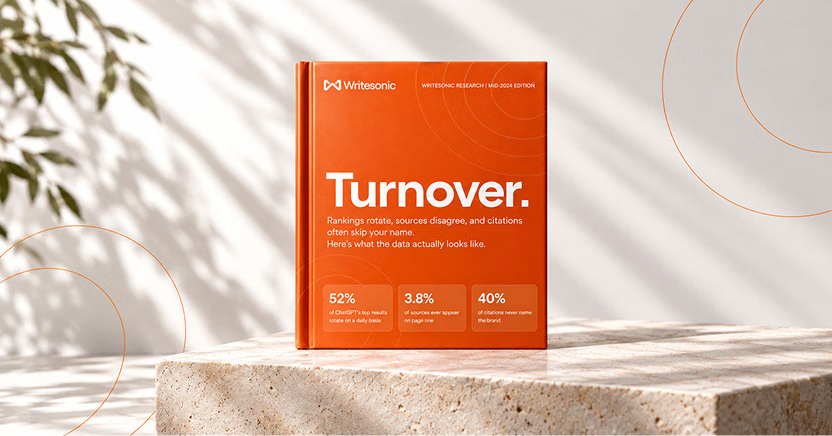
The #1 brand in ChatGPT changes 52% of the time.
Get the report and find out why.
Features that actually matter
Let’s be real: Most enterprise GEO tools promise tracking and “insights,” but what you really need is a full suite that delivers visibility, action, and real impact—all in one place. This is exactly where Writesonic’s enterprise generative engine optimization platform stands out.
Let’s break down what really drives value at the enterprise level—and why.
1. AI Visibility Tracking
This is the starting point for any enterprise generative engine optimization strategy. You need to know, at a glance, how visible your brand actually is inside AI-generated answers, not just if you “rank” but if you’re actually being surfaced to users.
With Writesonic’s GEO tool, you get:
- A single visibility score showing what percentage of relevant AI answers mention your brand.
- Trends over time, so you can see if you’re gaining or losing share as engines change.
- An AI visibility leaderboard benchmarking you against top competitors, so you know exactly where you stand in the space.
For example: On the dashboard, I can see that our visibility is at 33%, trending up over the last week, and I can compare this directly with other brands like Semrush.
Pro tip: Don’t just chase “impressions,” focus on how often your brand is chosen as an authority in generative results.
2. AI Citation Tracking
Visibility is great, but it’s the actual citations that prove your authority. This is about knowing which answers, on which engines, are specifically crediting your brand, your site, or your products, and which aren’t.
Writesonic’s GEO platform delivers:
- Exact citation logs with the real snippets and prompts that triggered your mentions.
- Breakdown by page, domain, and even theme, so you know which areas are winning (and which need work).
- Competitor and industry-wide tracking, so you can see not just how many times you’re cited, but how this stacks up in your niche.
- Historical citation graphs so you can track new/lost citations and immediately see the impact of your efforts.
Example: I can pull up every page, prompt, and answer where Writesonic was cited in a Google AI Overview, compare it to previous weeks, and spot where we’ve lost ground to a competitor.
So cool, isn’t it?
3. Competitor Benchmarking
Understanding your place in the AI world isn’t optional. With Writesonic, you don’t just get your own stats; you see exactly how you compare against every major player:
- Market share and position metrics at a glance.
- Leaderboards and competitor alerts for emerging threats and changes in the pecking order.
- Actionable “competitors to watch” recommendations, so you can target the brands gaining ground on your priority topics.
4. Prompt and Topic Analysis
The difference-maker in generative SEO: analyzing the actual questions and topics that get brands cited. Writesonic tracks:
- Which prompts drive your brand’s visibility—and which don’t.
- Top-performing topics and missing prompt opportunities to guide your content roadmap.
- Visibility and sentiment trends for each theme over time, so you can double down on what works.
5. Citation Source & Domain Tracking
Not all citations are created equal. Writesonic provides:
- A breakdown of every domain and site that mentions you in AI answers.
- Quality scoring for each citation source—so you can prioritize outreach to high-authority sites.
- Day by day, new/lost citation graphs make it simple to see if your PR or outreach is paying off.
6. Sentiment and Theme Monitoring
Brand reputation is more than just presence; it’s how you’re talked about. Writesonic lets you:
- Monitor sentiment (positive, neutral, negative) of your brand in AI-generated content.
- See top sentiment keywords and shifts by theme, giving you early warning of PR risks or wins.
7. Action Center: Integrated SEO + GEO Workflows
Here’s what most GEO tools miss: you don’t just want to see the data, you need to act on it. Writesonic’s Action Center is built for this:
- Centralized, prioritized to-do list with data-driven recommendations—fix technical SEO issues, boost content, and get external mentions, all from the same dashboard.
- Effort/impact scores help you prioritize what to tackle next, from high-impact technical fixes to creative content opportunities.
- Seamless workflow integration—assign, track, and resolve items without switching platforms.
Example: If you lose citations because your robots.txt is blocking AI crawlers, Action Center flags it and walks you through the fix.
If you want an enterprise generative engine optimization platform that goes beyond reporting and empowers you to act fast, at scale, and with full context, Writesonic is built for you.
With Writesonic’s Enterprise GEO platform, businesses can proactively manage and enhance their presence in AI-generated content, ensuring they remain at the forefront of AI search visibility.
To see Writesonic’s GEO tool in action, schedule a call with our team.
Final Thoughts
If you’re leading digital for an enterprise brand, you cannot afford to ignore the generative engine shift.
Getting cited (or not) by AI is quickly becoming as important as traditional rankings.
An Enterprise GEO platform isn’t just a “nice to have” for reporting; it’s how you defend and grow your authority, adapt to algorithm changes, and prove your team’s value as search evolves.
My advice:
- Define your pain points and “jobs to be done” first
- Demand real, AI-driven features (not just SEO with a new label)
- Insist on transparency, data access, and support
- Run a pilot – optimize a few key pages, measure changes, and see if the platform actually drives visibility
If you want a tool that’s built for this new world, and a team obsessed with helping you win in it – I genuinely recommend trying Writesonic’s Enterprise GEO platform.
The #1 brand in ChatGPT changes 52% of the time.
Get the report and find out why.

Content Marketer
Pragati Gupta is a Content Marketer @Writesonic, specializing in AI, SEO, and strategic B2B writing. Leveraging the power of Generative AI, she produces high-impact content that drives superior ROI.