Traffic was a useful SEO metric — when search engines worked the old way. I used it too: rankings led to clicks, and clicks led to growth.
But that model doesn’t hold up in AI search. Tools like ChatGPT and Perplexity don’t show 10 blue links. They generate answers. Your brand could be mentioned, cited, or even recommended — and you’d never know from looking at traffic alone.
If you’re still using traffic as your primary KPI, you’re missing critical context. It’s time to track AI SEO metrics that reflect how AI systems actually treat your brand.
Why Traffic Is Overrated in the Age of AI Search
Traffic worked when SEO was about ranking on Google. You could measure clicks, optimize pages, and see a clear correlation between rankings and visits. But AI search doesn’t work like that. It doesn’t list websites — it generates answers.
When someone asks an AI search engine for a product, tool, or recommendation, it may mention your brand, explain your offering, or even cite your content.
But that mention won’t always lead to a click. There’s no CTR to track. And often, no link at all.
That’s the problem. You could dominate AI results and see no change in traffic. Or worse — your traffic could look stable, while AI systems quietly remove your brand from the conversation.
If you’re only looking at traffic, you’re missing how visible your brand really is in AI-generated responses. And traditional SEO tools won’t show you that.
7 AI SEO Metrics That Matter More Than Traffic
Before you can optimize for AI search, you need to understand how AI platforms evaluate, reference, and present your brand. These seven generative engine optimization (GEO) metrics reflect how large language models process authority, visibility, and relevance — and give you clearer signals than traffic alone.
1. Brand Mentions
Brand mentions are the total number of AI-generated responses where your brand appears — regardless of placement, sentiment, or platform.
Why it matters
Mentions are the simplest indicator that your brand is being included in AI conversations. This includes generic prompts like “best project management tools,” specific product-related queries, or industry comparisons.
Mentions differ from traditional impressions.
They don’t just show exposure potential — they reflect AI systems actively selecting your brand to appear in an answer. This includes both direct name mentions and indirect references tied to your brand entity.
How to use it
Tracking mentions over time helps you measure top-of-funnel awareness inside AI search platforms.
If you’re seeing flat or declining mention counts, it’s a sign your brand isn’t meeting one of the criteria that AI uses to build answers, such as:
- Having content related to that prompt
- Being mentioned by other websites or review platforms for the same topic
- Properly structuring content to help AI systems recognize content
Identifying your brand mention count and fixing these issues through a platform like Writesonic helps improve mentions over time.
2. Citations
Citations tell you the number of times your content — or third-party content about your brand — is cited in AI-generated responses.
Why it matters
Citations are like backlinks. However, unlike traditional backlinks, AI citations aren’t placed in the middle of content. Rather, they are used to construct the answer itself and then give credit.
If your site or brand is cited frequently, it signals to the AI that your content is trustworthy, relevant, and contextually aligned with the user prompt.
How to use it
Track how often your site, blog posts, or product pages are cited in AI responses. If you’re not being cited — or being cited for the wrong topics — you’re less likely to get any traffic from AI.
Tools like Writesonic let you break this down by:
- Pages cited (your site vs others)
- Domains citing you (unique sources)
- Citation gaps (where competitors are cited but you’re not)
3. AI Visibility Score (by Platform)
AI visibility score tells you the percentage of AI-generated answers where your brand is mentioned — for a defined set of prompts.
Why it matters
AI visibility reflects your brand’s actual presence in generative search results. Unlike raw mention counts, this metric accounts for coverage.
For example, if your brand is mentioned in 42 out of 100 tracked responses to high-value prompts, your visibility score is 42%.
This metric is also segmented by platform.
ChatGPT, Claude, Gemini, and Perplexity each have different training data, indexing methods, and citation preferences. Segregating visibility helps you determine if you’re lagging in one platform or performing well in another.
How to use it
Use platform-level visibility to identify where your brand is strongest — and where it’s missing. A visibility score below 30% typically indicates low AI relevance or lack of strong citation coverage. Scores above 70% suggest dominant presence across tracked prompts.
Tracking visibility week over week also helps you measure the effectiveness of AI-specific SEO actions — such as updating your content, improving technical structure (like adding llms.txt), or earning mentions from domains that AI trusts.
4. Brand Position (Recommendation Rank)
Brand position tells you where exactly your brand is placed within AI-generated answers — whether it appears first, second, later in a list, or not at all.
Why it matters
Position determines prominence. Just like how being ranked higher on Google gets you more traffic, being listed as the first or primary recommendation in an AI response significantly increases user trust and engagement.
It also increases the chance of click-through, where links are provided.
In contrast, being mentioned as one of several options — especially in the third or fourth slot — reduces visibility and influence. If your brand only appears in lower-ranked positions, you may technically be “visible” but functionally overlooked.
How to use it
Track your brand’s position in response outputs across the AI platforms most relevant to your audience. Prioritize improving rank in high-intent prompts, such as:
- “[Best] tools for [specific use case]”
- “Which [product type] is better for [audience]”
- “Top [category] platforms in 2026”
5. Sentiment Score
Sentiment score measures the tone or sentiment used when AI platforms mention your brand — categorized as positive, neutral, or negative.
Why it matters
Sentiment score is probably the most important metric you need to track, along with visibility.
Not all mentions are beneficial. A brand that’s frequently included in AI answers but framed in negative terms — such as “limited features,” “overpriced,” or “not recommended” — may suffer reputational harm, even if visibility and citations are high.
How to use it
Monitor the sentiment attached to your brand mentions across platforms. Identify patterns — for example, if sentiment varies significantly between ChatGPT and Perplexity, or between product-focused prompts and comparison queries.
If negative or neutral sentiment is concentrated around specific themes (e.g., pricing, UX, support), use that insight to adjust both messaging and product documentation.
Improving citation quality, updating outdated content, or increasing the number of positive third-party references can also shift sentiment positively.
6. Market Share / Share of Voice (vs Competitors)
Market share measures our brand’s share of total mentions or visibility relative to competitors across tracked AI prompts.
Why it matters
AI search is zero-sum. If a competitor is cited more often, recommended more frequently, or positioned higher in answers — that space is no longer available to you.
Share of voice shows how much of the AI conversation your brand occupies, and how that compares to others in your category.
This metric helps you benchmark performance at the category level, rather than in isolation. It reveals whether your visibility gains are meaningful — or if competitors are still capturing most of the attention.
How to use it
Track your brand’s mention and visibility percentage alongside top competitors. A 30% share of voice means your brand appears in roughly one-third of relevant AI answers — giving you a clear, quantifiable sense of position in the market.
Tools like Writesonic platform help visualize share of voice across prompts and platforms. You can identify which competitors are gaining ground, uncover prompt types where they outperform you, and pinpoint opportunities to close visibility or citation gaps.
7. AI Traffic Analytics (Human + Bot)
AI traffic analytics show the traffic by AI crawler bot activity on your website (e.g. GPTBot).
Why it matters
AI platforms frequently crawl websites to build answer indexes, yet these visits are not recorded by tools like Google Analytics. Similarly, users clicking through from AI-generated answers may bypass tracking mechanisms, especially if links are embedded or obfuscated within the AI interface.
As a result, brands often underestimate the volume and quality of AI-driven traffic — particularly high-intent visits that originate from recommendation-based responses. Without tracking this activity, performance attribution remains incomplete.
How to use it
Use server-side analytics or purpose-built tools like Writesonic’s AI Traffic Analytics to:
- Identify which AI bots are accessing your content
- Track the pages they visit and cite most
- Attribute human visits that originate from AI-generated answers
This provides a more accurate view of which content AI systems value, and which mentions actually drive engagement. It also helps assess whether changes in AI visibility or citations translate into site activity or conversions.
Final Thoughts: Track AI SEO Metrics Through Writesonic
AI search has changed how visibility works. Traffic is no longer enough — and in many cases, it’s no longer relevant.
You need to know if your brand is being mentioned, how it’s being described, whether it’s being cited, and how you compare to others in your space.
These aren’t metrics you’ll find in traditional SEO dashboards. But they’re essential if you want to understand your position in AI-generated answers.
That’s exactly what Writesonic tracks.
GEO monitors every core metric covered in this guide — visibility, sentiment, brand position, mentions, citations, and AI crawler activity. But it goes further.
You get a prompt-level breakdown:
- Which prompts mention your brand
- What position you appear in
- What kind of answers you’re included in — and how often
- Which AI engines (like ChatGPT or Perplexity) surface your brand
You also get competitive insight:
- Which prompts your competitors rank for
- How frequently they’re mentioned
- What you’re missing — prompts relevant to your brand that don’t include you yet
This isn’t just SEO. It’s Generative Engine Optimization — and if you want to stay ahead in an AI-first web, this is the layer you need to optimize for.
Start tracking the metrics that matter through Writesonic.
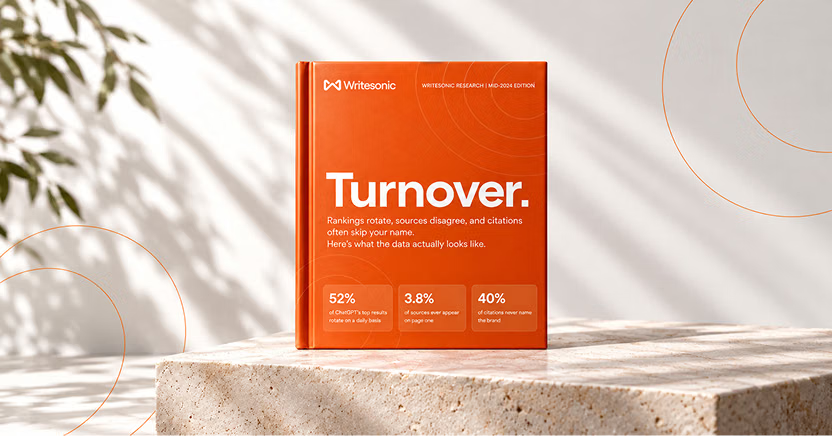
The #1 brand in ChatGPT changes 52% of the time.
Get the report and find out why.

Niyati Mahale is a SEO/GEO Content Writer @Writesonic. She specializes in artificial intelligence and B2B, with a flair for combining effective storytelling and SEO best practices to create impactful content.