
AI now influences more buyer decisions than most realize.
Consider this: a user asks ChatGPT for recommendations, notes a few options, then goes to Google to dig deeper.
That makes AI the first layer of discovery. If your brand isn’t visible in those AI answers, it likely won’t make it into the buyer’s consideration set at all.
The solution? Appear as a recommendation in those AI answers.
In this guide, you’ll find every practical strategy to improve AI visibility: from earning citations and creating AI-friendly content to fixing the technical issues and building your brand’s presence across the web.
Let’s get started.
TL;DR: Improving AI Visibility in 2025
- Close citation gaps by auditing which pages AI engines cite, then securing placements where competitors are mentioned but you’re missing.
- Show up in trusted sources like Reddit, Quora, review sites, and directories since AI heavily cites UGC and third-party reviews.
- Create AI-friendly content with topic clusters, structured comparisons, clear formatting, and regular refreshes to stay relevant.
- Strengthen authority signals with detailed authorship, E-E-A-T best practices, and structured data for better machine readability.
- Fix technical blockers by allowing AI crawlers, improving site speed, and ensuring accessibility so your content can actually be surfaced.
Use Writesonic to automate citation tracking, UGC discovery, content refresh alerts, and schema insights, turning AI visibility into a repeatable advantage.
Off Page Strategies to Improve AI Visibility
1. Find & Fix Citation Gaps
AI engines build answers by sourcing information from different pages. These pages are the citations used to build that answer.
If those pages list your competitors but not you, AI is naturally not able to recommend you. That’s called a citation gap.
Every time users ask about tools or services, the AI pulls from those pages and you’re excluded. Good news? Fixing citation gaps is one of the easiest ways to improve your AI visibility.
How to fix:
- Audit which articles, roundups, and reviews AI already cites in your category by running prompts manually or using tools like Writesonic.
- Note down the cited pages for prompts where your competitors are mentioned but your brand is missing.
- Reach out to authors or editors of those pages with:
Why your product is a good fit for the page
Product updates or use cases they overlooked.
Any new data from your brand that’s relevant
Why your product is a good fit for the page
Product updates or use cases they overlooked.
Any new data from your brand that’s relevant
Why your product is a good fit for the page
Product updates or use cases they overlooked.
Any new data from your brand that’s relevant - Why your product is a good fit for the page
- Product updates or use cases they overlooked.
- Any new data from your brand that’s relevant
- Even one placement often covers multiple queries (e.g., updating a “best project management listicle” might cover “best remote tools,” “Monday alternatives,” “startup project management” and any other prompt that refers to the same source), so you’ll get visibility in multiple answers.
Reach out to 50 such pages to begin with. If you land mentions even in just 10 of them, your brand starts showing up in hundreds of AI responses.
Check out our case study on how we showed up in 1000+ AI answers with just 4 new mentions.
2. Engage in UGC Sources AI Trusts
AI engines source heavily from user-generated content (UGC) on Reddit, Quora, LinkedIn, and industry forums. For example, according to our research, Reddit and other UGC sites are cited in more than 21% of AI Overviews.
These discussions carry weight because they reflect real user experiences. If your brand is absent from these conversations, AI will not recommend you. To improve AI visibility, you need to show up in relevant UGC conversations.
How to fix:
- Run prompts in ChatGPT, Claude, or Perplexity to see which Reddit, Quora, and other discussions are being cited.
- Contribute to those discussions with genuine, helpful input.
- Share insights such as:
Hidden costs competitors overlook
Challenges, tips, and lessons
Scaling roadmaps from real-world use cases
Hidden costs competitors overlook
Challenges, tips, and lessons
Scaling roadmaps from real-world use cases
Hidden costs competitors overlook
Challenges, tips, and lessons
Scaling roadmaps from real-world use cases - Hidden costs competitors overlook
- Challenges, tips, and lessons
- Scaling roadmaps from real-world use cases
- Keep contributions practical and credible, not promotional. Only pitch your product when a discussion asks for it.
Dos:
- Be transparent about your role or affiliation.
- Share specific examples, data, or firsthand insights.
- Contribute to threads with active engagement and upvotes.
Don’ts:
- Don’t drop promotional replies.
- Don’t argue with negative feedback or downvotes.
- Don’t post in every thread. Focus on quality discussions.
Contribute to 10 Reddit threads with 50+ comments and post 3 high-value Quora answers in your category every week to build a strong UGC base for your brand.
3. Reviews, Directories, and PR
AI engines frequently cite review sites and product directories when generating answers. Profiles on G2, Capterra, Trustpilot, or Clutch often show up as trusted sources.
A strong presence here signals credibility and increases the likelihood of being included in recommendations.
However, getting genuine reviews is difficult. Many customers skip leaving feedback unless reminded. Low volume or outdated reviews weaken trust and reduce the chances of being cited.
How to fix:
- Trigger review requests after positive milestones like successful onboarding or project completion.
- Use email or in-app nudges to remind customers to leave reviews.
- Offer small perks such as gift cards or access to exclusive features without forcing positive feedback.
- Update product descriptions, screenshots, and testimonials regularly.
- Thank customers for positive feedback and address concerns professionally.
In the meanwhile, submit your product to as many directories as possible to gain visibility.
On-Page Strategies to Improve AI Visibility
4. Topic and Intent Clusters
AI engines often cite multiple articles covering the same intent. They do this to give a more complete answer, pulling from several trusted sources at once.
If your site hasn’t published content on those high-citation topics, your brand won’t appear. Competitors that have written about these clusters will keep getting cited, while your content is ignored. Covering these clusters ensures your brand shows up in the answers users actually see.
How to fix:
- Identify high-citation clusters by analyzing AI answers for your category. Look for patterns where multiple articles cover similar queries.
- Build a pillar page that gives a complete overview of the topic.
- Create supporting topic clusters that target variations of the query and link them back to the pillar.
- Use internal linking with descriptive anchor text to show relationships between the pages.
- Structure content so AI can parse it easily: add definitions, frameworks, tables, and FAQs.
- Keep the cluster updated with new data, case studies, and industry examples.
Even a small cluster (1 pillar + 3–4 supporting pages) can boost visibility across dozens of related prompts.
5. Comparisons that Win Citations
AI engines get many queries where users ask to compare products directly. Prompts like “Slack vs Teams” or “Asana vs Monday vs ClickUp” are common.
To answer them, AI looks for structured, detailed comparison pages. Creating these pages gives your brand a strong chance of being cited when buyers search for alternatives.
How to fix:
- Create dedicated comparison pages for common queries in your industry.
Two-way (X vs Y): Focus on head-to-head matchups. Include a decision matrix, pricing breakdowns, and a clear “best for” recommendation.
Three-way (X vs Y vs Z): Cover broader choice queries. Use a side-by-side table with features, pros/cons, and trade-offs. - Two-way (X vs Y): Focus on head-to-head matchups. Include a decision matrix, pricing breakdowns, and a clear “best for” recommendation.
- Three-way (X vs Y vs Z): Cover broader choice queries. Use a side-by-side table with features, pros/cons, and trade-offs.
- Start with summarized bullets at the top to give users a quick overview.
- Break down pricing by team size or use case.
- Add a feature-by-feature comparison table with clear distinctions.
- Explain onboarding, ease of use, and learning curve.
- Include “best for” scenarios (e.g., best for startups, best for enterprise, best for creative teams) to cover more prompts.
Well-structured comparisons position your brand in the exact decision points buyers care about, making it easier for AI to surface your content.
6. Conversational Structure and AI-Friendly Formatting
Most buyers phrase their queries as natural questions. If your content mirrors that structure, it’s easier for both readers and AI systems to understand. Clear formatting and concise answers increase the chances of being cited.
How to fix:
- Use questions as H2/H3 headings that reflect how people ask.
- Keep paragraphs short: two to three sentences.
- Add bullets and numbered lists for steps, comparisons, or features.
- Insert definition boxes for key terms and concepts.
- Use pros and cons tables to show trade-offs at a glance.
- Include a TL;DR or summary box at the start of longer guides.
Good formatting reduces friction for the reader and makes your content easier to extract for answers.
Check our blog on How LLMs Interpret Content to know more about AI-friendly content structuring.
7. Refresh Evergreen Content
Outdated pages quickly lose visibility. AI systems prioritize sources with recent data, examples, and case studies. Keeping evergreen pages fresh is one of the fastest ways to regain citations.
Make sure your most important pages at least are updated in the last 90 days.
How to fix:
- Update top-performing pages every few weeks with:
2–3 new statistics
A recent case study or example
1–2 new FAQs
An updated “last modified” date in the title or header
2–3 new statistics
A recent case study or example
1–2 new FAQs
An updated “last modified” date in the title or header
2–3 new statistics
A recent case study or example
1–2 new FAQs
An updated “last modified” date in the title or header - 2–3 new statistics
- A recent case study or example
- 1–2 new FAQs
- An updated “last modified” date in the title or header
- Refresh secondary pages every few months by:
Replacing old examples
Updating internal links
Rewriting weaker sections
Replacing old examples
Updating internal links
Rewriting weaker sections
Replacing old examples
Updating internal links
Rewriting weaker sections - Replacing old examples
- Updating internal links
- Rewriting weaker sections
- Add seasonal or time-sensitive relevance where possible.
Regular updates signal authority and make your content the preferred source for new answers.
8. E-E-A-T and Authorship
Credibility is a major factor in whether your brand gets mentioned in AI. Pages that demonstrate real experience, expertise, authority, and trust are more likely to be surfaced. Clear authorship signals show both readers and AI that your content is reliable.
How to fix:
- Add detailed author bios with credentials and links to professional profiles.
- Highlight first-hand experience in the content (e.g., lessons learned, original data, case studies).
- Show trust signals like awards, client logos, and testimonials.
- Link articles to organization and person schema so authorship is machine-readable.
- Maintain a consistent brand voice and expertise across all content.
Strong E-E-A-T signals make your site harder to ignore when answers are being generated.
Technical Strategies to Improve AI Visibility
9. Structured Data and Metadata
Structured data helps AI interpret your content correctly. Without it, even strong pages can be overlooked. Schema markup makes your content machine-readable and increases the chance of being cited in answers.
How to fix:
- Start with the most important schema types:
Organization (define your brand details)
Product (name, description, price, availability, rating)
Service (scope, provider, features)
Article/BlogPosting (author, date, publisher)
Person (credentials, profiles)
FAQPage (ready-made Q&A pairs)
Review (ratings, author, body) - Organization (define your brand details)
- Product (name, description, price, availability, rating)
- Service (scope, provider, features)
- Article/BlogPosting (author, date, publisher)
- Person (credentials, profiles)
- FAQPage (ready-made Q&A pairs)
- Review (ratings, author, body)
- Use JSON-LD format for consistency.
- Check schema implementation with Google’s Rich Results Test.
- Keep metadata clean and aligned with user intent:
Descriptive titles and meta descriptions
Alt text for all images
Clear, keyword-rich headings
Descriptive titles and meta descriptions
Alt text for all images
Clear, keyword-rich headings
Descriptive titles and meta descriptions
Alt text for all images
Clear, keyword-rich headings - Descriptive titles and meta descriptions
- Alt text for all images
- Clear, keyword-rich headings
Structured data works as a signal of trust and context, making it easier for AI to use your content in responses.
10. Allow AI Crawlers
Many websites block AI bots without realizing it. If the right crawlers can’t access your content, you won’t appear in answers. Adjusting these permissions is the first step.
How to fix:
- Allow key AI bots like ChatGPT-User, OAI-SearchBot (or Googlebot-Extended/GoogleOther), Claude-Web, PerplexityBot to access your site.
- Allow GPTBot so your site can be used for training, which improves long-term visibility.
- Verify bot access in server logs. If there’s no crawl activity, check for misconfigurations.
Or, use Writesonic’s Action Center to see which AI crawlers are allowed:
11. Optimize Site Speed and Accessibility
Even if crawlers can reach your content, poor site performance can reduce visibility. Slow load times, broken pages, or buried content hurt both user experience and AI parsing.
How to fix:
- Improve page speed by compressing images, reducing scripts, and enabling caching.
- Ensure mobile optimization with responsive design and fast rendering.
- Monitor crawl errors (404s, 500s, timeouts) in server logs.
- Keep architecture clean: important pages should be no more than 3 clicks from the homepage.
- Test accessibility by disabling JavaScript; core content should still load.
A fast, accessible site signals quality and makes it easier for AI systems to process your content correctly.
How Writesonic Can Help Improve AI Visibility
The above strategies can help you improve AI visibility. But maintaining AI visibility should be an ongoing strategy spread across prompts and topics: finding citation gaps, refreshing content, tracking where you appear, and fixing technical issues.
Doing this manually is slow and resource-heavy. Writesonic makes the process faster and more actionable.
With Writesonic, you get:
- Citation tracking: See exactly which pages AI engines already cite, where competitors are mentioned, and where you’re missing.
- UGC discovery: Identify Reddit threads, Quora answers, and forum discussions that AI trusts, so you know where to participate.
- Content guidance: Get prompts for high-citation topic clusters and comparisons that your site should cover.
- Refresh alerts: Track when your content loses visibility in AI answers and get notified to update it.
- Structured data insights: See where schema is missing or misapplied, and apply fixes with confidence.
- AI search volumes: Prioritize the prompts and queries that matter most for visibility, not just traditional keyword volume.
Start using Writesonic to find citation gaps, optimize your content, and secure your spot in AI recommendations. Try Writesonic today and turn AI visibility into a competitive advantage.
FAQs on Improving AI Visibility
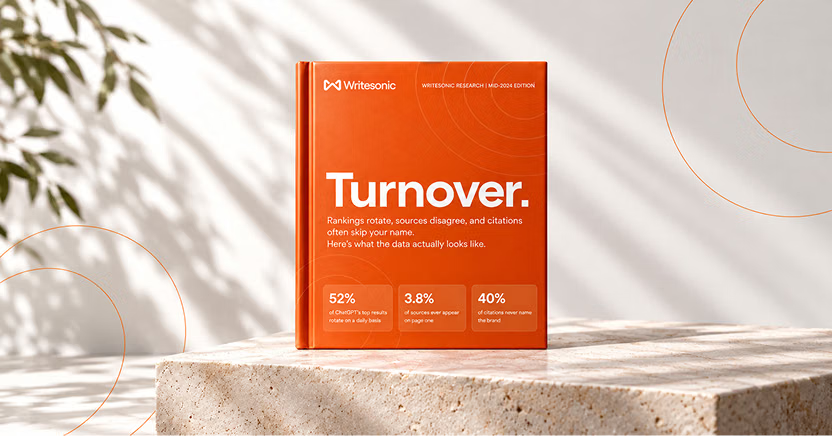
The #1 brand in ChatGPT changes 52% of the time.
Get the report and find out why.

Niyati Mahale is a SEO/GEO Content Writer @Writesonic. She specializes in artificial intelligence and B2B, with a flair for combining effective storytelling and SEO best practices to create impactful content.