TL;DR
- AI search is already converting (Ahrefs: 23% higher than organic), but imperfect GA4 attribution is stopping budget approvals
- The brands building citation authority now are creating advantages that will be expensive to overcome in 12-18 months
- Frame GEO as an optimization layer on existing SEO work. You need to keep the lights on across every discovery channel and GEO and SEO are very much connected
- Use a 6-month pilot structure to give leadership a low-risk way to test with a clear exit point
Making the business case for GEO isn’t a “maybe someday” story. Yes, AI search is still somewhat new. But it’s already driving conversions and the adoption curve is steep.
Just imagine my surprise when my non-tech-savvy dad told me he used ChatGPT to develop a care plan for his freshly-planted quinces and bought a suggested product.
That’s a sign that AI search is far beyond the early adoption stage and is already converting skeptics (and just your run–of-the-mill shoppers) into users.
800 million people use ChatGPT every week — and that’s just one AI tool. Data from Omnisend tells us that 50% of online shoppers in the US, UK, Canada, and Australia already use AI tools for online shopping.
The buyers are already there, and AI platforms are building the commercial infrastructure to answer their needs. OpenAI, for example, has recently announced an integration with Shopify and Etsy to allow purchasing directly from the chat.
So if you’re waiting for others to figure out AI search until you pitch it to your boss, you’re already behind those who are experimenting and getting results from the emerging channel.
This guide helps you turn “maybe someday” into “where and how do we start?”
It comes with receipts and a framework to justify the GEO investment. Just in time for the 2026 budget conversations.
What We Know About AI Search So Far (And What We Don’t)
Let’s take a deeper look at the conversion data we already have.
Ahrefs’ research shows that 12.1% of their signups came from AI search traffic, which represents only 0.5% of their total traffic. That’s a 23% higher conversion rate than visitors from traditional organic search.
We’ve seen it on our side, too.
50% of our “How did you hear about us?” survey answers mention they discovered us through AI platforms, and one of our customers, Blitzmetrics, saw their AI traffic bring multiple customers worth $100,000.
But there’s still something stopping teams from making the case for GEO.
And that’s imperfect attribution.
We have the awareness metrics. We have traffic data, just like with “traditional” SEO. What we don’t have are airtight conversion metrics. GA4 can track referral traffic from LLMs with the right setup, but connecting every lead back to a specific AI platform query remains messy.
That said, waiting for “perfect attribution” to take the leap while AI search steadily pulls from organic traffic means you’re using the wrong decision framework.
Because the question isn’t “Do we have perfect attribution?” It’s “Do we have enough signal to know this matters?” And the answer is yes.
Why Waiting Is Losing
Waiting it out might make sense on paper. But the brands that are investing and experimenting with GEO are setting themselves up for citation authority that you’ll have to compete with a year from now.
AI platforms are learning which sources to trust and cite. The more citations your brand gets in AI search, the more likely you are to get the next one. Citation patterns compound and heavily impact your visibility, much like backlinks and domain authority do in SEO. The brands investing now are building advantages that will be expensive to overcome later.
We’ve already watched this exact pattern play out with SEO.
Companies that invested in SEO in 2008-2010 built compounding organic visibility.
But brands that waited until 2015-2016 to start catching up had to invest significantly to compete for rankings that were already claimed.
So if you wait 12 more months for “better attribution data” and a straightforward GEO playbook, here’s what will happen:
- Your competitors establish citation positioning that you’ll need to overcome
- The relatively uncrowded optimization window closes
- You’re playing catch-up on a channel already driving high-converting traffic
- Establishing visibility costs more in both time and budget
Investing now means building authority. The longer you wait, the more expensive it gets to compete for the same visibility.
The Budget Justification Framework
You’ve got the signals. Now you need to get the budget approved.
Here’s a budget justification framework that gets your leadership to say yes.
Lead With Data
CFOs care about conversion rates and revenue per channel, not AI citations.
Instead of opening up the budget discussion with vague statements like “AI search is the future” or “We need to optimize for LLMs,” lead the conversation with actionable data.
Here are some lines you can say, based on the data you already have:
- “We’re tracking AI referral traffic that’s converting at X% higher rates than organic search.”
- “Survey data shows X% of our recent customers discovered us through ChatGPT/Perplexity/Claude.”
- “Sales team reports X% of discovery calls mention finding us through AI search.”
If your attribution data is incomplete, use the Ahrefs benchmark as context or benchmark against competitors:
- “Ahrefs is seeing AI traffic convert 23% higher than organic. They received 12% of signups from less than 1% of traffic. We need to understand if we’re seeing similar patterns.”
- “Our top 3 competitors are appearing in X% more AI search results than we are for our core category queries.”
- “We’re invisible in AI search for X high-intent queries where we rank well in traditional search.”
Position GEO as Search Diversification, Not Channel Migration
Don’t overwhelm them with every signal and data point you have. It’s enough to pick 2-3 metrics that show the efficiency case and lead with those.
CFOs resist new budget lines, but they understand risk mitigation. Frame GEO as protecting search visibility rather than abandoning SEO.
AI search engines rely on the open web, ChatGPT, Perplexity, Claude & co. all get live information from web sources through search infrastructure. The plumbing is different from platform to platform, but the principle is consistent: they pull from a public ecosystem where content is crawled, ranked, evaluated for authority and then surfaced in answers.
That means SEO isn’t optional in a GEO world. If your site isn’t crawled, indexed and perceived as a trustworthy source, AI systems are far less likely to surface it. Strong SEO signals increase your chances of being discovered; GEO increases your chances of being cited once you’re discovered.
But even if SEO and GEO were completely separate, you’d still need to keep the lights on for both. Your audience researches, compares, and makes decisions across Google and AI platforms. You can’t afford to go dark in any channel where customers look for answers.
Frame it like this:
“We’ve invested heavily in SEO, and that investment is working. But search behavior is fragmenting. We need to protect the visibility we’ve already earned by making sure our content shows up where people search — not just on Google, but on AI platforms as well.”
Address the Attribution Gap Directly
The attribution objection will come up. Here’s how to handle it.
When someone pushes on imperfect GA4 tracking, acknowledge it immediately and reframe:
“You’re right that we don’t have perfect GA4 attribution for AI platform traffic yet. That’s part of what we’re building in this pilot.”
Then point to the data you already have:
- Your own AI referral traffic and conversion data
- Changes in traffic trends (AI referral growth vs. organic decline)
- Competitive positioning gaps
- Commercial infrastructure signals, like OpenAI + Shopify integrations and agentic commerce adoption
Close with this:
“We’re making a strategic timing decision based on compelling directional signals. Waiting for perfect attribution means ignoring a discovery, evaluation and, soon, purchasing channel that our customer base is adopting at a high rate.”
Use a Project Pilot Structure With Milestones
A 6-month pilot with a defined timeline and measurable outcomes gives your leadership team a low-risk way to test the channel with a clear exit point if results don’t meet expectations.
Here’s how to structure the request:
“I’m proposing a 6-month pilot focused on our top commercial-intent queries. We’ll establish baseline visibility, optimize for AI citations, and measure results through clear milestones.”
Success Metrics
Be specific about what you’re tracking:
- Visibility baseline: Where do we appear (or not appear) in AI search results for our core queries?
- Citation rate improvements: X% increase in citations across target prompts
- AI referral traffic growth: Measurable increase in traffic from AI platforms
- Attribution improvements: Higher percentage of “how did you hear about us” responses mentioning AI discovery
Investment Breakdown
Break down exactly what you need:
- Tech stack: Visibility tracking platform (e.g., Writesonic starting at $199/month)
- Time allocation: X hours per week from the existing team, reallocated from lower-performing content work
- Content investment: Optimization of existing high-value pages + creation of citation-optimized content for visibility gaps
Decision Gates
Build in clear checkpoints so leadership knows exactly when and how you’ll evaluate progress:
- Month 2: Baseline visibility established across target platforms, competitive positioning documented
- Month 4: Citation rate improvements measured, traffic trends analyzed, early conversion signals reviewed
- Month 6: Go/no-go decision based on directional metrics, competitive positioning gains, and cost to continue vs. cost of inaction
At month 6, you’re evaluating if you’re seeing directional improvement in visibility, citations, and referral traffic. Not whether you have perfect attribution.
Close With Competitive Positioning
After you’ve walked through the data, the reallocation frame, the pilot structure, and addressed attribution, close with the question that reframes the entire conversation.
Use this language:
“We have two options. To establish positioning while it’s available, or play catch-up in 12-18 months when the cost is significantly higher. The data shows AI search is already converting. The question is whether we invest now while citation patterns are still being established, or whether we pay premium rates later to compete against brands that are already embedded in the platforms.”
This reframes the decision from “Should we invest in GEO?” to “Do we want to pay early-mover prices or catch-up costs?”
One of these options is significantly more expensive than the other, and it’s not the pilot you’re pitching.
What the Investment Looks Like
Here’s how to break down the cost so leadership knows exactly what they’re approving.
Tech Stack
Tracking tools show you where you appear (and don’t appear) in AI search results.
You need:
- AI visibility tracking platform for citation monitoring across ChatGPT, Perplexity, Gemini, and other platforms
- Competitive benchmarking to see where you stand relative to competitors
- Citation pattern tracking to measure improvement over time
Typical cost: For example, platforms like Writesonic start at $199/month.
Use this language:
“Similar to how we need Ahrefs for SEO visibility, we need platform-agnostic citation tracking for GEO. One-time setup plus monthly tracking.”
Time Allocation
You need:
- Strategy and prompt selection: Identifying the commercial-intent queries that are relevant for your business (X hours/week).
- Content creation and optimization: Creating new and improving existing high-value pages for citation optimization — structured data, factual density, source citations (X hours/week).
- Technical implementation and tracking: Setting up monitoring, analyzing results, and adjusting strategy (X hours/week)
Total time investment: X hours/week, reallocated from lower-performing SEO work or content that’s not driving results.
Frame it like this:
“We’re adding an optimization layer to the SEO work we’re already doing. The content we’re creating for organic search needs basic adjustments to perform in AI search too — structured data, factual density, clear sourcing. This isn’t separate work, it’s making existing work more effective.”
Content Investment
Most companies already have a content budget. This is about making that investment work harder.
You need:
- Content optimization: Adding structured data, improving factual density, and strengthening source citations on your highest-value pages
- Citation-optimized content creation: Filling visibility gaps where competitors appear, but you don’t
- Brand mentions: Third-party placement and outreach to build citation patterns
Total investment: X hours/week from the in-house content team and/or existing freelancer/agency budget directed toward dual-optimized content
Use this language:
“We’re already creating content for search visibility. The question is whether we optimize it to perform in traditional search only, or across both traditional and AI search. The incremental effort is minimal — structured data, factual density, clear sourcing — but the visibility gains are significant.”
The Quick-Start Visibility Audit
You don’t have to wait for budget approval to start building your case. Gather the most compelling data right now, for free.
Before your budget meeting, run this visibility audit:
- Identify your top 10-20 commercial-intent queries (the searches that drive signups, demos, or purchases for your business).
- Check your visibility manually across ChatGPT, Perplexity, and Gemini for each query (or use free trial tools if available).
- Check competitor visibility for the same queries. Who’s getting cited when you’re not?
- Pull your “how did you hear about us” data if you track it and look for any mentions of AI platforms.
- Check GA4 for AI referral traffic. Even if attribution is incomplete, you might see some signal.
This gives you:
- Concrete visibility gaps to show in your budget deck. You’ll get to show specific queries where your brand is invisible.
- Baseline metrics for your pilot goals. You’ll know exactly what you’re trying to improve.
- Internal proof that this matters. Which makes getting buy-in much easier.
This 2-4 hour audit turns your budget pitch from “AI search is the future” to “Here are 15 high-intent queries where our competitors appear and we don’t.”
Let Us Make the Case for You
Everything we just walked through—the visibility tracking, identifying which prompts are relevant, the optimization work—that’s what we built Writesonic to do.
We track your visibility across ChatGPT, Perplexity, Gemini, and several other platforms. We show you the high-intent prompts your brand needs to show up for. We benchmark you against competitors so you can walk into that budget meeting with “here’s where we’re losing” instead of “AI search seems important.”
And then we help you fix it. Our Action Center prioritizes what to do about your visibility gaps, from technical issues blocking crawlers to content that needs restructuring and citation opportunities you’re missing.
Plenty of GEO tools give you a dashboard. We give you the dashboard and the execution layer.
If you want help building your case (or you’re past the case and ready to start) we’ll show you where you stand.
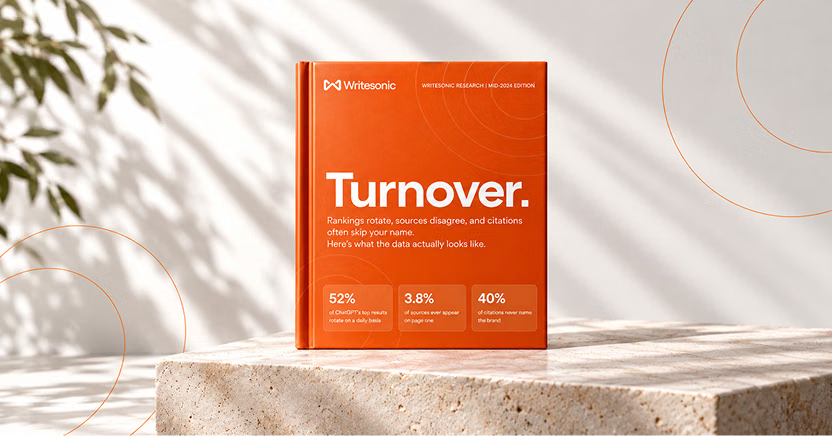
The #1 brand in ChatGPT changes 52% of the time.
Get the report and find out why.

Content Marketer
Mariana is a creator and strategist making ICPs, CEOs, SERPs, LLMs (and many other acronyms) happy all at once. Over the past seven years, she's designed, deployed and scaled content programs that deliver measurable growth for B2B and B2C brands alike.
Quality-first (always), AI-curious (not AI-dependent) and just the right amount of stubborn about what makes content worth reading.