TL;DR
- Adding GEO to your agency’s stack turns existing SEO expertise into a new revenue stream while keeping you ahead of competitors who haven’t adapted yet.
- Agencies can offer GEO either as an SEO add-on or as a standalone consulting service focused on AI visibility.
- New services need a new tech stack. Use Writesonic to audit your clients’ AI visibility, uncover citation opportunities and measure progress across ChatGPT, Gemini, Perplexity and more.
- Now is the best time to build your first few GEO projects, document results and position your agency as one of the first-movers that rolled out GEO.
If we had a dollar for every time someone asked, “How do we show up in ChatGPT?” we’d have another revenue stream by now.
Cheekiness aside, it’s true that the question comes up a lot lately. Most brands are aware of the emergence of AI search and the need to optimize for what’s effectively a new discovery surface. And they expect the SEO agencies they already pay for to figure that out on their behalf.
54% of businesses already expect their SEO or digital marketing partners to lead their AI search efforts. We’re willing to bet that includes your clients. But right now, you probably don’t have a great answer.
Not because you’re behind, but because GEO is so new that most agencies are still figuring out what it even means to “optimize” for ChatGPT or Perplexity. There’s no playbook yet, nor is there an established pricing model.
Which means you’re either building this service from scratch or you’re dodging the conversation until someone else swoops in with a solution.
This guide helps you do the former. We’ll show you how to introduce GEO as a service, what to charge for it and how to use Writesonic to deliver results without hiring a whole new team to figure it out.
What GEO Is (And Isn’t)
Generative Engine Optimization (GEO) (sometimes also referred to as “AEO” or “LLMO” by others; there’s not yet a universal term for the practice) is the process of optimizing a brand’s content to make it easier for AI systems to understand and thus surface it in answers.
This is similar to what you already do on the SEO side, but instead of focusing on ranking in traditional search results, you help brands also get mentioned and cited in AI search.
Simply put:
- SEO answers the question “Can Google find it?”
- But GEO also covers “Will AI mention it + cite it?”
What AI mentions and cites has a lot to do with the content that’s already ranking in traditional search engines like Google. Writesonic’s study of 1 million+ AI Overviews revealed that 40.58% of citations came from the top 10 Google results.
In fact, Google is a go-to retrieval source for other AI engines like ChatGPT and Perplexity, as well as for Google’s own Gemini and AI Mode.
That’s why many of the strategies that help rank content in SEO also stand true for GEO.
In both SEO and GEO, you:
- Optimize for clarity and structure. Heading hierarchy and readable formatting help both Google and AI engines interpret brand content accurately.
- Build credibility throughout the web. Backlinks and mentions from trusted sources improve brand authority for AI visibility as well.
- Strengthen E-E-A-T signals. Expert quotes, strong author profiles, recent data and stats all work to signal credibility in both search types.
- Optimize for topical depth. Covering related subtopics and long-tail questions increases your relevance in AI and traditional search.
This overlap is what makes GEO such low-hanging fruit for agencies already specializing in SEO. It’s not a replacement or an alternative, but rather an “upgrade” to your SEO plans—and that’s exactly how you should position GEO services to clients.
Still, the similarity doesn’t mean you can get away with just doing the same things you did for SEO and call it a day. GEO is different in certain aspects, especially in how you measure AI visibility and how you choose topics to focus on.
Standard SEO tools such as Google Analytics and GSC aren’t equipped to show how a brand performs in AI search. So not only do you need new processes and a set of best practices, a few additions to your tech stack are also in order.
How To Add GEO To Your Agency
How you position GEO makes all the difference between generating actual new revenue versus just absorbing more work into existing retainers.
Your clients very likely already want this. What you need to do is figure out how to structure it so you’re not just tacking on “AI visibility” work with vague deliveries and opaque pricing.
There are two main ways you can go about this, but most agencies will need both to capture the full opportunity..
As an Integrated Service
The easiest way to introduce GEO is to fold it into your existing SEO or content workflows. You aren’t pitching GEO as a completely new and isolated service here, but simply as an extension of what you’re already doing.
Position it as an upgrade to your current offering:
“We now optimize for both Google and AI search.”
Clients who already trust you to keep them visible in search will be more open to being visible in yet another channel, rather than investing in an entirely new, isolated service.
In practice, this model lets you:
- Expand existing retainers by adding GEO as a deliverable within current SEO packages.
- Offer a premium-tier SEO package that includes AI search visibility as a core component, justifying a higher price point for a more future-proof service.
This works for all types of clients: small businesses, freelancers, enterprises and anyone else interested in both SEO and GEO.
Standalone GEO offering
Some accounts, such as established enterprises or even other smaller agencies, have the SEO bit figured out in-house but want someone to come in and guide them through the still mysterious waters of AI search.
For this set of clients, a separate GEO-only plan is your best bet. Instead of a standard content optimization retainer, you position your agency as a specialized consultant focused on the future of search.
You can offer services such as:
- GEO strategy and roadmap building: Developing a comprehensive plan to maximize the brand’s visibility in generative AI search results.
- AI visibility audits: Analyzing existing content performance and technical setup to identify specific gaps and opportunities for AI citing.
- Consulting and training: Providing expert guidance to their in-house SEO or content teams on GEO best practices and new engine updates.
For pricing, you can opt for a project-based fee if it is a one-off project. Or, have a custom monthly retainer for ongoing training or consulting services.
The Workflow and Company Culture
Adding GEO to your service stack impacts your agency from within. Not just how you sell, but how your team thinks, who owns what and whether you can answer basic questions consistently.
Before you pitch a single client, figure out: who runs GEO research? What your agency’s official stance is on the questions every prospect will ask?, Does your own agency even shows up in AI search?
Without that structure, GEO will be a vague line item that clients don’t trust and your team can’t deliver.
Team Structure
Should you hire someone dedicated to GEO? Maybe. That’s very much up to you, the size of your agency and how many customers will likely bite on the offer.
What’s non-negotiable is training your existing teams in the basics of AI visibility. Every SEO and content specialist in your agency needs to understand how AI engines surface, cite and mention brands.
You can then add someone who focuses solely on generative engines, a “GEO anchor” who keeps themself and the entire team updated on the happenings of AI search.
A good team setup looks like this:
- GEO Anchor: One person who owns ongoing research, testing and experimentation. They stay on top of AI engine updates, test new workflows, document findings and train the team as and when required. It can be either a new hire or someone you already have in-house who’s shown interest and curiosity in the subject and has the chops to take on the role.
- Account Managers: Dedicated managers who handle three to ten client accounts and can confidently explain GEO’s value to clients and how it complements SEO.
- Content Strategists & GEO Specialists: Know how to optimize content for AI discoverability, develop strategies and fix visibility gaps both for your own agency and your clients.
Your staff are already SEO pros, so you only need to train them on GEO principles. There’s no need to hire entirely new staff.
But you do need everyone aligned on a single point of view..
Internal Philosophy and Processes
When a client asks about GEO, every person on your team needs to give the same answer.
“If you have one account manager say ‘GEO is basically the same as SEO,’ while the other is over there is positioning it as something completely separate, it’s going to kill your credibility,” explains Mariana Fernandes, Head of Content at Writesonic.
Mariana spent four years in the agency trenches and was heavily involved in helping roll out GEO for her customer at the time.
“You need a unified stance,”she adds. “What’s your POV on how GEO and SEO work together? What’s your philosophy on prompt selection? These aren’t questions you figure out client by client. You figure them out once, as an agency, as a team, and then have everyone deliver the same message.”
Address this early in the training. Develop your position on common yet much-debated questions like:
- “Should we prioritize GEO or SEO?”
- “We don’t get clicks through AI engines. What’s the point of GEO?”
- “How do you know GEO is working?”
- “How do we even know which prompts to track?”
Document the answers. Turn them into an internal “GEO Playbook” that captures your agency’s official stance on each of these points and is your team’s single source of truth for how to talk about and deliver GEO.
Use it to train new hires and keep client pitches consistent so your agency always shows up with one clear voice on GEO.
Thought Leadership and Marketing
In a market where plenty of agencies are still figuring out what GEO is and how to roll it out, your documented, unified understanding of it is its own differentiator
But you can’t sell GEO without establishing credibility and proving that you have the expertise. You must endeavor to:
- Publish GEO-related content on your website, including blog posts, case studies, experiments, practical tips from your “Playbook” and so on.
- Talk about GEO on your podcast if you have one, or publish GEO-related videos on your YouTube channel, LinkedIn and other social media.
- Run webinars, live audits and Q&As and provide direct, tangible suggestions. These are low-cost, high-impact ways to generate leads.
- Share your own results (how you improved your AI visibility, how you helped a [specific industry] client, etc..) to build credibility.
Your visibility is proof of expertise. New clients will look you up before they hire you and they’ll make their decision based on whether you have credible insights and demonstrated experience.
Selling GEO To Clients
Most clients have already heard about “AI search” or “showing up in ChatGPT,” so awareness isn’t the issue. It’s that they don’t know what it actually takes, what they should be paying for or how to evaluate whether an agency knows what they’re doing.
Agencies that can turn that vague anxiety into a structured offer are the ones that close deals.
Establish Credibility Before You Pitch
Your clients might know AI visibility matters. But do they know why or what separates GEO work from someone just saying “we’ll optimize for ChatGPT” with no actual methodology behind such a bold claim?
If you can articulate what GEO involves, speak confidently about how it’s measured and have a unique POV on it, you’ve already separated yourself from 90% of agencies that are still winging it.
You should be able to answer questions like:
- Will GEO affect our current SEO rankings or traffic?
- Is this something we need to invest in now, or can it wait?
- How are you going to measure the outcome of GEO?
- Why should we trust your agency to do this?
With experience, you can figure this out on your own: research how AI engines cite sources, experiment with prompt testing and track brand mentions across platforms. But that takes time and GEO changes fast.
That’s why we publish monthly GEO insights: the latest research, frameworks and updates on AI visibility so you’re always equipped to answer client questions without having to become a full-time researcher.
Start with our guide on What is Generative Engine Optimization? to get the foundational knowledge, then use our ongoing research to stay ahead.
You can also give clients hands-on experience with Pitch Projects, which allows you to create dedicated, temporary demo projects for clients’ brands.
Join Writesonic’s Agency Partner Program to access Pitch Projects and specialized agency features that empower you to provide clients with a complete GEO experience, all while earning a recurring monthly commission.
Based on her experience, Mariana believes that “at this stage, clients value partnership over perfect execution. They know GEO is new. What they’re buying is your willingness to figure it out alongside them and your expertise in explaining how it connects to what they already understand about SEO.
If you can genuinely guide them (not just sell them a service but help them understand what this still scary change means) they’ll value that consulting far more than they’ll value a million dollar pitch deck.”
The Sales Framework
Speaking of pitch decks, you know your way around those. Now you just have to create one for the new service rollout: standard enough that it’s repeatable but flexible enough that you can adapt it to different industries, competitor landscapes and client maturity levels.
1. Start with the problem
State the pain point clearly: “Your customers are asking AI, not Google. Right now, you don’t know if you show up in those answers.”
Include any supporting case studies and stats (such as ChatGPT converts 2.08x better than Google) to solidify the problem.
2. Present the solution
Introduce Generative Engine Optimization (GEO) as the evolution of SEO, not a replacement for it. You want to make it sound both familiar and forward-looking.
Your clients already understand the importance of visibility in Google; now you’re helping them achieve the same in AI search. Talking points like“GEO is the next layer of discovery,” and “same team, same strategy, broader reach” keeps clients from feeling like they’re being upsold on something unproven, while also assuring them they’re in good hands when it comes to future-proofing their content strategy.
3. Give the offer
Once they understand the problem and trust you have a real solution, don’t leave them hanging with “let us know if you’re interested.” Close with a concrete, low-risk way to get started that makes GEO sound like a natural extension of their current investment.
Depending on the client’s maturity and goals, you can show up to the call with one of the two options we discussed earlier:
Add-on model: If the client is already on an SEO retainer, frame GEO as an upgrade rather than a new, separate contract.
“We’ll integrate GEO into your existing SEO plan to expand your visibility beyond Google into AI engines like ChatGPT, Gemini and Perplexity.”
Price this model at $1.5K–$3K/month above their existing package. It’s small enough that it doesn’t trigger a new budget approval cycle, but meaningful enough to prove value fast and boost your recurring revenue.
Standalone GEO audit: For enterprise clients or teams managing SEO in-house, offer a one-time project that benchmarks their AI visibility and identifies growth opportunities as a springboard for further spend.
“We’ll run a complete AI visibility audit: analyzing where your brand currently appears across AI engines, which competitors are winning citations and what steps will help you close the gap.”
This can run $7K–$12K for a one-off project and can easily convert into an ongoing consulting retainer once they see what’s possible and what they’re missing.
“The audit offering is their first taste, so you might price it slightly lower than your full value to get them in the door,” Mariana explains. “After they see what’s possible, converting that into an ongoing retainer is significantly easier.”
Whatever you offer, be specific about deliverables: visibility scorecards, citation opportunities, competitive analysis, GEO strategy, training and so on. You can price each deliverable separately as an add-on if they want to phase the work.
The Execution Framework (A Pilot to Get it Off the Ground)
Before rolling GEO out to clients, it’s smart to test it internally first. Treat your own agency as the pilot project, as it’ll give you an edge over others on two fronts:
- Prove your expertise: It’s not off the table that clients will check your own AI visibility before trusting you with theirs. Optimize your brand first to show you know what you’re doing.
- Build your first case study: In the absence of GEO clients, you can use your own results and turn your agency’s visibility and conversion wins into a case study that demonstrates credibility and real outcomes.
That said, if you have an eager customer who wants a look into their AI visibility immediately, you can always use them as the guinea pig.
To run a pilot effectively though, you’ll need visibility data, citation tracking and performance benchmarks, none of which traditional SEO tools provide. In other words, you’ll need a GEO-focused platform like Writesonic.
“When I was running AI visibility audits, one of the most frustrating parts was working with tools that didn’t have proper export functions,” recalls Mariana. “I’d spend hours (and, memorably, an entire night) manually tracking citation patterns in spreadsheets and Word docs just to create an audit for a client. Or I’d identify citation gaps but I had no systematized way to track outreach or monitor when we finally earned those mentions.
It was exhausting and frankly, nearly impossible to scale. That’s one of the things that really attracted me to Writesonic in the first place.”
Writesonic helps you measure all required AI visibility metrics such as mentions, citations, sentiment and more. Then, it helps you fix any visibility gaps with a dedicated Action Center, your go-to dashboard to get both your agency’s brand and your customers’ rise to the top of AI search rankings.
Month 1: Foundation and Quick Wins
Your goal in Month 1 is to set up the foundation and deliver the first tangible proof that GEO works. You’ll do that in two steps: delivering a baseline report and strategy early in the month and then executing the strategy and documenting the early wins.
The baseline report
Start by setting up the brand project inside Writesonic (or any GEO tool you are using) to begin tracking AI visibility data across platforms.
Then, check and report where your brand (or one of your customers’) currently stands in AI search by zeroing in on these three metrics:
- Visibility: Which platforms currently mention or cite the brand, and how often?
- Authority: Which topics or prompts are you ranking for, and where do competitors outperform you?
- Positioning: How is the brand being described when it does appear: positive, neutral, or negative?
- Traffic. How much human traffic are AI citations generating to our website?
Writesonic shows you these metrics in the main dashboard so you don’t have to manually calculate them:
- Visibility % is the total share of AI answers that mention your brand with respect to the prompts you’ve set up.
- Similarly, Your Position tells you the average position in which your brand gets mentioned compared to competitors.
- Scroll down and you can check the top prompts where you are visible and also see how AI engines are representing your brand.
Traffic data isn’t shown in this main dashboard view, but you can easily find it in the AI Bot Analytics tab for a clearer look at how much human traffic your AI citations are generating.
These metrics give you a clear idea of where your (or your clients’) brand currently stands in AI search. Document them in the baseline report—but don’t stop there. Metrics alone don’t prove value unless you show how you’ll improve them.
Your report should also include a short, actionable strategy outlining how you plan to raise visibility and strengthen brand positioning over the next 30 days.
If you’re using Writesonic (which identifies and allows you to fix visibility and citation gaps in-platform), head to the Action Center and pick your focus areas for the month:
- Fix technical blockers: Make sure AI crawlers like GPTBot, ClaudeBot and PerplexityBot can access your brand’s site.
- Optimize five key pages: Update high-performing SEO pages for AI readability with better structure, schema markup and explicit brand mentions.
- Reach out to citation sources: Pick 15–20 domains that the Action Center identifies and request inclusion or updates.
Mention this action plan in the report and you’ll have a complete Baseline GEO Audit.
Execution and Early Results Reporting
You can execute the strategy directly from Writesonic’s Action Center by clicking on the identified opportunity and selecting Address Now to fix the issue. If you’re using another tool, perform the same updates manually: apply on-page fixes, reach out for blog updates, check for technical issues, and so on.
Throughout the month, track the same core metrics, i.e., visibility %, position and sentiment to monitor early movement. At the end of the first 30 days, compile the results into a short report highlighting your first wins, such as:
- Increase in visibility percentage
- Uptick in human traffic from AI citations
- New citations or mentions gained
- Positive sentiment improvements or ranking shifts
- New mentions in answers where competitors were mentioned instead
These small but measurable results are your first proof of concept, which sets the tone for Month 2’s deeper execution phase.
Month 2: Systematic Execution
Month 2 is when you amp up the GEO efforts and create a consistent process based on results from Month 1.
Weekly Check-ins and Strategy
On a fixed day every week (say Monday, for ease), check your clients’ current visibility metrics and compare them to the previous week’s.
Note down any positive or negative changes, new themes and prompts the brand’s been mentioned in, as well as any sentiment changes.
Based on the health check, decide on your action items for the week. Since you’ve already started optimizing for GEO in Month 1, there might be multiple optimizations driving good results. First, check what’s pending from last week:
- Following up on outreaches you’ve not heard back from
- Checking the visibility metrics of pages published just last week
Then, go back to the Action Center, and check for:
- Any new citation opportunities that are driving mentions in a lot of AI-generated answers.
- Underperforming pages that haven’t improved in visibility or mentions since last week and need a refresh.
- Content that competitors have published recently but your customer hasn’t yet covered on their own website.
Prioritize actions that have the highest potential impact. For example, say you found ten citation opportunities for the week but only have the bandwidth to do four. Check which of those pages are mentioned in the most number of LLM answers and reach out to those.
You might also notice that certain optimizations drive stronger results than others. Document these patterns to personalize and refine your GEO strategy for each client based on what drives the most value.
Month 3: Scale and Reporting
By Month 3, you have two months of consistent data showing how your GEO efforts are improving the brand’s AI search visibility.
Your goal at this stage is to: deliver a full-scale GEO performance report that proves ROI, then use that to scale the scope of work, either by expanding to more pages and assets or converting a project into an ongoing retainer.
Building the Performance Report
The GEO performance report should tell a compelling before-and-after narrative.
Structure it around four sections:
1. Executive Summary
The most important top-line metrics. should be immediately visible. Use percentage changes and concrete numbers that tell a story. :
- Visibility increase: “Your visibility in AI search increased from 12% to 31% over 90 days, which is a 158% improvement.”
- New citations gained: “We secured 47 new citations across ChatGPT, Gemini, and Perplexity, up from 8 at baseline. These citations translated into an uptick of 56% in LLM traffic.”
- Position improvement: “Your average mention position improved from 4.2 to 2.1, meaning you’re now cited earlier in AI-generated answers.”
- Sentiment shift: “Positive sentiment mentions increased by 64%, while neutral mentions decreased by 22%.”
2. Month-by-Month Progression
Show the trend in a simple table or chart:
| Metric | Month 1 | Month 2 | Month 3 | Total Change |
| Visibility % | 12% | 23% | 31% | +158% |
| Citations | 8 | 28 | 47 | +488% |
| Avg Position | 4.2 | 3.1 | 2.1 | +50% |
| Traffic | 450 | 560 | 780 | +73% |
| Answers Mentioning Brand | 142 | 387 | 621 | +337% |
3. What Drove the Results
Break down which specific actions had the biggest impact so your clients can connect strategies to the outcomes:
- Top-performing optimization: “Updating the ‘Best [Product Category]’ comparison page with structured data and expert quotes resulted in 14 new citations and appearing in 89 new answers.”
- Most valuable citation source: “Being mentioned on [Authority Site] led to your brand appearing in 23% more AI answers across all platforms.”
- Platform breakdown: “ChatGPT now mentions your brand in 38% of relevant queries, up from 9%. Perplexity citations grew from 2 to 19.”
The Impacts and Results column in Writesonic’s Action Center shows you which specific actions drove what kind of results, which is information you can directly use in this section.
4. Competitive Positioning
Show where the brand now stands relative to competitors:
- “You’re now cited in 31% of answers where competitors appear, up from 8%.”
- “For high-intent prompts like ‘best [product] for [use case],’ you rank ahead of [Competitor A] 67% of the time.”
- “Your visibility now exceeds [Competitor B] by 14 percentage points in AI search, even though they outrank you in Google for several terms.”
If you’ve closed the gap with a key competitor or surpassed them entirely, call that out. Clients care about winning against rivals, regardless of what their GEO looks like.
“The hardest part of reporting GEO results is making clients (or often, their bosses) understand why it’s relevant,” says Mariana. “Visibility scores and citation counts don’t mean much if you can’t connect them to business outcomes, which isn’t too far from the issue we’ve had with reporting on organic traffic alone.
I learned to frame it like this: ‘You now appear in 40% more AI-generated answers than you did months ago. That means when someone asks ChatGPT for recommendations in your category, you’re in the conversation. Your competitors who aren’t optimizing for this aren’t.
But I’d also push them to look at other signals. Are you seeing traffic you can’t fully attribute? Are you getting leads who say they found you through ‘research’ and it turns out the source is ChatGPT? That’s ROI right there. Not to mention, with AI adoption rates being what they are, you can’t afford to wait until attribution is perfect. By then, you’re already behind.”
Scaling The Scope of Your Contract
You’ve presented the data, now don’t wait for the client to ask “what’s next?” Guide that conversation and present scaling the investment as the logical next step.
Position scaling as something more
The worst thing you can do is frame Month 4+ as “we should keep doing this.”
Instead, position it as scaling what’s already working:
“We’ve proven GEO works for your top five pages. Now we can expand to your product pages, regional content, and FAQ sections, where competitors are currently outranking you in AI search.”
This takes the conversation from “should we continue?” to “how fast do we want to scale?”
Use competitive gaps to create urgency
Point to specific areas where competitors are winning and the customer’s brand isn’t:
“Right now, [Competitor X] appears in 40% of AI answers for ‘[topic]’ prompts, and you don’t appear at all. We can close that gap in 60 days by optimizing your existing content on that topic.”
Be the Agency That Started GEO
You still have time to be early.
A lot of agencies are watching, waiting to see if GEO is as relevant as they think. A few are running quiet tests. Almost none have built it into their service stack in a way that’s documented, repeatable and provable.
That’s your opening.
Build your first few GEO client projects, document what worked and what didn’t. Then, turn those results into case studies that show you’ve solved problems other agencies are still trying to understand. You don’t need a dozen wins, just a few strong examples that prove you figured this out.
“In six months, every agency will claim they do GEO. It’s the ones who start today that will have the case studies, the workflows and the credibility that late adopters can’t fake,” Mariana concludes.
Writesonic helps you get there faster. Track AI visibility, uncover citation opportunities, manage every optimization in one platform. We give you the infrastructure to turn GEO from an experiment into a scalable, revenue-generating service.
This is your moment to lead the charge. Before it becomes table stakes.
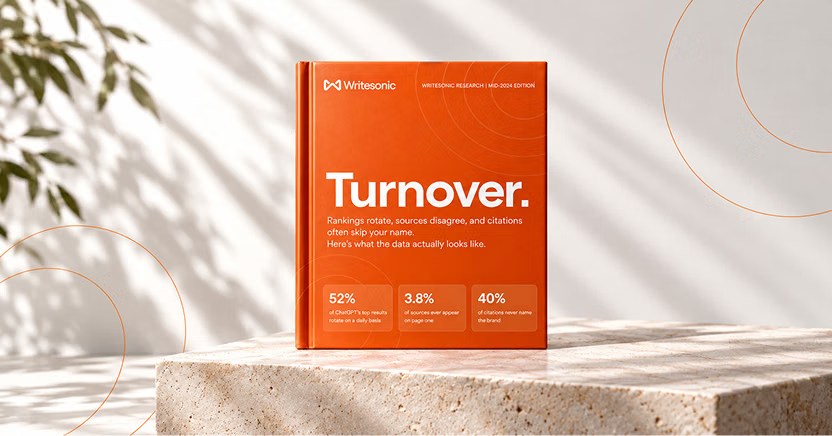
The #1 brand in ChatGPT changes 52% of the time.
Get the report and find out why.

Niyati Mahale is a SEO/GEO Content Writer @Writesonic. She specializes in artificial intelligence and B2B, with a flair for combining effective storytelling and SEO best practices to create impactful content.