Key Takeaways
- LLM tracking is the new SEO. If you’re not visible in AI answers, you’re missing a growing share of your audience.
- The best tools combine monitoring and action: mentions, citations, competitor benchmarking, and optimization.
- Writesonic leads with end-to-end visibility + optimization, while tools like Peec, Profound, Scrunch, and Otterly each offer unique strengths.
- Don’t wait; early adopters of LLM tracking will shape how AI models represent brands in the long term.
- Success comes from using insights to act: fixing misrepresentations, creating AI-friendly content, and tracking competitors continuously.
Wondering which LLM tracking tools to go for in 2025?
Well, every marketer is trying to answer the same uncomfortable question: What are the AI models saying about us, and why can’t we see it?
ChatGPT, Claude, Gemini, and Perplexity are now the first stop for product research and buying decisions. They shape perception long before anyone reaches your website.
And yet most companies are flying blind. They have no idea how these models describe them, rank them, or stack them against competitors.
That’s exactly what LLM tracking tools are built for. They help you find:
- If (and where) your brand shows up in AI answers
- How accurately you’re being represented
- How often are competitors mentioned instead of you
In this blog post, I’ve covered the 12 best LLM tracking tools that you can try in 2025.
What Are LLM Tracking Tools?
LLM tracking tools are platforms that show you how Large Language Models (LLMs) like ChatGPT, Gemini, and Claude see and surface your brand.
Here’s what the LLM visibility tool helps you track:
- Visibility: Does the AI mention your brand at all?
- Accuracy: Is it describing your product or company correctly?
- Sentiment: Is the mention positive, neutral, or negative?
- Competitors: Who else is being cited—and are they ahead of you?
For marketers and product teams, this data is critical. It helps you understand whether AI systems are amplifying your brand, ignoring it, or misrepresenting it, and gives you the leverage to optimize accordingly.
What to Look for in an LLM Tracking Tool
Choosing the right LLM tracking tool comes down to clarity and actionability. Here are the essentials to look for:
- Multi-model tracking: It should cover all major AI platforms (ChatGPT, Gemini, Claude, Perplexity) so you’re not working with a partial picture.
- Accuracy checks: Beyond mentions, the tool should flag when details about your brand are wrong or misleading.
- Competitor insights: Visibility only matters in context. The best tools show how you stack up against rivals.
- Sentiment analysis: Mentions are one thing, but knowing whether they’re positive or negative gives real depth.
- Optimization guidance: Reports are useful, but the real value comes when a tool helps you take action. For example, Writesonic not only tracks visibility but also helps you improve it.
Top 12 LLM Tracking Tools To Try in 2025
LLM-tracking tools are your lens into how AI sees your brand — what’s working, what’s invisible, and what you need to fix before your competitors beat you there. Here are the top 12 LLM tracking tools that you can try out.
1. Writesonic – #1 LLM Tracking Tool
Best for: Businesses looking for an all-in-one GEO + SEO platform to track, benchmark, and improve their visibility across every major AI search engine.
About the tool
Writesonic is a Generative Engine Optimization (GEO) platform that is built to help brands track, understand, and improve how they appear across AI search engines.
It monitors your visibility in ChatGPT, Perplexity, Google AI Overviews, Gemini, Claude, Grok, DeepSeek, Copilot, and more, with no extra platform add-on fees (unlike other GEO tools, which charge for each additional AI engine).
What makes Writesonic different is simple: It doesn’t just show what’s happening; it tells you how to fix it, combining LLM tracking with content optimization, GEO insights, SEO tools, and AI Traffic Analytics (which is even available on a free tier).
Key features
- AI Visibility Tracking: See where your brand appears across all major AI engines.
- Competitor Benchmarking: Compare citations, visibility share, sentiments, and gaps.
- Citation & Source Tracing: Identify which URLs models are referencing.
- AI Bot Analytics: Track AI crawler activity, even page-level breakdowns.
- Prompt-Level Insights: Monitor winning/losing prompts and discover opportunities.
- Action Center + Content Tools: Fix visibility issues with guided on-page, off-page, and technical recommendations, and generate or optimize content inside the platform.
Pros
- Complete Track → Act → Win workflow, not monitoring-only.
- Supports all major LLMs with no hidden add-ons.
- Includes SEO + content creation tools.
- Actionable recommendations, not just dashboards.
- Intuitive user interface; you don’t need deep technical skills to get value out of it.
Cons
- A learning curve due to the depth of features.
Pricing
Paid plans start at $199/month.
To see Writesonic in action, get in touch with our team.
2. SE Ranking – Best For SEO & GEO With Competitor Analytics
Best for: Mid-sized agencies and teams that want to combine SEO with GEO in one tool.
About SE Ranking
SE Ranking helps businesses better understand their traditional and AI visibility. Apart from the SEO solutions like rank tracking, backlink monitoring, and site audits, its AI search tool tracks brand mentions and links in multiple languages across five major AI search platforms: AI Overviews, AI Mode, Perplexity, ChatGPT, and Gemini. The platform regularly updates visibility data and puts it into historical context so users can track their brand’s progress.
Competitor AI visibility analytics shows where the competing brands stand in AI search and provides prompt insights. Each prompt that is analyzed during tracking or competitor analysis has a cached version that allows users view how your brand is presented online.
Key Features:
- Tracks brand mentions and citations in multiple languages across AI Overviews, AI Mode, ChatGPT, Perplexity, and Gemini.
- Offers competitor AI monitoring.
- Lists top-cited sources in LLMs for your prompts.
- Collects cached AI answers to show how brands are framed
- Offers custom insights on where to put your efforts first to improve LLM visibility.
- Offers a suite of SEO and content marketing tools.
Pros:
Covers multiple AI search systems, offers competitor analytics and historical data, and a suite of SEO tools in the same plan with GEO capabilities.
Cons:
Doesn’t offer automated sentiment analysis yet.
Pricing:
Core $129/mo for 100 prompts and 2k keywords; Growth $279/mo with 250 prompts and 5k keywords; AI Search add-on for $79-$345 for adding 200-1000 prompts and additional features. A 14‑day trial is available.
Customer Feedback:
Users compliment SE Ranking for being “a very reliable platform—especially for teams that want structured data, content optimization, and competitive insights in one place”.
Overall:
SE Ranking is a well-rounded visibility tracking solution that combines the GEO toolset with traditional SEO tools and content marketing capabilities. It’s best suited for teams that want to consolidate their visibility tracking tools.
3. AIclicks – Best For SEO teams and business to track their AI visibility
Best for: SEO teams and business owners seeking a single platform to monitor AI visibility and generate content to fill citation gaps.
About AIclicks
AIclicks helps brands track how they appear across major AI search platforms such as ChatGPT, Google AI Overviews, Gemini and Perplexity. It supports a wide range of models – including Claude, Grok, – and combines visibility tracking, competitor benchmarking and content creation.
The platform delivers a visibility audit that highlights where you and your competitors show up in AI answers and provides a done‑for‑you action plan/ AI agents can create and publish content to close citation gaps, while weekly recommendations help you prioritise topics
Key Features:
- Tracks brand mentions and citations across ChatGPT, Perplexity, Gemini, Google AI Overviews and other models
- Offers AEO monitoring, competitor analysis and weekly AI recommendations
- AI agents create content to address missed citations
- Comprehensive action plan to improve AI search visibility
Pros: Broad model coverage; integrates monitoring, benchmarking and content generation; weekly recommendations and clear audits
Cons: Higher prompt tiers (150+) require more expensive plans.
Pricing: Starter $79/mo for 50 prompts and 10 AI blog posts; Pro $189/mo with 150 prompts and 20 posts; Business $499/mo covering Claude and Grok, offering 300+ prompts and 30 posts. A 7‑day trial is available.
Customer Feedback: Users praise AIclicks as “a game‑changer for optimising your business for AI… simple to use and note it has become their “command centre for AI Search”.
Overall: AIclicks is a well‑rounded GEO solution that pairs AI visibility tracking with automated content creation. It’s best suited for teams willing to invest in a comprehensive, multi‑model tool to boost their brand’s presence in AI‑generated answers.
4. Gauge
Best for: Growth marketing and SEO teams that want their AI visibility data analyzed, translated into strategy, and turned into published content from a single platform.
Pricing: Starter at $99/month (100 prompts, ChatGPT only); Growth at $599/month (600 prompts, 6 platforms); Enterprise is custom. Free trial available.
Gauge is a GEO platform built around a closed-loop philosophy — data → action → measure — but what makes it distinct in this space is Ask Gauge, an AI marketing agent that sits on top of all your search data and actually works with you.
Most GEO tools surface dashboards and leave you to interpret them. Ask Gauge draws the conclusions for you. Connect your Google Search Console and GA4 data alongside Gauge’s AI visibility tracking, and the agent merges everything into a single conversational interface. Ask it why a competitor is gaining ground and it will analyze visibility data, citation patterns, and traffic signals to identify the cause and recommend a response. Ask it to build a content plan and it pulls from your AI visibility gaps, GSC keyword performance, and GA4 referral data to generate a strategy — then drafts the content directly within the platform.
This agent-first approach extends across the workflow. Ask Gauge analyzes your existing prompt coverage, identifies tracking gaps, and suggests new prompts with volume data. It feeds insights directly into Gauge’s end-to-end content engine — auto-generated calendar → briefs → outlines → fully written articles — so the path from “here’s what the data says” to “here’s a published article addressing it” happens inside one tool.
Gauge also tracks a nuance most tools miss: the difference between citation rate (how often your content is sourced) and mention rate (how often your brand is actually named in the answer when cited). AI models frequently cite your content but strip your brand from the generated text — Gauge surfaces both metrics separately so you can act on the gap.
Key Features
- Ask Gauge AI agent that merges AI visibility data, GA4, and GSC into a single conversational co-pilot for analysis, planning, and execution
- End-to-end content engine from calendar through published article, driven by agent insights and real visibility gaps
- Citation and mention rate tracking with domain-level and URL-level views, trend graphs, and filtering by topic, model, and date
- Query Fan Out visibility showing the actual Google searches ChatGPT runs when processing a prompt
- Agent-driven prompt creation that identifies coverage gaps and generates short-tail and long-tail prompts with volume data
- GA4 integration tracking real AI referral traffic at the page level with AI UTM source breakdowns
- Competitor benchmarking with per-prompt and per-topic visibility breakdowns
Pros and Cons
| Pros | Cons |
| Ask Gauge agent draws conclusions and shapes strategy, not just charts | Claude and Grok tracking only on Enterprise tier |
| GSC + GA4 integration makes it a unified search analytics hub | Single country tracking on Starter and Growth; multi-country requires Enterprise |
| Full content engine included, from brief to published article | Newer platform, though shipping major features monthly |
| Case studies show 2x visibility in 2 weeks, 5x in 4 weeks | |
| Keyword-driven prompt generation covering short and long tail | |
| Accessible entry pricing vs. enterprise-only competitors |
Verdict: If your team needs a GEO tool that doesn’t just show you what’s happening but actively analyzes why and helps you respond, Gauge’s agent-first approach fills a gap most monitoring platforms leave open. The combination of an AI co-pilot with GSC/GA4 integration and a built-in content engine makes it one of the more complete action-to-outcome platforms in the space.
5. Scrunch AI – Best for Persona-Based LLM Monitoring & AI Traffic Insights
Best for: Teams that want persona-driven visibility tracking and strong AI-crawler analytics without needing built-in content creation or optimization workflows.
About the tool
Scrunch AI is a monitoring-focused LLM visibility platform that tracks how your brand shows up across major AI engines like ChatGPT, Perplexity, Meta AI, Claude, Gemini, and Google AI Overviews.
It also analyzes AI bot traffic and offers the Agent Experience Platform (AXP), a machine-readable version of your site designed specifically to help AI crawlers understand, index, and cite your content more accurately. Scrunch delivers strong analytics but requires external tools for content optimization or execution.
Key features
- Multi-platform LLM visibility & citation tracking
- Persona-based prompt segmentation
- Domain-level citation frequency & competitor insights
- AI bot/crawler analytics across all plans
- Page-level crawl pattern monitoring with GA4 & Cloudflare integrations
- AXP (Agent Experience Platform) for AI-optimized content delivery
- Basic site audits for technical & content issues
Pros
- Broad engine coverage with persona-driven insights
- Strong sentiment and brand safety analysis
- AI bot analytics are included even in entry plans
- AXP improves AI crawlability without changing your main website
Cons
- Monitoring-only — no content creation or optimization workflows
- Recommendations lack depth
- Only 2 months of historical data (industry norm is 6–12+)
- AXP is powerful but still early-stage for many teams
Pricing
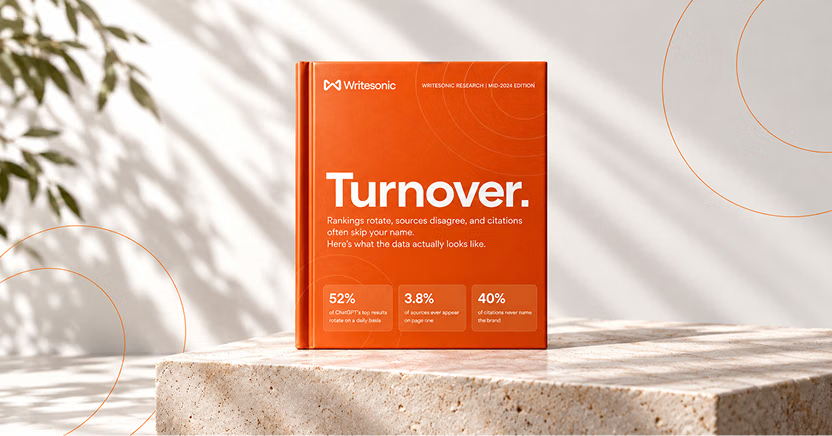
The #1 brand in ChatGPT changes 52% of the time.
Get the report and find out why.
Starts around $300/month for monitoring-only capabilities.
6. AthenaHQ – Best for Multi-Region GEO Monitoring & Vertical-Specific Insights
Best for: Brands operating across multiple countries or industries that want granular, region-based AI visibility tracking with ML-powered prompt insights.
About the tool
AthenaHQ is a monitoring-focused GEO platform built around multi-region, multi-language AI visibility tracking and proprietary prompt-volume estimation powered by machine learning.
It tracks your brand across 8+ AI engines and highlights regional, industry-specific visibility trends. AthenaHQ also includes a lightweight Action Center that gives vertical-specific suggestions, but relies on external tools for full content creation or optimization. It’s powerful for analytics, less so for execution.
Key features
- AI visibility across 8+ engines with geographic granularity
- ML-powered prompt volume estimation
- Competitor benchmarking across regions & industries
- Vertical-specific Action Center recommendations
- Citation patterns over time with domain authority scoring
- “Impersonation” mode to simulate competitor perspectives
- Real-time shareable dashboards
Pros
- Excellent for international brands with multi-country visibility needs
- Strong ML-driven prompt estimation
- Detailed regional + industry segmentation
- Good competitor intelligence with impersonation insights
Cons
- Monitoring-heavy; limited content creation or optimization tools
- Less mature platform (newer than Writesonic or Profound)
- No free tier; limited technical GEO recommendations
Pricing
Starts around $95/month, depending on billing cycle.
7. Otterly AI – Best Budget-Friendly LLM Monitoring Tool
Best for: Startups and small teams that want a simple, low-cost way to monitor brand mentions across major AI engines.
About the tool
Otterly AI is a lightweight LLM monitoring platform that tracks how your brand appears across ChatGPT, Perplexity, Gemini, Google AI Overviews/Mode, and Copilot.
It runs your prompts automatically, collects the AI outputs, and highlights where you’re mentioned, how you’re positioned, and which links/models cite you. It’s affordable, easy to set up, and built purely for LLM visibility monitoring; no optimization or content workflows.
Key features
- Multi-engine prompt monitoring (ChatGPT, Gemini, Perplexity, Copilot).
- Brand & competitor mention tracking with sentiment.
- Citation/link detection across AI responses.
- Automatic daily/weekly prompt runs + alerts.
- Shareable dashboards & simple reporting.
Pros
- Very affordable (ideal for SMBs).
- Simple, fast setup; minimal learning curve.
- Tracks mentions + citations across major engines.
- Great “starter tool” for AI visibility.
Cons
- Monitoring-only — no optimization or content creation.
- Limited depth for enterprise GEO use cases.
- Costs increase if you monitor many prompts.
Pricing
Plans start around $29/month, depending on prompt volume.
8. Nightwatch – Best Hybrid SEO + LLM Tracking Tool
Best for: SEO teams and agencies that want to combine traditional rank-tracking with emerging LLM/AI-search visibility — all in one dashboard.
About the tool
Nightwatch is a full-fledged SEO and AI-visibility tracking platform. It tracks keyword rankings globally, monitors SERP features (organic, snippets, local pack, AI snippet, image carousel, knowledge panel, etc.), and also offers AI tracking, showing how your content fares inside LLM-driven answers (ChatGPT, Claude, Gemini, and more).
It’s designed to bridge traditional SEO with the new world of AI search, letting you see both where you rank on Google and how you show up to AI-powered assistants.
Key features
- Global + local keyword rank tracking (desktop & mobile)
- SERP-feature & AI-snippet rank tracking
- LLM/AI-tracking: visibility, citation, and snippet monitoring in AI responses
- Automated white-label reports & customizable dashboards
- Site audits, backlink/SEO-health tools
- Keyword & competitor tracking at scale with segmentation by region or audience
Pros
- Combines classic SEO and emerging GEO/AI tracking
- Covers traditional rank tracking and AI-snippet/LLM-monitoring
- Strong SERP-feature coverage
- Automated reporting and global/local tracking
- Competitive entry-level pricing
Cons
- More tracking/monitoring than deep GEO optimization
- If you focus purely on AI citation optimization, you might need a more specialized GEO tool
- Advanced optimization features are not its strongest side
Pricing
Plans start at $32/month (billed annually) for the entry-tier (250 keywords tracked daily, 50 websites, 5 competitors, 25-page audit, global rank tracking).
9. Goodie – Best Full-Stack AEO Tool With AI-Crawler Intelligence
Best for: Teams that want both LLM-visibility tracking and AI-optimized content creation in a single platform.
About the tool
Goodie is an AEO (Answer Engine Optimization) platform designed to help brands understand how they appear across AI search engines like ChatGPT, Gemini, Perplexity, and Google AI Overviews.
Beyond monitoring, Goodie also analyzes AI-agent crawler behavior and provides an AI-optimized content writer built specifically to improve LLM visibility. It’s positioned as a full-stack solution, combining tracking, crawler analytics, and AI-friendly content generation.
Key features
- Multi-engine LLM visibility & mention tracking
- Competitor benchmarking and sentiment analysis
- AI-agent / crawler analytics with real-time crawl data
- AI-optimized content writer for AEO-friendly articles
- Topic explorer for prompts, gaps, and visibility opportunities
Pros
- Strong blend of visibility + content execution
- Includes AI-crawler analytics not found in lightweight tools
- Good for teams adopting an AEO-first strategy
- Supports multi-language, multi-region monitoring
Cons
- No transparent pricing (demo required)
- More complex than simple monitoring tools
- It may be overkill if you only need basic LLM tracking
Pricing
Pricing is not publicly listed; access requires a product demo.
10. AirOps – Best for AI-Powered Content Ops + LLM Workflow Scaling
Best for: Teams that want to combine LLM visibility insights with full-scale content workflows, automation, and AI-powered execution, all in one platform.
About the tool
AirOps is a workflow and optimization platform that goes beyond simple LLM tracking.
It helps you build AI-powered workflows: track visibility, generate or refresh content, integrate with CMS/SEO tools, and funnel AI-driven output directly into publishable content, without needing to copy-paste across multiple tools.
It’s designed to bridge visibility + execution at scale.
Here are the top AirOps alternatives that you can check out.
Key features
- Tracking for prompts/pages across multiple answer engines (LLMs + AI Overviews)
- AI-powered workflow builder — research → draft → review → publish pipelines
- Content production & refresh tasks tied to real-time visibility signals
- CMS integrations, brand kits, knowledge bases & SEO tooling
- Bot + crawl analytics, task-based automation & exportable data
Pros
- Combines visibility + content ops + automation, fewer tools needed overall
- Great for large teams, agencies, or companies scaling content output
- Integrations with CMS/SEO stack streamline publish pipelines
- Offers flexibility: custom tasks, workflows, and automation logic
Cons
- More complex setup and steeper learning curve than simple trackers
- Cost grows with task volume / usage (workflow-heavy teams may hit overage)
- Overkill if you only need basic LLM visibility or lightweight SEO
Pricing
Offers a 14-day free trial. For more, get in touch with Sales.
11. Peec AI – Best Lightweight LLM Tracking Tool for Monitoring
Best for: Teams that want simple, affordable LLM visibility tracking without needing built-in optimization or content tools.
About the tool
Peec AI is a clean, monitoring-focused platform built to track brand visibility, sentiment, citations, and competitor mentions across AI engines. It offers strong UX, fast onboarding, and attractive entry pricing, making it popular with SMBs and agencies.
But Peec is monitoring-only: it shows visibility problems yet provides no tools to fix them (no content generation, optimization, or AI crawler analytics). It also limits base pricing to only 3 AI platforms, with all others sold as add-ons.
Key features
- Brand visibility, sentiment & competitor tracking
- Citation/source tracing
- Prompt monitoring & organization
- Multi-language support (115+ languages)
- Clean, user-friendly dashboard
Pros
- Simple, fast to adopt
- Affordable entry pricing
- Unlimited seats, agency-friendly
- Strong customer support
Cons
- Monitoring-only, no optimization or content tools
- Missing enterprise readiness (no SOC 2, no SSO)
- Hidden costs: only 3 engines included; Claude, Gemini, DeepSeek, Llama, Grok, etc., cost extra
- No AI crawler analytics
Pricing
Plans start at €89/month (~$103) for 3 AI engines and 25 prompts. Add-ons raise real costs significantly.
12. Profound – Best for Enterprise-Grade AI Visibility Monitoring
Best for: Enterprises that want deep LLM monitoring, broad engine coverage, and advanced visibility analytics.
About the tool
Profound is a monitoring-first LLM visibility platform built for large teams that need detailed insights across 10+ AI engines, including ChatGPT, Google AI Overviews/Mode, Claude, Gemini, Perplexity, Copilot, Grok, and DeepSeek.
Its signature feature, Conversation Explorer, analyzes a proprietary dataset of 400M+ real prompts, giving enterprises unmatched visibility into what users actually ask AI systems. Profound excels at showing what’s happening, but offers limited tools for fixing or optimizing content.
Key features
- Visibility, citations, sentiment & share-of-voice across 10+ LLMs
- Conversation Explorer for real prompt trends (400M+ dataset)
- Agent Analytics for AI bot/crawler behavior
- Competitor benchmarking & branded answer analysis
- ChatGPT Shopping tracking for ecommerce brands
Pros
- Broadest engine coverage
- Unique prompt-intelligence dataset
- Strong enterprise credibility (SOC 2, HIPAA, Fortune 500 logos)
Cons
- Monitoring-heavy; minimal optimization workflows
- No free trial
- Limited historical data on lower tiers (e.g., 2 months)
Pricing
Starts at $99/month for ChatGPT-only; enterprise pricing required for full engine coverage.
Get #1 LLM Visibility Tracking Tool – Writesonic
The shift from search engines to AI answers is rewriting the rules of visibility. Instead of just ranking on page one, brands now need to track how LLMs cite, represent, and compare them across ChatGPT, Gemini, Claude, Perplexity, and more.
The tools we covered, from Writesonic to Peec, Profound, Gumshoe, Semrush AIO, Scrunch, RankScale, and Otterly, all give you different angles on solving this challenge.
Some specialize in monitoring, some in benchmarking, and a few, like Writesonic, go further by offering optimization guidance to actively improve your visibility.
The bottom line: LLM tracking isn’t optional anymore. The brands that get visibility right inside AI systems will own the next wave of AI search. Those who don’t risk being left out of the conversation entirely.
To see Writesonic in action, get in touch with our team.
Frequently Asked Questions about LLM Tracking Tools
The #1 brand in ChatGPT changes 52% of the time.
Get the report and find out why.

Content Marketer
Pragati Gupta is a Content Marketer @Writesonic, specializing in AI, SEO, and strategic B2B writing. Leveraging the power of Generative AI, she produces high-impact content that drives superior ROI.