Search has fundamentally changed.
If you have been in digital marketing and navigating this AI era, terms like “prompts” and “keywords” are probably frequent visitors to your vocabulary.
But do you genuinely understand the differences, and why mastering these distinctions matters now more than ever?
Let’s delve into the critical differences between prompts and keywords, and why mastering both is essential for modern businesses and marketers.
Keywords: The Traditional SEO Approach
Keywords have been the backbone of digital search, helping search engines understand content and match it with user queries.
Short-Tail Keywords
Broad, high-volume, competitive phrases (generally 1-2 words) such as:
- “resume templates”
- “article generator”
- “AI tools”
Long-Tail Keywords
More specific phrases targeting narrower queries (around 3-5 words):
- “best coffee shops in Brooklyn”
- “digital marketing strategies for startups”
- “travel apps for solo travelers”
Learn more about short-tail vs long-tail keywords.
Question Keywords
Queries structured explicitly as questions, usually beginning with who, what, where, when, why, or how:
- “how to improve SEO”
- “what are effective email marketing strategies”
- “where can I find travel deals”
Keywords: Quick Summary
- Length: 2-5 words
- Style: Fragmented phrases
- Context: Limited
- Intent: Often implied
- Format: Optimized for search engines
While keywords remain critical, simply matching terms is no longer sufficient. Modern search engines have evolved to prioritize content quality, context, and user intent.
Learn more about keyword research.
As per Writesonic’s recent study of 1M+ AIOs, nearly 85% of AIOs do not contain the exact query, indicating that context is more important than the keyword match.
Prompts: The AI-Driven Approach
Unlike traditional keyword searches, prompts reflect how users naturally speak or type into AI-driven search platforms, conversational bots, and virtual assistants like ChatGPT, Siri, and Alexa.
Rather than fragmented terms, prompts use complete sentences, clearly conveying user intent and context. In simple terms, prompts are longer, context-rich, and explicitly state the user’s intent and specific requirements.
Real-World Examples of Prompts:
- “I’m traveling alone to Europe for the first time and need recommendations for easy-to-use travel planning apps.”
- “Our startup struggles with email marketing ROI; what are the most effective strategies to increase engagement?”
- “I manage a small coffee shop and want to attract more local customers through social media. Which platforms and strategies are best?”
Notice the clear difference: prompts naturally include context, specific details, and explicit intent, resulting in much more tailored responses.
Prompts reflect how humans naturally communicate. AI tools don’t just match keywords; they interpret entire questions and conversations, providing answers that are contextually relevant and deeply personalized.
Also, here are the top ChatGPT prompts that you can try out in 2025.
Types of Prompts That Drive AI Search
1. Feature/Capability Questions:
- “What running apps track distance and provide customized training plans?”
- “Which graphic design tools are beginner-friendly and affordable?”
2. Comparison Queries:
- “Nike vs Adidas running shoes for long-distance running—how do they compare?”
- “Comparison of Adobe Illustrator alternatives for small business owners”
3. Use-Case Specific:
- “Best graphic design software for creating social media graphics quickly”
- “Top running shoes for beginners training for a half marathon”
4. Problem-Solution Prompts:
- “How can I prevent injuries when training for my first marathon?”
- “Our design team struggles with inefficient workflow—how can we streamline project management?”
5. Direct Tool Searches:
- “Most popular running shoe brands for trail running?”
- “Which online booking platform offers the best deals on budget hotels?”
Prompts aren’t just questions—they are context-rich narratives that AI can analyze deeply. Marketers must focus on optimizing content to meet this new standard.
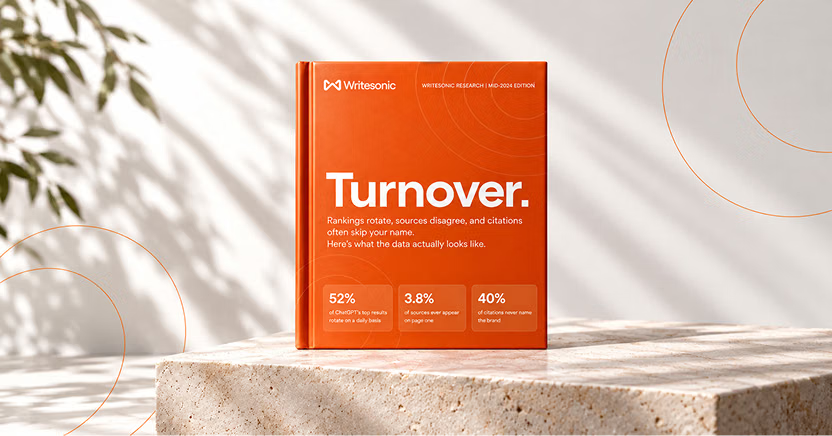
The #1 brand in ChatGPT changes 52% of the time.
Get the report and find out why.
Prompts vs Keywords: Distinct Differences
| Aspect | Keywords | Prompts |
| Length | Short, around 2-5 words | Longer, conversational, around 10-25 words |
| Style | Brief and fragmented | Natural and conversational |
| Context | Limited | Extensive and detailed |
| Intent | Often implied | Explicitly articulated |
| Interaction Type | Search-centric | Conversation-centric |
Why Prompts are Dominating Digital Discovery
Here are the top four reasons why the shift is happening:
1. AI thrives on context
Unlike keyword-based search engines, generative AI platforms process complete sentences, understanding nuances and subtleties in language. This enables more precise, relevant answers rather than generic search results.
2. Users demand personalized responses
People no longer want a list of links; they seek direct answers tailored to their unique context and needs. AI platforms deliver personalized experiences that traditional SEO cannot match.
3. Increased voice and chat-based interactions
Voice-activated devices and chat-based interfaces naturally encourage users to speak in complete, conversational sentences rather than fragmented queries. AI tools excel at interpreting these longer, context-driven queries.
4. Complex decision-making
Decisions today often involve complex scenarios. Users turn to conversational AI to navigate these complexities effectively by posing detailed prompts. AI platforms can dissect and respond effectively to these sophisticated queries, providing detailed, relevant guidance.
Tips on How Brands Can Adapt to This Prompt-Driven Era
Successfully adapting your content and SEO strategy for prompts involves a few strategic shifts:
1. Write for humans, not algorithms
Check out the real-life questions that your audience might ask. Create FAQ pages, detailed guides, and comprehensive blog posts addressing these conversational queries. Ditch keyword stuffing in favor of meaningful engagement.
2. Create context-rich content
Produce detailed articles, blog posts, and resources that thoroughly answer users’ queries, including examples, scenarios, and step-by-step guides. This makes it easy for AI tools to pull out relevant information.
3. Focus on clear intent
Identify user intent explicitly and structure your content accordingly. Whether it’s informational, transactional, or navigational, clarity in intent improves AI-driven discoverability.
4. Leverage real-world scenarios
Incorporate genuine use cases and examples reflecting real user challenges, enhancing your content’s authenticity and relatability.
Boosting AI Visibility with Writesonic’s Generative Engine Optimization Tool
Writesonic’s Generative Engine Optimization tool provides critical insights into prompt-driven searches. This innovative solution offers some powerful capabilities, including:
- AI Visibility Leaderboard: Instantly see your brand’s visibility compared to competitors. Identify your position clearly and strategize accordingly.
- Top Prompts Analysis: Quickly discover which prompts are currently driving visibility for your brand and how well you rank, helping you strengthen content that performs best.
- Competitive Prompt Gap Analysis: Easily identify prompts that currently drive visibility for competitors but not your brand, presenting clear opportunities for content creation and optimization.
- Prompt Performance Tracking: Monitor trends over time, including visibility and sentiment changes, enabling proactive content adjustments to maintain or enhance your AI presence.
By leveraging Writesonic’s comprehensive prompt analytics, your brand gains actionable insights to bridge visibility gaps, outperform competitors, and boost overall engagement with AI-driven search.
Stay Ahead In The Prompt-Driven Era With Writesonic
The shift from keywords to prompts represents a broader change in digital behavior and technology. Prompts aren’t just longer keywords; they represent a completely new mindset towards content discovery.
Understanding the differences between prompts and keywords is not optional; it’s essential for strategic growth.
By understanding and embracing this shift, your brand can better align with user expectations, enhancing engagement, driving traffic, and building authority in the age of conversational AI.
Ready to master prompts and transform your content strategy? Start leveraging Writesonic today.
The #1 brand in ChatGPT changes 52% of the time.
Get the report and find out why.

Content Marketer
Pragati Gupta is a Content Marketer @Writesonic, specializing in AI, SEO, and strategic B2B writing. Leveraging the power of Generative AI, she produces high-impact content that drives superior ROI.