Key Takeaways:
- LLMs pull 60% of their citations from outside the top 10 SERP results. That means your traditional SEO playbook only covers part of the story now.
- User-generated platforms dominate AI citations. Reddit had 7.3 million citations in our analysis. Wikipedia had 4.3 million. Seven of the top 10 most-cited domains are UGC platforms.
- Third-party placement is relationship work, not commodity content. You need to know who maintains the content, craft personalized outreach that adds value first, and build trust over time. This higher barrier to entry means better margins.
- The work breaks into two phases: audit your client’s current visibility across citation sources, then execute strategic outreach to listicles, review sites, Reddit threads, and syndication partners.
- Manual monitoring doesn’t scale. Checking hundreds of listicles monthly is manageable. Tracking Reddit, Quora, and Medium discussions daily for 10+ clients isn’t. Writesonic’s Action Center automates discovery and provides prioritized outreach lists so you can focus on the high-touch relationship work.
Our concept of what a website is hasn’t fundamentally changed from the first, static Dreamweaver-built monstrosities of yesteryear.
It’s a business card. You want yours to be classy, like a pale nimbus background with raised lettering. Maybe a Silian Rail font.
And every CMO feels understandably protective of that business card. Understandably, content agencies have built an entire industry on supporting this reflex. For the last couple decades, the core toolkit has barely changed: you go in and clean up the technical SEO, deliver a content strategy, fire up the blog machine.
There have certainly been upheavals along the way. The gated gardens of social media corralled many eyeballs into just a few isolated pastures within the internet’s great expanse. You could no longer completely control the message, but it was close enough you could still say you “owned” your marketing assets and keep a straight face.
Your website, your blog, and your social channels. That is the holy trinity of traditional agency optimization.
For a long time, the rules were stable. Google rewarded the signals you could actually shape. Things like your site quality and your content depth and your link authority. So, agencies built entire workflows around those signals. You knew what mattered, and you knew how to move the needle.
But LLMs … don’t really care about any of that. They scour the rest of the internet. And that’s scary because neither you, nor your clients, control all those other parcels of land.
LLMs might key in on some Reddit thread from 2019, or a years-old Capterra review, or a Substack article that’s part product comparison and part anecdote.
These are the things that end up feeding the model’s understanding of your client. And if these third-party sources talk about your client loudly, or incorrectly, or (worse!) not at all, that’s what the AI parrots. It’s scraping consensus signals, and those signals no longer live on the landing page.
All the stuff you’ve been doing still works, of course. This is not an “SEO is dead” moment (just like the last time wasn’t. Nor the time before that). After all, 40% of AI citations are pulled from the top 10 SERP results.
But, it does mean 60% of citations aren’t covered in your traditional playbook. AI is like an expansion pack to the game content marketers are used to playing.
In case you missed it: our GEO playbook for agencies.
Why Third-Party Placement Is a Service Line
If you’ve been watching how LLMs answer questions, you’ve probably noticed they love certain corners of the internet. They keep circling back to places like Reddit, Quora, Medium, Hacker News.
In fact, nearly 22% of AI citations come from user-generated content like this. Our most recent analysis of 2.4 million domains across eight AI platforms found that seven of the top 10 most-cited domains are UGC platforms. Reddit alone had 7.3 million citations. Wikipedia had 4.3 million. YouTube, LinkedIn and Medium all follow the same pattern.
LLM models love these places not because they are polished or authoritative like you would expect from traditional EEAT content, but because they’re crowded with people talking in detail about problems and the solutions to those problems.
Sometimes, those conversations are inaccurate or outdated. But the model has no reason to correct them when it feeds you those conversations as answers. That, as we’ll explore below, is your job.
Once you understand where the model likes to pull from, though, you can put your marketing strategist hat back on, open up the playbook, and start updating the oldies but goodies based on this new generative engine optimization (GEO) battleground.
It requires relationship capital
This is where agencies earn their keep, because AI doesn’t do diplomacy (yet).
Publishers aren’t always going to want to hear your pitch. If you want them to update a listicle, it needs to be because it’s helpful first and foremost for them and their readers.
It’s the difference between:
“Hey, I noticed this line is outdated. Here’s the correct information, with a source to verify it. Hope this was helpful!”
and
“Here’s why my tool, EIE.io, is better for enterprise ag producers than the Old Mac app.”
This is time consuming, and it doesn’t scale. Fortunately, just gaining a few extra brand mentions can drive 1,000 new citations from LLMs, so we’re not talking about days and days of work here. You can afford to take your time and personalize your messages.
User-generated content platforms work differently, but the principle is the same: be authentic or bounce.
Hacker News readers have a sixth sense for brand plants. Reddit mods will gleefully vaporize anything that smells like a PR initiative.
Your presence in these communities has to be slow, steady, and, above all, helpful. That means adding value by answering questions and hardly, if ever, mentioning your client unless it is really, truly the best answer.
This is high-touch work that requires deep expertise. It isn’t commodity content work clients can get from Fiverr. Fortunately, that higher barrier to entry equates to better margins for your agency.
It’s recurring revenue
Generating third-party mentions requires ongoing management.
There are always going to be new listicles popping up in mentions while others fall out of date. Subreddits are always rehashing arguments, and those new threads get picked up by the LLMs, so you need to make sure your voice is in the mix there, too.
You can’t fix things once and expect your client’s narrative to stay put. Maintaining their reputation is a constant battle, which means it fits best within a retainer model.
In addition to monitoring your client monthly, there will be intermittent bursts of outreach work when something important changes. That makes it a stable, profitable service line.
It’s a hedge against SEO commoditization
Before SEO became a profession, nobody was thinking in terms of keywords or topic clusters. People wrote recipes, built fan pages, and wrote angsty LiveJournal entries but it all just sat out in the ether in a disorganized mess.
Half the magic of the old internet was how chaotic it all was. You’d search for something and stumble onto a blog and it felt like you’d discovered a secret world in the back of your wardrobe.
The downside, of course, was that finding anything specific was difficult. That’s what Google fixed. Backlinks as a proxy for authority was a brilliant idea that made the internet far more usable. But, it also kicked off the longest-running cat-and-mouse game in marketing: Google trying to surface genuine expertise, and everyone else trying to look like genuine experts.
Over time, the “right” way to write so you appeared atop the SERPs became fairly codified. You got your hub-and-spokes and ultimate guides. FAQs and key takeaways appeared in every article because they became part of a checklist.
Along the way, a lot of content ended up sounding exactly like its neighbors. Then AI showed up, trained on all that sameness, and turned the dial to max. If SEOs were already drifting toward a shared voice, AI took that voice and blended it into an even smoother puree, then made it cheap enough to crank that SEO smoothie out for pennies a pound.
So, now you’ve got two forces flattening content at once. Writers are adapting to Google’s preferences, and AI is learning from those writers. This templated stuff is now a commodity that can only compete on price. And competing on price is a race with only one destination: the bottom.
Third-party placement, on the other hand, is stubbornly human work.
You have to actually understand which sites matter in your client’s space, because they’re not always the ones with the highest domain rating. Then, you have to figure out who actually maintains that content and write outreach that actually captures their attention. That requires a level of category fluency that lets you position a client as the right answer for the page without overselling it.
This is how the best agencies will start to move up the food chain from mass production to strategic visibility work.
The operational framework
None of the work that goes into third-party visibility is mystical or hand-wavy. What surprises most people when they first dig in is how familiar the tasks actually end up feeling.
The terrain outside your familiar website SEO work may be a bit different. You’re not auditing title tags or rewriting H2s, but the instincts you honed doing that work will serve you well here.
Phase 1: The third-party visibility audit
In phase 1 for each of your clients, you will map:
Citation source categories
To understand your client’s citation footprint, you need to know which types of sources tend to shape the LLM’s understanding of their space.
This usually falls into recognizable buckets. There will be review aggregators like G2 and Capterra, listicles that rank the “best X tool for Y users”, trade pubs, Reddit communities, Wikipedia pages, and experts writing on Medium and Substack.
Different industries will have different gravitational centers. Some will have unusually active Reddit communities, while others have a well-respected industry newsletter.
Current visibility
Once you’ve mapped the categories, the next step is to see where your client actually shows up within the industry’s LLM ecosystem.
You want to find where the client is mentioned, and then figure out whether that source talks about your client accurately, whether it’s a recent citation, and whether the mention is positive or negative. Also look for citations where your competitors are mentioned, but your client isn’t.
Now, research those sources a little more deeply. Figure out what their domain authority is and how often they are cited by LLMs.
This snapshot becomes the raw data set from which you’ll work going forward. It’s the baseline from which you’ll show your client how you’ve improved their visibility.
Gap prioritization
Once you’ve gathered information about the current state of play, your next step is to sort out what deserves your attention first. Not all gaps are created equal.
This step is like prioritizing keywords. Only, instead of search volume, difficulty, and intent you’ll use authority and influence to sort your priorities.
Every category is different, but in general you can sort into the following tiers:
- High-priority pages like listicles in your client’s exact category, review sites where buying decisions happen, and Wikipedia pages for their category.
- Medium-priority pages like adjacent category listicles that may have a broader reach but are less directly related. You can also throw mentions from industry publications and strategic Reddit communities into this bucket.
- Lower priority pages like generic business listicles, low domain-authority directories, and thin content aggregators.
At the end of this phase, you’ll have a comprehensive third-party visibility audit alongside a prioritized opportunity list to deliver to your client.
Phase 2: Strategic Outreach
With a visibility audit and an opportunity list in hand, it’s time to execute.
This is the part that doesn’t scale neatly. That’s OK. It’s why your clients are willing to pay top dollar for your expertise, skills, and influence in the industry.
For listicle and review site inclusion
There are likely to be dozens and dozens of listicles and review sites that you could chase on behalf of your clients. We encourage you not to get sidetracked pitching every client to every list.
Instead, work to build relationships with high-authority sources within your agency’s verticals. As you prove yourself again and again to be a useful contact, you’ll build trust as a resource they can turn to when it comes time to update their content.
Here’s what the process looks like:
- Identify the decision-maker. This is likely someone like a publication editor, a list curator, or the site’s owner. If there isn’t a byline, look for a contact in the masthead, or in an “about” section. You can also try and find someone on LinkedIn associated with the site that has “editor” or something similar in their title. One last source is to do a quick WHOIS lookup to reveal the domain registrar.
- Research update frequency. If there isn’t a date attached to the blog, you can sometimes get clues from the screenshots they use within the blog, the features they highlight about each tool, or follow their outbound links and see how old those pages are.
- Understand inclusion criteria. Look at who’s already on the list and how they’re described. Patterns in the entries usually reveal what the curator values, whether it’s pricing transparency, UI/UX, the availability of a free tier, or integrations. Whatever shows up again and again through the list is probably what they’re optimizing for.
- Craft a non-spammy pitch. The key here is to be specific and to add value. Point to the exact line or section you’re hoping to update. Then, explain what’s changed and why this information helps their readers. Give them a clean, ready-to-paste version along with a verified source for the information.
- Provide easy-to-use assets. Along with the copy and a source link, you might include screenshots, comparison data, and any other information that will help inform their readers.
- Follow up strategically. Give your contact time to respond and make the changes. They’re busy, too, after all. After a week or two, it’s OK to give them a polite nudge in the form of an email that references your original note. If they don’t respond after this nudge, though, let it go. You don’t want to get a reputation as pushy or spammy.
For Reddit/Quora presence
It is so, so, so tempting to go full marketer mode here. Resist the urge at all costs. If you’ve chosen well, these communities are full of your client’s exact audience, so missteps will have outsized consequences for your client’s reputation.
We recommend identifying 5-10 high-value threads in a client’s category. Don’t go reviving dead threads. These should be live, active conversations. It’s better to be patient and wait for the right thread to emerge than to rampage through the subreddit like a bull in a china shop.
When you do engage, make sure it is to provide genuinely helpful answers, not pitches. Only mention your client if doing so actually answers the question in a useful way. Placement should be the cherry on top of your reputational sundae.
For Wikipedia
Wikipedia wants to know if your client has been covered in independent, reputable sources like mainstream publications, industry press, scientific research, or books. If all you’ve got are blog posts and press releases, Wikipedia doesn’t consider you notable, and that’s OK.
If your client does meet the bar for inclusion, then be sure to follow Wikipedia’s editing protocols strictly. What you write must be backed by a reliable, third-party source. You should summarize your client neutrally, without spin. Wikipedia will absolutely remove any promotional content.
For content syndication
First, let’s clarify what we’re talking about here. There’s “syndication” in the PR-network sense where you pay a few hundred bucks and end up splattered across 50 sites. That’s not what we’re talking about here.
The kind of syndication you want is the editorial kind. You want to find a partner where your client’s perspective will make the partner’s publication better for their readers. That’s because you’re going to be repurposing your client’s best-performing content (with their permission, naturally) for syndication.
You’ll know it’s the right kind of publication because it will include disclaimers that say “originally published in …”, usually at the top of the article. What these publishers are looking for is usually primary research and analysis or perspectives that test the establishment view on a topic.
Look for editors that want a regular cadence of articles from your client. Done well, this kind of work raises the publisher’s prestige while also framing your client as an authoritative thought leader in the industry.
Make sure to give the editor the canonical link, an author bio, and the exact copy they should use to credit your client so everything is attributed appropriately.
Writesonic does this for you
If you’ve made it this far, then you probably agree the opportunity for agencies here is pretty huge.
You may also have identified a problem.
Most any agency could offer third-party placement. Agencies are pros at running audits, building relationships, pitching editors. The work isn’t the issue.
But systematically identifying where your dozens of clients should be mentioned across hundreds of potential sources is a bottleneck that sounds like it would probably kill this service before it ever launched.
What you’d need to do manually
Let’s take a look again at the work involved in building a client’s third-party invisibility.
First, you’d have to check hundreds of high-authority listicles in each client’s category to see if they’re mentioned. You’ll need to cross-reference the information in those listicles against your client’s latest feature updates to identify errors that need to be corrected or updated. That’s laborious, but you could get away with doing this just monthly. So, this alone is probably manageable.
Unfortunately, monitoring communities like Reddit, Quora, Medium, and Substack has to be done almost daily or you risk missing relevant discussions as they happen in real-time.
Now, remember you have to do all this work not just for client mentions, but for all their competitors as well.
For one client, this is 10-15 hours of research. For a roster of 10+ clients, it quickly becomes untenable.
What Writesonic’s Action Center Does
Instead of spending a week shining a flashlight into every nook and cranny of the internet hoping to spotlight opportunities, Writesonic’s Action Center gives you a dashboard.
On this dashboard, you’ll see where the gaps are. It shows:
- High-domain-authority listicles and review sites where your client isn’t mentioned (but should be)
- UGC forums (Reddit, Quora, Medium) with relevant discussions where they’re not present
- Wikipedia pages in their category where they’re missing
- Places where they ARE mentioned but with incorrect or outdated information
Writesonic also gives you the data you need to sell the service:
- Specific URLs of placement opportunities
- Contact information (name and emails) of the editors/owners
- Domain authority and citation frequency for each source
- Competitive gap analysis
- A prioritized list of sources to pursue based on citation patterns we’re seeing across AI platforms and what will have the most impact
So, instead of 15 hours of manual research per client, you’ll automatically receive a comprehensive, ready-to-present audit report and a prioritized outreach list.
In addition, to those high-value client deliverables, you can use the Action Center to automatically monitor mentions of both your client and their competitors. That way, those deliverables remain living, useful documents instead of dusty PDFs rotting in some forgotten folder on your shared Google Drive.
You’ll be able to provide monthly reporting to clients, and have an ongoing list of outreach tasks to pursue on their behalf. All of this slots neatly into your recurring monthly revenue model.
Without this tool, you’re looking at manual tracking that produces inconsistent data because it depends who on your team does the research. There’s no systematic way to prioritize your outreach because it comes down to the researcher’s gut feel on what matters. And, you’ll struggle to prove whether placements are actually improving AI citation rates.
The Action Center offers infrastructure that automates discovery across citation sources, provides a consistent methodology you can use for all your clients, delivers high-value data for your clients and ROI tracking that shows the value you bring to the table.
If you want to see what this looks like for your clients’ categories – what placement opportunities exist, where competitors are mentioned, what sources you should go after – we’ll give you a walkthrough.
Book a demo and we’ll pull a real audit for your space so you can see how big the opportunity really is.
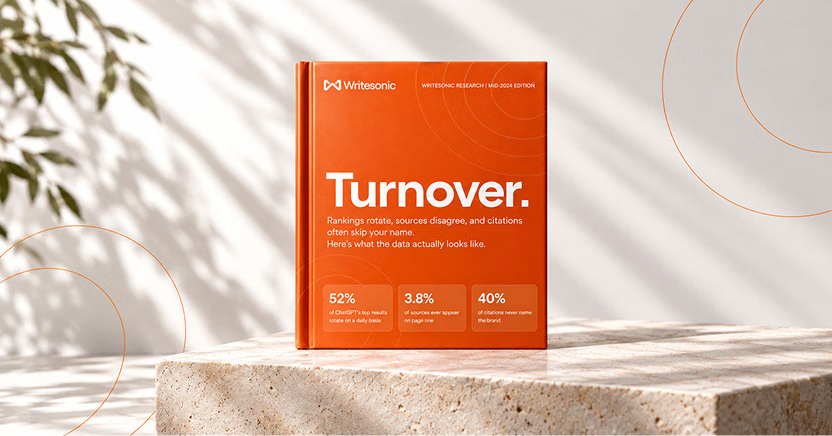
The #1 brand in ChatGPT changes 52% of the time.
Get the report and find out why.

Content Marketer
Mariana is a creator and strategist making ICPs, CEOs, SERPs, LLMs (and many other acronyms) happy all at once. Over the past seven years, she's designed, deployed and scaled content programs that deliver measurable growth for B2B and B2C brands alike.
Quality-first (always), AI-curious (not AI-dependent) and just the right amount of stubborn about what makes content worth reading.