Staying visible across platforms like ChatGPT, Perplexity, and Google’s AI Overviews has become crucial for brands and marketers in 2025. Tools like PEEC AI and Otterly AI have emerged to meet this need, offering generative engine optimization (GEO) solutions that track brand mentions, sentiment, and prompt-level performance across multiple AI models. But how do they stack up against each other—and are they enough on their own?
This blog post provides an in-depth comparison of PEEC AI vs Otterly AI. We’ll explore their features, benefits, limitations, and pricing structures to help you make an informed decision.
PEEC AI vs Otterly AI: A Comparative Study
| Feature | PEEC AI | Otterly AI |
| LLM Coverage | Multi-LLM | Limited LLM |
| Prompt-Level Tracking | Yes | Yes |
| Sentiment Analysis | Yes | Yes |
| Competitor Benchmarking | Yes | Likely Limited |
| Crawler Detection | No | No |
| Content Optimization | No | No |
| AI Content Tools | No | No |
| Integrations | CSV/API | Standalone |
| Free Plan | No | Free Trial |
PEEC AI: Overview and Features
PEEC AI is designed primarily for marketing teams tracking brand mentions across AI platforms. It focuses on visibility monitoring and competitive benchmarking.
Key Features
- Brand mention tracking: Monitors your brand’s presence across ChatGPT, Perplexity, and Google AI Overviews
- Multi-language support: Tracks visibility across different regions and languages
- Competitive benchmarking: Compares your brand’s AI visibility against competitors
- Percentage-based visibility: Shows how often your brand appears in AI responses for specific queries
- Regional breakdown: Offers visibility metrics across different geographic regions
Pros of PEEC AI
✅ Strong brand monitoring: Excellent at tracking mentions across multiple AI engines
✅ Global visibility tracking: Supports multi-country and multi-language monitoring
✅ Competitor visibility data: Provides solid competitive benchmarking at the brand level
✅ Enterprise focus: Well-suited for large organizations with global presence
Cons of PEEC AI
❌Limited actionability: Provides data but offers minimal guidance on how to improve visibility
❌No content tools: Requires external platforms for content optimization
❌No direct crawler detection: Doesn’t track actual AI crawler activity on your site
❌Steep pricing: Starts at €89/month with limited functionality in the basic tier
❌Disconnected workflow: Analysis in PEEC requires switching to other tools for implementation
PEEC AI Pricing
- Starter Plan: €89/month – 25 prompts, 3-country tracking
- Pro Plan: €199/month – 100 prompts, 5-country tracking
- Enterprise Plan: €499/month and up – Custom solutions
- Free trial: 7 days
- No free plan available
Otterly AI: Overview and Features
Otterly AI helps monitor brand appearances across AI search engines with a focus on brand safety and reputation management.
Key Features
- Prompt-level tracking: Turns SEO keywords into AI prompt variations
- Brand ranking: Shows how often your brand and backlinks appear in AI responses
- Sentiment analysis: Analyzes sentiment of brand mentions
- Weekly link tracking: Monitors backlinks appearing in AI-generated content
- Exportable reports: Provides domain-level citation analytics across engines
Pros of Otterly AI
✅ Comprehensive monitoring: Tracks brand mentions across multiple AI platforms
✅ Sentiment insights: Provides sentiment analysis of mentions
✅ Link monitoring: Tracks backlinks appearing in AI-generated content
✅ Hallucination detection: Identifies incorrect information about your brand in AI responses
✅ Basic API integration: Offers some connectivity with external systems
Cons of Otterly AI
❌ Limited optimization guidance: Primarily focused on monitoring rather than improvement
❌ No content creation tools: Requires external platforms for content creation and optimization
❌ Query-based system limitations: Relies on systematic prompt testing rather than direct tracking
❌ Scalability concerns: Pricing increases significantly with higher prompt volumes
❌ Limited real-time data: Less emphasis on immediate insights
Otterly AI Pricing
- Lite Plan: $29/month – 10 search prompts
- Standard Plan: $189/month – 100 search prompts
- Pro Plan: $989/month – 1000 search prompts
- Free trial: 14 days
- No free plan available
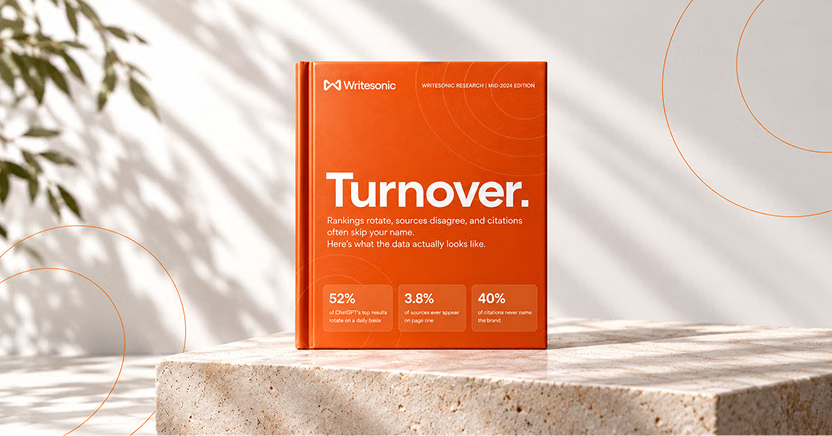
The #1 brand in ChatGPT changes 52% of the time.
Get the report and find out why.
Comparing PEEC AI vs Otterly AI
Let’s directly compare PEEC AI vs Otterly AI across key dimensions:
1. Brand Visibility Tracking
PEEC AI: Focuses on percentage-based visibility across AI platforms with multi-language support. Excels at global brand monitoring but lacks page-level insights.
Otterly AI: Uses a query-based monitoring system with prompt variations. Strong on direct brand mentions and sentiment analysis but has limitations in scalability and real-time monitoring.
Winner: Tie — Both offer solid brand monitoring with different strengths (PEEC for global coverage, Otterly for sentiment analysis).
2. Analytics & Reporting
PEEC AI: Data-rich dashboard with weekly reporting and competitive metrics. Information is comprehensive but lacks actionable prioritization.
Otterly AI: Provides detailed reports on brand mentions, sentiment, and link tracking. Offers exportable data but limited guidance on improvements.
Winner: PEEC AI – Slightly more comprehensive analytics, though both have similar limitations in actionability.
3. Competitive Intelligence
PEEC AI: Strong brand-level competitor benchmarking with regional visibility breakdowns. Limited topic-level competitive data.
Otterly AI: Side-by-side comparison of brand mentions and competitive share of voice. Focus on monitoring rather than strategic advantage.
Winner: PEEC AI – Better regional competitive insights, though both are limited to brand-level analysis.
4. Content Optimization Support
PEEC AI: Primarily recommendation-based, requiring external tools for implementation. Limited content-level insights.
Otterly AI: Basic insights on brand visibility gaps without specific content improvement guidance. No integrated optimization tools.
Winner: Tie – Both have significant limitations in providing actionable content optimization.
5. Integration Capabilities
PEEC AI: Limited API and exports. Mostly manual setup, especially for content teams.
Otterly AI: Basic API integration and email reporting. Requires external workflow for implementation.
Winner: Otterly AI – Slightly better API capabilities, though both have limited integration options.
6. Pricing Value
PEEC AI: Higher starting price (€89/month) with prompt and regional limitations. Significant jumps between tiers.
Otterly AI: Lower entry point ($29/month) but very limited functionality. Steep pricing increases for comprehensive monitoring.
Winner: Otterly AI – Lower entry point, though both become expensive at scale.
Writesonic GEO: The Superior Alternative
While both PEEC AI and Otterly AI offer valuable monitoring capabilities, they share significant limitations in actionability, integration, and cost-effectiveness. Writesonic GEO addresses these limitations with a more comprehensive approach to AI visibility.
Key Advantages of Writesonic GEO
- Integrated content optimization: GEO connects visibility data directly to content performance and works in-sync with Writesonic’s built-in tools to improve underperforming content:
AI Article Writer for creating new content
SEO AI Agent for optimizing existing pages
Schema markup tools for enhancing content structure - AI Article Writer for creating new content
- SEO AI Agent for optimizing existing pages
- Schema markup tools for enhancing content structure
- Topic-level competitive intelligence: Goes beyond brand-level benchmarking to show which content types and subjects your competitors are winning on across AI engines.
- Actionable recommendations: Provides specific content recommendations based on AI visibility data, not just monitoring reports.
- Unified workflow: Eliminates the need to switch between tools for analysis and implementation, saving time and increasing efficiency.
- Superior pricing value: Starts at just $16/month (compared to €89 for PEEC and $29 for Otterly) while offering more functionality, including a free plan option.
Writesonic GEO Pricing
- Standard: $79/month – Advanced analytics, full content suite
Why Writesonic GEO Offers Better ROI
- Complete visibility cycle: GEO covers the entire process from tracking to optimization to measurement, eliminating the need for multiple tools.
- Integrated action path: When visibility issues are identified, you can immediately fix them using built-in tools rather than exporting data to other platforms.
- Comprehensive feature set: GEO includes all the monitoring capabilities of both competitors while adding critical optimization features.
- Cost-effectiveness: Lower pricing with more functionality makes GEO accessible to businesses of all sizes.
For teams focused on outcomes rather than just reporting, Writesonic GEO delivers faster results with less overhead and better integration.
Conclusion: Making the Right Choice for Your AI Visibility Needs
While both PEEC AI and Otterly AI offer valuable AI visibility monitoring, they focus primarily on observation rather than action. Both require additional tools and workflows to translate insights into improvements, creating friction and inefficiency.
Writesonic GEO represents a more evolved approach that combines comprehensive monitoring with direct optimization capabilities. By providing real crawler data, topic-level competitive intelligence, and integrated content tools, it delivers superior value at a lower price point.
For businesses serious about maximizing their presence across AI platforms, Writesonic GEO offers the most complete solution in today’s market.
Frequently Asked Questions (FAQs)
The #1 brand in ChatGPT changes 52% of the time.
Get the report and find out why.

Sumana Sarmah is a Content Writer @ Writesonic, with 5+ years of hands-on experience in B2B content writing and copywriting.
With a knack for creative brainstorming, she strategizes and curates impactful content that brings in exceptional engagement.