We are introducing Citation Decay in Writesonic to help you see which pages are gaining citation share in AI search, which are holding steady, and which are fading.
You can now see whether a cited page is rising, holding, declining, or recovering, and compare that movement across AI platforms and topics. That gives your team a clearer view of which content is still performing and which pages may be worth revisiting.
Earning a citation is only the start. What matters is whether that page continues to hold its ground.
The feature is available in Citations Overview and the new Momentum tab under All Citations.
Why we built Citation Decay
Our AI visibility and citation tracking already showed customers which pages AI platforms used as sources. Customers wanted to know what was happening to those pages over time.
A page holding at 3% citation share and a page that has fallen from 10% to 3% have the same current share. But they call for different decisions. One is consistent; the other has lost much of its previous presence in the answers you track.
Citation share is the proportion of scanned answers that cite a page. It helps distinguish a change in performance from a change in the volume of answers being scanned.
Our study of 4,670 brands found that gains in citation share were associated with stronger AI visibility growth. That makes the direction worth watching.
With Citation Decay, you can see that direction for individual pages and identify where a closer review is needed.
Find the pages worth revisiting
Open Citations → All Citations → Momentum (14d). Each cited page has a trend line and a status describing its recent performance:
- Rising: Citation share is climbing and currently at its highest point in the window.
- Holding: Steady and close to its peak.
- Declining: Below its peak and still falling.
- Faded: Citation share has dropped below half its peak.
- Recovering: Receiving citations again after a quiet period.
- Dormant: No recent citations.
- New: Too recent to judge.
Hover over a status to see the page-specific numbers behind it.
The status I would look at first is Faded. These pages have already shown they can earn citations. If one answers an important buyer question, I want to know what changed before committing the team to another new article on the same subject.
Declining pages deserve attention while they are still losing share. Recovering pages give you a way to follow content as it starts appearing in answers again. Together, these statuses help you decide where to investigate, where to keep watching, and where no immediate change is needed.
Understand how much a page has lost
On Citations Overview, the page-level view brings together the trend and the measurements behind it:
- Peak citation share: The highest daily share the page reached in the latest 14 days.
- Days to peak: The time from its first recorded citation to that peak.
- Half-life: The number of days from the peak until its share fell below half and stayed there.
Half-life tells you how quickly a decline happened. It is an observed measurement, not a prediction of when a page will stop receiving citations.
You can review your own pages, competitor pages, and social and forum sources. That broader view reflects how AI answers are assembled: your website is one of several places a platform may turn for information. Our research on citation sources and brand visibility explores why those third-party sources deserve attention too.
See where the decline is happening
A brand can gain citation share on ChatGPT while losing it on Perplexity. A combined number can hide the difference.
The Platform view on Citations Overview separates those trends. You can see whether a decline is concentrated in one AI platform or happening across several, then focus your review on the relevant answers and sources.
Our citation overlap study found that even the closest pair of AI platforms shared less than a quarter of their combined cited domains for the same prompts. Performance on one platform gives you an incomplete picture of the others.
Switch to Topic to see which subjects or product categories need attention. For example, a cookware brand could be gaining citation share for induction cookware while losing it for frying pans. The topic view gives the team a specific area to investigate.
Both breakdowns use the same 14-day window and calculation approach as the page-level view.
The questions you track provide the context for all of this. Prompt targets help you generate questions around your buyers, funnel stages, and markets, so the pages you monitor are being evaluated against relevant questions.
Put an existing page back on the agenda
Start with a faded or declining page that matters to your business. Review whether its information is current, whether it answers the buyer's question fully, and how it compares with the sources appearing in your tracked answers.
If it needs updating, our guide to structuring content for AI citations covers direct answers, clear organization, and supporting evidence. The AEO checklist extends the review to technical access and authority.
Then follow the citation-share trend after making changes. The status tells you where performance changed; the review helps you work out why. Recovery is something to measure.
For me, the value is in that decision. A page your team might have overlooked is now on the review list, with a reason to be there.
Get started
Citation Decay is available in Citations Overview and All Citations → Momentum (14d).
The views use the latest 14 days, ending today, independently of the dashboard's date picker. A dash means there is no reliable measurement to show, either because there are too few scan days or because a page has not crossed the sustained half-peak threshold. Days to peak can extend beyond the window; half-life cannot exceed 14 days.
Open Momentum and start with a page your team has invested in. See whether it is still earning its share of citations and whether it deserves another look.
New to Writesonic? Book a demo → to see Citation Decay and the rest of the platform in action.
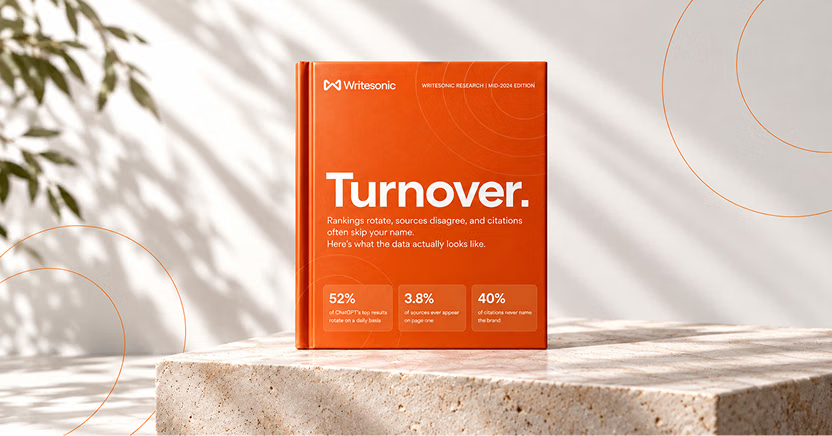
The #1 brand in ChatGPT changes 52% of the time.
Get the report and find out why.

Founder @ Writesonic
Samanyou is the founder of Writesonic, a platform that helps you track & boost your brand’s visibility in AI search. Two years before the launch of ChatGPT, Writesonic was already at the forefront, helping organizations automate their entire marketing workflow through specialized AI agents for SEO and content. Samanyou is a Forbes 30 Under 30 awardee and a winner of the 2019 Global Undergraduate Awards, often referred to as the junior Nobel Prize.