
Before we navigate what a GEO Action Center does, it is important to understand that more people are asking questions directly to AI tools like ChatGPT, Perplexity, and Claude. These tools don’t just show a list of websites — they give straight-up answers.
And where do those answers come from?
From content like yours. But only if the AI finds, understands, and trusts it.
That’s where Generative Engine Optimization (GEO) comes in. Think of it as the new SEO — for AI.
In this guide, we’ll explain what the generative AI ecosystem is all about and how to use a “GEO Action Center” to make sure your brand gets featured in AI-generated answers.
Understanding the Generative AI Ecosystem
Generative AI engines function differently from traditional search engines. Rather than simply indexing and ranking existing content, they create new content based on vast datasets they’ve been trained on. This fundamental difference necessitates entirely new approaches to optimization.
The modern content ecosystem includes multiple AI touchpoints:
- Generative search interfaces that produce direct answers rather than links
- AI writing assistants that reference external sources
- Automated content curation systems
- Citation and attribution mechanisms within AI outputs
Each of these touchpoints can be addressed by a common action center that helps with strategic AI search optimization.
Implementing a GEO Action Center
An effective GEO action center centralizes your strategy for maximizing visibility and accurate representation within generative AI systems. Here’s how to develop your own action center:
Step 1: Performance Analysis & Tracking
Begin by implementing tools to analyze how your brand and content appear across AI search platforms. Key metrics to track include:
- Brand Mentions: Monitor how often and in what context your brand appears in AI-generated responses
- Source Citations: Track which of your content pieces are being cited most frequently
- Response Analysis: Evaluate the quality and accuracy of AI responses that reference your content
- Comparative Share of Voice: Measure your brand’s presence against competitors in AI search results
Step 2: Content Gap Identification
Use your tracking data to identify gaps in your content strategy:
- Analyze queries where competitors are cited but your content isn’t
- Identify topics relevant to your expertise where AI systems are providing incomplete or outdated information
- Determine which content formats and structures are most frequently cited by AI systems
Step 3: Content Optimization Framework
A GEO Action Center helps brainstorm what to write about, how to write about it, and also provides a skeleton for how to structure their content to be optimized to get picked up by AI Search. Following this approach:
- Create targeted content tailored toward prompts that matter for AI search
- Structure content with clear, factual statements that are easy for AI systems to attribute
- Implement machine-readable citation markers using semantic HTML and structured data
- Emphasize uniqueness and authority by creating original research and definitive guides
Step 4: Multi-Platform Optimization
Different AI platforms have different citation practices. Your GEO action center should include strategies for optimizing across multiple systems:
- ChatGPT Optimization: Focus on clear, definitive content with strong factual statements
- Google AI Overviews: Structure content to directly answer common queries in your domain
- Perplexity & Claude: Implement comprehensive citations and references to establish authority
- Vertical-Specific AI: Target industry-specific AI systems with specialized content
Step 5: Actionable Recommendations & Implementation
Based on performance data, generate specific recommendations:
- Rewrite underperforming content to better align with AI citation patterns
- Create net new content to fill identified gaps
- Adjust content structure to enhance AI readability
- Implement technical optimizations for better AI interpretation
Step 6: Performance Monitoring & Iteration
Unlike traditional SEO with established metrics like rankings and organic traffic, GEO requires new measurement approaches:
- Monitor citation frequency across major generative platforms
- Analyze semantic accuracy of AI-generated references to your content
- Track transformative usage patterns—how generative systems incorporate your content into outputs
- Continuously refine your strategy based on performance data
Writesonic’s GEO Tool Action Center
The GEO Action Center in Writesonic tool provides a snapshot of your current GEO performance with clear metrics showing unresolved, in-progress, and resolved items, and at the same time quickly address their overall AI visibility status and track progress over time.
Prioritized Action Categories
The platform organizes optimization opportunities into three strategic categories:
- Technical Issue Resolution: Identifies critical technical barriers preventing AI systems from properly accessing and citing your content. Example actions include fixing robots.txt configurations that might be blocking AI crawlers.
- External Mention Acquisition: Focuses on strategies to increase citations and mentions across high-authority third-party platforms, enhancing your content’s perceived authority in AI systems.
- Content Visibility Boosting: Provides specific recommendations for creating and optimizing content to maximize AI citations, including competitive analysis of content types that are winning in AI search results.
Impact & Effort Assessment
Each recommended action includes clear indicators for:
- Impact Level: Ranging from medium to high, this helps teams prioritize high-value opportunities
- Effort Required: The platform has a visual indicator of the resource investment needed
- Action Item Count: Tells you the number of specific tasks within each category
Competitive Intelligence
The GEO Action Center provides insights into competitor performance in AI citations, allowing teams to create content specifically designed to compete in areas where competitors are currently dominating AI visibility.
One-Click Prioritization
The “Address now” feature allows teams to immediately act on high-priority items, streamlining the workflow from insight to implementation.
GEO Action Center Checklist
- Publish authoritative content with structured formatting
- Add proper schema and meta tags
- Optimize for brand/entity recognition
- Include original data, quotes, or case studies
- Create FAQ sections and summaries
- Build citations from high-authority AI-visible sources
- Use tools like Writesonic to monitor and act on AI visibility
- Update and republish high-performing content regularly
- Track mentions, clicks, and feedback in AI platforms
- Be ready to adapt as new engines emerge
Conclusion
Just as marketers once raced to understand Google’s algorithm, we now need to decode the new engines of discovery: generative AI interfaces. With the GEO Action Center framework, you can start building not just AI search traffic — but trust, authority, and future-proof visibility.
The winners in the age of AI search won’t be the loudest — they’ll be the most structured, cited, and consistently present across AI interfaces with tools like Writesonic.
FAQs on GEO Action Center
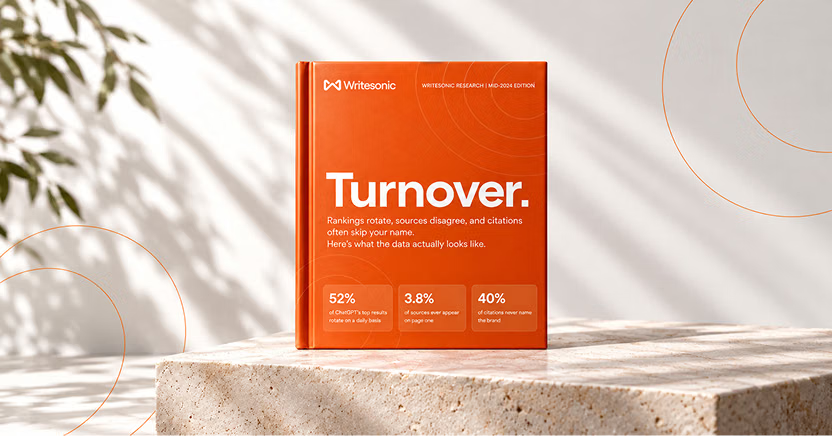
The #1 brand in ChatGPT changes 52% of the time.
Get the report and find out why.

Sumana Sarmah is a Content Writer @ Writesonic, with 5+ years of hands-on experience in B2B content writing and copywriting.
With a knack for creative brainstorming, she strategizes and curates impactful content that brings in exceptional engagement.