The web didn't keep pace as Writesonic changed its positioning. This is the source-by-source method I'm following to replace outdated AI descriptions with an accurate picture of the business today.
Several weeks ago, I started a Temporary Chat with one prompt:
What is Writesonic?
I submitted it repeatedly. Within a few minutes, ChatGPT gave me descriptions of two different businesses.
One response presented Writesonic as a platform for marketing and content production. The other led with our shift toward AI search and referenced our current site.
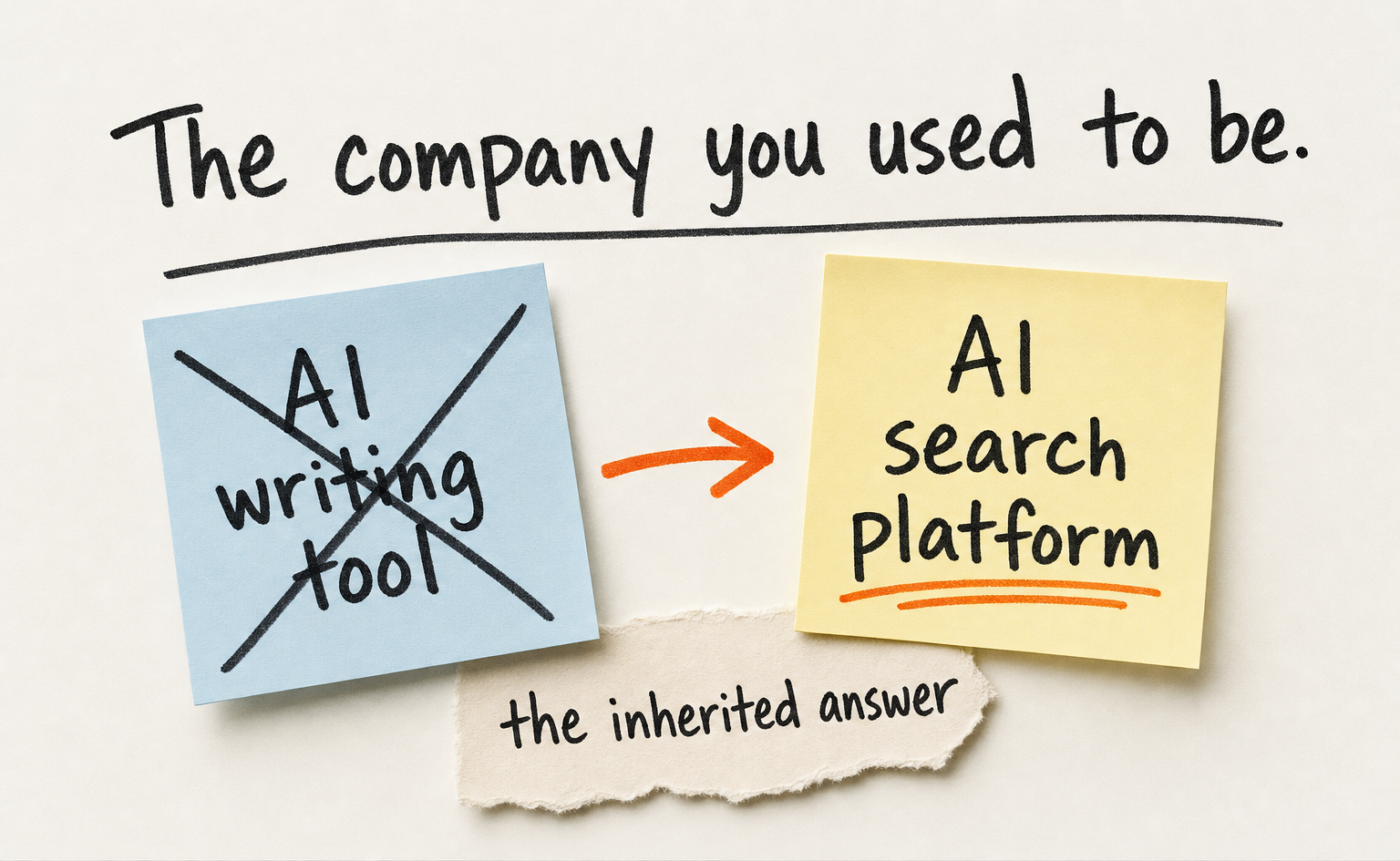
We launched Writesonic in 2021 as an AI writing tool. The company now helps brands measure and strengthen their presence within ChatGPT, Claude, Gemini, and other AI search experiences.
Our product evolved. So did our site and the category we operate in. The web updated its understanding at a far slower pace.
In this article, I'll explain how I quantified that mismatch, traced it to outdated sources, and turned the work into a reusable five-step system.
The condensed version
- A single AI can present two conflicting versions of your business within minutes.
- Your latest positioning might appear on a small set of refreshed pages, while years of documentation, directories, reviews, listicles, and backlinks continue promoting the previous version.
- Branded queries usually change sooner because the answers frequently draw from websites you own.
- Category-level queries take longer to shift because outside sources influence the category AI assigns to you.
- You need to establish a baseline, update the most important sources first, and keep rerunning identical tests.
A single AI response isn't a useful baseline
Those screenshots confirmed that our earlier positioning remained accessible. They couldn't tell me how frequently it appeared.
A model's response can change with the engine, geography, wording, account history, timing, and sources selected during retrieval.
Temporary Chat excludes chat history and memory-based personalization. That produces a cleaner experiment, but you're still looking at one model's response from one specific moment.
The real issue I needed to investigate was wider:
Across the prompts, engines, markets, and runs we care about, how often does AI describe us as the old company?
To answer it, I tracked responses across engines, locations, and time with our product. Using our own software made the setup easy. More importantly, it made us experience the exact challenge customers ask us to solve.
You need two separate measurements because each reveals something different:
| Metric | What it helps you determine |
|---|---|
| AI Visibility | Does the response mention or recommend your brand? |
| Citation Share | What pages appear as supporting citations? |
AI Visibility shows whether a prospective buyer encounters your brand. Citation Share provides clues about what led the model to that answer.
Razvan Surdu ran one product against 47 prompts. A competing product showed up 31 times, while his appeared only three times.
That example made the revenue risk much clearer to me. A buyer requests a recommendation, and AI puts somebody else's company in front of them.
I refer to this as the inherited answer
AI search systems may draw from associations learned earlier while also retrieving current information from the web. If those two inputs conflict, the output can alternate between your former identity and your present one.
If a model reaches our present homepage, it generally recognizes the updated positioning.
If retrieval sends it to an outdated directory entry, review page, help document, or comparison article, Writesonic can slide back into its former category.
That persistent description is what I call the inherited answer.
It reflects what the web learned about your business before the repositioning. Since no single page created that identity, changing one page won't remove it.
For Writesonic, the confusion stretched far outside our own domain.
The web remembered four different versions of Writesonic
Over time, we repeatedly revised our hero copy, supporting message, category, and overall product narrative.
The current homepage opens with "Win customers from AI search." Several years earlier, it promoted a different offering. An even older version framed the business another way.
Writesonic also had a broader history than the writing-tool label suggested.
We released a chatbot builder, an image generator, an audio product, and a larger SEO suite. Every launch gave the web one more reasonable way to explain what the company did.
The first version appeared plainly on our About page in 2021. At the time, we described our work as building "state-of-the-art AI-powered apps," beginning with the tool I used to create landing-page copy.
Each description told the truth when it went live. Collectively, though, they left behind a fragmented record of our identity.
Think of your homepage as a single vote
One analogy helped me understand the scale of the issue.
Across the web, an election is constantly deciding what your company represents, and your homepage casts only one vote.
Other votes come from Wikipedia, software directories, review sites, and your documentation. App stores, GitHub repositories, Reddit discussions, listicles, and years of anchor text from backlinks contribute their own signals.
Changing the homepage replaces one influential signal. Meanwhile, hundreds of smaller signals may continue voting for the previous category.
This problem requires more than new marketing copy. You have to bring the retrievable source layer used by AI systems and search engines into alignment.
We also removed blog posts that kept associating Writesonic with audiences and subjects we'd moved beyond. Some of those pages ranked well, yet they drew students and freelancers rather than the marketers we intended to reach.
A Hindi article that ranked for "what should I write in my bio" illustrates the problem. The page generated visits, but it contributed almost nothing to the identity we wanted the web to learn.
HubSpot has explained how it approached deleting a substantial collection of obsolete content. Animalz has also written about a related content-pruning initiative for QuickBooks.
Their experiences changed how I evaluated our library. Traffic at the individual-page level can obscure the broader lesson your entire catalog sends about your market and ideal audience.
Even a collection of pages that perform well on their own can describe a business you no longer want to be.
Our audit uncovered stale positioning in overlooked sources
We began by cataloging every influential page that continued assigning Writesonic to its former category. Next, we divided the inventory between sources we could directly update and sources we could only try to influence.
Both our About page and homepage reflected the current company. The opening of our Wikipedia article now identifies Writesonic as a generative engine optimization and AI visibility platform.
The story changed when we looked one level deeper.
When we conducted the audit:
- The description on Trustpilot emphasized ads, product descriptions, landing pages, and blog content.
- Writesonic's Product Hunt page labeled the product an "AI writing tool for content creators."
- The listing on GetApp categorized us around writing assistance and content marketing.
None of those summaries had been false when they were created. They'd simply stopped representing the company accurately.
Since then, we've revised the listings within our control, Trustpilot included. Even so, the exercise demonstrated how long an old category can persist in profiles that teams rarely revisit after launching them.
The inventory kept growing from there.
Outdated wording appeared throughout old integration pages, product documentation, browser extensions, help articles, app stores, GitHub repositories, and WordPress plugins.
Your most obsolete company description may be hiding in a property nobody on the marketing team routinely visits.
I'd assumed we'd encounter stale listicles. Discovering equally old messaging inside our help center and developer materials was harder to excuse.
Our API documentation continued to describe Writesonic as "an AI-powered content automation platform."
Another abandoned help-center post responded to "How is Writesonic different?" by presenting the product as an AI writing tool.
At that point, the issue became actionable rather than abstract. An AI response had cited the same help-center page.
Instead of leaving us to guess, the model had exposed the outdated source supporting its outdated description.
We updated sources according to a fixed priority
The findings produced a clear sequence for the work:
- Identify the pages that show up in actual AI responses.
- Update every relevant property you own or have the ability to claim.
- Focus next on authoritative outside sources you can't edit directly.
- Create new evidence that associates Writesonic with its current category.
There's little glamour in this process. Its advantage is that every step points to a specific asset you can improve.
Rather than hoping a model behaves differently on its next run, you repair the information feeding the response.
When discussing brittle search strategies, Lily Ray puts it this way: "It works until it doesn't."
Accurate information at the source has a better chance of lasting through future changes to models.
The #1 brand in ChatGPT changes 52% of the time.
Get the report and find out why.
Branded queries improved ahead of category queries
Our initial corrections made a difference, although category and branded prompts didn't respond at the same rate. Their different trajectories revealed which part of the source layer still needed attention.
The AI search story now appears with greater consistency when somebody uses a branded query such as "What is Writesonic?" Responses to those prompts commonly rely on properties under our control.
Broader category queries behave differently.
When someone asks for "alternatives to Writesonic," AI frequently groups us with writing products. In many cases, the supporting sources are older listicles and external comparison pages.
We observed the same split repeatedly:
- Current first-party pages helped branded prompts adopt the new positioning sooner.
- The broader web's classification of Writesonic kept category prompts anchored to the past for longer.
Today, I treat the distance between those two sets of results as an approximate indicator of how widely our positioning has spread outside writesonic.com.
We've narrowed that distance, but we haven't eliminated it.
A five-step method for changing the inherited answer
This process overlaps with link building in some respects, though I use a different measure of success.
The raw link count matters less to me than the accuracy of the sources informing commercially relevant questions.
After a major repositioning, this is the sequence I'd recommend.
1. Establish a repeatable baseline
Select the branded and category queries with the greatest commercial value.
We monitor our set with Writesonic's AI Visibility Tracker, which collects identical queries across the markets, regions, and engines that matter to us.
You don't need a specific provider to follow this approach. The essential part is preserving a consistent prompt set while recording citations, answers, and competitor appearances over time.
Instead of accumulating unrelated screenshots, you'll get a high-level view of the overall pattern.
Measure these three elements independently:
- Whether the response includes your brand
- What language it uses to define your company
- Which pages provide support for that definition
While you're actively updating sources, examine the complete dataset every week. After the positioning becomes more stable, reviewing it every two weeks or once a month may be enough.
A historical view uncovers details that sporadic manual testing misses, including repeated citations, the prevailing company description, geographic variation, and competitors receiving your mentions.
Leave the query set unchanged long enough to determine whether the distribution is genuinely shifting.
2. Update the source layer within your control
Start with the assets you're able to revise immediately:
- Homepage and About page
- Developer and product documentation
- Help-center content
- Customer stories centered on the former offering
- GitHub repositories, plugins, app-store listings, and browser extensions
- Directory and review profiles your team can claim
Look for legacy category terms, feature lists that no longer apply, and use cases designed for the customers you previously served.
Editing the copy won't solve every profile. For example, reviews attached to an obsolete category on G2 or a similar marketplace may require you to create the right category entry and gather new reviews within it.
3. Rank external sources by importance
Let citations from real AI outputs determine the order of your outreach.
Assess every outside page using four criteria:
- AI systems still cite it, or the page continues to rank.
- Its description places you in the previous category.
- There's a realistic path to supplying context or requesting a factual correction.
- Independent reporting exists to substantiate your current description.
Our first targets were the small number of pages that kept resurfacing in answers with clear commercial value.
A few frequently retrieved sources deserve more attention than every listicle writer who has ever included your brand.
4. Create credible proof of the new category
You won't persuade every third-party publisher to revise an old page. Over time, stronger and more recent evidence can counterbalance those sources while giving AI systems better material to retrieve.
That evidence might take several forms:
- Outside coverage connected to the current product
- Case studies demonstrating the new use case
- Comparison content featuring your present competitive group
- Valuable contributions to the communities and forums that discuss the category
- Recent reviews filed under the correct category
- Original tools, research, or datasets worth citing elsewhere
You can't dictate how Wikipedia positions your company. What you can do is build the independent source base editors need to support an accurate description.
5. Repeat the original measurement
After completing each round of source updates, run the same initial prompts again.
Measure the new distribution against the baseline and check for:
- Company descriptions gaining frequency
- Outdated sources that continue resurfacing
- Engines or markets where the former category remains dominant
- Queries where another brand still appears in your place
Use those results to begin the next source review.
Success isn't a flawless screenshot from one run. You're aiming for a persistent change across the prompts, geographies, engines, and repeated tests that influence your business.
The next constraint was execution volume
Once we understood the method, our limiting factor became the amount of execution required.
Revise a directory profile. Repair an overlooked document. Reach out to a publisher. Secure another relevant citation. Then continue across the rest of the web.
You can't sustain that workload through one intense weekend.
I'm now developing three experiments to systematize the recurring tasks:
- An AI outreach agent that targets pages still assigning Writesonic to the former category
- An AI digital-PR agent that pursues timely coverage suitable for independent citation
- A Reddit research and participation agent focused on discussions within forums
Human involvement will remain necessary in parts of the process. Without judgment, automated activity can become spam almost immediately.
Systems are better suited to tasks such as research, ranking opportunities, drafting, follow-ups, and ongoing measurement. As these tests develop, I'll publish what we learn, including workflows, prompts, results, and failed approaches.
Every repositioning requires a web-wide migration
A newly published hero section can't wipe away years of company descriptions scattered across other sites.
You announce the change on your own domain. Your identity only completes its migration when the rest of the web reflects it.
I now manage repositioning through five connected stages:
- Quantify the inherited answer.
- Trace it back to the sources sustaining it.
- Revise the properties within your control.
- Replace or influence the sources outside it.
- Continue testing until category queries align with branded queries.
If you've dealt with an inherited answer after changing your positioning, I'd like to know what finally shifted it.
If AI's memory still trails behind your company's evolution, Writesonic's AI Visibility Tracker can establish your starting point and show whether the inherited answer is beginning to change.
The #1 brand in ChatGPT changes 52% of the time.
Get the report and find out why.

Founder @ Writesonic
Samanyou is the founder of Writesonic, a platform that helps you track & boost your brand’s visibility in AI search. Two years before the launch of ChatGPT, Writesonic was already at the forefront, helping organizations automate their entire marketing workflow through specialized AI agents for SEO and content. Samanyou is a Forbes 30 Under 30 awardee and a winner of the 2019 Global Undergraduate Awards, often referred to as the junior Nobel Prize.