Looking for Writesonic alternatives?
You’re probably comparing GEO platforms, the tools built to help your brand surface inside ChatGPT, Gemini, Perplexity, and AI Overviews.
But here’s the catch: plenty of products claim to help with AI visibility, but only a few actually track citations, analyze answer engines, and show you how machines interpret your content.
This guide breaks down the 8 best Writesonic alternatives that genuinely compete in the Generative Engine Optimization space, what they’re good at, who they’re built for, and where they fall short.
Let’s dive in.
Key Takeaways
- AI visibility is becoming as crucial as SEO; choosing the right GEO/LLM tracking tool impacts how AI models surface your brand.
- Each Writesonic alternative offers distinct strengths, from lightweight monitoring to full AI-search optimization.
- The best platforms combine citations, competitor insights, and corrective actions.
- Your choice depends on scale: solo creators need simplicity, while teams need deeper analytics.
- Early adoption gives brands an edge as AI answer engines reshape discovery.
What is Writesonic?
Writesonic is a full-fledged Generative Engine Optimization (GEO) platform, designed to help your brand get seen by AI engines like ChatGPT, Claude, Gemini, and more, not just traditional search engines. Here’s how it works in real terms:
- Your project starts by defining your site, region, language, topics, and competitors, so you’re tracking what matters.
- Writesonic continuously monitors how often AI engines (conversation bots, indexing crawls, training bots) visit your content, “bot visits,” “human visits,” “click rate,” etc.
- It flags where your brand is mentioned or cited by AI, spots gaps where competitors are winning, and gives you guided action steps.
- You get dashboards showing which pages get AI attention, which don’t — so you know where to fix content, structure, or technical access.
In short, Writesonic doesn’t assume your visibility just comes from ranking. It assumes you need to be recognized by machines and gives you the tools to prove it. That’s your baseline.
The 8 Best Writesonic Alternatives
- AthenaHQ: Best for data-heavy teams wanting AI-driven recommendations ($295/mo)
- Otterly AI: Best for simple, entry-level AI visibility monitoring ($29/mo)
- Peec AI: Best for multi-language GEO insights (€89/mo)
- Surfer AI: Best for SEO teams beginning to layer in GEO ($89/mo)
- Nightwatch: Best for hybrid SEO + AI overview checks ($32/mo)
- Profound: Best for tracking AI-generated summaries across channels ($99/mo)
- Ahrefs Brand Radar: Best for quick brand-citation benchmarking ($129/mo)
- Scrunch AI: Best for brand safety and misinformation monitoring ($300/mo)
Top Writesonic Alternatives at a Glance
| Tool Name | Best For | Pricing (Starts at) | Free Trial |
| Writesonic | Full GEO workflows (benchmark) | $199/mo | Yes |
| AthenaHQ | AI recommendations | $295/mo | No |
| Otterly AI | Simple monitoring | $29/mo | No |
| Peec AI | Multi-language GEO | €89/mo | 7 days |
| Surfer AI | SEO teams adding GEO | $89/mo | No |
| Nightwatch | SEO + AI visibility | $32/mo | Yes |
| Profound | AI summary monitoring | $199/mo | No |
| Ahrefs Brand Radar | Benchmarking | $129/mo | No |
| Scrunch AI | Brand safety | $300/mo | No |
1. AthenaHQ
Best for data-heavy teams that want AI-driven GEO recommendations
About the Tool
AthenaHQ is a GEO analytics platform built to track how your brand appears across major AI engines like ChatGPT, Gemini, Perplexity, and Claude. It focuses on prompt-level insights, competitor benchmarking, and visibility gaps; it is useful for teams that need deeper analysis rather than simple mention tracking.
Pros
- Strong multi-engine visibility analytics
- Clear competitor benchmarking
- Prompt-level insights and content-gap detection
- Good for larger teams needing structured reporting
Cons
- Expensive for smaller teams
- No free tier
- More complex than lightweight monitoring tools
Pricing
Plans start at $295/month. No free plan available.
2. Otterly AI
Best for small teams that want simple AI-search visibility checks
About the Tool
Otterly AI monitors how your brand shows up across ChatGPT, Gemini, Perplexity, and other AI engines. You add prompts, and it tracks whether you’re cited, which URLs appear, and how consistently you surface in AI answers. It’s a lightweight, beginner-friendly GEO monitor.
Pros
- Easy setup and simple dashboard
- Tracks citations across multiple AI engines
- Affordable entry pricing
Cons
- Limited depth compared to full GEO platforms
- Basic competitive insights
- Prompt caps on lower plans
Pricing
Plans start at $29/month. Free trial available.
3. Peec AI
Best for teams that want straightforward, affordable AI-visibility tracking
About the Tool
Peec AI helps you see how your brand shows up across ChatGPT, Gemini, Perplexity, and other AI engines. You add the prompts your audience uses, and Peec monitors citations, URLs, and visibility shifts over time. It’s built for teams that want GEO insights without a heavy platform or steep learning curve.
Pros
- Simple, clean dashboard that makes visibility easy to understand
- Tracks mentions across multiple major AI engines
- More affordable than most GEO analytics tools in this category
Cons
- Doesn’t offer deep competitive intel or content recommendations
- Limited scalability for teams tracking many prompts or languages
- Insights lean descriptive rather than strategic
Pricing
Plans start at €89/month, with higher tiers for expanded prompt limits and data depth.
4. Surfer AI Tracker
Best for SEO teams experimenting with GEO inside a familiar workflow
About the Tool
Surfer AI Tracker is Surfer’s add-on for monitoring how your site shows up across AI search engines. You add the questions your audience asks, and Surfer checks whether ChatGPT, Google’s AI Overviews, Perplexity, and other models cite your domain.
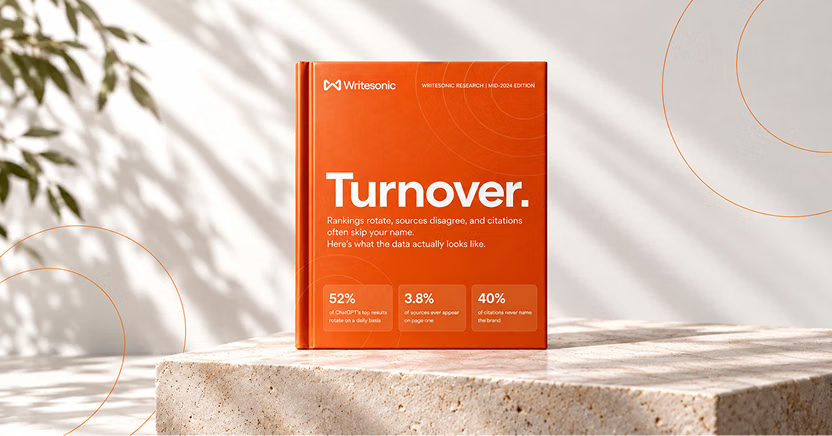
The #1 brand in ChatGPT changes 52% of the time.
Get the report and find out why.
Because it sits inside the Surfer ecosystem, it’s especially handy for teams already using Surfer for SEO and content.
Pros
- Integrates GEO tracking into Surfer’s existing SEO suite
- Clean, simple dashboards for visibility trends
- Supports multiple AI engines, including Google’s AI Overviews
Cons
- Sold as an add-on, so pricing stacks up quickly
- Limited depth compared to GEO-first platforms
- Best suited for SEO teams, not standalone GEO programs
Pricing
Starts at $95/month for the AI Tracker add-on.
5. Nightwatch
Best for teams that want SEO rank tracking with basic AI-visibility monitoring
About the Tool
Nightwatch is an SEO platform that recently added AI-tracking, letting you see whether your site appears inside AI Overviews and other LLM-generated answers.
It blends keyword tracking, SERP features, and site audits with simple AI-search visibility checks — useful if you want both SEO and early GEO signals in one tool.
Pros
- Combines SEO rank tracking with LLM citation monitoring
- Supports global and local visibility tracking
- Good for agencies managing multiple sites or large keyword sets
Cons
- AI-tracking isn’t as deep as GEO-first platforms
- Interface can feel heavy if you only want AI visibility
- Costs scale quickly as tracking volume increases
Pricing
Plans start at $32/month.
6. Profound
Best for enterprise teams that want deep, multi-engine AI visibility analytics
About the Tool
Profound is an enterprise GEO platform that tracks how your brand appears across major AI engines like ChatGPT, Google AI Overviews, Perplexity, and Copilot.
It focuses on visibility analytics, source attribution, and share-of-voice insights — built for teams that treat AI search as a measurable channel, not a guessing game.
Pros
- Strong coverage across multiple AI engines
- Detailed visibility and source-attribution reporting
- Scales well for large teams and complex sites
Cons
- Expensive for smaller organizations
- Dashboards can feel heavy without internal analysts
- Limited content-creation or optimization features
Pricing
Plans start around $99/month.
7. Ahrefs Brand Radar
Best for teams already using Ahrefs who want basic AI-visibility signals
About the Tool
Brand Radar is Ahrefs’ brand-monitoring tool that now includes AI-search visibility. It shows how often your brand is cited across AI engines like ChatGPT, Perplexity, and Google AI Overviews, while also combining search demand and web-mention data, useful if you want everything in one place.
Pros
- Easy add-on if you’re already in Ahrefs
- Tracks citations across major AI platforms
- Combines AI visibility with brand-search and web-mention insights
Cons
- Less detailed than GEO-first platforms
- Not ideal for prompt-level or deep competitive tracking
- Value depends on already paying for Ahrefs
Pricing
Included in Ahrefs subscription plans, no separate Brand Radar fee.
8. Scrunch AI
Best for brands that want AI-bot crawling insights and an AI-friendly version of their site
About the Tool
Scrunch AI tracks how often your site is cited across AI engines like ChatGPT, Perplexity, and Meta AI, while also auditing how AI bots crawl and interpret your pages.
Its standout feature is AXP, a simplified, AI-friendly version of your site designed to make your content easier for models to read and reference.
Pros
- Tracks citations across major AI platforms
- Includes AI-bot crawl audits and technical insights
- AXP feature helps make sites more LLM-friendly
Cons
- Higher starting price than most entry-level GEO tools
- Limited content-creation or optimization workflows
- Some features still feel early or evolving
Pricing
Plans start around $300/month.
Pick the GEO Tool That Actually Moves Your Visibility
AI search isn’t a “future trend” anymore. It’s the channel shaping what people see, trust, and click today.
Every tool on this list does something useful — some track mentions, some visualize prompts, some offer technical fixes, some give you dashboards to stare at.
But if you’re choosing a platform to win in AI answers, not just monitor them, the decision is simpler.
Most alternatives show you what happened. Writesonic shows you what to fix, what to publish, and how to get cited more often across ChatGPT, Gemini, Perplexity, and Google’s AI Overviews. It doesn’t stop at visibility. It gives you the workflows to actually improve it.
If AI engines are rewriting the internet, make sure they’re writing about you; consistently, accurately, and more often than your competitors. That’s what Writesonic was built for.
The #1 brand in ChatGPT changes 52% of the time.
Get the report and find out why.

Content Marketer
Pragati Gupta is a Content Marketer @Writesonic, specializing in AI, SEO, and strategic B2B writing. Leveraging the power of Generative AI, she produces high-impact content that drives superior ROI.